
French Military Mission Artillery Section Plan for the Employment of the Artillery in Defensive - n.d.
Transcript
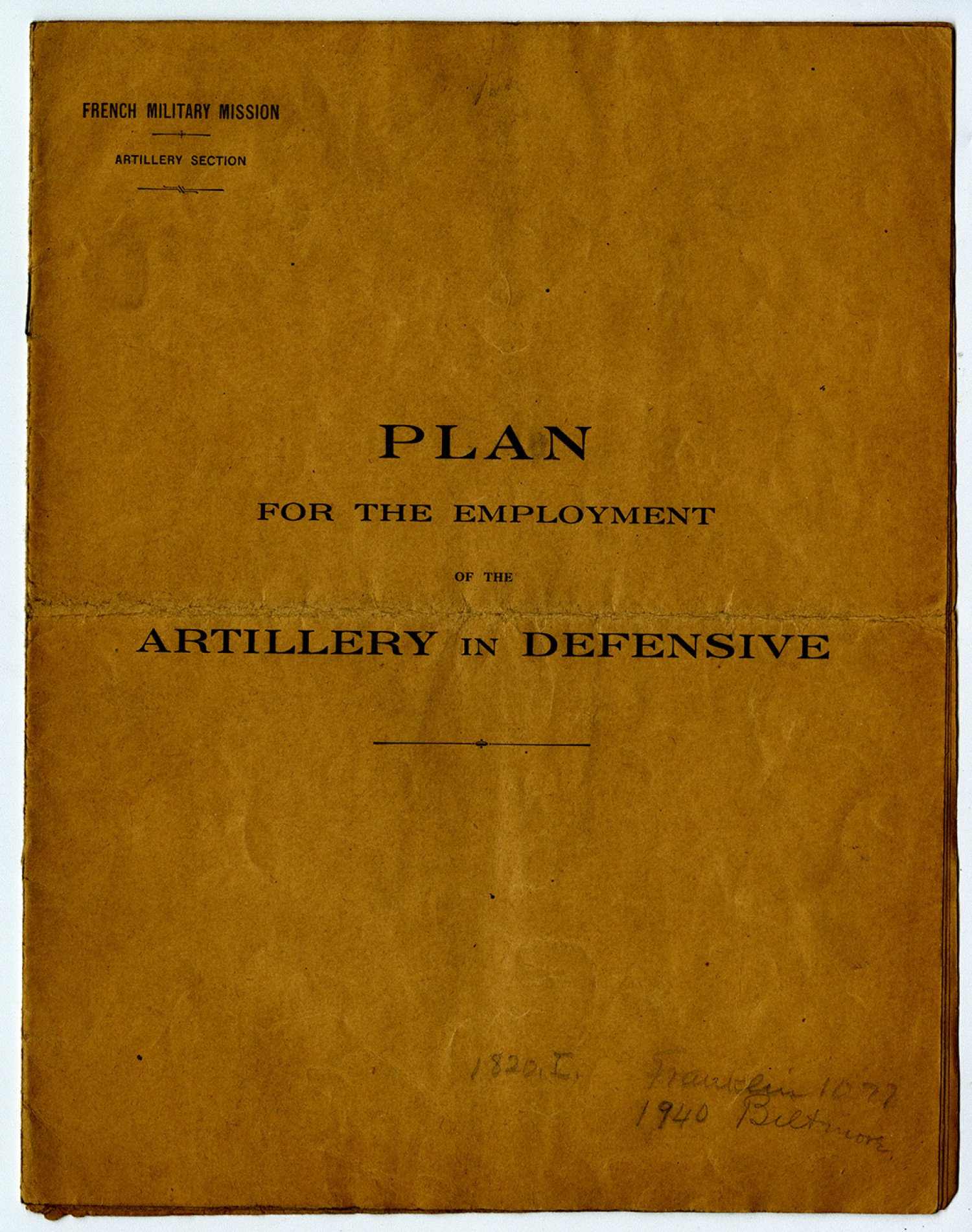
FRENCH MILITARY MISSION ARTILLERY SECTION PLAN FOR THE EMPLOYMENT OF THE ARTILLERY IN DEFENSIVE 1820 I. Franklin 1077 1940 Biltmore.
Transcript
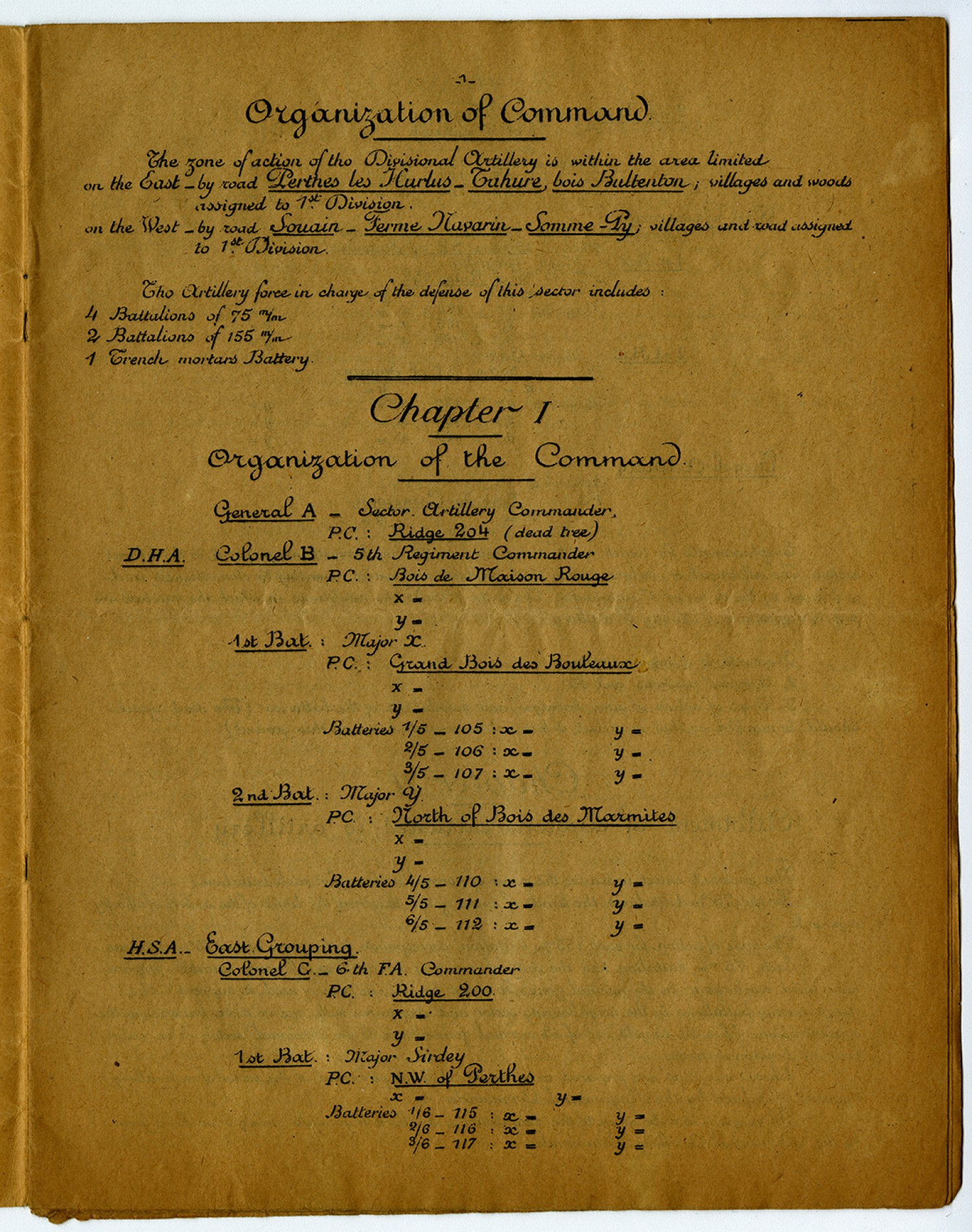
[page 1] Organization of Command. The zone of action of the Divisional Artillery is within the area limited on the East - by road Perthes les Hurlus
Transcript
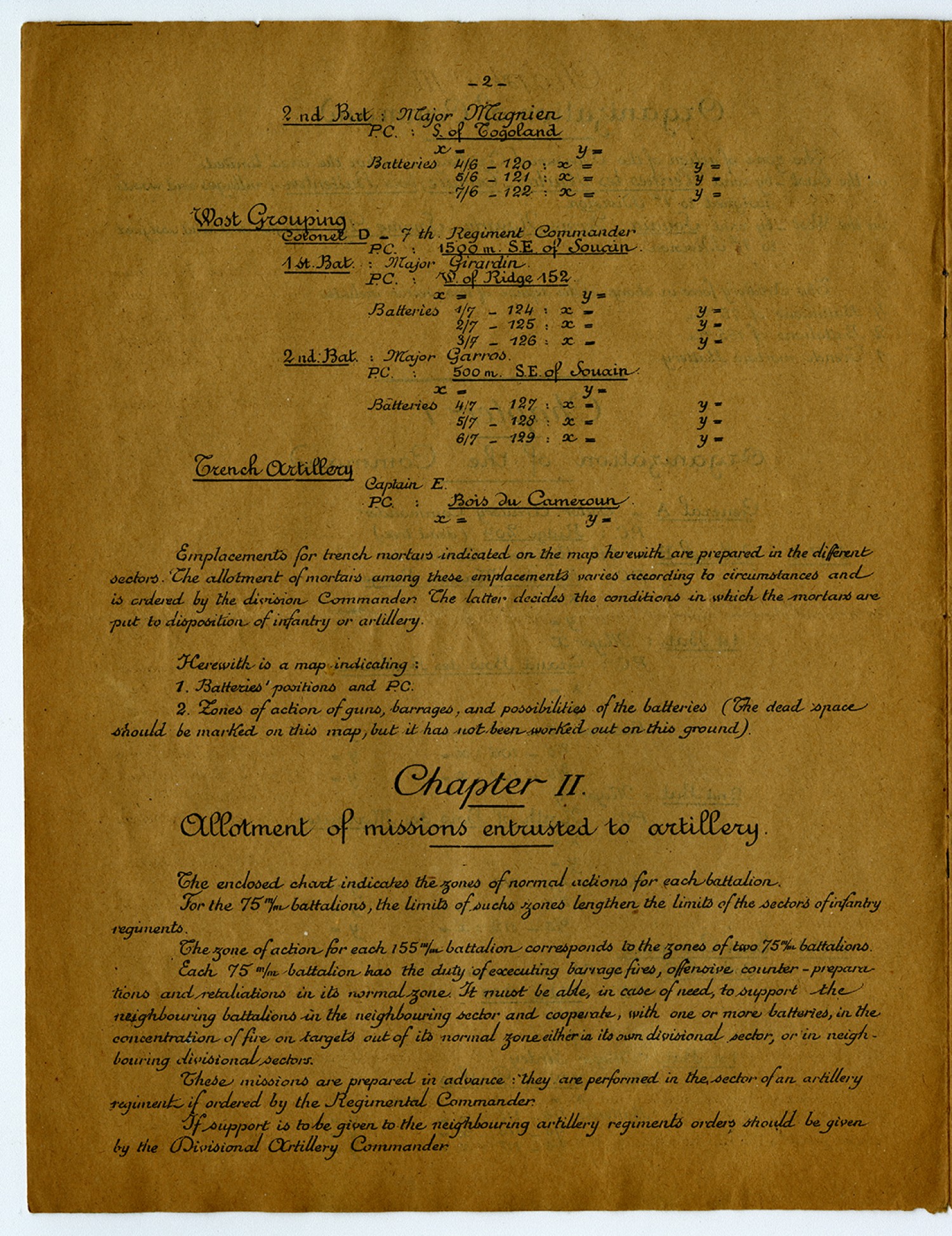
[page 2] 2nd Bat.: Major Magnien P.C.: S. of Togoland x= y= Batteries 4/6
Transcript
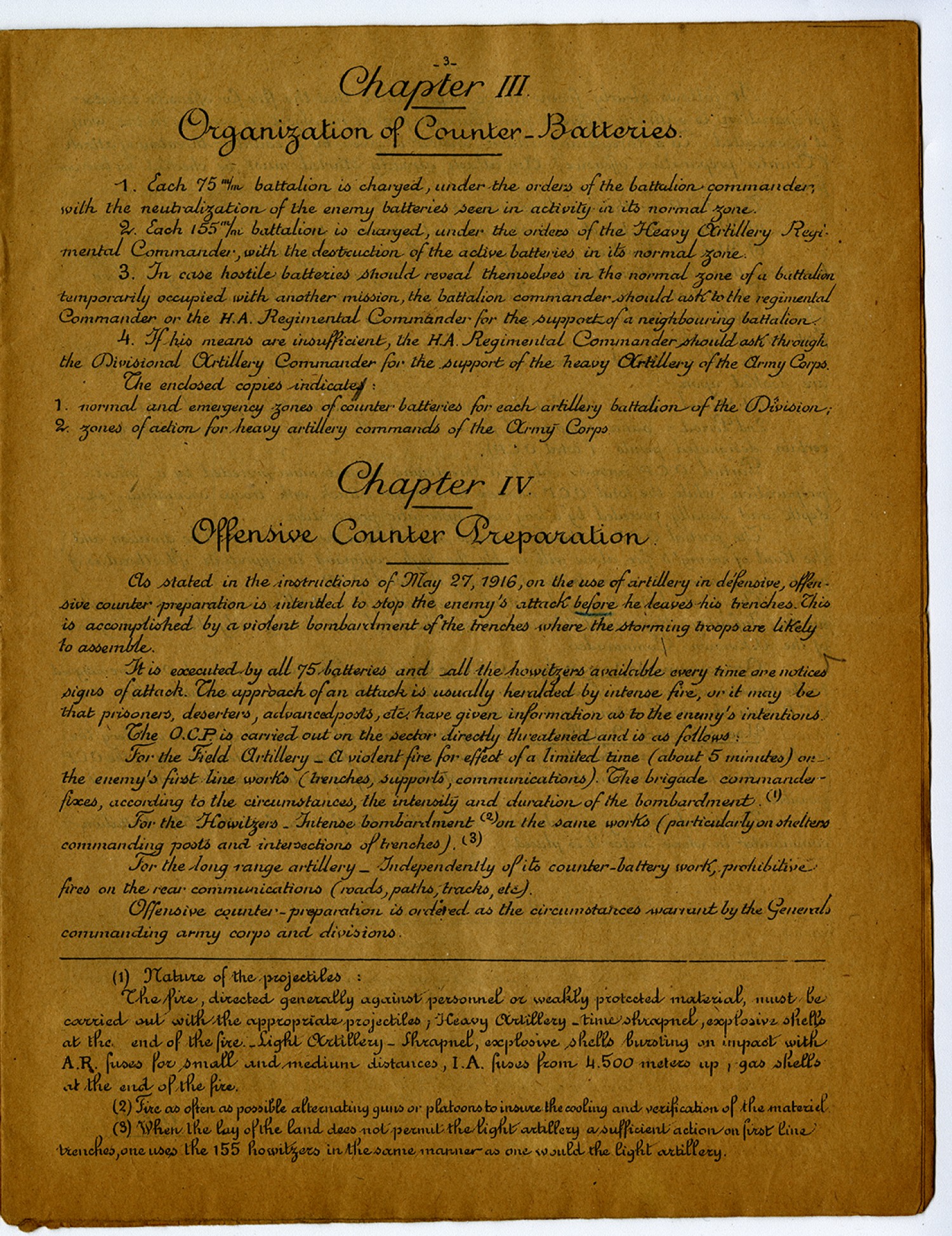
[page 3] Chapter III. Organization of Counter Batteries. 1. Each 75 m/m battalion is charged, under the orders of the battalion commander, with the neutralization of the enemy batteries seen in activity in its normal zone. 2. Each 155 m/m battalion is charged, under the orders of the Heavy Artillery Regimental Commander, with the destruction of the active batteries in its normal zone. 3. In case hostile batteries should reveal themselves in the normal zone of a battalion temporarily occupied with another mission, the battalion commander should ask to the regimental Commander or the H.A. Regimental Commander for the support of a neighbouring battalion. 4. If his means are insufficient, the H.A. Regimental Commander should ask through the Divisional Artillery Commander for the support of the heavy Artillery of the Army Corps. The enclosed copies indicate: 1. normal and emergency zones of counter batteries for each artillery battalion of the Division; 2. zones of action for heavy artillery commands of the Army Corps. Chapter IV. Offensive Counter Preparation. As stated in the instructions of May 27, 1916, on the use of artillery in defensive, offensive counter preparation is intended to stop the enemy
Transcript
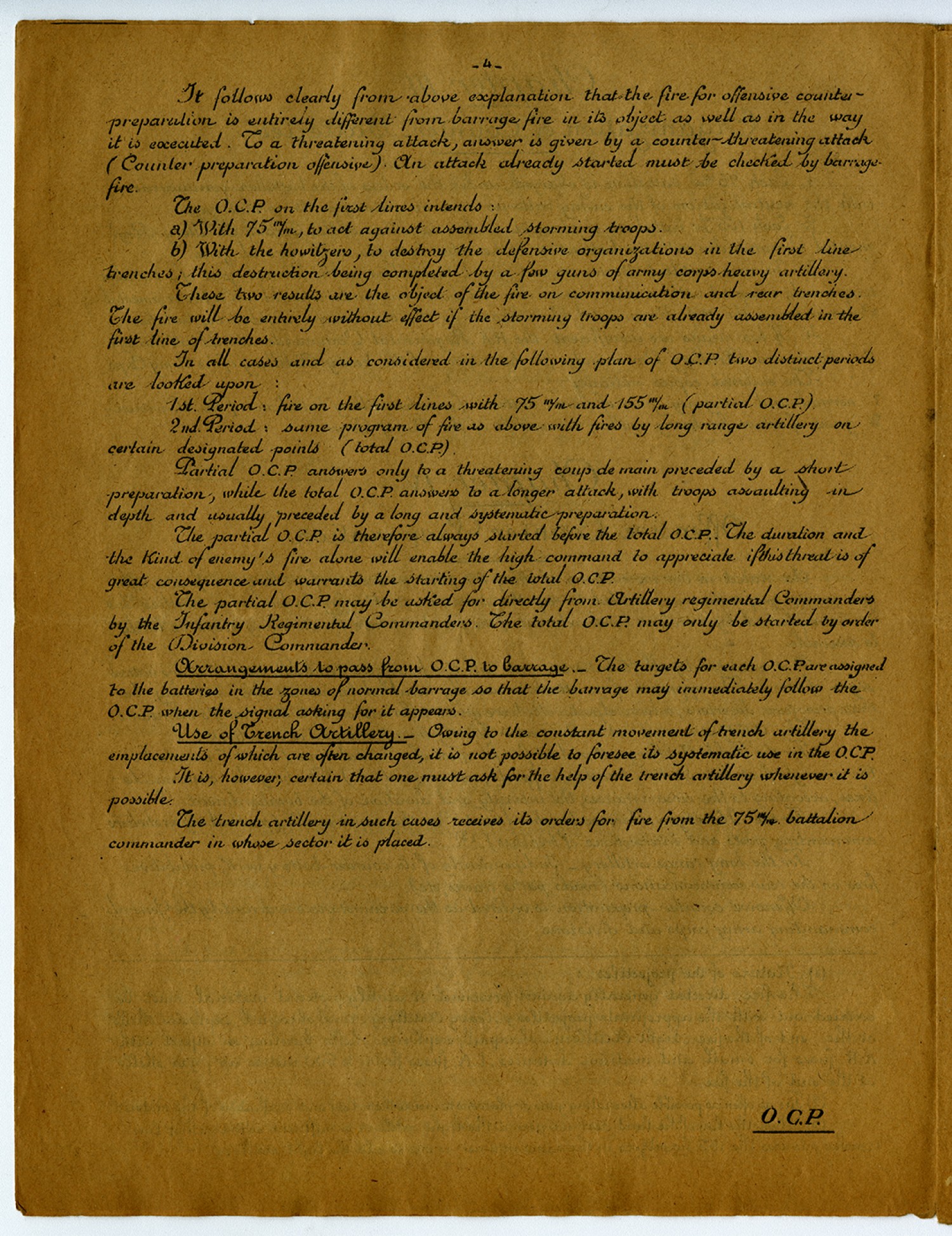
[page 4] It follows clearly from above explanation that the fire for offensive counter preparation is entirely different from barrage fire in its object as well as in the way it is executed. To a threatening attack, answer is given by a counter threatening attack (Counter preparation offensive). An attack already started must be checked by barrage fire. The O.C.P. on the first lines intends: a) With 75 m/m, to act against assembled storming troops. b) With the howitzers, to destroy the defensive organizations in the first line trenches; this destruction being completed by a few guns of army corps heavy artillery. These two results are the object of the fire on communication and rear trenches. The fire will be entirely without effect if the storming troops are already assembled in the first line of trenches. In all cases and as considered in the following plan of O.C.P. two distinct periods are looked upon: 1st Period: fire on the first lines with 75 m/m and 155 m/m (partial O.C.P) 2nd Period: same program of fire as above with fires by long range artillery on certain designated points 9total O.C.P). Partial O.C.P. answers only to a threatening coup de main preceded by a short preparation, while the total O.C.P. answers to a longer attack, with troops assaulting in depth and usually preceded by a long and systematic preparation. The partial O.C.P. is therefore always started before the total O.C.P. The duration and the Kind of enemy
Transcript
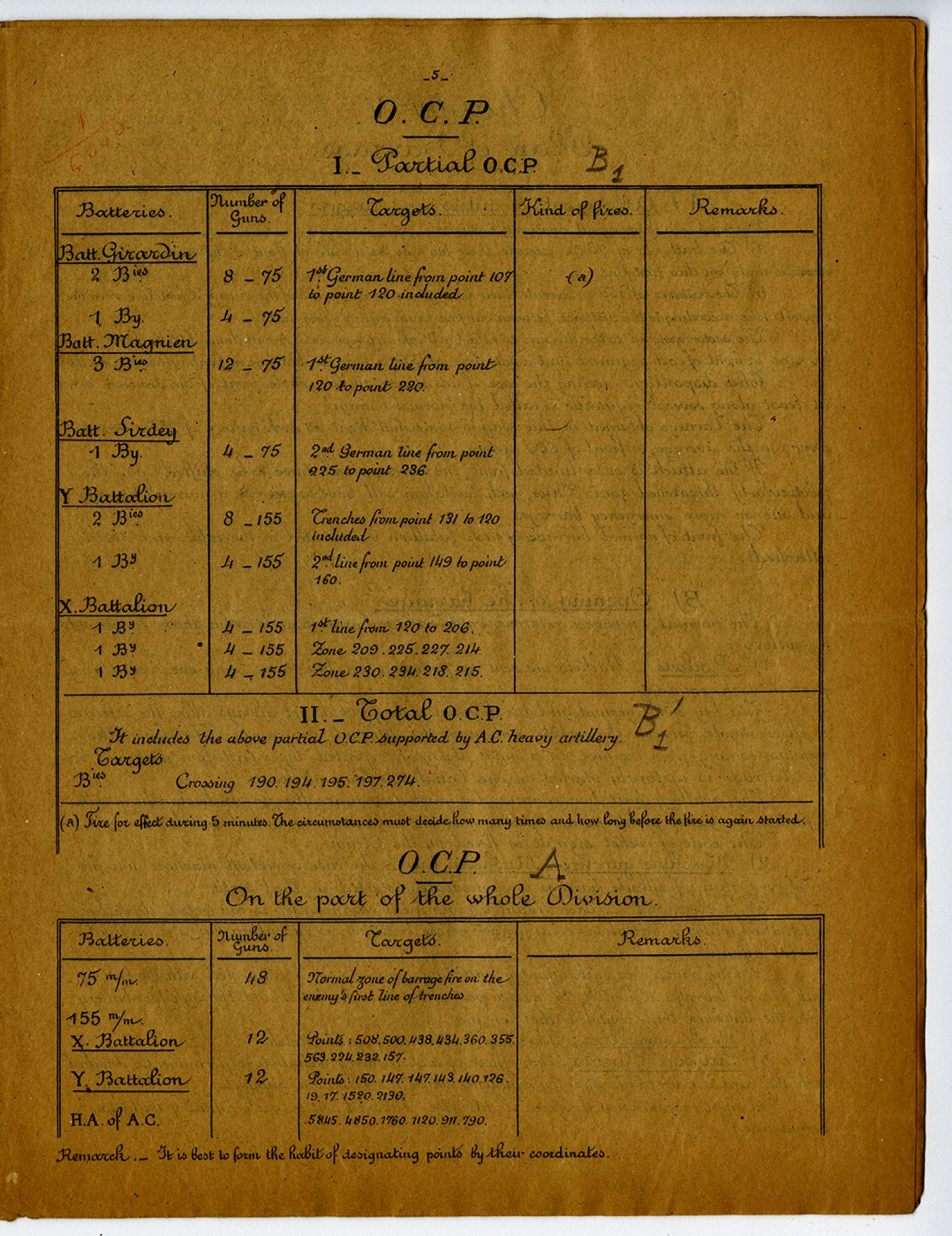
[page 5] O.C.P. I. Partial O.C.P. [Batteries.] Batt. Girardin 2 Bies [Numbers of Guns.] 8-75 [Targets.] 1st German line from point 107 to point 120 included [Kind of fixes.] (a) [Remarks.] [Batteries.] 1 by. Batt. Magnien 3 Bies [Numbers of Guns.] 4-75 12-75 [Targets.] 1st German line from point 120 to point 220 [Kind of fixes.] [Remarks.] [Batteries.] Batt. Sirdey 1 By. [Numbers of Guns.] 4-75 [Targets.] 2nd German line from point 225 to point 236 [Kind of fixes.] [Remarks.] [Batteries.] Y Battalion 2 Bies [Numbers of Guns.] 8-155 [Targets.] Trenches from point 131 to 120 included [Kind of fixes.] [Remarks.] [Batteries.] Y Battalion 1 By [Numbers of Guns.] 4-155 [Targets.] 2nd line form point 149 to point 160 [Kind of fixes.] [Remarks.] [Batteries.] X Battalion 1 By [Numbers of Guns.] 4-155 [Targets.] 1st line from 120 to 206 [Kind of fixes.] [Remarks.] [Batteries.] X Battalion 1 By [Numbers of Guns.] 4-155 [Targets.] Zone 209 225 227 214 [Kind of fixes.] [Remarks.] [Batteries.] X Battalion 1 By [Numbers of Guns.] 4-155 [Targets.] Zone 230 234 218 215 [Kind of fixes.] [Remarks.] II. Total O.C.P. It includes the above partial O.C.P. supported by A.C. heavy artillery. Targets Bies Crossing 190 194 195 197 274. (a) Fire for effect during 5 minutes. The circumstances must decide how many times and how long before the fire is again started. O.C.P. On the part of the whole Division [Batteries.] 75 m/m [Numbers of Guns.] 48 [Targets.] Normal zone of barrage fire on the enemy
Transcript
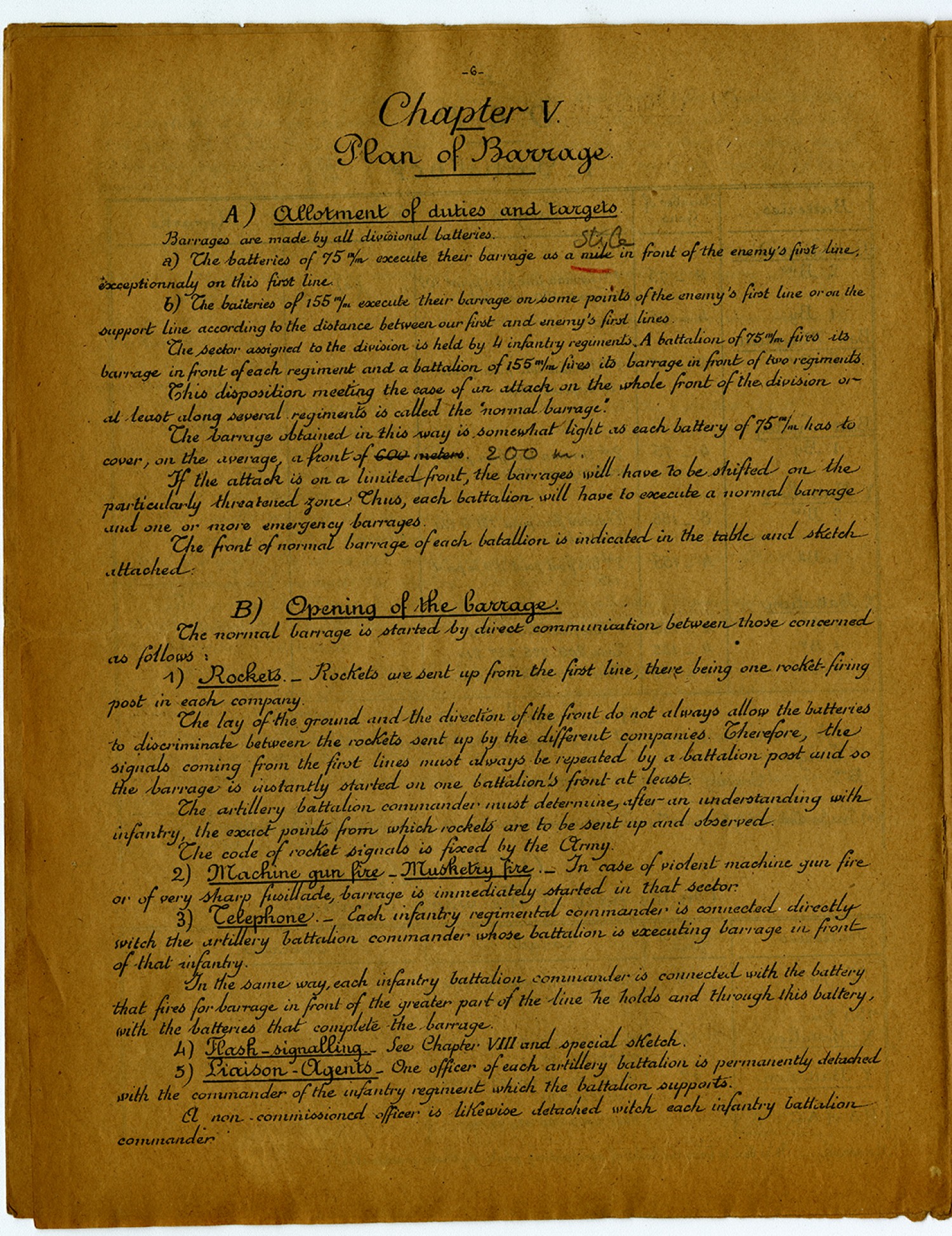
[page 6] Chapter V. Plan of Barrage. A) Allotment of duties and targets. Barrages are made by all divisional batteries. a) The batteries of 75 m/m execute their barrage as a mile in front of the enemy
Transcript
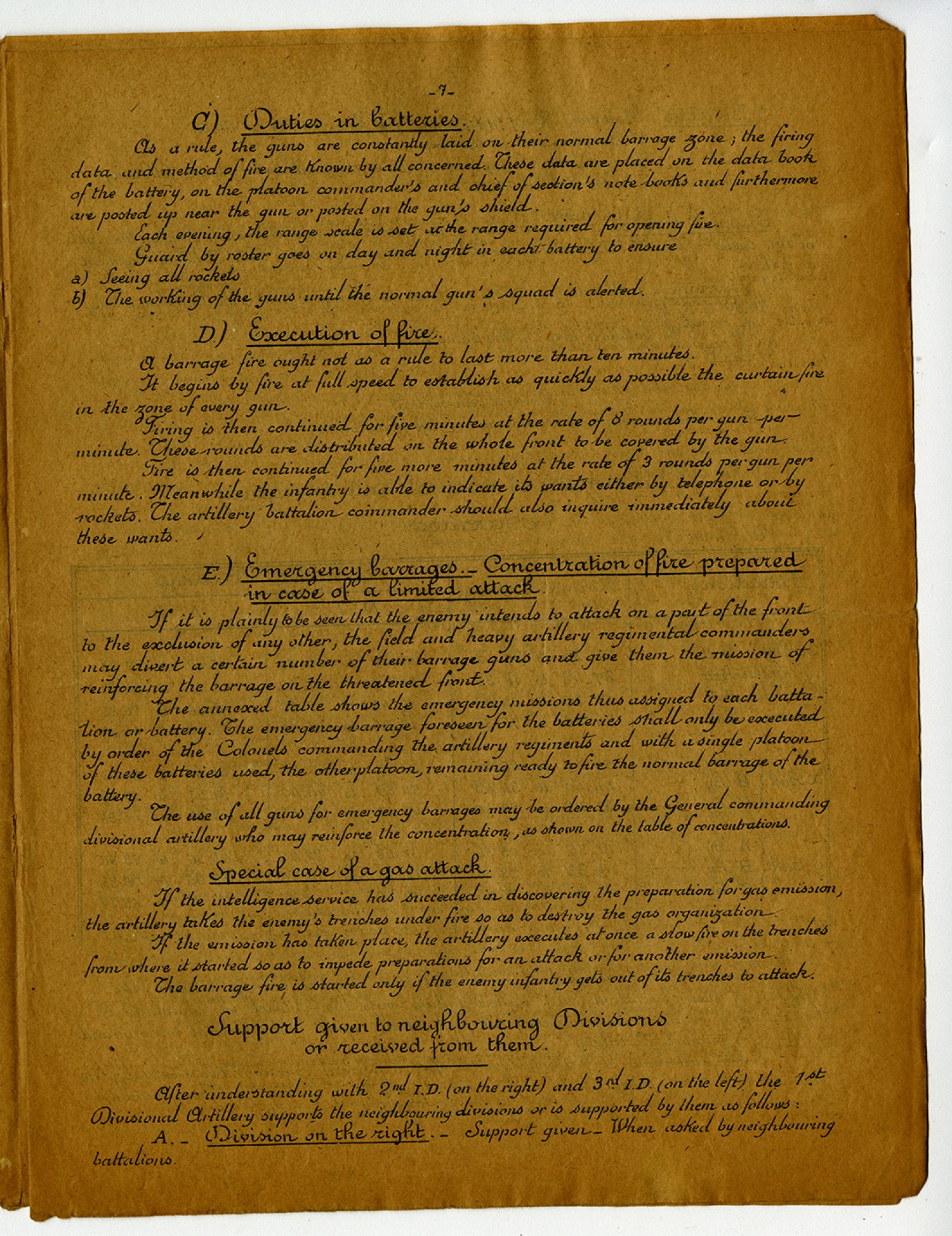
[page 7] C) Duties in batteries. As a rule, the guns are constantly laid on their normal barrage zone; the firing data and method of fire are known by all concerned. These data are placed on the data book of the battery, on the platoon commander
Transcript
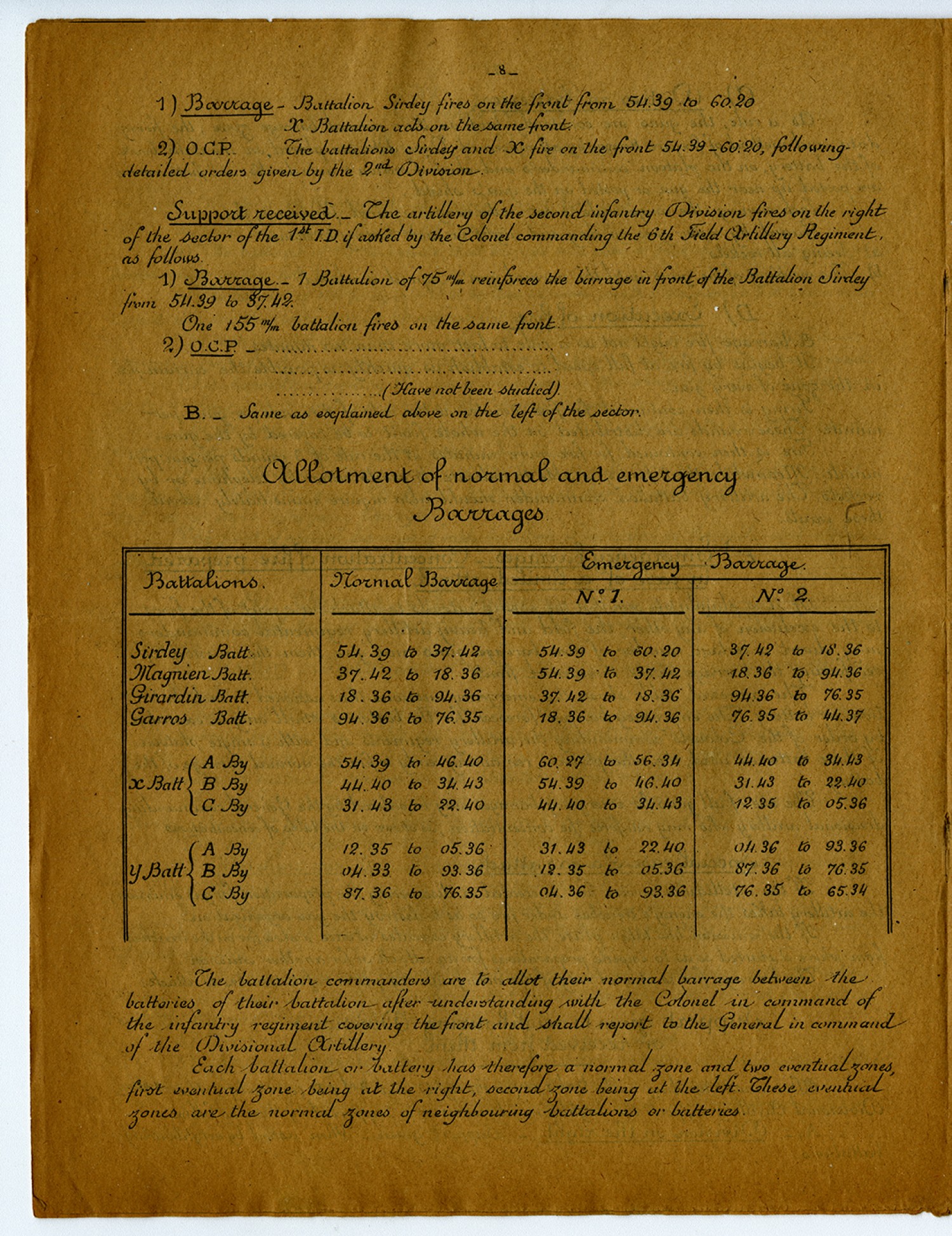
[page 8] 1) Barrage
Transcript
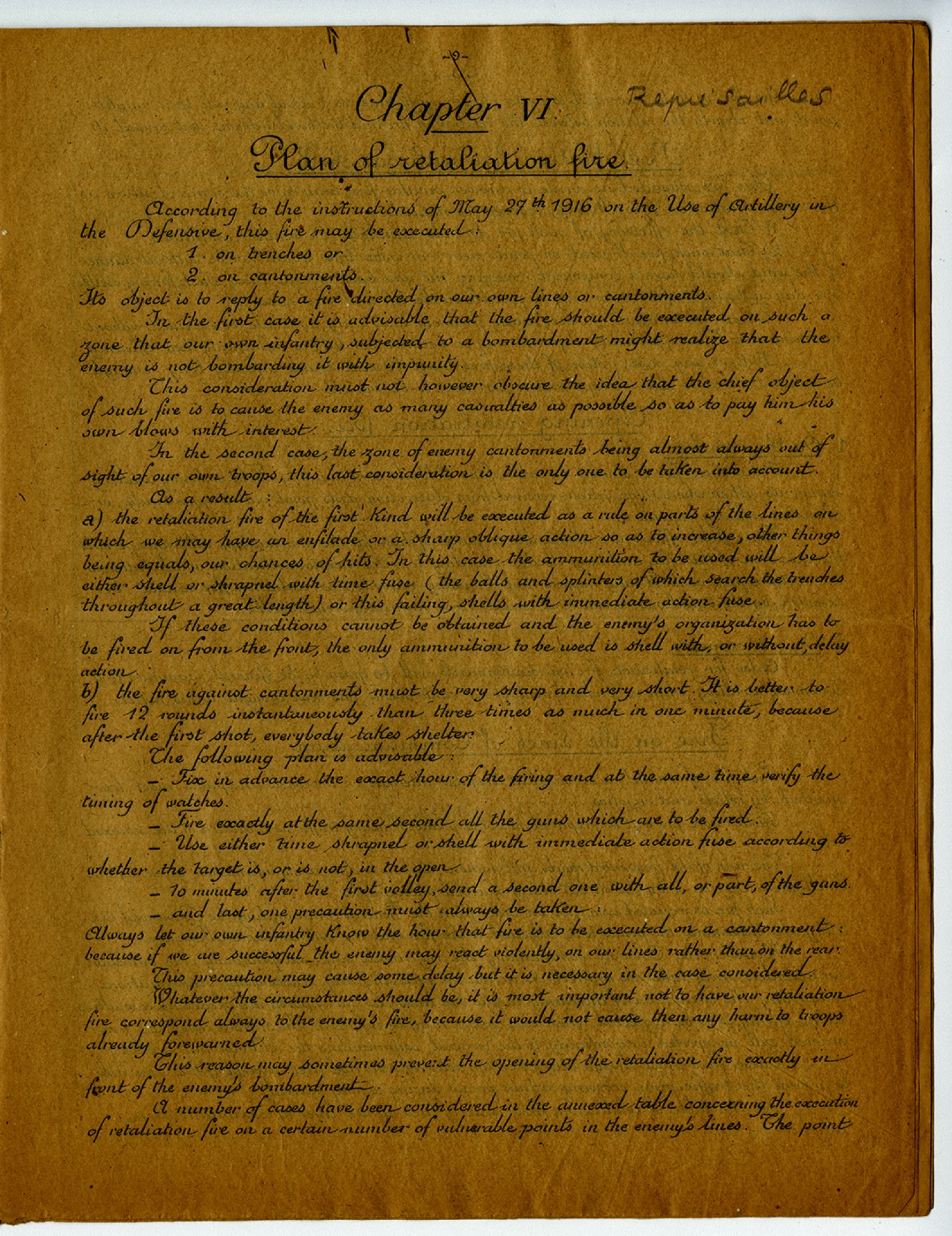
[page 9] Chapter VI. Plan of retaliation fire. According to the instructions of May 27th 1916 on the Use of Artillery in the Defensive, this fire may be executed: 1. on trenches or 2. on cantonments. Its object is to reply to a fire directed on our own lines or cantonments. In the first case it is advisable that the fire should be executed on such a zone that our own infantry, subjected to a bombardment might realize that the enemy is not bombarding it with impunity. This consideration must not however obscure the idea that the chief object of such fire is to cause the enemy as many casualties as possible so as to pay him his own blows with interest. In the second case, the zone of enemy cantonments being almost always out of sight of our own troops, this last consideration is the only one to be taken into account. As a result: a) the retaliation fire of the first kind will be executed as a rule on parts of the lines on which we may have an enfilade or a sharp oblique action so as to increase, other things being equals, our chances of hits. In this case the ammunition to be used will be either shell or shrapnel with time fuse (the balls and splinters of which search the trenches throughout a great length) or this failing, shells with immediate action fuse. If these conditions cannot be obtained and the enemy
Transcript
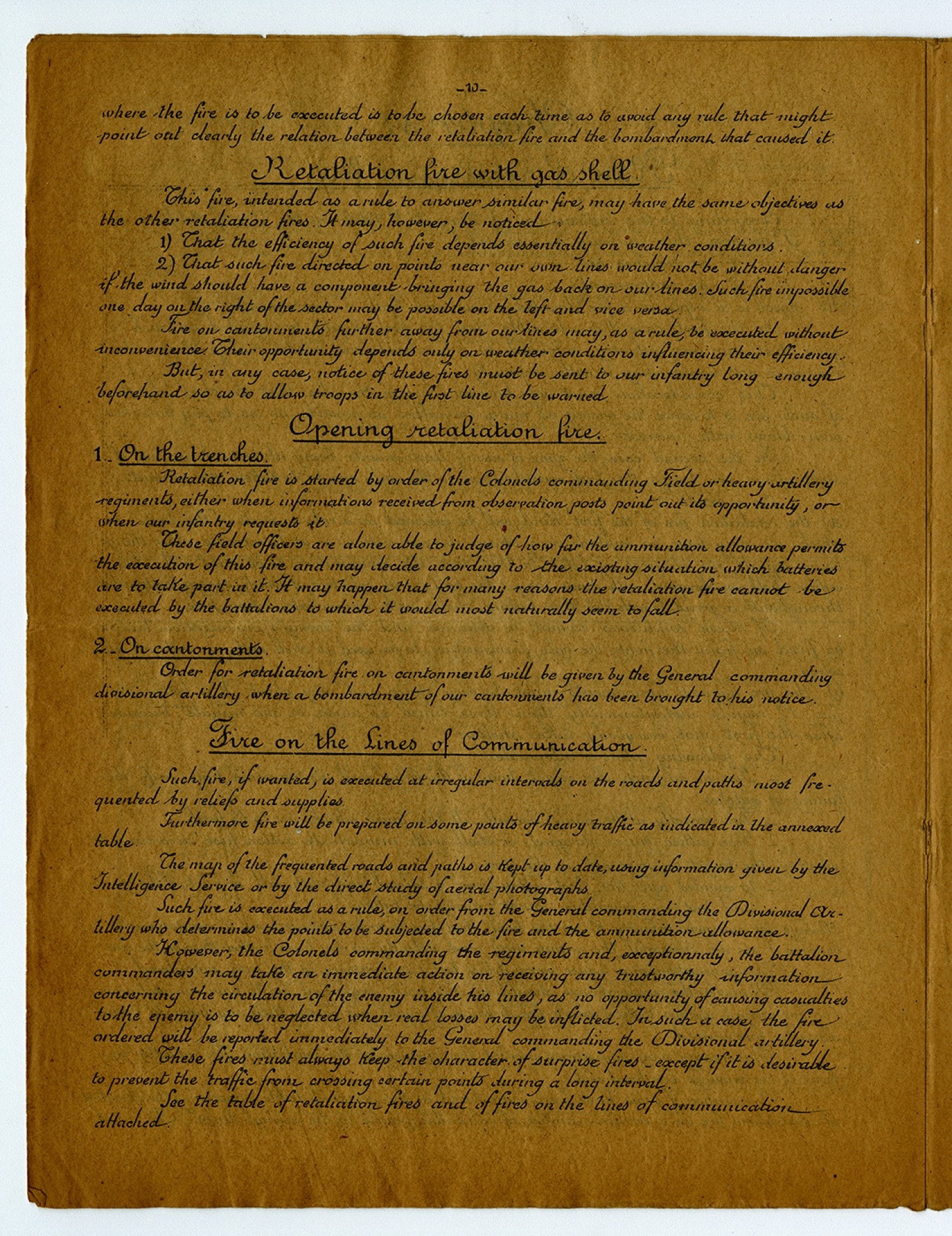
[page 10] where the fire is to be executed is to be chosen each time as to avoid any rule that might point out clearly the relation between the retaliation fire and the bombardment that caused it. Retaliation fire with gas shell. This fire, intended as a rule to answer similar fire, may have the same objectives as the other retaliation fires. It may, however, be noticed. 1) That the efficiency of such fire depends essentially on weather conditions. 2) That such fire directed on points near our own lines would not be without danger if the wind should have a component bringing the gas back on our lines. Such fire impossible one day on the right of the sector may be possible on the left and vice versa. Fire on cantonments further away from our lines may, as a rule, be executed without inconvenience. Their opportunity depends only on weather conditions influencing their efficiency. But, in any case, notice of these fires must be sent to our infantry long enough beforehand so as to allow troops in the first line to be warned. Opening retaliation fire. 1. On the trenches. Retaliation fire is started by order of the Colonels commanding Field or heavy artillery regiments, either when informations received from observation posts point out its opportunity, or when our infantry requests it. These field officers are alone able to judge of how far the ammunition allowance permits the execution of this fire and may decide according to the existing situation which batteries are to take part in it. It may happen that for many reasons the retaliation fire cannot be executed by the battalions to which it would most naturally seem to fall. 2.- On cantonments. Order for retaliation fire on cantonments will be given by the General commanding divisional artillery when a bombardment of our cantonments has been brought to his notice. Fire on the Lines of Communication. Such fire, if wanted, is executed at irregular intervals on the roads and paths most frequented by reliefs and supplies. Furthermore fire will be prepared on some points of heavy traffic as indicated in the annexed table. The map of the frequented roads and paths is kept up to date, using information given by the Intelligence Service or by the direct study of aerial photographs. Such fire is executed as a rule, on order from the General commanding the Divisional Artillery who determines the points to be subjected to the fire and the ammunition allowance. However, the Colonels commanding the regiments and, exceptionnaly, the battalion commanders may take an immediate action on receiving any trustworthy information concerning the circulation of the enemy inside his lines, as no opportunity of causing casualties to the enemy is to be neglected when real losses may be inflicted. In such a case the fire ordered will be reported immediately to the General commanding the Divisional artillery. These fires must always keep the character of surprise fires
Transcript
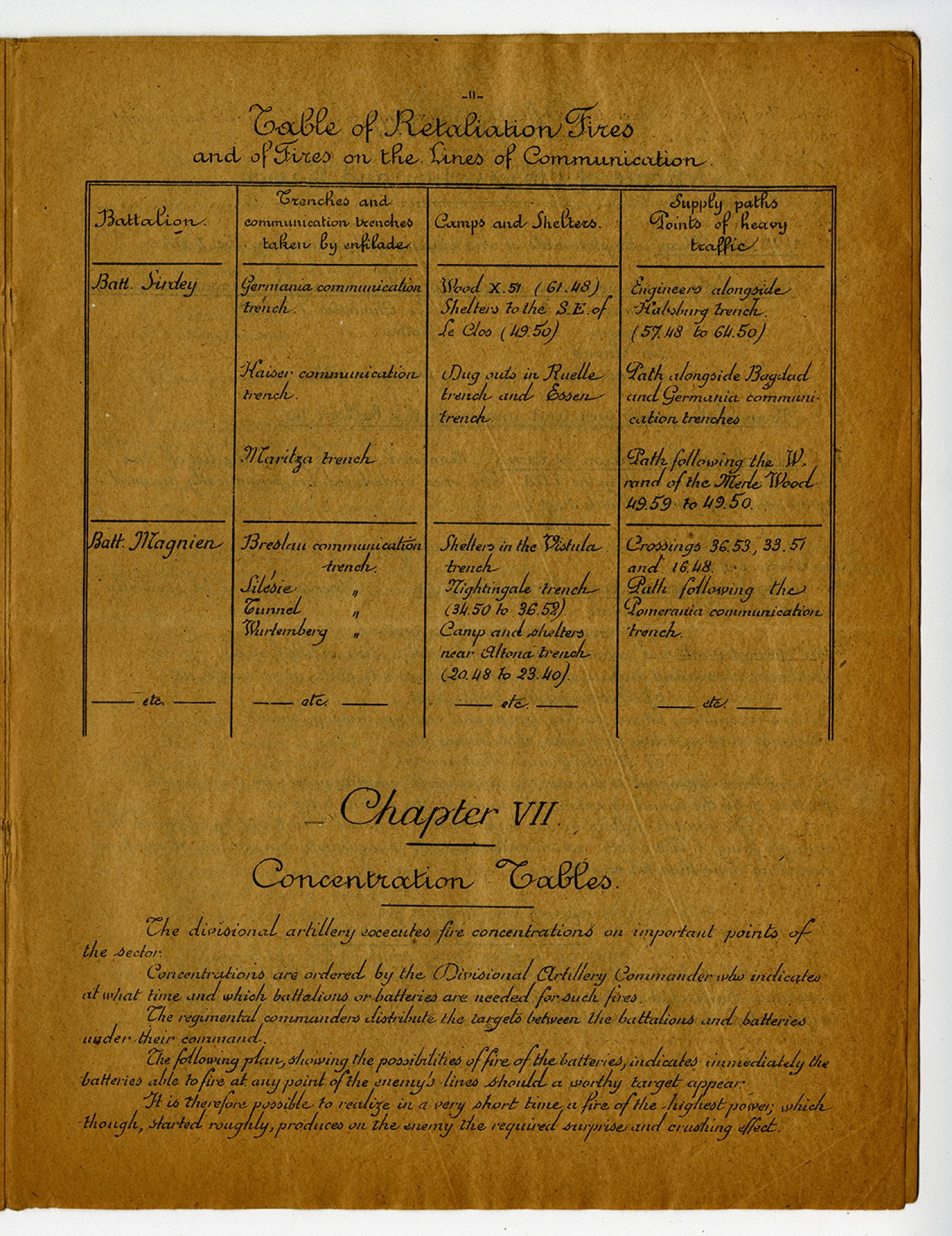
[page 11] Table of Retaliation Fires and of Fires on the Lines of Communication [Battalion] Batt. Sirdey [trenches and communication trenches taken by enfilade] Germania communication trench [Camps and Shelters] Wood X. 51 (61.48) Shelters to the S.E. of Le Clos (49.50) [Supply paths Points of heavy traffic] Engineers alongside Habsburg trench (57.48 to 64.50) [Battalion] Batt. Sirdey [trenches and communication trenches taken by enfilade] Kaiser communication trench [Camps and Shelters] Dug outs in Ruelle [Supply paths Points of heavy traffic] Path alongside Bagdad and Germania communication trenches [Battalion] Batt. Sirdey [trenches and communication trenches taken by enfilade] Maritza trench [Camps and Shelters] [Supply paths Points of heavy traffic] Path following the W. rand of the Merle Wood 49.59 to 49.59 [Battalion] Batt. Magnien [trenches and communication trenches taken by enfilade] Breslau communication trench [Camps and Shelters] Shelters in the Vistula trench [Supply paths Points of heavy traffic] Crossings 36.53, 33.51 and 16.48 [Battalion] Batt. Magnien [trenches and communication trenches taken by enfilade] Sil
Transcript
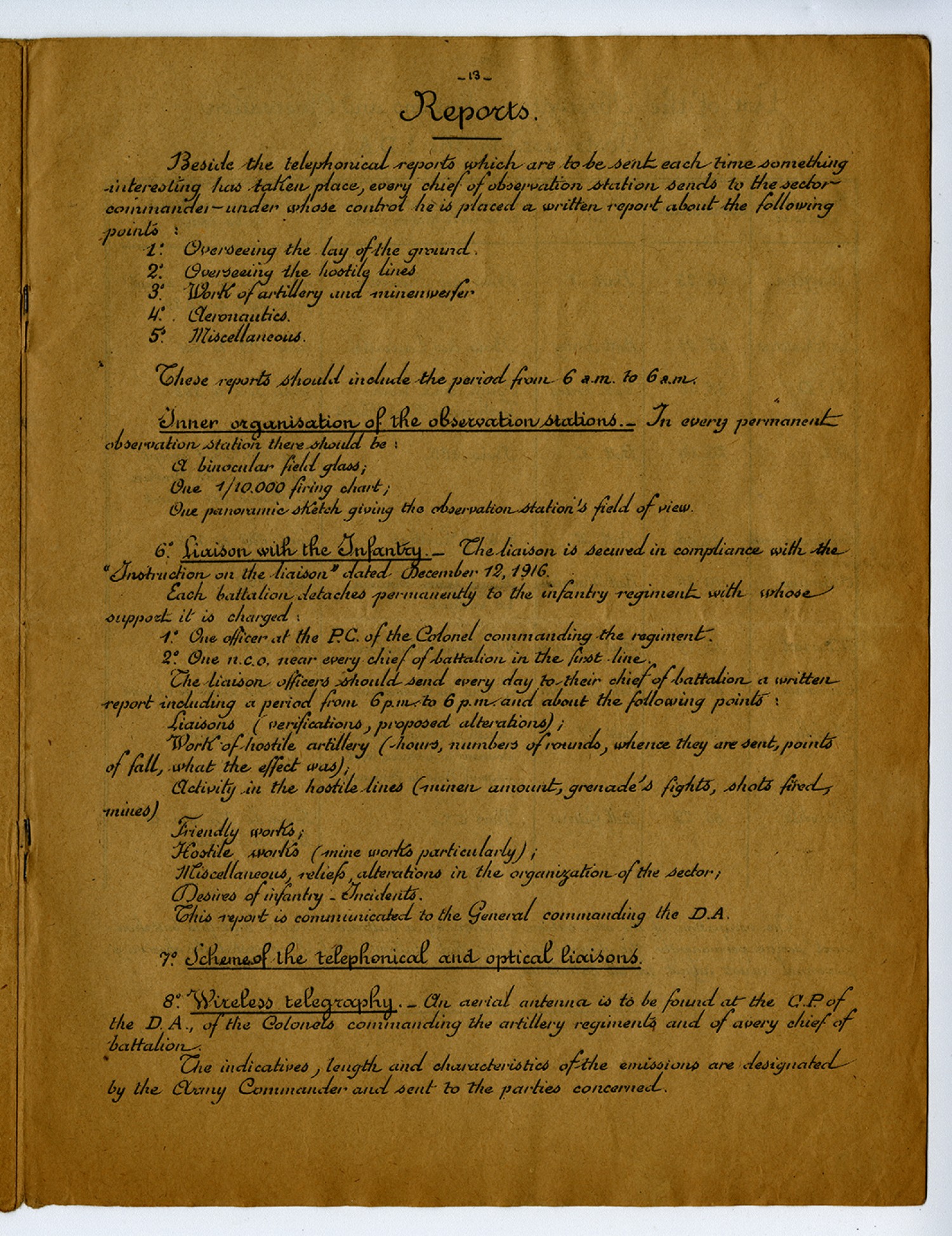
[page 13] Reports. Besides the telephonical reports which are to be sent each time something interesting has taken place, every chief of observation station sends to the sector commander under whose control he is placed a written report about the following points: 1: Overseeing the lay of the ground. 2: Overseeing the hostile lines 3: Work of artillery and minenwerfer 4: Aeronautics. 5: Miscellaneous. These reports should include the period from 6 a.m. to 6 a.m. Inner organization of the observation stations.- In every permanent observation station there should be: A binocular field glass; One 1/10,000 firing chart; One panoramic sketch giving the observation station
Transcript
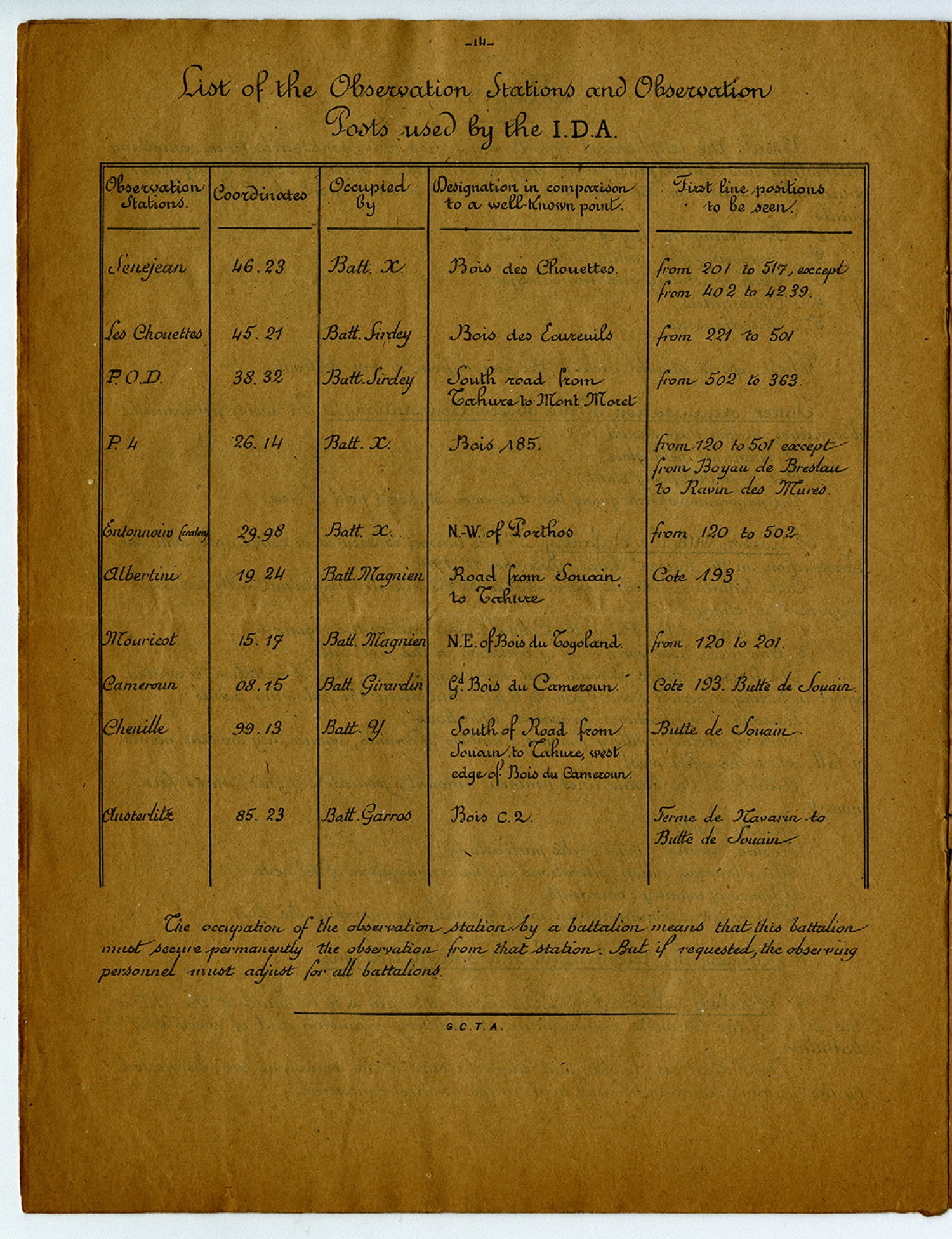
[page 14] List of the Observation Stations and Observation Posts used by the I.D.A. [Observation Stations] Senejean [Coordinates] 46.23 [Occupied by] Batt. X. [Designation in comparison to a well-known point.] Bois des Chouettes [First line positions to be seen.] from 201 to 517, except from 402 to 42.39 [Observation Stations] Les Chouettes [Coordinates] 45.21 [Occupied by] Bat.. Sirdey [Designation in comparison to a well-known point.] Bois des Ecureuils [First line positions to be seen.] from 221 to 501 [Observation Stations] P.O.D. [Coordinates] 38.32 [Occupied by] Batt. Sirdey [Designation in comparison to a well-known point.] South road from Tahurelo Mont Moret [First line positions to be seen.] from 502 to 363 [Observation Stations] P.H. [Coordinates] 26.14 [Occupied by] Batt X [Designation in comparison to a well-known point.] Bois 185 [First line positions to be seen.] from 120 to 501 except from Boyau de Brestau to Ravin des Mures. [Observation Stations] Entonnous (craters) [Coordinates] 29.98 [Occupied by] Batt. X [Designation in comparison to a well-known point.] N-W. of Porthos [First line positions to be seen.] from 120 to 502 [Observation Stations] Albertini [Coordinates] 19.24 [Occupied by] Batt. Magnien [Designation in comparison to a well-known point.] Road from Souain to Tahure [First line positions to be seen.] Cot 193 [Observation Stations] Mouricot [Coordinates] 15.17 [Occupied by] Batt. Magnien [Designation in comparison to a well-known point.] N.E. of Bois du Togoland. [First line positions to be seen.] from 120 to 201 [Observation Stations] Cameroun [Coordinates] 08.15 [Occupied by] Batt. Girardin [Designation in comparison to a well-known point.] Gd. Bois du Cameroun. [First line positions to be seen.] Cote 193. Butte de Souain. [Observation Stations] Chenille [Coordinates] 99.13 [Occupied by] Batt. Y. [Designation in comparison to a well-known point.] South of Road from Souain to Tahure, west edge of Bois du Cameroun. [First line positions to be seen.] Butte de Souain [Observation Stations] Austerlitz [Coordinates] 85.23 [Occupied by] Batt. Garros[Designation in comparison to a well-known point.] Bois C.2 [First line positions to be seen.] Ferme de Navarin to Butte de Souain. The occupation of the observation station by a battalion means that this battalion must secure permanently the observation from that station. But if requested, the observing personnel must adjust for all battalions. G.C.T.A.
Details
| Title | French Military Mission Artillery Section Plan for the Employment of the Artillery in Defensive - n.d. |
| Creator | Unknown |
| Source | Unknown. French Military Mission Artillery Section Plan for the Employment of the Artillery in Defensive. n.d. Rumbold, Frank M., General Collection. A1331. Missouri History Museum, St. Louis, Missouri. |
| Description | Military hand book outlining the best practices for artillery battalions during battle. Includes the organization of command and various batteries. Also discusses best firing practices in certain situations. |
| Subject LCSH | Artillery; World War, 1914-1918--Artillery operations; World War, 1914-1918--Trench warfare; Military training |
| Subject Local | WWI; World War I |
| Site Accession Number | A1331 |
| Contributing Institution | Missouri History Museum |
| Copy Request | Transmission or reproduction of items on these pages beyond those allowed by fair use requires the written permission of the Missouri History Museum: 314-746-4510 |
| Rights | The text and images contained in this collection are intended for research and educational use only. Duplication of any of these images for commercial use without express written consent is expressly prohibited. Contact the Missouri History Museum's Permissions Office at 314-746-4511 to obtain written consent. |
| Date Original | n.d. |
| Language | English |