Frank M. Rumbold Memoir - 1917-1919
Transcript
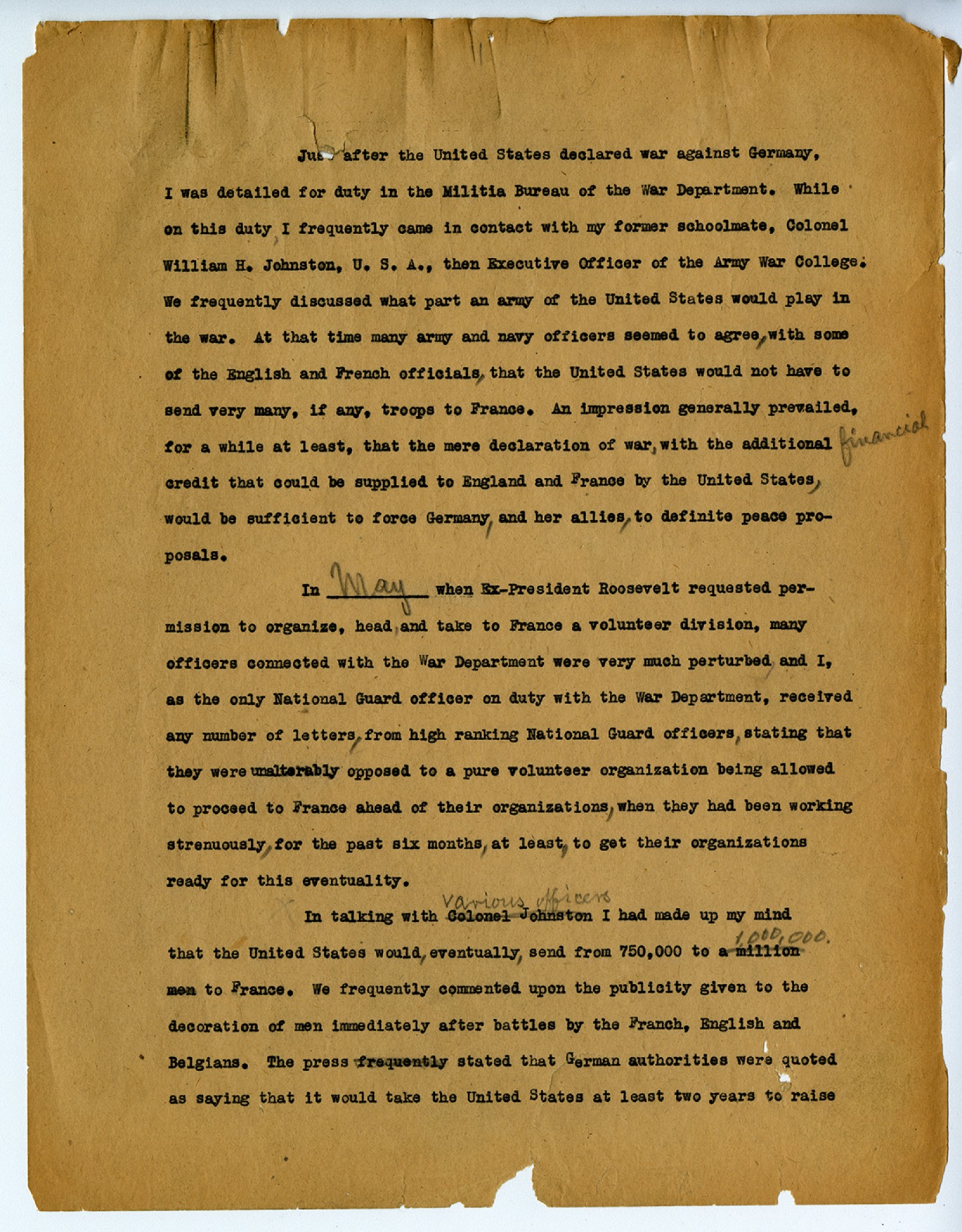
Just after the United States declared war against Germany, I was detailed for duty in the Militia Bureau of the War Department. While on this duty I frequently came in contact with my former schoolmate, Colonel William H. Johnston, U.S.A., then Executive Officer of the Army War College. We frequently discussed what part and army of the United States would play in the war. At that time many army and navy officers seemed to agree, with some of the English and French officials, that the United States would not have to send very many, if any, troops to France. An impression generally prevailed, for a while at least, that the mere declaration of war, with the additional financial credit that could be supplied to England and France by the United States, would be sufficient to force Germany, and her allies, to definite peace proposals. In May when Ex-President Roosevelt requested permission to organize, head and take to France a volunteer division, many officers connected with the War Department were very much perturbed and I, as the only National Guard officer on duty with the War Department, received any number of letters, from high ranking National Guard officers, stating that they were unalterably opposed to a pure volunteer organization being allowed to proceed to France ahead of their organizations, when they had been working strenuously, for the past six months, at least, to get their organizations ready for this eventuality. In talking with various officers I had made up my mind that the United States would, eventually, send from 750,000 to 1,000,000 to France. We frequently commented upon the publicity given to the decoration of men immediately after battles by the Franch, English and Belgians. The press stated that German authorities were quoted as saying that it would take the United States at least two years to raise
Transcript
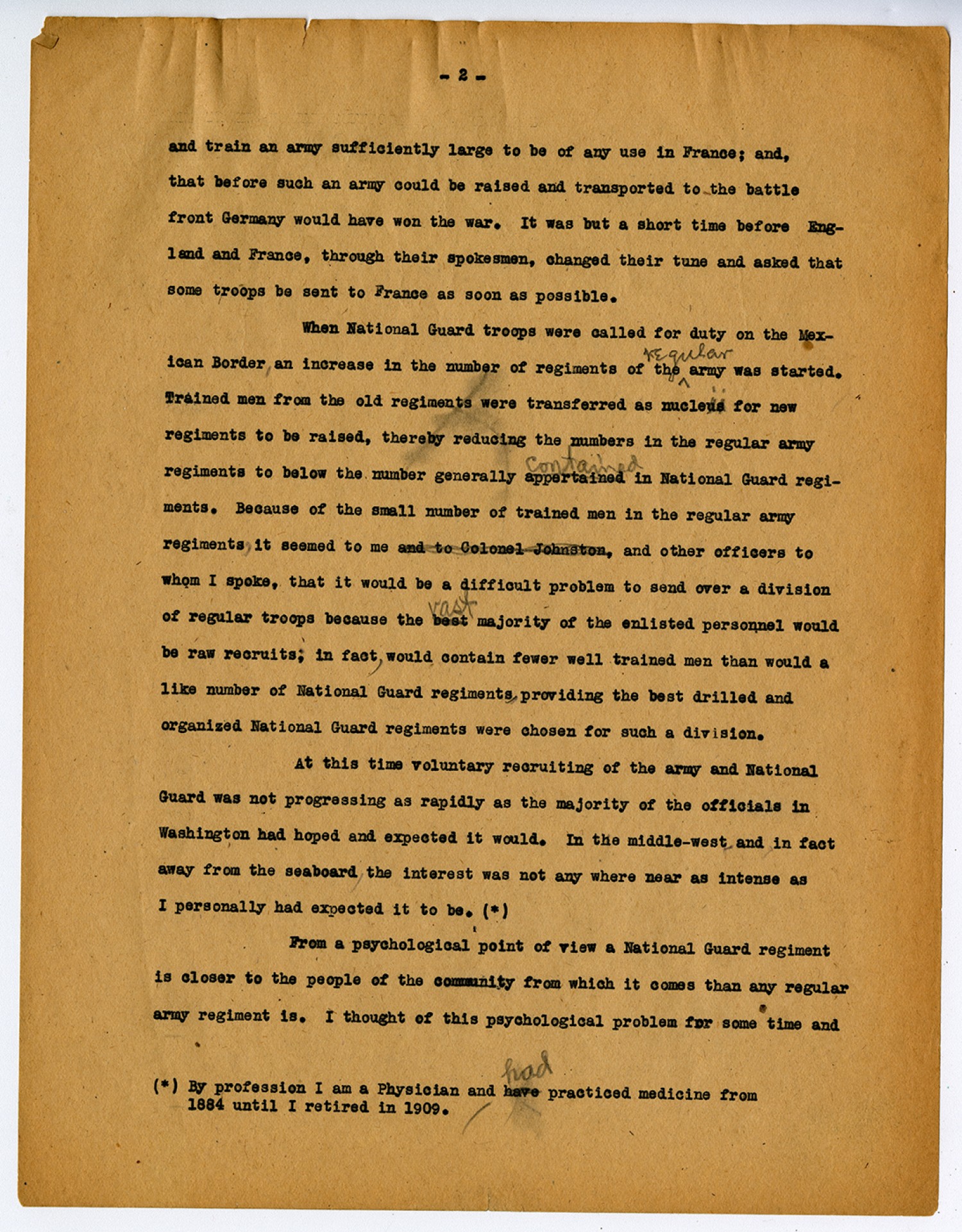
[page 2] and train an army sufficiently large to be of any use in France; and, that before such an army could be raised and transported to the battle front Germany would have won the war. It was but a short time before England and France, through their spokesmen, changed their tune and asked that some troops be sent to France as soon as possible. When National Guard troops were called for duty on the Mexican Border, an increase in the number of regiments of the regular army was started. Trained men from the old regiments were transferred as nucleus for new regiments to be raised, thereby reducing the numbers in the regular army regiments to below the number generally contained in National Guard regiments. Because of the small number of trained men in the regular army regiments, it seemed to me and other officers to whom I spoke, that it would be a difficult problem to send over a division of regular troops because the vast majority of the enlisted personnel would be raw recruits; in fact, would contain fewer well trained men than would a like number of National Guard regiments, providing the best drilled and organized National Guard regiments were chosen for such a division. At this time voluntary recruiting of the army and National Guard was not progressing as rapidly as the majority of the officials in Washington had hoped and expected it would. In the middle-west and in fact away from the seaboard the interest was not any where near as intense as I personally had expected it to be.(*) From a psychological point of view a National Guard regiment is closer to the people of the community from which it comes than any regular army regiment is. I thought of this psychological problem for some time and (*) By profession I am a Physician and had practiced medicine from 1884 until I retired in 1909.
Transcript
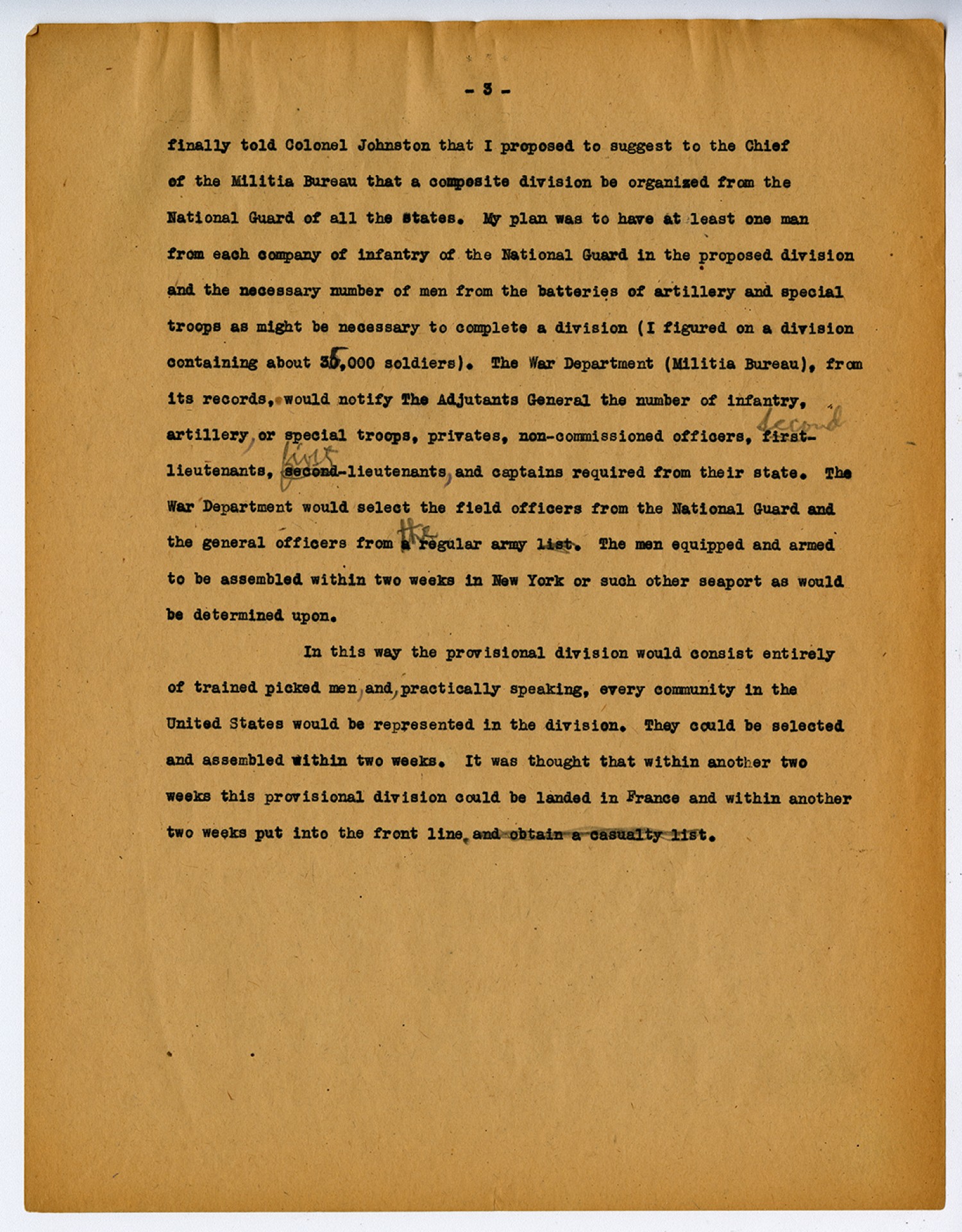
[page 3] finally told Colonel Johnston that I proposed to suggest to the Chief of the Militia Bureau that a composite division be organized from the National Guard of all the states. My plan was to have at least one man from each company of infantry of the National Guard in the proposed division and the necessary number of men from the batteries of artillery and special troops as might be necessary to complete a division (I figured on a division containing about 35,000 soldiers). The War Department (Militia Bureau), from its records, would notify The Adjutants General the number of infantry, artillery, or special troops, privates, non-commissioned officers, Second-lieutenants, first-lieutenants, and captains required from their state. The War Department would select the field officers from the National Guard and the general officers from the regular army. The men equipped and armed to be assembled within two weeks in New York or such other seaport as would be determined upon. In this way the provisional division would consist entirely of trained picked men, and, practically speaking, every community in the United States would be represented in the division. They could be selected and assembled within two weeks. It was thought that within another two weeks this provisional division could be landed in France and within another two weeks put into the front line.
Transcript
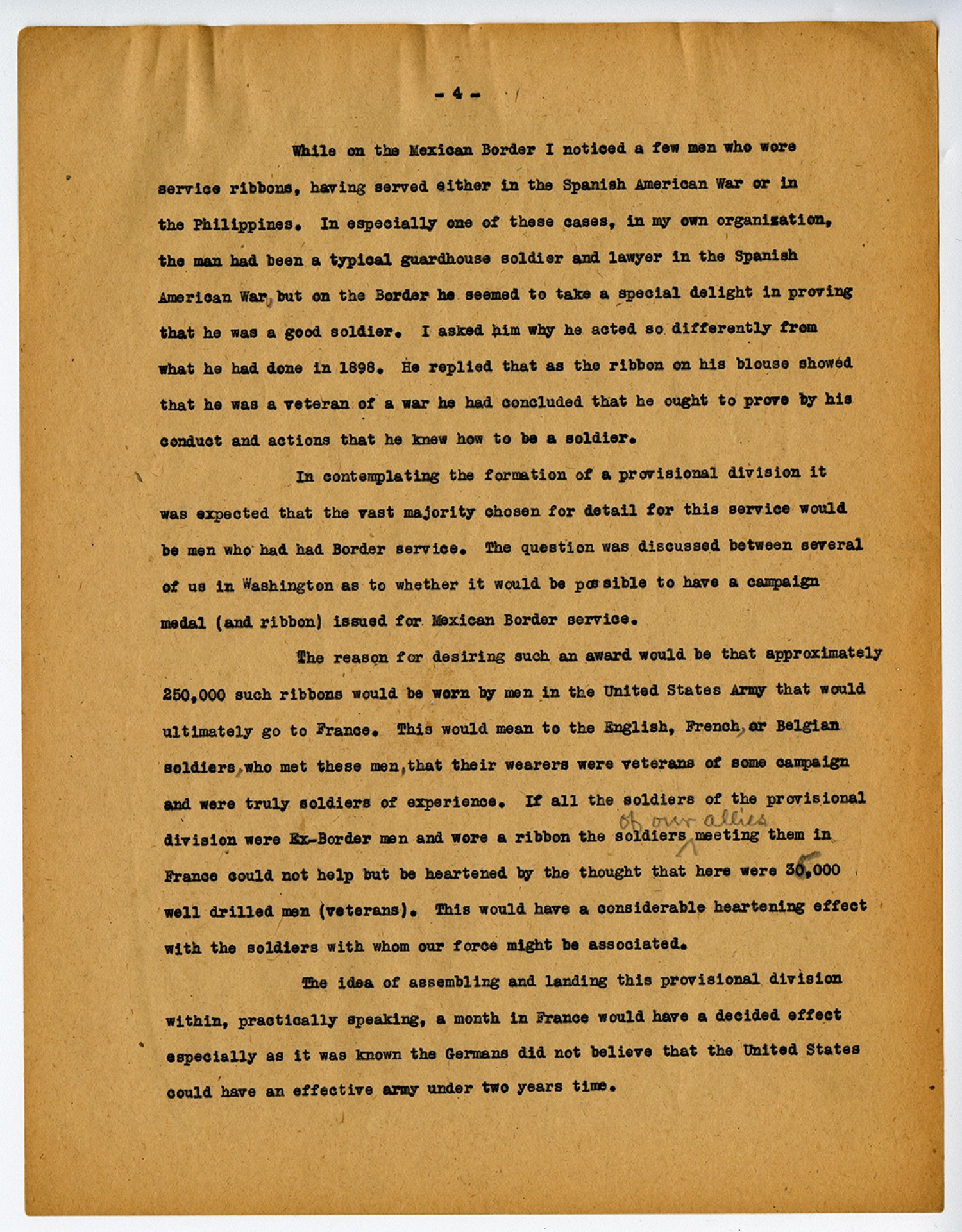
[page 4] While on the Mexican Border I noticed a few men who wore service ribbons, having served either in the Spanish American War or in the Philippines. In especially one of these cases, in my own organization, the man had been a typical guardhouse soldier and lawyer in the Spanish American War but on the Border he seemed to take a special delight in proving that he was a good soldier. I asked him why he acted so differently from what he had done in 1898. He replied that as the ribbon on his blouse showed that he was a veteran of a war he had concluded that he ought to prove by his conduct and actions that he knew how to be a soldier. In contemplating the formation of a provisional division it was expected that the vast majority chosen for detail for this service would be men who had had Border service. The question was discussed between several of us in Washington as to whether it would be possible to have a campaign medal (and ribbon) issued for Mexican Border service. The reason for desiring such an award would be that approximately 250,000 such ribbons would be worn by men in the United States Army that would ultimately go to France. This would mean to the English, French, or Belgian soldiers, who met these men, that their wearers were veterans of some campaign and were truly soldiers of experience. If all the soldiers of the provisional division were Ex-Border men and wore a ribbon the soldiers of our Allies meeting them in France could not help but be heartened by the though that here were 35,000 well drilled men (veterans). This would have a considerable heartening effect with the soldiers with whom our force might be associated. The idea of assembling and landing this provisional division within, practically speaking, a month in France would have a decided effect especially as it was known the Germans did not believe that the United States could have an effective army under two years time.
Transcript
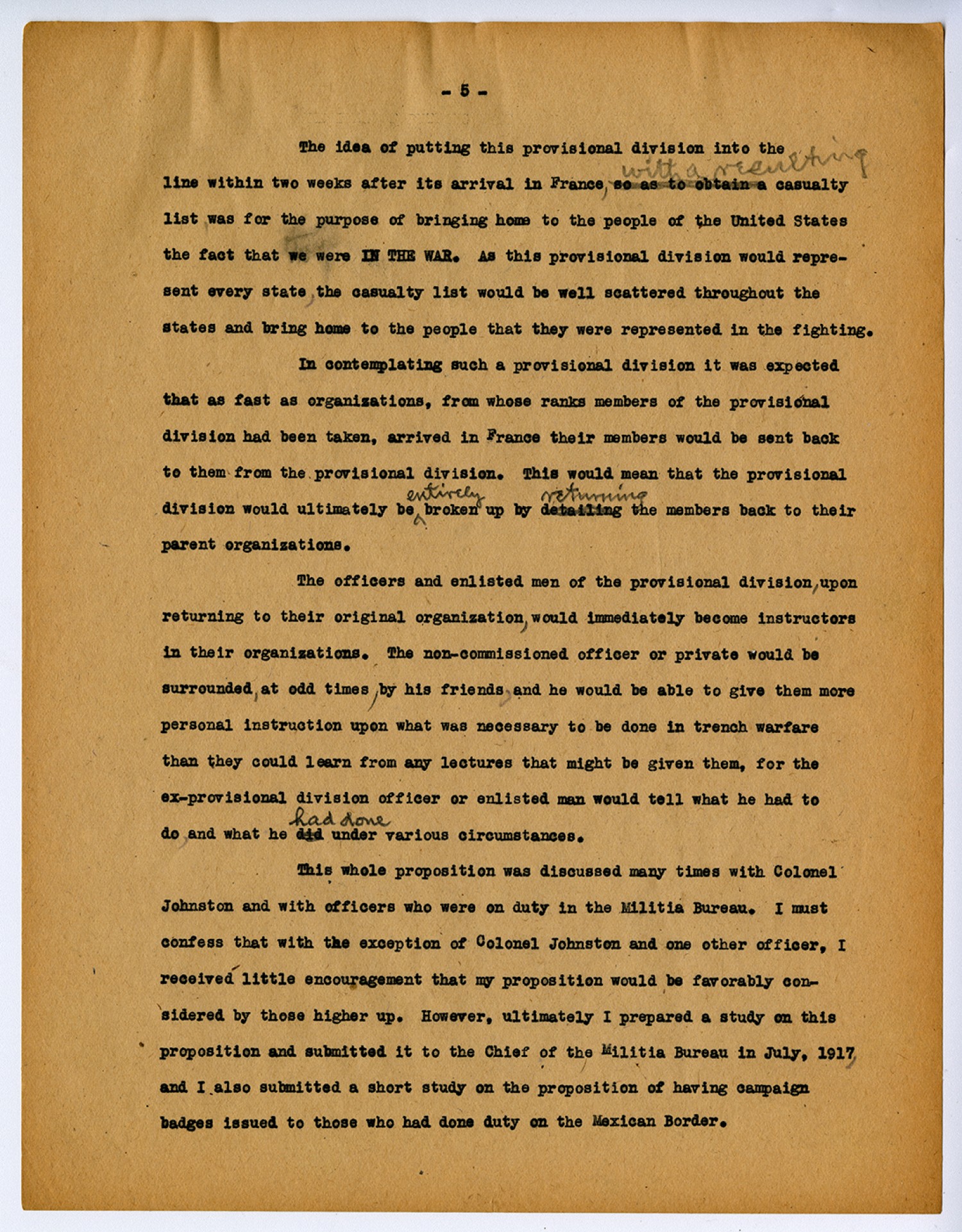
[page 5] The idea of putting this provisional division into the line within two weeks after its arrival in France, with a resulting casualty list was for the purpose of bringing home to the people of the United States the fact that we were IN THE WAR. As this provisional division would represent every state, the casualty list would be well scattered throughout the states and bring home to the people that they were represented in the fighting. In contemplating such a provisional division it was expected that as fast as organizations, from whose ranks members of the provisional division had been taken, arrived in France their members would be sent back to them from the provisional division. This would mean that the provisional division would ultimately be entirely broken up by returning the members back to their parent organizations. The officers and enlisted men of the provisional division, upon returning to their original organization, would immediately become instructors in their organizations. The non-commissioned officer or private would be surrounded, at odd times, by his friends, and he would be able to give them more personal instruction upon what was necessary to be done in trench warfare than they could learn from any lectures that might be given them, for the ex-provisional division officer or enlisted man would tell what he had to do, and what he had done various circumstances. This whole proposition was discussed many times with Colonel Johnston and with officers who were on duty in the Militia Bureau. I must confess that with the exception of Colonel Johnston and one other officer, I received little encouragement that my proposition would be favorably considered by those higher up. However, ultimately I prepared a study on this proposition and submitted it to the Chief of the Militia Bureau in July, 1917, and I also submitted a short study on the proposition of having campaign badges issued to those who had done duty on the Mexican Border.
Transcript
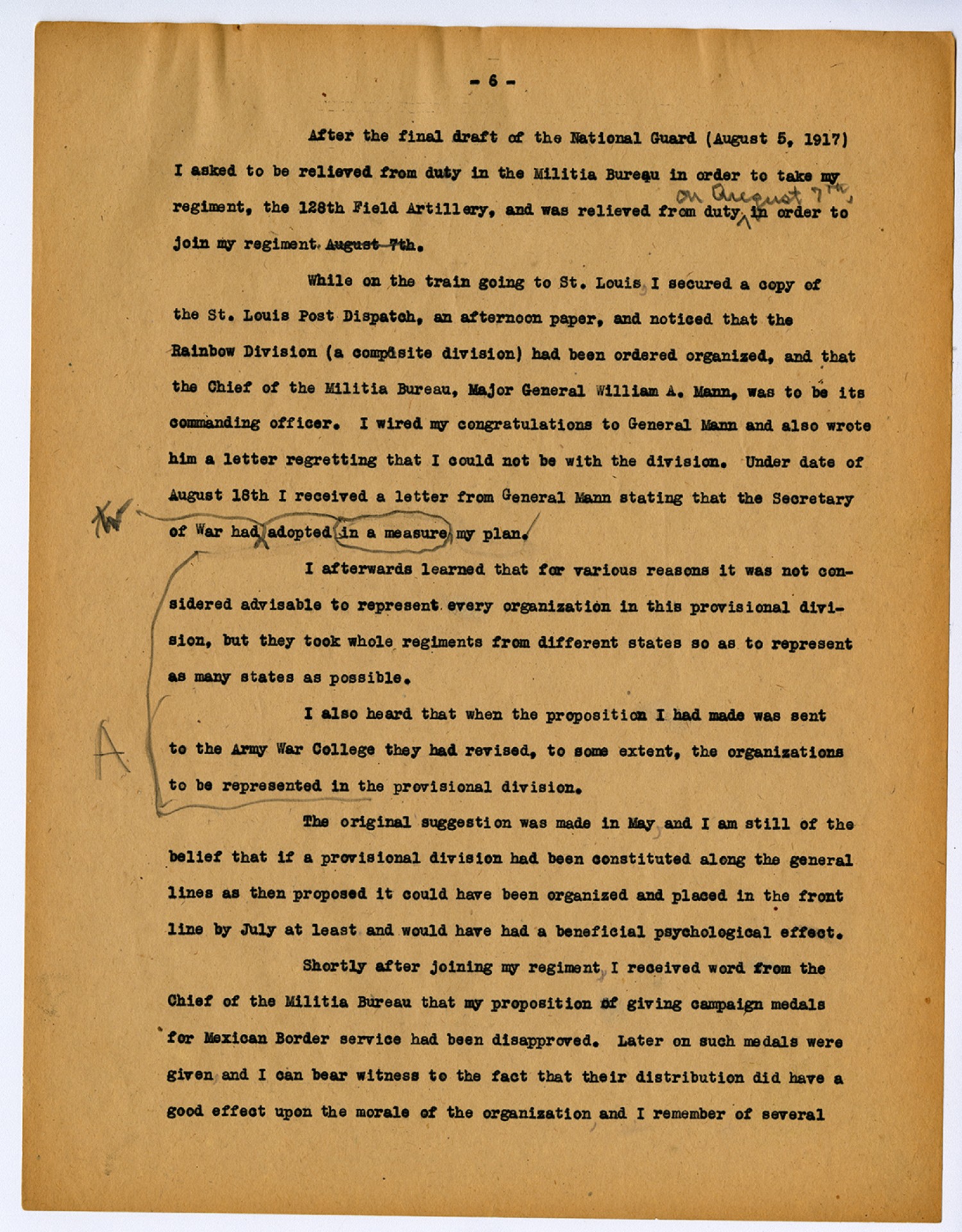
[page 6] After the final draft of the National Guard (August 5, 1917) I asked to be relieved from duty in the Militia Bureau in order to take my regiment, the 128th Field Artillery, and was relieved from duty on August 7th, in order to join my regiment. While on the train going to St. Louis, I secured a copy of the St. Louis Post Dispatch, and afternoon paper, and noticed that the Rainbow Division (a composite division) had been ordered organized, and that the Chief of the Militia Bureau, Major General William A. Mann, was to be its commanding officer. I wired my congratulations to General Mann and also wrote him a letter regretting that I could not be with the division. Under date of August 18th I received a letter from General Mann stating that the Secretary of War had in a measure adopted my plan. I afterwards learned that for various reasons it was not considered advisable to represent every organization in this provisional division, but they took whole regiments from different states so as to represent as many states as possible. I also heard that when the proposition I had made was sent to the Army War College they had revised, to some extent, the organizations to be represented in the provisional division. The original suggestion was made in May, and I am still of the belief that if a provisional division had been constituted along the general lines as then proposed it could have been organized and placed in the front line by July at least and would have had a beneficial psychological effect. Shortly after joining my regiment, I received word from the Chief of the Militia bureau that my proposition of giving campaign medals for Mexican Border service had been disapproved. later on such medals were given, and I can bear witness to the fact that their distribution did have a good effect upon the morale of the organization, and I remember of several

Transcript
[page 7] French officers mentioning the fact that I must have a good many veterans as he saw so many campaign ribbons among the men.
Transcript
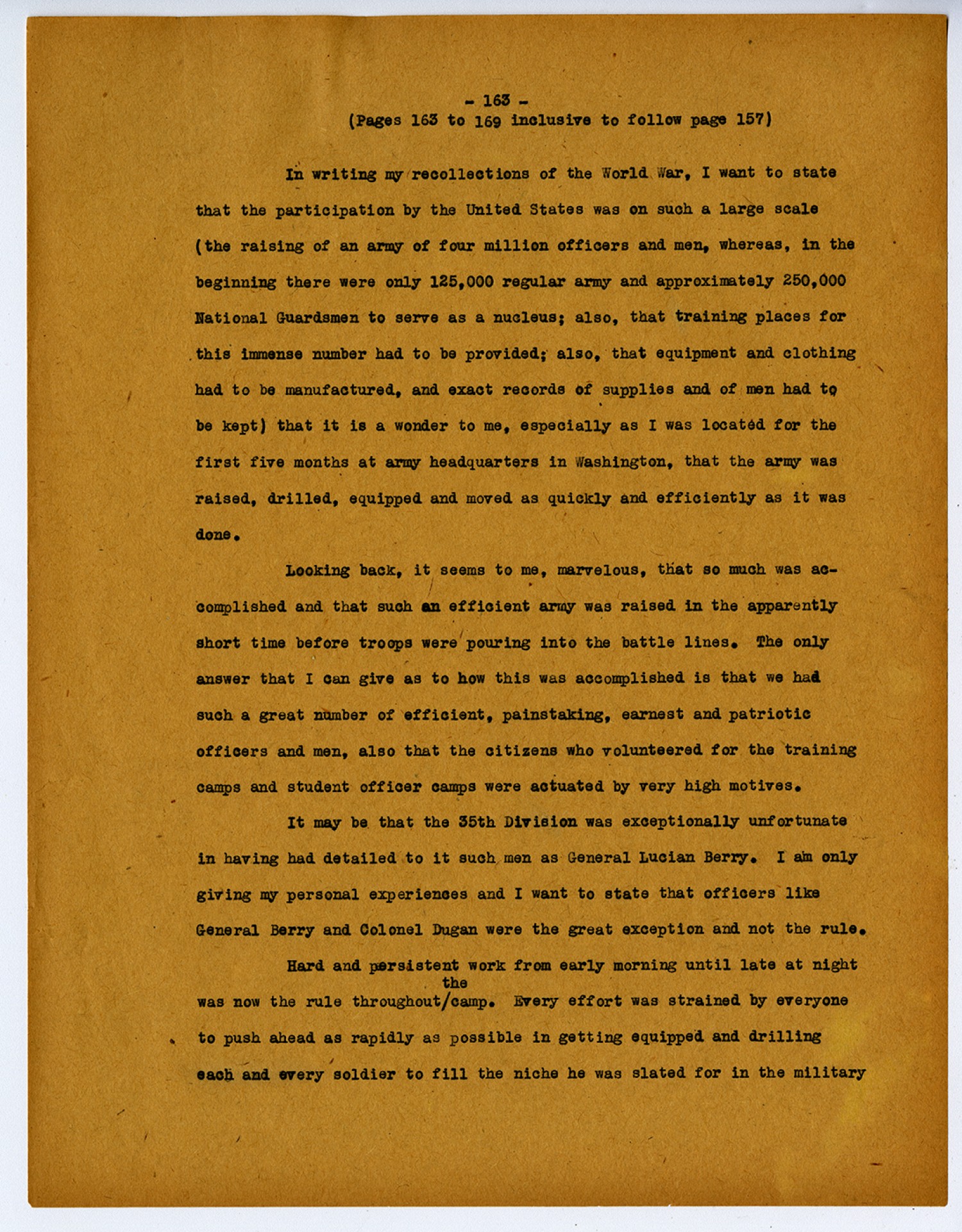
[page 163] (Pages 163 to 169 inclusive to follow page 157) In writing my recollections of the World War, I want to state that the participation by the United States was on such a large scale (the raising of an army of four million officers and men, whereas, in the beginning there were only 125,000 regular army and approximately 250,000 National Guardsmen to serve as a nucleus; also, that training places for this immense number had to be provided; also, that equipment and clothing had to be manufactured, and exact records of supplies and of men had to be kept) that it is a wonder to men, especially as I was located for the first five months at army headquarters in Washington, that the army was raised, drilled, equipped and moved as quickly and efficiently as it was done. Looking back, it seems to me, marvelous, that so much was accomplished and that such an efficient army was raised in the apparently short time before troops were pouring into the battle lines. The only answer that I can give as to how this was accomplished is that we had such a great number of efficient, painstaking, earnest and patriotic officers and men, also that the citizens who volunteered for the training camps and student officer camps were actuated by very high motives. It may be that the 35th Division was exceptionally unfortunate in having had detailed to it such men as General Lucian Berry. I am only giving my personal experiences and I wasn
Transcript
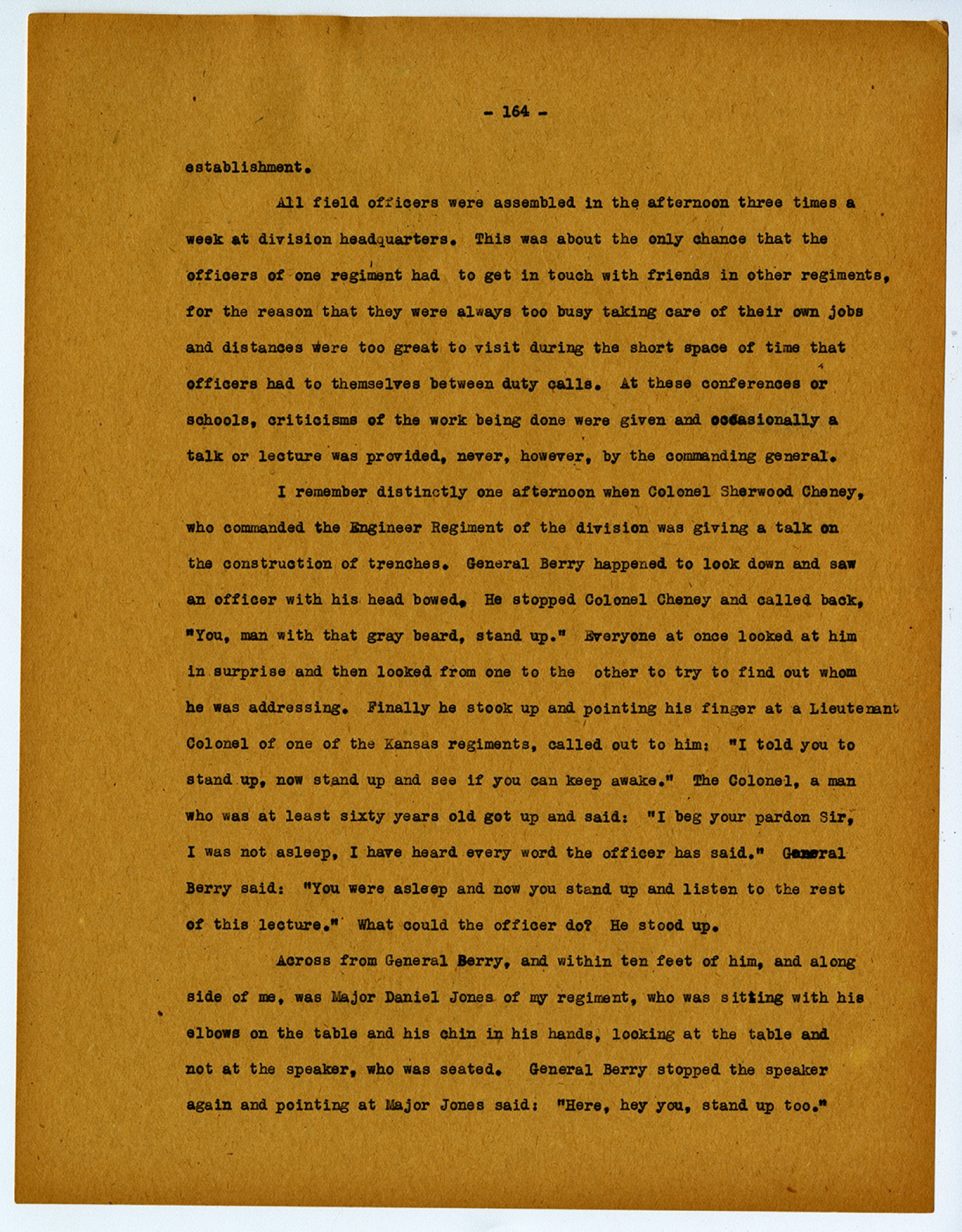
[page 164] establishment. All field officers were assembled in the afternoon three times a week at division headquarters. This was about the only chance that the officers of one regiment had to get in touch with friends in other regiments, for the reason that they were always too busy taking care of their own jobs and distances were too great to visit during the short space of time that officers had to themselves between duty calls. At these conferences or schools, criticisms of the work being done were given and occasionally a talk or lecture was provided, never, however, by the commanding general. I remember distinctly one afternoon when Colonel Sherwood Cheney, who commanded the Engineer Regiment of the division was giving a talk on the construction of trenches. General Berry happened to look down and saw an officer with his head bowed. He stopped Colonel Cheney and called back,
Transcript
[page 165] Shortly after this the talk was concluded and the officers were dismissed. Outside the officers gathered in little groups for a few minutes and you could hear them saying:
Transcript
[page 166] his counsel, that he always did son, unless there was some special reason why he should not. I knew that if an officer appeared before a board or a court and applied for the court to detail some officer as his counsel that the court or board would see that he was supplied with counsel. I considered it my duty to appear for my friend and I told him that he could file my name as counsel. Before the board met I was visited by Captain Dwight Davis, who was detailed in the office of the Adjutant General of the division and who after a little preliminary talk asked me whether I thought it wise to appear as counsel to defend an officer before an efficiency board when that officer had been cited to appear by my division commander. I recognized Captain Davis
Transcript
[page 167] Colonel Raupp, as he had relieved him from command before the first section of his regiment had detrained. he then brought forward a statement that Colonel Raupp had been in trouble while on the Mexican Border, at Lorado, Texas, and he read into the record an endorsement about Raupp that had been sent him by the commanding general at San Antonio who had formerly commanded the troops at Lorado, Texas. I called attention to the fact that Colonel Raupp, upon his discharge from the call to duty on the Mexican Border had had no black marks against him so far as the War Department was concerned, because they had called him in under the general draft law, knowing what his record was. I then stated that while I was an assistant to the Chief of the Militia bureau and when Missouri had been called upon for six regiments, they were entitled to two Brigadier Generals. At that time prior to the call of the draft, Colonel Raupp had been tentatively slated for the grade of Brigadier General, but on account of some difficulty at Lorado (in which he was trying to defend two of his officers) he was somewhat afraid of taking the position. he wrote me at the time and I very frankly went with the letter to General Mann who was Chief of the Militia bureau and who had been in command at Lorado, Texas, when the trouble had occurred, and explained the case to him, and asked him the direct question:
Transcript
[page 168] had taken stenographic notes of everything that had occurred in court and a complete copy was sent to General Enock Crowder [Enoch Crowder], Judge Advocate General, and to Champ Clark, Speaker of the House and to Senator William Stone, Chairman of Foreign Relations Affairs Committe in the Senate. Before going to Camp Doniphan and while the six regiments of Infantry were in camp at the state camp ground, Navada, [Nevada] Missouri, I visited that camp and found it in command of a Colonel of Cavalry whom I had known for a great many years. It so happened that while visiting him one afternoon, at first drink time, Ihappened to ask him how he rated the Colonels of Infantry and their regiments. He stated that he ranked Colonel Raupp, No. One, this is, the most efficient. As soon as the hearings before the board were over I prepared a set of questions, in the shape of a deposition, and forwarded them to this Colonel, who was at that time a Brigadier General in the west, and asked him to answer them, explaining that I wished to use them before an efficiency board. Time passed and word was received that the findings of the board were disapproved by the Judge Advocate General and Colonel Raupp ordered for duty, unless new evidence was to be presented. The board was ordered convened again. The evidence gone over and I put in this deposition. The board again found Colonel Raupp inefficient, the findings were disapproved, and he was ordered to report to the school at San Antonio (commonly called by the students
Transcript
[page 169] South and I learned later, did excellent work, and was finally placed in command of an Engineer regiment, was ordered to France but never got started due to an influenza attack, and the signing of the protocol.
Transcript
[page 170] Later on I heard a great deal about these efficiency boards and after my return to Washington, I had a talk with Colonel Cheney about the efficiency board above referred to. He told me that under the circumstances he had made up his mind to find every officer inefficient who was put before the board by the division commander, as he considered that an officer who was primarily considered inefficient by the division commander should not be in the division. There may be something to this thought but I do not think that it should be carried so far as to brand the man inefficient on account of a personal dislike. Intensive work was continued. The grumbling and talk of dissatisfaction with the division commander became more persistent and intense. Finally a proposition was made for all the officers of the division to tender their resignations in a body. It was thought that this would demand an investigation and would finally draw attention to where the trouble lay. However, it began to be rumored that General Wright was on his way back from France and would soon be back in command of the division. In the long run the proposition regarding the resignations was abandoned. In the meantime a psychological survey of the division was made. Every man and officer was examined as regards his mentality. The ranking physician in this matter was a Major who came from Chicago. He used to spend a part of each evening with me, telling me of his work and how it was progressing. Finally one evening he asked me whether I thought he had a right to report upon the mentality of the division commander. I asked him what his orders were. He replied that he was ordered to proceed to Camp Doniphan and report along his line of work upon all
Transcript
[page 171] officers and men of the division. I tolk him that under that order he surely had a right to report upon the division commander; however, I advised that he send a personal letter to the Surgeon General stating approximately what his report would be and asking for personal instructions. He said that he did not quite know how to draft the letter and asked me if I would draft one. I did so and he forwarded the letter to the Surgeon General in Washington. A little while later he came to see me. He did not show me the answer he had received but he said that he had received an answer and that he had been advised to
Transcript
[page 173] At the end of the month in the school at San Antonio, all the artillery officers, from that school, reported to the School of Fire at Ft. Sill. It so happened that the commanding general was a friend of mine and three of the instructors. Student officers were crowded into wooden barracks
Transcript
[page 174] my request to him. He replied that he had been placed in command of the regiment and had been told, by General Berry, to whip it into proper shape, and that most likely he would command the regiment in France as he, General Berry, thought that I would be eliminated. The week before the class was to graduate, there was considerable uneasiness because the members of the class had not received any official notification as to whether they were to graduate or not. It was the custom for the graduating class to receive notice a week before the time of graduation as to whether they had passed or not. The senior officer in our class was a Major of Coast Artillery, who had been promoted to Colonel and assigned to the field artillery. The day after our reports were considered in default, I happed to go to the headquarters of the school and met a Major De Russy Hoyle, Secretary of the school, whom I knew very well; I asked him why the report was being held up. He smiled and said:
Transcript
[page 175] he went to them and stated very frankly:
Transcript
[page 176] Infantryman for over twenty years, that he was thoroughly versed in that branch, that he had never had anything to do with artillery, that he was anxious to serve, that he had asked not to be assigned to artillery, in fact I stated his case as he had stated it to me. I then called on the commanding general of the school and asked him if he thought it possible for himself, had he spent twenty years in infantry and paid no attention to field artillery, to have gone though the artillery School of Fire in the time set and passed the examination. He answered:
Transcript
[page 177] until night in target practice. Upon reporting at my tent to take my regiment, the Colonel, who had been temporarily in command, seemed very much put out and said that he did not know whether he was required to return the regiment to me or not. As my order stated distinctly that I was to return to duty with my regiment I told him that I was going to take command and that he could settle his position with the brigade and temporary division commander, General Berry. Reluctantly, I think, General Berry decided that I was in command. This occurred one afternoon. The next morning I went out to join the regiment at target practice and went up to the first battery I came to. I was just starting to criticize a correction given by the officer, who was shooting, when General Berry came up behind me and said, so that all could hear:
Transcript
[page 178] further instruction in that matter. Soon the infantry had all moved and only the three regiments of artillery were left. It was remarkable with what smoothness the movement east was made. It was a great disappointment that the St. Louis regiment was routed through Kansas City without going through St. Louis and that the Kansas City regiment was routed through St. Louis without going through Kansas City. While I felt sorry for the men who had no chance to see their people at the station, I was very glad indeed that some one had the good sense to route the troops the way they did and thereby save us an immense amount of trouble. The discipline on the train was excellent. There was no boisterousness at any station, no one left behind and everything moved smoothly. Upon arriving in New York we went into one of the temporary camps and I succeeded in getting a house near by where I could have quarters for myself and wife. The time in this camp was used up in finishing vaccinations, going over personal equipment, completing descriptive rolls of late recruits, and correcting odds and ends of that kind. The last train to leave Ft. Sill contained my guns, 24 car loads, with my ordinance officer in charge. He reported to me in camp, two days after we arrived, and stated that upon his train getting in he had immediately gone to headquarters and asked if they knew what boat the guns were to go on. He was told that no arrangements had been made for a regiment of 4.7 to go on any vessel. This information got me in a panic. I immediately called up the office of the Chief of Field Artillery in Washington and in finally getting General Snow, explained the case to him. He advised me to come to Washington at once. I explained that my wife was there and that
Transcript
[page 179] as we would have to sail within a few days, I did not like to lose the time and asked if I could not send my adjutant, Captain Rumsey, in my place. He agreed to that but told me to be sure and get him off that night. This occurred about half past nine in the morning. I I immediately went to see General Berry and found Colonel Klem with him. General Berry held a telegram in his hand and looked a little blue. I explained the situation to him, told him what General Snow had said and told him that I was going to send Captain Rumsey at once. He said:
Transcript
[page 180] who was killed in Mexico just before the World War. It developed later on that Colonel Klem
Transcript
[page 181] Colonel Klem
Transcript
[page 182] the first call for troops, Klem had gone to the Colonel of the 3rd Infantry, in Kansas City, and asked if he could not be made a Major in the regiment. The above and following information I received at that time from the Colonel of the 3rd Missouri Infantry, from Kansas City. It seems that at this time there was a great deal of talk about the father and uncle of Klem
Transcript
[page 183] He said:
Transcript
[page 184] commanding officer of the port required that the senior officer, on duty with troops to embark, should report to the vessel twenty-four hours in advance of arrival of the troops; also that having reported, he could not thereafter leave the dock. As Klem at the time stood relieved, I was the senior officer of the two regiments so the next morning, and before Captain Rumsey reported back to New York, I had to report to the steamer. Of course, I had received a telegram from Captain Rumsey that our guns had been ordered shipped to France. The next day, the two regiments marched on the dock, Colonel Klem in command of his regiment and he superseded me in command of troops on board the vessel. From the upper works of the vessel we could see the surrounding buildings and could see the crowds in the buildings watching the troops march to the docks. Of course, the people in the streets could not help seeing the troops march through the streets to the docks. The streets in the neighborhood of the docks were packed with people and all the windows and roofs of the buildings across the street were packed with people. In spite of all of this, strict orders were issued, just before the vessels were to leave the docks, that not a soldier should be seen on the decks and everyone was confined indoors, as if this movement would keep anyone, sufficiently interested from knowing that the vessels were loaded with American troops. Of course I did not know upon what vessel we would leave and so I could not tell Mrs. Rumbold. Mrs. Kreismann, the mother of one of my men and wife of the former Mayor of St. Louis, and a great personal friend of Mrs. Rumbold, was in New York with her and in some way found out about the time the vessels would sail. They got on board a ferry boat, went to see the Captain, told him why there were there and he invited them on to his upper deck and had chairs placed for them just outside of his pilot house, and
Transcript
[page 185] said that while he did not know what vessel any special troops would be on, he knew the vessels that were going to take troops out and that he could tell from the activity of the tugs in the neighborhood about when they would leave. They rode back and forth on that ferry boat and as our vessel was pulling out the Captain slowed his boat up so as to pass near us. It just so happened that I opened the cabin door, looking out on the deck, as we were passing that ferry boat and saw my wife and Mrs. Kreismann on the upper deck of the vessel and later wrote her about it. She received this letter before I could receive a letter from her, so that she knew that she had definitely seen our vessel pull out. Three vessels pulled out at about the same time and we proceeded without regard to each other, to Halifax where we were joined by other vessels and where we finally left in a fleet containing seventeen vessels, convoyed by an English cruiser. While anchored for a day and a half in Halifax, we were just below that portion of the city that was devastated by the terrific explosion that had taken place some time before.
Transcript
[page 186] I do not know whether passengers were carried on other vessels or not but our vessel carried about fifty passengers, a few of whom were nurses going overseas for service, the others were women and children, and a few men, who were going back to England, from all parts of the world. We zig-zaged considerably, going so far north that we saw a few
Transcript
[page 187] merchant marine captains were able to hold their formation night and day. Day after day I would be on the bridge before the break of day and everyone up there would strain their eyes, with the rising of the mist, to see and identify vessels on either side of us, ahead and behind us. It was seldom that any vessel was much out of position. Boat drill was held every day when everyone was required to report to their station. Life preservers were worn by everyone from the time they got up until the time they went to bed. I happened to be on the bridge when we were expecting shortly to sight land. The first visible indication was the appearance of two torpedo boat destroyers who took station on either side of the convoy and began to patrol from the front to the rear. One the way over the English cruiser varied its position by zig-zagging from the right to the left of our column. Shortly after the appearance of the destroyers, and aeroplane came out and circled in front of us and proceeded back to the land. Within an hour after its appearance four more destroyers appeared and all of them were exceedingly active in scouting in front of the flotilla and on the sides of the column of vessels. We were in the Channel and all the officers and passengers were in the dining room at dinner tie when, without warning, the vessel began to tremble and a
Transcript
[page 188] submarine off the right of the column and had dropped some depth bombs, or
Transcript
[page 189] The regiment marched with full packs for about four miles through the city and out to a rather high hill where camp had been established under the command of an English General. Here we rested three days. We were given careful instructions as to what to do, in case of an aerial raid by the Germans, which was to proceed to certain dugouts. Here, for the first time, I came in contact with the English Army as such. I noticed a peculiar thing in the English salute. The English soldier in bringing his hand to the visor of his cap or to his forehead, as the case might be, always brought it up with a trembling motion of the hand just before reaching his forehead and threw his head back a little bit, protruding his chin. I also noted the fact that the English soldier was very punctilious in saluting the English Army Officer; but, he failed to salute the American Army Officer unless an English officer was within sight. I noticed this dozens of times afterwards, while in France. In connection with the above: Prior to our leaving Camp Doniphan we had been ordered to send ten officers and twenty-five non-commissioned officers to France in advance of the regiment, for the purpose of attending an artillery school. The officers and enlisted men, of the three regiments, of our brigade, happened to be placed under the command of Major Rutledge, of my regiment, as he was the senior officer detailed for this trip. When he later reported to the regiment he stated that when he landed at Brest and was told to take the detail to Camp Pontenaisone, at the edge of town, he marched the detail from the dock up to the town. He was then puzzled in what direction to proceed. He noticed an English non-commissioned officer on the sidewalk across the street. He called one of his Sergeants and told him to go over to the non-commissioned officer and ask him how he should proceed to get to the camp. The Sergeant crossed the street and went up to the non-
Transcript
[page 190] commissioned officer and, in the usual nonchalant way among soldiers, said:
Transcript
[page 191] To go at beginning of my service in the World War In relating my experiences in the World War, it must be distinctly understood that I am not trying to give any history of the preparation for or of the war itself. The whole thing was so vast that I doubt if any history, in the accepted definition of that term, can ever be written. Any criticism that I may make regarding army officers relates to my personal experience with that individual officer and not with officers of the regular army as a whole. From the beginning of my military service in the National Guard, and in all the numerous years during which I worked trying to increase the efficiency of my own organization, and trying to bring the national Guard, and the Regular Army, closer in touch with each other, it so happens that I never met a single officer of the regular army, to whom I appealed for assistance in my efforts that I did not find a ready and earnest response. Even when I was trying to do what was then considered, by many, as almost revolutionary, I found that after I had thoroughly explained what I was trying to do, I always secured the support of the officers whom I appealed to, and especially so, when they were in an official position to assist me. In looking back over my past life I find that I have had many friends. It is often stated that a man can count his actual friends on the fingers of one hand and always can on the fingers of two. In counting up those friends, who have been real friends, I find that I can use the digits of two hands for army officers alone, whom it has been my good fortune to become acquainted with. Inefficient men are found in all professions and walks of life. The average professional is always above the average amateur in ability. My high regard for the efficiency and earnestness in their work of Regular Army officers perhaps made it harder for me to have to deal with officers of the army, who
Transcript
[page 192] were placed in responsible positions over me, and who demonstrated, to my satisfaction at least, not only their inability but their unsuitableness for the position they were occupying. When I think over the immense task that army officers, as a class, had to face, the wonder is that so comparatively few did not measure up to the proper standard. I was taken to an old castle about a mile and a half from the town of Feneu, which was located about five miles from Aungier. The first battalion was located at Feneu; the second battalion was located about four miles distance at Montraeil and the third battalion at about four miles distance from Feneu, at. These towns were located at the three points of a triangle. A charming French widow was occupying the castle, Madame Rocquefeuil, whose father was an American who had gone to France just prior to the Franco-Prussian War and who was engaged in the manufacture of rifles, and who had married there. She spoke English very well. Miss Fagananie, and American woman from Boston, who was her cousin, was living with her. Miss Fagananie was an artist who had lived in Paris for years and who had left Paris when the Germans made their drive on that city and when the government treasury was moved from Paris to Aungier. Officers and men were billeted with French families. Incidentally, we were the first foreign troops these towns had seen. The day following our arrival there I spent the time at Feneu in looking over the field and arranging with the Mayor of the city for drill fields for the batteries located there.
Transcript
[page 193] Lieutenant Cheviard of the French artillery reported as Laison officer. He spoke excellent English. While his father was French, his mother was Irish, and he had been educated at Dublin. He had had a bullet wound through his wrist in the Chemin. When the French surgeon insisted that his hand would have to be amputated, he asked to be sent to the
Transcript
[page 194] especially to the old women, carrying in the buckets of water, chopping and bringing in the wood. Many of the soldier boys were from the country and small towns and in less than no time they had the kitchens filled up with chopped wood. It was hard, however, for our soldiers to get used to the fact that, in a great many cases, the stable or the lean-to for the cow adjoined the house and was entered through a door from the kitchen. For several days we could do nothing but hold foot drills and marching with full packs. We were waiting for the arrival of our guns and transportation for them. In a little over a week I received the disquieting news that we were to be armed with the French 75 mm. guns. The regiment had transferred all of its trained drivers to another regiment and had worked hard educating and training expert motor men. In a few days a complete equipment of guns was received at each station. The next morning Captain Lajoie of the French Army reported at my headquarters at Feneu, in a Ford machine, and stated that he would like to go to the other two battalion stations and make certain that the guns had arrived. The preceding day I had been supplied with a closed Dodge car. As I was expecting this, I had arranged in advance to have my chauffeur ready. This chaufferu, Duke Auerbach, was a step-son of Ernest Decker, a relative by marriage. Auerbach had been offered a position as Corporal and could easily have gone to Sergeant but stated that he preferred to remain as chauffeur with me. I persuaded Captain Lajoie to leave his machine, which he was driving himself, at Feneu and accompany me in my machine.
Transcript
[page 195] Upon arriving at Montraeil, our first stop, we came across a lot of men around four guns in a lot at the edge of town. As we came up to these men I noticed that all of them were in fatigue clothing. As soon as we stopped the machine the Captain of the battery, in fatigues, came up and reported and Captain Lajoie, who had jumped out of the machine, came back very excitedly repeating,
Transcript
[page 196] Training became intensified and we gradually began to accumulate horses, mainly of the Percheron type. At first I instituted a system of messengers, on foot, that started from the headquarters of the 2nd and 3rd battalions to Feneu; a messenger starting from Feneu at the same time toward these two other places. The messenger from Feneu would carry telegrams and orders to the battalion. The messenger from the battalion would carry reports, requests, etc. to regimental headquarters. These messengers would meet half way between the two towns and exchange packets and return to their home stations. As soon as we received wire and telephone equipment, for our telephone details, I started the men out to make telephonic connection, both for convenience and practice. Within two hours after these details started, I was besieged by city officials who said that I was not allowed to drive any nails in the trees along the roads. As we had no telephone poles the soldiers used insulators which they fastened on the trees with a nail and strung the wires thereon.
Transcript
[page 197] To be inserted on Page 192 When one takes into consideration the few officers of the regular army down to and including the grade of major, in comparison to the number of officers, of the same grade, in the whole American Army, during the World War, and, when one also remember the fact that so many officers were needed in technical positions, such as construction and inspection of ordinance and other war materials, it is remarkable that they accomplished das much as they did. While in the Militia Bureau, I often spoke of the necessity of getting rid of inefficient National Guard, and National Army officers, in some such manner as to arouse as little as possible opposition from the organizations and from the communities from which they came. For this reason I prepared and submitted the following to the Chief of the Militia Bureau.
Transcript
[page 198] as may seem to him proper and just, a list of those whom he considers, from observation, to be incompetent, with the reasons therefor. Prior to the visit of an inspector, this list should be submitted to him, so he will be acquainted with it at the time of making his inspection. During his inspection he can, easily, have the marked men indicated to him and can test their efficiency without exciting undue publicity. If convinced of the justness of the judgment, he can have a private interview with the officer and point out the fact that he is deficient, and that he (the inspector) believes that if he (the officer) is ordered before an Efficiency Board, he will be reported upon as inefficient, with the resulting publicity of an ordered dismissal. He can advise the officer in question to voluntarily tender his resignation, assigning any reasonable excuse for so doing. The great majority will do as advised, and they and their families will always, thereafter, combat any insinuation that there was anything of compulsion in the case, and not be so apt to attempt to exert political pressure. Every one has friends, and it is only too true that newspapers, as a whole, and
Transcript
[page 199] I did not know what to do and appealed to lieutenant Cheviard. He explained to me the process that I would have to go through with, if I followed out the suggestions of the French officers who came to me; this meant it would take a month or two months before I could get permission to string my telephone lines. I concluded to go ahead and had lines up functioning the next day. As we did not have horses enough to drill the battery mounted, we had a surplus of men to keep out of mischief. These were drilled with heavy packs and sent on long marches, in order to toughen them physically. It surprised the natives to see these men as soon as they returned to their billets and were dismissed to get out the baseballs and begin to play ball in the fields and roads. I made a few trips to Aungier to see our Brigade Commander, General Berry. I began to notice a peculiarity in his conduct toward me. When we were entirely by ourselves, he tried to make himself genial and companionable, but let any one else be around and he at once assumed a bullying attitude. At this time I was anxiously looking for an officer to fill the position of Adjutant. I learned that two St. Louis officers were on duty at the Artillery School at Somure. I got permission for my Lieutenant Colonel and myself to go down to this school. I wanted to see General P.D. Glassford, who was in command of the school and who had been instructor with the battery during some of their summer camps. Upon arriving at Somure, I found that General Glassford had been detailed away in command of a Brigade of Artillery, but I did run across Captain A.C. Orrick of Old Battery A, Spanish American War, and Captain a fellow member of the University Club of St. Louis. I asked the school Commandant whether he would approve of their [detail]
Transcript
[page 200] [detail] in case I sent an application through G.H.Q. for them for service with my regiment. He replied that he did not see how he could spare them, but would take the matter up whenever the application arrived. I received a letter from my niece, Miss Ellen Day, who was on duty at Isodune, an aviation field, not a great distance from Aungier. She and my wife, her aunt, had taken a course as nurses
Transcript
[page 201] Hard liquor was taboo for American soldiers
Transcript
[page 202] had, several times, been under the instruction of Captain and Colonel
Transcript
[page 203] he recognized the water cart on account of the repair work that had been done on it. He reported to me and I went with him, with a detail of men, to the battery, crawled under, saw our brand, went to the Captain of the battery showing him that it was our cart and took it away.
Transcript
[page 204] way you feel about it and want to talk sensible, I will sit down
Transcript
[page 205] will be ready at any time to take my case up with higher authority.
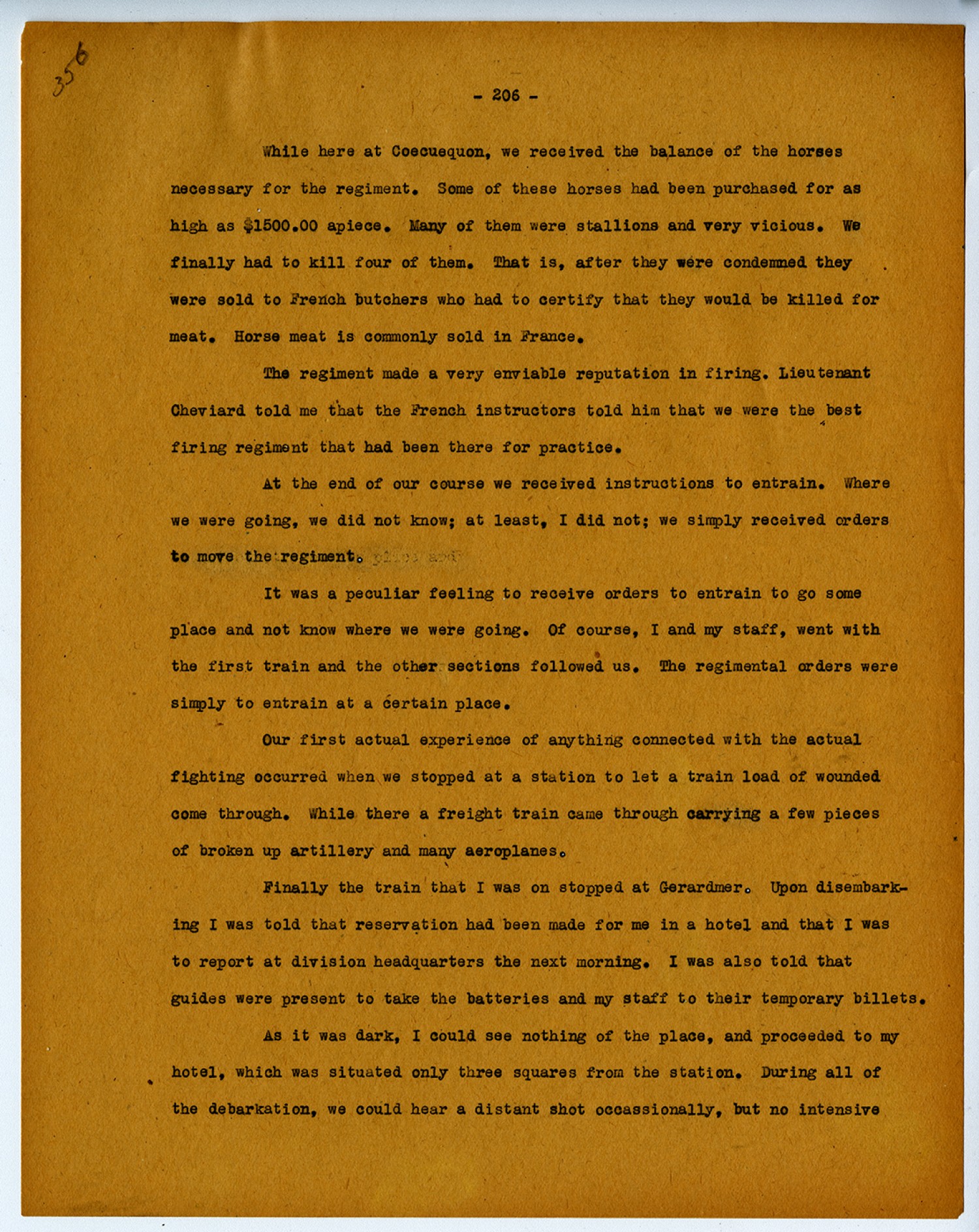
Transcript
[page 206] while here at Coecuequon [Cucuron], we received the balance of the horses necessary for the regiment. Some of these horses had been purchased for as high as $1500.00 apiece. Many of them were stallions and very vicious. We finally had to kill four of them. That is, after they were condemned they were sold to French butchers who had to certify that they would be killed for meat. Horse meat is commonly sold in France. The regiment made a very enviable reputation in firing. Lieutenant Cheviard told me that the French instructors told him that we were the best firing regiment that had been there for practice. At the end of our course we received instructions to entrain. Where we were going, we did not know; at least, I did not; we simply received orders to move the regiment. It was a peculiar feeling to receive orders to entrain to go some place and not know where we were going. Of course, I and my staff, went with the first train and the other sections followed us. The regimental orders were simply to entrain at a certain place. Our first actual experience of anything connected with the actual fighting occurred when we stopped at a station to let a train load of wounded come through. While there a freight train came through carrying a few pieces of broken up artillery and many aeroplanes. Finally the train that I was on stopped at Gerardmer. Upon disembarking I was told that reservation had been made for me in a hotel and that I was to report at division headquarters the next morning. I was also told that guides were present to take the batteries and my staff to their temporary billets. As it was dark, I could see nothing of the place, and proceeded to my hotel, which was situated only three squares from the station. During all of the debarkation, we could hear a distant shot occasionally, but no intensive
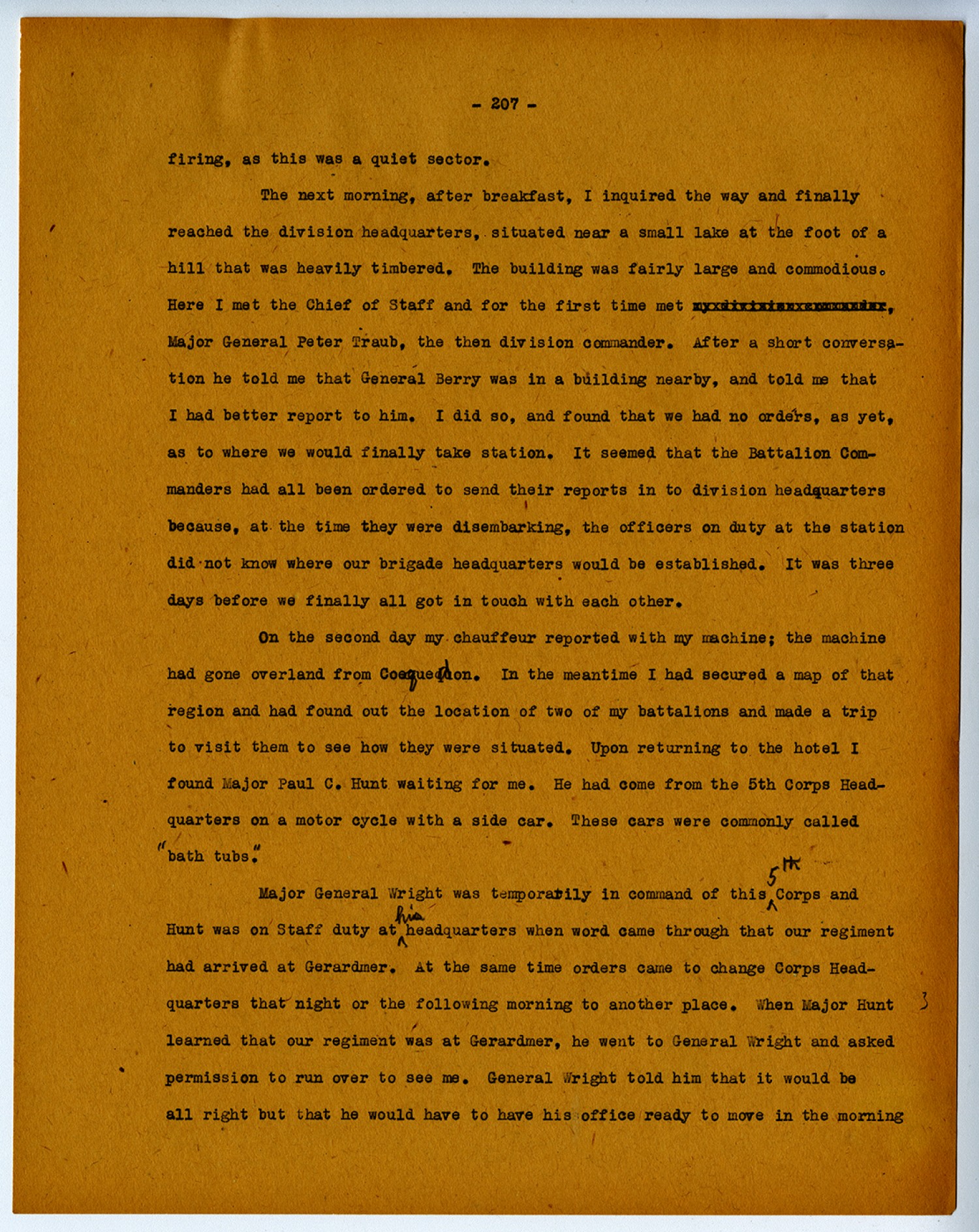
Transcript
[page 207] firing, as this was a quiet sector. The next morning, after breakfast, I inquired the way and finally reached the division headquarters, situated near a small lake at the foot o fa hill that was heavily timbered. The building was fairly large and commodious. Here I met the Chief of Staff and for the first time met, Major General Peter Traub, the then division commander. After a short conversation he told me that General Berry was in a building nearby, and told me that I had better report to him. I did so, and found that we had no orders, as yet, as to where we would finally take station. It seemed that the Battalion Commanders had all been ordered to send their reports in to division headquarters because, at the time they were disembarking, the officers on duty at the station did not know where our brigade headquarters would be established. It was three days before we finally all got in touch with each other. On the second day my chauffeur reported with my machine; the machine had gone overland from Coequedon [Cucuron]. In the meantime I had secured a map of that region and had found out the location of two of my battalions and made a trip to visit them to see how they were situated. Upon returning to the hotel I found Major Paul C. Hunt waiting for me. He had come from the 5th Corps Headquarters on a motor cycle with a side car. These cars were commonly called
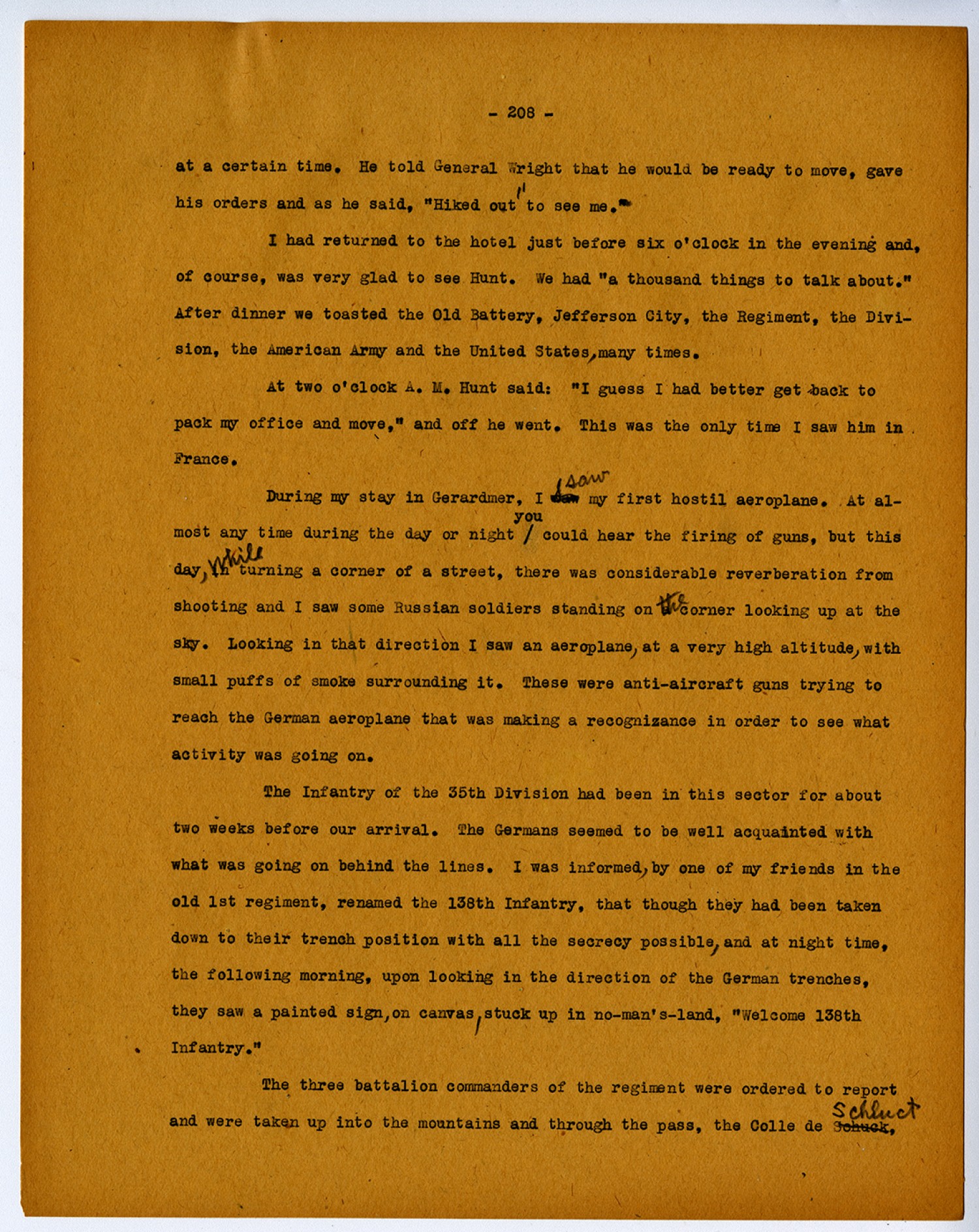
Transcript
[page 208] at a certain time. He told General Wright that he would be ready to move, gave his orders and as he said,
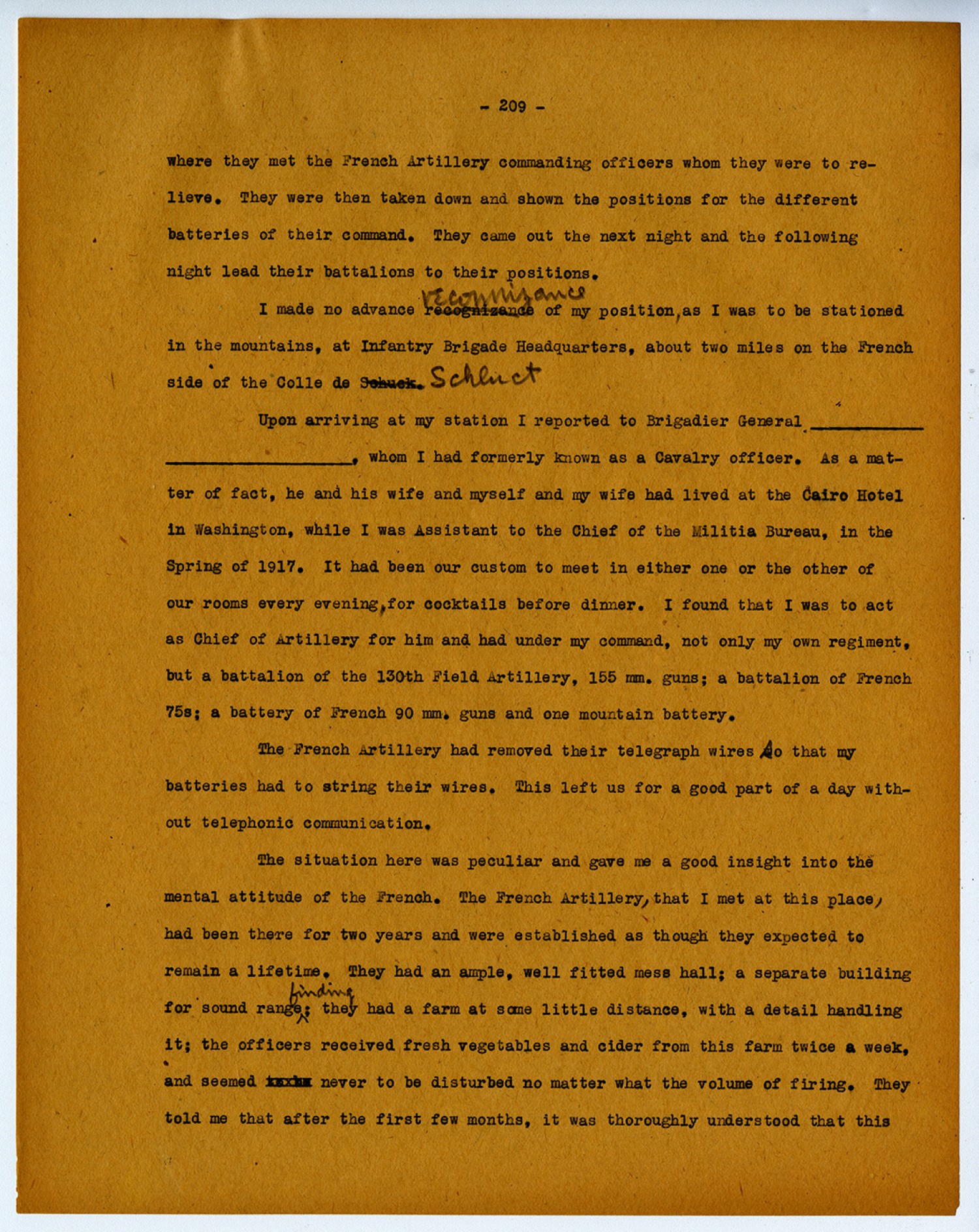
Transcript
[page 209] where they met the French Artillery commanding officers whom they were to relieve. They were then taken down and shown the positions for the different batteries of their command. They came out the next night and the following night lead their battalions to their positions. I made no advance reconnizance of my position, as I was to be stationed in the mountains, at Infantry Brigade Headquarters, about two miles on the French side of the Colle de Schluct. Upon arriving at my station I reported to Brigadier General, whom I had formerly known as a Cavalry officer. As a matter of fact, he and his wife and myself and my wife had lived at the Cairo Hotel in Washington, while I was Assistant to the Chief of the Militia Bureau, in the Spring of 1917. It had been our custom to meet in either one or the other of our rooms every evening for cocktails before dinner. I found that I was to act as Chief of Artillery for him and had under my command, not only my own regiment, but a battalion of the 130th Field Artillery, 155 mm guns; a battalion of French 75s; a battery of French 90 mm. guns and one mountain battery. The French Artillery had removed their telegraph wires so that my batteries had to string their wires. This left us for a good part of a day without telephonic communication. The situation here was peculiar and gave me a good insight into the mental attitude of the French. The French Artillery, that I met at this place, had been there for two years and were established as though they expected to remain a lifetime. They had an ample, well fitted mess hall; a separate building for sound range finding; they had a farm at some little distance, with a detail handling it; the officers received fresh vegetables and cider from this farm twice a week, and seemed never to be disturbed no matter what the volume of firing. They told me that after the first few months, it was thoroughly understood that this
Transcript
[page 210] was to be a quiet sector and that neither side wished to provoke the other into any extensive raids or hard fighting. This was evidently because each side wanted, as far as possible, to keep the good will of the inhabitants. However that might be, the little hotels or wayside houses of the past had all been deserted, and they had all been subject to artillery firing and were considerably knocked up. The military office buildings were on the side of the mountain and all connected with dugouts, that went into the mountain, for retreat in case the gun firing or aereal bombs began to come close to them. In going down to make an inspection, that is, to look over the location of one of my battalions and see how they were situated, I passed an aerial tramway. This had been put up by the French so as to get provisions down to the location of a battalion of artillery, which would save them about three miles of going on a road that would be subject to observation by field glasses from the enemy
Transcript
[page 211] was under a French Commanding General and that the French Artillery Officer who was with us represented this French Commanding General. Lieutenant Cheviard turned to me and said that the French officer wanted to know how we could possibly fire that gun, situated as it was. he also stated that the gun should be in a position where it could be loaded and fired immediately upon notification that its fire was needed. I turned to the Captain of the battery, who was an old regular army Sergeant, and had been on duty with Battery A as an instructor, and explained the question that had been asked me. He called four of his men, who were I the vicinity, they loosened some guy ropes and let the tree down. He then explained that he had to put the gun there to keep his proper interval so as not to mix up his firing data. They had sawed the tree nearly through, had put on heavy hinge and had arranged the guy ropes so that they could let the tree down and pull it back into position. As he explained,
Transcript
[page 212] all of these officers reported to the French Commanding Officer and also learned they they praised, very highly, the accuracy of firing and the rapidity with which the officers
Transcript
[page 213] strong and fearless warriers trained could be. Your men are unusually bright and with young people have you one old and experienced regiment trained. We have assurance, that with such soldiers will the Allies great victory attain. I will wish that soon artillery 128 regiment and this 51st to the Rhine next each other marching can. At next Spring, sure will be we together, on shore the large river be; in Fall will be we Berlin reach
Transcript
[page 214] in contact with enlisted men, that the possession of a campaign ribbon has a decided beneficial effect upon their military bearing. 2. As a rule the wearer of a ribbon is more alert, takes more pride in the proper performance of his duties, is looked up to and envied by those of his companions who are not the possessors of a ribbon. 3. It is apparent, as evidenced by published reports from France and as evidenced by the
Transcript
[page 215] While in Billet at Feneu While my regiment was stationed in this territory I had an opportunity to see how many of the German prisoners were used. On account of scarcity of men for farm labor, owing to nearly every available man being in the army, German prisoners, when willing to work, were used on French farms. It was a queer sight in leaving the chateau, where I was billeted, and going to Feneu in the early morning, to see German prisoners driving a small cart with an old French woman accompanying them going to the fields. These German prisoners were mostly young men and seemed perfectly contented. They seemed to work faithfully and I never heard of any one of them trying to escape. They got along on good terms with those for whom they worked and, I was told, that they would frequently send food, given them by the French, to their families in Germany, via Switzerland. These men were working on these farms without any guard whatsoever. Early one afternoon I was called to Infantry Brigade Headquarters and was told that that night I was to have two batteries shell two roads over which the Germans generally sent their relief forces and supplies. These roads had been watched, for a long time, and it was found out that the Germans were very methodical and at what specified times these roads would be used at night. Some little time before this the Germans had bombarded one of the French camouflaged roads that led down to the French front line trenches and this bombardment, from our side, was to be a reprisal to, as stated, teach them that, if they didn
Transcript
[page 216] then to order my two batteries into action. This bombardment was to be with gas shells. It should be understood that upon the explosion of a shell, soldiers who had been at the front, for any length of time, could always tell whether it was a gas shell or a high explosive. If a gas shell, they simply put on their gas masks and stayed in the open watching, to learn, if possible, the point from which the bombardment came. If this could be found out, a counter bombardment would be started at once. I asked the French officer, who brought the order, whether I could not use some high explosive shells interspersed among the gas shells. He said that they were very conservative in the use of high explosive shells, and that, under the order, I was not supposed to use anything but gas shells. I talked it over with Lieutenant Cheviard and told him that I intended to use a few high explosive with the gas. Promptly at two o
Transcript
[page 217] box barrage. This was to protect a small raiding party, which was sent into the German trenches, for the purpose of securing some prisoners to see if any changes had been made in the troops occupying that sector. A few days later I was ordered to have the battalion of heavy artillery, 155 mm. guns, shell the German headquarters. Later on, while on duty with the General Staff, of the War Department, in Washington, in 1921, I went to the War College to hear a lecture delivered. This lecture was illustrated with long distance moving pictures, and was given by Colonel, who had been the brigade commander ordering the bombardment. The pictures shown were of the bombardment by the battalion under my command. I was surprised at the accuracy of the firing and the damage done to the buildings occupied by the Germans. All the time the artillery was in this quiet sector our horses were on short rations of oats and had very little hay. At the end of two weeks, orders were received to proceed about eight miles from Gerardmer and entrain; for where, we did not know. Limbers and caissons were loaded to the limit with ammunition. When I finally saw some of my batteries on the march, for the first time since leaving Coecuequon [Cucuron] I remarked to Lieutenant Colonel Warner that if we had any hard marches ahead of us we would lose a great deal o four stock. No man was allowed to ride nor were they allowed to pub any packs on the caissons or limbers. After reaching the railhead we had to wait for two days for trains. I happened to be at the station when one empty train came in. In switching the cars around, in some way a freight car hit an obstruction on the track and was derailed and turned over. The French railroad officer became very much excited and explained to Lieutenant Cheviard, who always accompanied me, that it would take some time before anything could be done. This train was for part of the 3rd Battalion under command of Major Sanford, who happened to be
Transcript
[page 218] standing talking with us and heard the remark. He turned to Lieutenant Cheviard and told him to ask the officer to wait a minute. He then ran over to his battalion and ordered a number of the men over, big husky men. They dropped their packs, took hold of that car, ended it up and put it on the track, in no time. Upon making inquiry, I could get no information as to where the trains were going, but I received word to proceed, in my machine, to a certain place. Upon arriving there I was stopped by an American officer, Major Bennett Champ Clark, at present a Senator from the state of Missouri, who gave me orders to proceed to another station and await further orders. Upon arriving at that station I was told to wait for one of my trains to arrive, which it did in about four hours. When it detrained we then received orders to proceed to. The batteries traveled only at night taking cover during the day. I went ahead in my machine to, where I was assigned a billet. This was in a large mining town and where there was quite extensive steel and iron works. Here I first saw women miners coming from the coal mines. While at this billet I was put to bed, by the surgeon of my regiment, with a high fever and a bad cough. That afternoon I heard several aeroplanes passing over head with considerable firing going on. I rushed to the window and saw an aeroplane being followed by two others. The two planes were firing at the one in advance and the one in advance was twisting and turning and firing back, but mainly was trying to dodge. I learned later that this leading plane, a German one, landed in a field near one of my batteries that had stopped for the day under some trees along the road. As the plane landed in the field, the Captain of the battery, with some of his men, made a rush to the plane and got there just as the pilot and the man with him were getting out of the plane. One of the Germans had a
Transcript
[page 219] pistol in his hand. The Captain of my battery pulled his pistol, covered the German and told him to throw up his hands, which he did. The other German asked if he could get something out of the plane. The Captain told him, no! It then developed that the man with the pistol intended to shoot into the gasoline tank and set fire to the plane, and, when he was forced to throw up his hands, the other man intended to strike a match and set fire to the plane, if he could, while leaning in it. This plane was taken into town and exhibited. It was the first capture made by my regiment. Our regiment was finally concentrated here and stayed for three days. I do not know whether all other troops were moved, from place to place, as we were; however, I imagine, that in the majority of cases the same proceedure was followed. Orders were received for the regiment to leave and go in the direction of the San Miguel Sector. As it would take several days for this movement I remained in the town an extra day, because I could easily catch up with the regiment, in my machine, before the time for our arrival again in a concentration point. Again the movements were at night and the different battalions, or the regiment as a whole, were in camouflaged or obscure positions, in forests, during the daytime. Upon arriving near the place where the organization was to remain for the night, the commanding officer would receive orders just where he was to go into camp. These orders, as a rule, also stated when he would leave, what road he would take, and what his objective point would be for that night
Transcript
[page 220] Here for the first time, since arriving at Gerardmer, did I come in direct contact again with my brigade commander, General Berry, who informed me that our division was to be in support, and would take no part in the actual fighting in the reduction of this salient, except in some emergency. The next morning after our concentration the general action for the reduction of the San Miguel salient started. As a matter of fact, the preliminaries started with a heavy bombardment the greater part of the night while we were concentrating in the forest. By proceeding a short distance from my headquarters, in the forest, I could get a considerable view of part of the fighting through my field glasses. I could see some of the troops advancing and could see many of the bursts of the shell on contact with the ground in the distance. Before the battle had finished I was called to brigade headquarters and received orders to move my regiment in a northerly direction. I was especially cautioned that I was to use no headlights on my machine. After issuing the necessary orders I proceeded in advance along the road to the next stopping place. After going a little distance along the road, in pitch darkness, which reduced our speed considerably, imagine my surprise to see two machines approaching in my direction with bright headlights. I ordered the chauffeur to pull off to the right of the road so as to run no risk of a collision. The machines went by at the rate of about forty miles an hour. I later passed several other machines with bright headlights and learned that they were war correspondents or French officers, and also learned that the correspondents and many French officers paid no attention to this order that was so strictly enforced with the American army. Our strict obedience to the orders about not moving until after dark, hampered us considerably. Several times we were camped near French artillery that was moving in the same general direction as ourselves. Almost invariably
Transcript
[page 221] these French troops would leave the forest about four o
Transcript
[page 222] for concentration for the Argonne event. It is hard for anyone, who did not go through the World War, to begin to appreciate what it means to move and care for a large army. Let us stop to consider what would have to be done in case an order came to move the inhabitants of a city numbering 200,000 people, from its present position, a distance of one hundred and fifty miles, making the movements in marches of different portions of those people some fifteen, some twenty and some twenty-five miles a day. Say that this movement is determined upon the first of any month, the movement to begin within three days. Consider the necessary amount of food that must be carried by these people, the amount that must meet them at different places, the forage for the horses, gasoline for motors, clothing of all kinds, shoes, etc. Figure the new articles issued for wearing in a city of 200,000 inhabitants every day. Figure in addition that on a movement of troops of this kind there is also an additional wasetage, over and above the normal wear and tear. The different bodies of people, from this city, must be moved so that when they stop they can be near where they can get water and where their food and supply can be replenished, if necessary. There is not a day but what many shoes have got to be issued. These kinds of problems were handled in an amazing fashion, when you consider everything, all through the warfare in France. Two million American soldiers were practically on the move nearly all the time. The only shortage that I know of that occurred, in my regiment, was in forage for horses. During the march from the San Miguel Salient to the Argonne Forest, eighty-five horses died or were killed in harness by overwork and under feeding. No matter how tired and foot sore the soldiers were they were not allowed to ride on any of the chests, or even ease themselves by putting their packs on the chests. Caissons and Limbers were loaded to the limit with ammunition. As
Transcript
[page 223] horses died or dropped in harness, Corporals, Sergeants and officers were dismounted and their horses used in the place of the draft animals that had to be dropped by the way. At times caissons and guns were dropped behind on account of the weakness of their animals and were two, three or four hours late in getting into camp. On this march the regiment passed through Bar-le-duc. Here for the first time I saw whole squares that had been wiped clean by aereal bombardments. The regiment was to concentrate in a forest near a village a short distance from Bar-le-duc. It had been our longest and hardest march. While the regiment was due to camp in a forest, at the edge of town, just before daybreak, it was noon the following day, before the last stragglers arrived. As we arrived nearer the Argonne, the roads became more and more conjested and frequent halts had to be made for an hour or more at a time before the conjestion of the road could be relieved. As the regiment was not to move for forty-eight hours, I took occasion to run up to a couple of hills where I had seen some search lights, and there, for the first time, I saw a sound-ranging apparatus that was in use. Here a battery of flashlights were used, whenever the sound-ranging apparatus gave notice of approach of aeroplanes, until the hostil planes were located, then they were kept fully lighted while the anti-aircraft guns were brought into play. The last day of the march to the immediate vicinity of the Argonne we passed hospital corps troops busily engaged in erecting hospital tents in large numbers at different places. Finally I hurried ahead of the regiment and arrived in. Here I accidentally ran into General Berry. While talking with him, General Pershing came along and stopped his machine. He always had an extra empty machine follow him. He had a few minutes conversation with General Berry and
Transcript
[page 224] went on. I then went on to, to stay for the night. In this town the 5th Corps headquarters had been established. Upon inquiry I found that Colonel Malin Craig, the son of my old Colonel in the Philippines, was on duty here. I tried to find him but he had left his office. That night Lieutenant Cheviard and I stayed in a house with some French officers and my chauffeur slept in the machine in front of the house. The next morning I learned that our brigade was to concentrate near this town and I went over to the forest, in which there were several large ammunition dumps, and waited for them to arrive. On all these marches, a short distance in the rear of the battle lines, we were in sound of firing every minute of the night and day. At nighttime, one could always see signal lights or rockets in the air. The sky looked exactly like approaching a city on the night of the 4th of July. In nearly all of the forests there were ammunition dumps. These often looked like the sod houses, cyclone cellars, one used to see in Kansas. All through these forests were narrow gauge railroads with little cars, something like coal mine cars, for carrying the ammunition to the edge of the forests for loading into trucks or vehicles at night. On two nights I slept in or under my car, the other nights I was fortunate in getting into some building. The second day after arriving near the front, all commanding officers, that is, including regimental commanding officers, were called up for a talk by General Traub, the division commander. At this meeting he explained to us about a new gas that was to be used
Transcript
[page 225] Insert after first paragraph on page 223 On concentrations of this kind there would occasionally be four columns of troops on the road, two going and two coming. Infantry would be marching along the side of the road, in the ditch or through the fields. Artillery ammunition and supply trucks would have the road. At most cross roads, there was generally an officer directing traffic. As a rule trucks coming from the front were returned empty, unless they might be carrying ambulatory wounded. Of course, with such an enormous number of trucks, some were bound to get out of order while on the road, and when this occurred, on a level road, they were often pushed along in the column until a place could be reached where they could be dumped off to the side. In cases of this kind, truck and contents were dumped over, irrespective of what damage might be done to contents, for the reason that the loss or destruction of the material contained in one truck did not compensate for the halting of the column on its movement. Of course, all this kind of material was salvaged, if possible, at later dates. I was told, by my friend, Captain Samuel McPheeters, of St. Louis, that he salvaged a Packard machine that had been abandoned because it had run out of gasoline. The General that had used it had evidently gone on in some other machine, that he met one the road. My friend, Captain McPheeters, was able to keep the machine for nearly a month before someone discovered that he did not have rank enough for that kind of a machine, and it was taken away from him. General Traub, at this same meeting, said that he wished to issue some specific directions. The following is his language as near as I can recall:
Transcript
[page 226] to retire from the position they are then occupying, my order is that he shall be shot on the spot by the nearest officer to him.
Transcript
[page 227]
Transcript
[page 228] post so that he could make a quick survey and immediately started to the rear to get his machine, that he had left at approximately the same place I had left mine. Majors Jones and Sandford had about a mile to go, to the left, before they could reach their positions. It was apparent that they could not get to their positions, make a proper survey, so that their battalions could go in, in the dark, and return to their machines in time to get back to their commands before dark. I told them that I would return to my machine and would make a quick run up the road, which was on the left of where we were, and if they would reach the road and flag me, when they could see me coming at high speed, I would know where to stop, turn around in the road, after they got in and could make a quick get out. An occasional French machine was seen on this road, but not enough of them to draw German fire. It was a hard drag for me to get back over the three lines of hills to reach my machine, but I finally made it. Lieutenant Cheviard and I, with a chauffeur made the run up the road, going at about fifty miles an hour. We were flagged, my two Majors jumped in, and we made a quick get out. We may have been seen by the Germans, but no fire was directed at us, although a French officer stopped us and attempted to scold us. When I got back to the forest, everything was in activity, and the horses were being harnessed, getting ready for the night movement up to the front. Colonel Pim was off to one side talking with the Assistant Surgeon. I think he had been talking, also, to Lieutenant Colonel Warner of the regiment. He came to me and handed me a slip of paper, just as an ambulance pulled up, directing that I go to a field hospital in the rear. He stated:
Transcript
[page 229] you are replaced and lose your regiment. Colonel Turck, the Chief Surgeon of the division, ahs wanted you to go back for a week
Transcript
[page 230] and asked me what the trouble was. I told him that all I needed was a little rest and to pay no attention to me, that I didn
Transcript
[page 231] I passed an operating ward. The following is a rough description of the way things were handled at this field hospital. As the men were received their tags were looked at and they were sent to right or left, to different tents, according to the nature of their injury. That is, this was the procedure with ambulatory patients. Stretcher cases were taken in to a large receiving room where they were immediately prepared for operation. It looked almost like an endless belt. The wounded part was exposed, the patient made ready for operation, the anesthetic given and the patient moved up, when anesthetized, to the operating surgeon who operated at once and passed him on to others, who would do the dressing, and, then others took him to the proper ward. Of course, it was not all accomplished as simply as I have expressed it, but in effect it was. The work done by the medical corps was simply marvelous. At this hospital I met two of the nurses who had been on the transport with us on the way over. I never saw them again. Upon getting out to the road, I saw an ambulance coming up, returning to the front, hailed it, had an orderly throw in my bed roll and I climbed up with the driver and proceeded to the front.
Transcript
[page 232] We had gone about five miles when the ambulance stopped at a field hospital, where it was to be loaded with wounded and return to the hospital that I had just left. I got off, took my bed roll and waited until an ambulance unloaded that had come from Newillie, and finally got to a field hospital at the edge of that town. Here I ran into two medical officers, whom I knew very well; one from St. Louis and one from St. Joseph, Missouri. While here I witnessed the burial of two soldiers who had just died from the effects of their wounds. There was a constant stream of ambulances coming and going. I asked the surgeon in charge to let me go forward on an ambulance that was going as far front as possible. He had an orderly go along the line of ambulances to find out where they had come from and he finally came to one that had come from Cheppy. The ambulance driver said that that was the farthest front that any had come from. I had my bed roll put in the ambulance and I climbed up with the driver. In passing through Newillie we were caught in a traffic jam. Ammunition and supply trucks going to the front, trucks loaded with engineering material and empty ambulances, empty ammunition trucks and loaded ambulances coming from the front, one constant stream going each way. Between these two lines of moving vehicles was a line of soldiers, mostly wounded, marching to the rear and squads of soldiers going to the front under officers or non-commissioned officers. The ambulance would move forward from a quarter to a half a mile and then would have to halt five or ten minutes, before moving ahead again. Finally we got up to where there had been a big blow-out in the road and which the engineers were trying to repair. A detour had been made around this blowout and across a small stream. Labor troops under supervision of engineer
Transcript
[page 233] officers, were working night and day at this place. A certain number of vehicles would be let through returning to the rear fro the front, then traffic would stop until they had cleared the ford and the one way road leading up to the main road, and a certain number of vehicles would then be allowed to go in the opposite direction. While waiting on the road, to detour around this blow-out, I witnessed a captive balloon shot down. It was far to the front but still within good observation distance. It was attacked by a German aeroplane, which was followed by an American plane, which was trying to divert it from getting to the captive balloon. The observer in the captive balloon did not wait for his balloon to be destroyed, but
Transcript
[page 234] of Sergeant in the army. I made inquiry and was told that there would be no chance of him going to France while holding his commission in the Filipino Scouts. After consulting with Major William H. Clopton, who had been transferred from the office of the Chief Quartermaster into an office with Colonel Bjorstead, which office had charge of, or something to do with the commissioning of officers in the National Army, I advised him to resign his commission and apply for a National Army commission in the signal corps. Pagelow had informed me that he was very much interested in ballooning. He resigned him commission, made application for commission in the National Army in the Balloon Corps, was accepted and sent to a balloon school at Omaha. As he came near my ambulance I called out to him. He stopped his motor-cycle, looked at me for a moment and his whole face illuminated in a smile. He got off his motor-cycle, wrung my hand and said:
Transcript
[page 235] that I should have taken the rest that Colonel Pim had ordered. Just then, an orderly came in with word that General Traub wished to see him. He told me to remain there, with his adjutant, until he returned. While he was gone, the adjutant gave me a general resume of what had taken place since the fighting began. Upon Colonel Turck
Transcript
[page 236] wounded.
Transcript
[page 238] the sky and apparently tried to trace the direction of a shell that was whizzing overhead. He said:
Transcript
[page 239] The way to the rear, in the ambulance, was very slow indeed. Finally we reached Newillie, and the ambulance stopped in front of what was left of the Church. Part of the roof of the Church had been demolished, but about one-third still remained under cover. This was filled with litters containing wounded men. In an aisle, between these litters, was streaming a line of ambulatory wounded. Non-commissioned officers, of the medical corps, would look at the tags on these wounded and direct them to one place or another, where they were to be congregated until transportation was available. Again I met an officer whom I knew very well, and told him that I was saiting around until they had a seat with the driver available. While walking around I noticed a young German lying on a stretcher, very quiet, with his hands folded over his chest; the rest of his body was covered with a blanket. His eyes were constantly watching the men who were passing. As I cam along I happened to take out and light a cigarette, and I noticed that his eyes seemed to light up. I passed his litter, and then went back and offered him a cigarette. At first he shook his head, and then, I smiled at him and spoke to him in German. I said:
Transcript
[page 240] wounded cases. Here I met about twenty officers, all of whom were waiting for transportation farther to the rear. I learned that most of them were being sent to the rear for a rest; they were simply worn out. I stayed there all night. The next morning I asked the officer in charge how long he thought it would be before I would be moved. He said it would not be for at least another day. He then told me that he was sending an ambulance to the railhead to get some supplies for the mess and wanted to know whether I wanted to ride down with it to see the activity at the railhead. Of course, I was glad of the chance. I arrived at the railhead about an hour and a half later, seated on the seat with the driver. This was a scene of intense activity. In one place I saw a stack of litters, folded up, about twenty feet wide, a hundred feet long and ten feet high. Here were piles of thousands of bags of prunes and other supplies in proportion. While the ambulance driver was going to different places to secure his supply, I watched German prisoners, with some American soldiers, unloading and stacking the supplies. Some of the bags, containing prunes or dried fruit, would have rents or tears in them, from which some of the contents would spill out. In picking up these sacks, it was comical to see the German prisoners trying to put some of the prunes or dried fruit in their mouths or pockets without being detected. In one case a soldier, standing guard, laughed when he saw the German trying to secrete some prunes in his pocket, and he called out to the German:
Transcript
[page 241] [straggling] along, ordinarily four abreast. German officers were marching along the side of the column, but not in the column. I should state that while at this railhead, I was fortunate enough to be able to secure about ten cartons of the cigarettes that I smoked. It seemed that there was a long train at the station being loaded with these German prisoners, for transfer farther to the rear. In the column of prisoners, I noticed some very young boys, some more or less stoop-shouldered and many wearing glasses. The column halted, and just in front of me, was a young German officer. He looked at me very wistfully, and I said to him, in German:
Transcript
[page 242] Incidentally, the driver of this ambulance was a German, who had gone to the United States when he was a boy about five years old. He spoke perfect German and many times, while we were stopped, he would talk with soldiers in the column of prisoners. While I could not understand everything that was said, I did get the general drift, and in each case the German prisoners said that they thought the war would soon be over, and they felt that Germany was bound to lose. From what they said, I felt certain that the German morale was gone. We returned to the little hospital about noon. That afternoon, as I walked from the office through a hall, to what was formerly the parlor or reception room of the house, I was hailed by Major Sidney Schwab, of St. Louis. I was very much surprised, as I did not know that Dr. Schwab had accepted a commission. As I went up to him, to shake hands, he asked me what was the matter with my left leg. I answered:
Transcript
[page 243] charge. Upon arrival there, I was sent, by his adjutant, to a room in the Chateau, that Major Schwab occupied. In two days Major Schwab returned and took personal charge of my case. He kept me there for a month before he would let me go. In the meantime my leg was treated with massage and electricity. The pressure of the trench boot was relieved by cutting out the top of the boot. While here, a bunch of American citizens visited and went through the hospital. Among them, I learned, was one of the officials of the Agriculture Department. I was introduced to him and when he heard my name, he asked me if I was any relation of Dr. Caroline Rumbold. I told him that she was my sister and he then told me that she was under him in the Agriculture Department and at that time was engaged in an investigation of diseases of sugar cane. This was in order to help increase the sugar product of Cuba. At this hospital, the majority of cases were the result of shellshock. A recreation hall, in the yard in which the Chateau was, was used as an assembly room for officers who were mildly shellshocked. Here there was a woman expert who worked with the men, mainly by conversation, in correcting their speech and in teaching them to overcome stammering and stuttering. At the main hospital, about a mile away, were several long tents that had been turned into shops, in which young men and women were engaged in educating shellshocked soldiers in work of all kinds, from needle work and weaving to making brass ornaments, out of empty shells. It was remarkable to see the time and thought that had already been given by someone connected with army headquarters in Washington, and in France, toward the beginning of rehabilitating this class of injured soldiers. Someone in the War Department, in Washington, had had this subject brought to their attention, had hunted up the people who knew about the requirements, had assembled the necessary personnel, had sent them abroad, and someone at
Transcript
[page 244] G.H.Q., in France, had been assigned to this work to provide place and means for beginning the rehabilitation of this class of injured men at the earliest opportunity. What I saw of this work, is but a mere fraction of what went on, in France, along this line. When one stops to consider it, they will begin to appreciate what the personnel of the War Department is called upon to handle in such great emergencies as a large war. The results attained, simply go to show the expansive ability and resourcefulness of the officer personnel of the American Regular Army.
Transcript
[page 245] I soon got into a regular routine at this hospital. After breakfast I would have massage treatments of the muscles of my left leg for about half an hour. Then an electrical treatment for varying lengths of time. With one or two of the officers, domiciled at the chateau, we would walk to the general hospital where we could get the morning papers and return to a reading room at the chateau. The afternoon would be given to playing bridge or walking short distances in the surrounding country. Toward evening, just before time for dinner, we would go down to the general hospital again in order to get the evening papers. We would then return to the chateau for dinner. After dinner we would go to our rooms and light lanterns. Some of the officers had to use candles as lanterns were not available. Here I would read the news of the fighting of the previous day and mark on my map the territory taken by the English, French or American troops. I should state that this was during the latter part of October. Every day showed territory occupied by the Germans was being recovered by the Allies. From the number of prisoners being captured and from the fact that the German counterattacks were never successful, it became seemingly apparent that the conflict was nearing its end. I should state that at the end of my first week at this place, I learned that some wounded of my regiment were located at Neu Chateau. One of the surgeons had to go to Neu Chateau, and very kindly took me with him. While there I was able to see Major Rumsey and two other officers who had been sent to the rear for recovery from the effects of gas. Another time one of the medical officers took me to a nearby town where they had discovered a Roman Mosaic floor, evidently the flooring of a reception or guest room of a Roman house. This was in excellent condition and
Transcript
[page 246] perfect. It was about eighteen by twenty-four feet and consisted of cut stones no piece larger than a half inch by a half inch. The Mosaic was inclosed and covered, with a gallery around it, so that no one was allowed on the floor. It was used as a museum place and an entrance fee was charged. Finally I was taken before a board and was then given my discharge and was ordered to report at Bloise. This took me through Paris, where I stayed over night. I took French leave for a day and night and called on Miss Faganani, the American cousin of the Marquesse DeRoquefeiul, at whose chateau I had been billeted near Feneu. Upon leaving Paris, I went direct to Bloise and there reported at a garrison post formerly occupied by the French, and where they had concentrated a great many American officers, who were awaiting transfer to organizations at the front, after having been returned to duty from hospitals. It was the rule that when an officer had been ten days away from his command, his place would be filled and he would then have to go into the reserve group of officers, until some vacancy occurred for an officer of his rank. It also seemed to be the rule that officers of field rank, that is, the grade of Major and higher grades, were sent to Bloise for classification. While they were in hospitals, or rest stations, they would be reported upon as to whether they were to be eliminated, reduced in rank, or returned to duty in their rank. This information preceded them to Bloise and when they reported, the local officils knew where to send them. I remained here for three days and two nights and had a good chance to go through the old castle and learn its history. On the third day, I received orders to proceed to Tours. I arrived at Tours the morning of the tenth of November. After registering at a hotel, facing a large park, I started out
Transcript
[page 247] to find the local American headquarters. As I was leaving the hotel I was very much surprised to run into a friend, an army officer, who was a Brigadier General. I was naturally curious and without stopping to think, asked him why he was there, as the last I had seen of him, he was in command of a brigade of troops. He told me that he had been ordered there to receive orders. We proceeded together to the local army headquarters and upon entering the building, found that we went in different directions. When I met the officer I was to report to, I received orders from him to proceed to Locorno, which was a short distance beyond Bordeau. It was about a half an hour before I left the building. Just as I arrived at the hotel, I met the General coming out of the hotel, and, looking at his overcoat sleeve, I saw that the silver star, denoting his grade, was not on the sleeve. Without stopping to think, I said:
Transcript
[page 248] had put in for the purpose of hastening the unloading and turning about of vessels carrying American supplies. Upon arriving at the nearest railroad destination to the artillery replacement camp, I met a former member of my old battery, in the person of Lieutenant Sampson. He was on duty there as a member of the military police. In some way he secured the use of an automobile to take me out to the artillery camp, a distance of about three miles. Upon arrival there, I found the camp in charge of a Colonel of artillery whom I had become well acquainted with when he was a Captain of artillery, of the Wisconsin National Guard. This camp contained about 15,000 American soldiers, all artillery men, who had come from various hospitals and were awaiting transfer to wherever their services were needed. I found about twenty men of my regiment there, and as most of them were short of funds, I was able to stake them
Transcript
[page 249] Just why I was suspicious, I do not know, but before I got to him, I said:
Transcript
[page 250] He finally smiled, and said:
Transcript
[page 251] medical officers who were casuals, and who had been ordered there for transportation home at the earliest opportunity. I laughed and told him that I was a medical man and ranker than any of them there. He finally told me that he would get me out at the earliest opportunity; which he did in two days, ordering me to Brest, for transportation to the United States. With this order in my pocket, I proceeded to Brest, registered at the hotel and went to local army headquarters. Here I ran into General, whom I had first met as a 1st Lieutenant of Coast Artillery in the Philippines, at Balanga in 1901, when he came there with a company of artillery to relieve the battalion of Infantry of our regiment, the 32nd U.S. Volunteers, stationed at that post. He remembered me, and we talked about the time. At the time of that relief in the Philippines, I was adjutant of the regiment and had taken him, and one other officer, to our little officers
Transcript
[page 252] I embarked on a vessel that carried a regiment of Infantry, under command of a Lieutenant Colonel, and about fifty casual officers. I was the senior officer on board and the Lieutenant Colonel, commanding the regiment, wanted me to take command. I explained to him that I could not take command of the vessel because he was in command of the troops, and that all the other officers on board the vessel, no belonging to his regiment, were casuals. This vessel was making its first trip. It had just come from the English dock yards and was not entirely finished. The cabins were all temporary structures. We arrived without incident in New York. After the vessel docked, all casual officers were ordered to report at local army headquarters, where each was asked a direct question, as to whether he desired to remain in the service, or desired immediate separation from service. The answer to this and other questions were all recorded, and he was required to sign the sheet. I remember one question in particular, because it was stressed in black type, capital letters. It was to the effect that I acknowledged having received a certain specific order from Washington, which was to the effect that the overseas cap was not a part of the uniform of the army of the United States, in the United States. After signing this blank, I received another order, ordering me to a camp near Baltimore, Camp Meade, for discharge. This order was to the effect that I should proceed at once, which meant that night. I went to the Commanding General
Transcript
[page 253] Army headquarters was surrounded by a fence and the gates guarded by soldiers. Just before getting to the gate, I met my wife, who was waiting in a rest room for me. I had sent a wireless to her, as soon as I was able, and gave her the name of our vessel and the approximate date of our arrival in New York. She went to New York, got in touch with army headquarters, and was advised when the boat would arrive, and so was able to meet me. The next day we left for Baltimore, arriving there Saturday evening. After getting a room at the hotel, I called up the residence of General William J. Snow, Chief of Field Artillery, in Washington. I told him that I was back, was in Baltimore and would go out to camp the next day to take my discharge. He told me that the camp where I was ordered to go, was in charge of General Jesse McI. Carter, who, as a Colonel of Cavalry, had been an officer in the office of the Chief of the Militia Bureau with me, prior to my taking command of my regiment. General Snow asked me to come to Washington for Sunday, as he wanted to have a talk with me. He said there would be no use in reporting at the camp until Monday morning. Sunday morning I went to Washington, took my wife to see my sister, Caroline, left her there and proceeded to General Snow
Transcript
[page 254] see the Chief of the Militia Bureau, General Heavey, whom I had been associated with at Lorado, Texas, during the border trouble. When I reported to General Heavey, he handed me a letter and asked me to take it to the Adjutant General
Transcript
[page 255] Upon returning, in about eight days, I found General Jesse McI. Carter in command of the Bureau. He had been relieved of command of the post near Baltimore, Maryland in the meantime. In a short time Colonel Dana Merrill reported for duty. He had formerly been in the Militia Bureau, at the same time that I was. While on duty, in the Militia Bureau, I tried to visualize the turmoil that would take place among the large number of soldiers, who would be discharged from the army, in their attempt to get back to civil life. Many of them would be very restless. Many would be unable to again secure their former positions, owing to the fact that those positions had been filled, and that firms did not like to discharge one man in order to hire another. While I knew that there would be a bonus paid to the soldiers, upon being discharged, I felt certain that many of them would spend this money foolishly,. I wrote a letter to Colonel Warner, formerly Lieutenant Colonel of the regiment, and who had been promoted Colonel, just prior to the organization leaving France, and suggested that the members of the organization form a mutual aid association. I suggested that each officer and man donate, to common fund, a certain amount of money, to be determined upon after a consultation of delegates from each battery; that five directors be selected by the officers and members of the regiment, so that there would not be more than two officers at the beginning, on the Board of Directors; that the primary board of directors was to act as trustees of the funds collected; that the money be invested, after consultation with a set of bankers, so that the fund would draw interest. That at the end of six months, after the discharge of the regiment from service, any member, participating in the creation of the fund, would be able to borrow money, in an amount to be determined on, from the fund at not
Transcript
[page 256] more than 5% interest, providing he could demonstrate, to the satisfaction of the directors, the feasibility or necessity for his use of the amount he desired to borrow, and provided the loan was properly secured. It was also provided that the interest derived from the investment of the fund could be used for the relief of any member of the regiment deserving assistance; this was to be an outright assistance and not a loan. I have forgotten all the details but I was attempting to hold the interest of the men in each other; trying to conserve some of the money that would be paid them on their discharge, and also trying to shape things so that there would be funds available for the relief of any needed members in the future. Some members of the war college heard of this plan and an official came to me, in the Militia Bureau, and asked for a copy of my plan. After studying it carefully, he said that some such plan would be of great benefit in helping to stabilize the men, if every regiment, upon being discharged, would put such a plan into effect. Upon the return of the regiment from France, I secured leave and went to St. Louis, where I met them upon their detraining for a parade through the city, before they proceeded to Ft. Riley for muster out. The 128th Field Artillery was the first regiment from Missouri to return home from the war. The march from the station through the down town district, was the greatest ovation ever given to any body of men in the city. My special duty was to assist in the preparation of regulations for the National Guard of the United States. I continued with this duty, until it was finished, and was finally discharged, at my own request, June 30, 1919.
Details
| Title | Frank M. Rumbold Memoir - 1917-1919 |
| Creator | Rumbold, Frank M. |
| Source | Rumbold, Frank M. Memoir. 1917-1919. Rumbold, Frank M., General Collection. A1331. Missouri History Museum, St. Louis, Missouri. |
| Description | Memoir of Frank M. Rumbold who served as Colonel of the 128th Field Artillery during World War I. He later served as Adjutant General of Missouri from 1925 to 1927. Rumbold details his experiences in the Missouri National Guard on the Mexican Border, the outbreak of the war, and his service overseas with the 128th Field Artillery. Rumbold helped fuse the roles of the National Guard and the Regular Army during World War I. |
| Subject LCSH | United States. War Department; Missouri. National Guard; Pershing, John J. (John Joseph), 1860-1948; Berry, Lucien Grant, 1863-1937; United States. Army. Field Artillery Battalion, 128th; Soldiers--Billeting; Trench foot; World War, 1914-1918--Prisoners; |
| Subject Local | WWI; World War I; Mexican Border War; Campaigns/Battles - Common names [Meuse-Argonne Offensive] |
| Site Accession Number | A1331 |
| Contributing Institution | Missouri History Museum |
| Copy Request | Transmission or reproduction of items on these pages beyond those allowed by fair use requires the written permission of the Missouri History Museum: 314-746-4510 |
| Rights | The text and images contained in this collection are intended for research and educational use only. Duplication of any of these images for commercial use without express written consent is expressly prohibited. Contact the Missouri History Museum's Permissions Office at 314-746-4511 to obtain written consent. |
| Date Original | 1917-1919 |
| Language | English |