George J. Maguolo letter to Father - August 5, 1918
Transcript
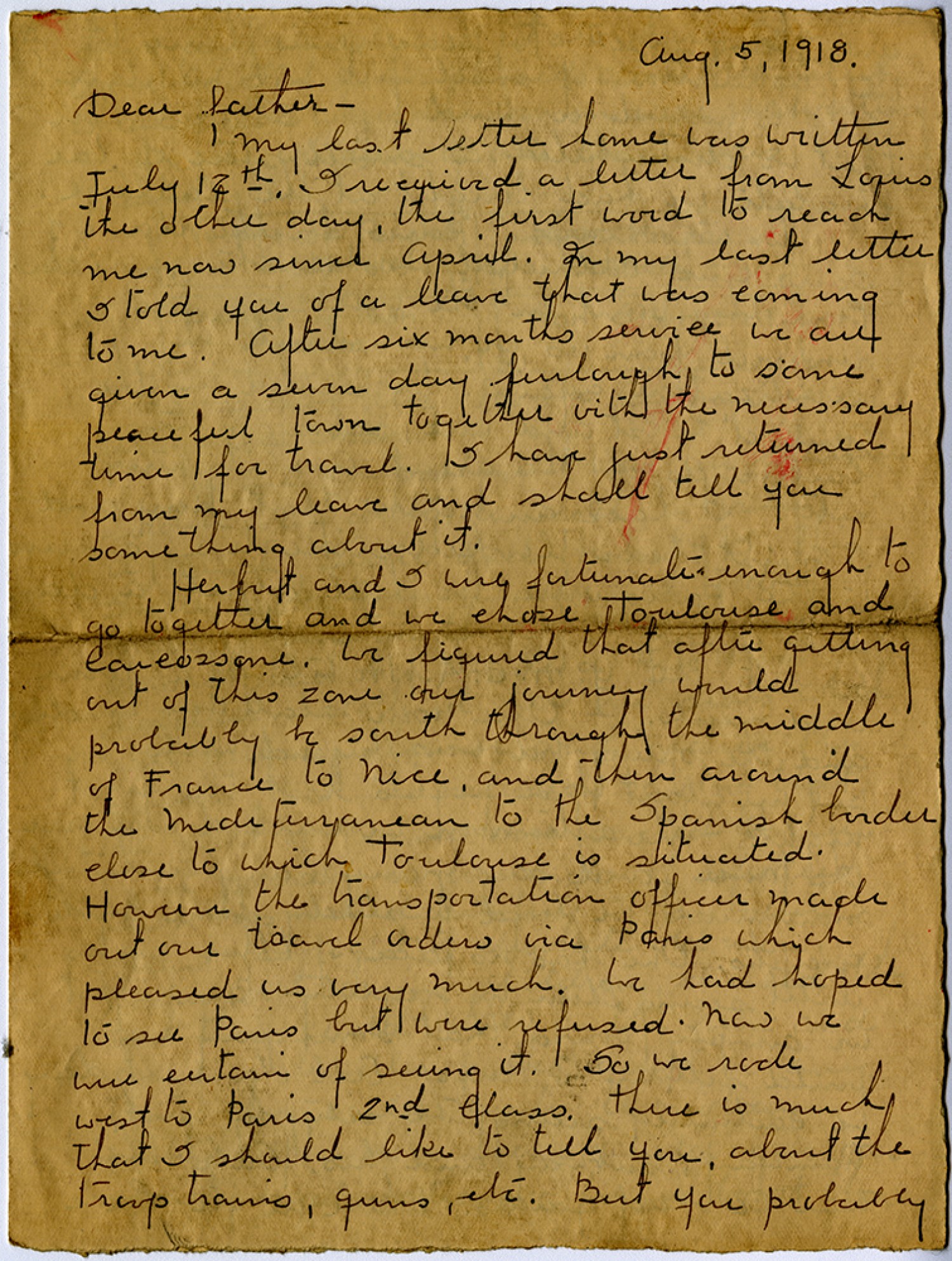
[August] 5, 1918. Dear father - My last letter home was written July 12th. I received a letter from Louis the other day, the first word to reach me now since April. In my last letter I told you of a leave that was coming to me. After six months service we are given a seven day furlough to some peaceful town together with the necessary time for travel. I have just returned from my leave and shall tell you something about it. Herbert and I were fortunate enough to go together and we chose Toulouse and [Carcassonne]. We figured that after getting out of this zone our journey would probably be south through the middle of France to Nice, and then around the Mediterranean to the Spanish border close to which Toulouse is situated. However the transportation officer made out our travel orders via Paris which pleased us very much. We had hoped to see Paris but were refused. Now we were certain of seeing it. So we rode west to Paris 2nd Class. there is much that I should like to tell you, about the Troop Trains, guns, etc. But you probably
Transcript
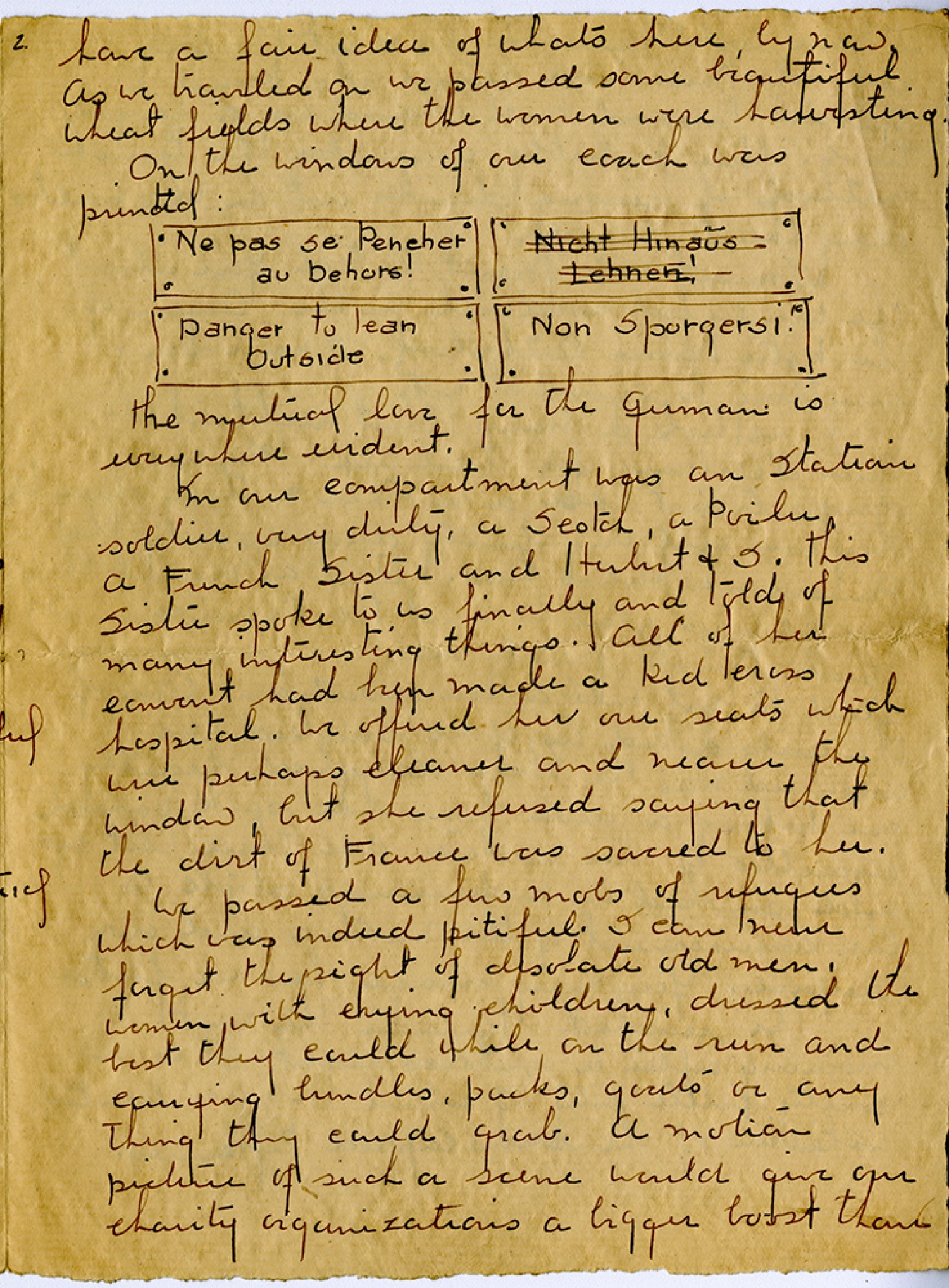
[page 2] have a fair idea of whats here, by now as we traveled on we passed some beautiful wheat fields where the women were harvesting. On the windows of our coach was printed [boxed text] No pas se Pencher au Dehors! Danger to Lean Outside Non Sporgersi the mutual love for the german is everywhere evident. In our compartment was an Italian soldier, very dirty, a Scotch, a Poilu, a French Sister and Herbert & I. This Sister spoke to us finally and told of many interesting things. All of her convent had been made a Red cross hospital. We offered her our seats which were perhaps cleaner and nearer the window, but she refused saying that the dirt of France was sacred to her. We passed a few mobs of refugees which was indeed pitiful. I can never forget the sight of desolate old men, women with crying children, dressed the best they could while on the run and carrying bundles, packs, goats or anything they could grab. A motion picture of such a scene would give our charity organizations a bigger boost than
Transcript
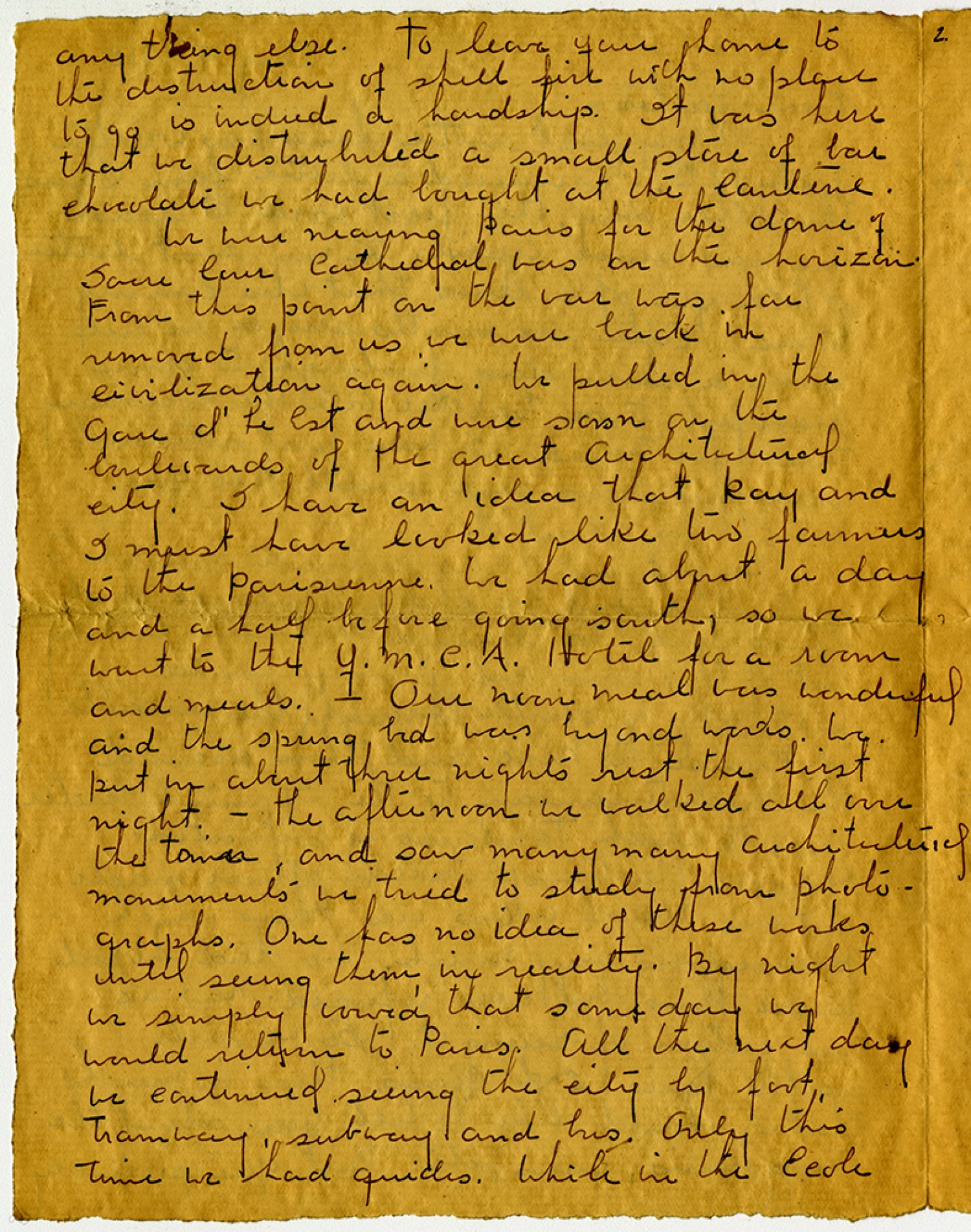
anything else. To leave your home to the destruction of shell fire with no place to go is indeed a hardship. It was here that we distributed a small store of bar chocolate we had bought at the cantine. We were nearing Paris for the dome of [ms illegible: 2 wds] Cathedral was on the horizon. From this point on the war was far removed from us we were back in civilization again. We pulled in the gare d’ Le Est and were soon on the boulevards of the great Architectural city. I have an idea that Ray and I must have looked like two farmers to the [Parisian]. We had about a day and a half before going south, so we went to the Y. M. C. A. Hotel for a room and meals. Our noon meal was wonderful and the spring bed was beyond words. We put in about three nights rest the first night – the afternoon we walked all over the town, and saw many architectural monuments we tried to study from photographs. One has no idea of these works until seeing them in reality. By night we simply vowed that some day we would return to Paris. All the next day we continued seeing the city by foot. Tramway, subway and bus. Only this time we had guides. While in the Ecole
Transcript
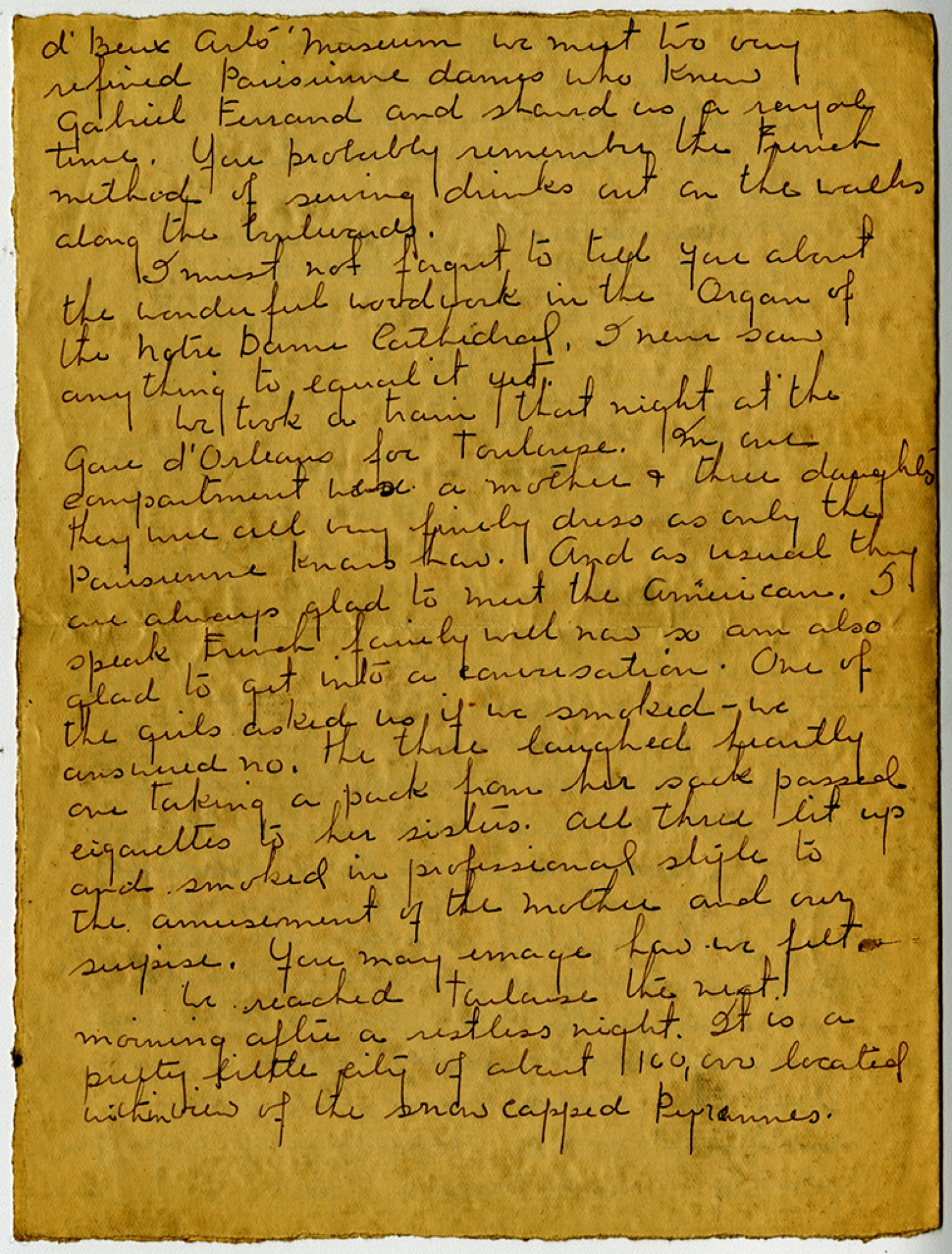
d’ Beux Arts Museum we met two very refined [Parisian] dames who knew gabriel Ferrand and showed us a royal time. You probably remember the French method of serving drinks out on the walks along the boulevards. I must not forget to tell you about the wonderful woodwork in the Organ of the Notre Dame Cathedral. I never saw anything to equal it yet. We took a train that night at the gare d’Orleans for Toulouse. In our compartment was a mother & three daughters they were all very finely dress as only the [Parisian] knows how. And as usual they are always glad to meet the American. I speak French fairly well now so am also glad to get into a conversation. One of the girls asked us if we smoked – we answered no. The three laughed heartly one taking a pack from her sack passed cigarettes to her sisters. All three lit up and smoked in professional style to the amusement of the mother and our surprise. You may image how we felt. We reached Toulouse the next morning after a restless night. It is a pretty little city of about 160,000 located within view of the snow capped [Pyrenees].
Transcript
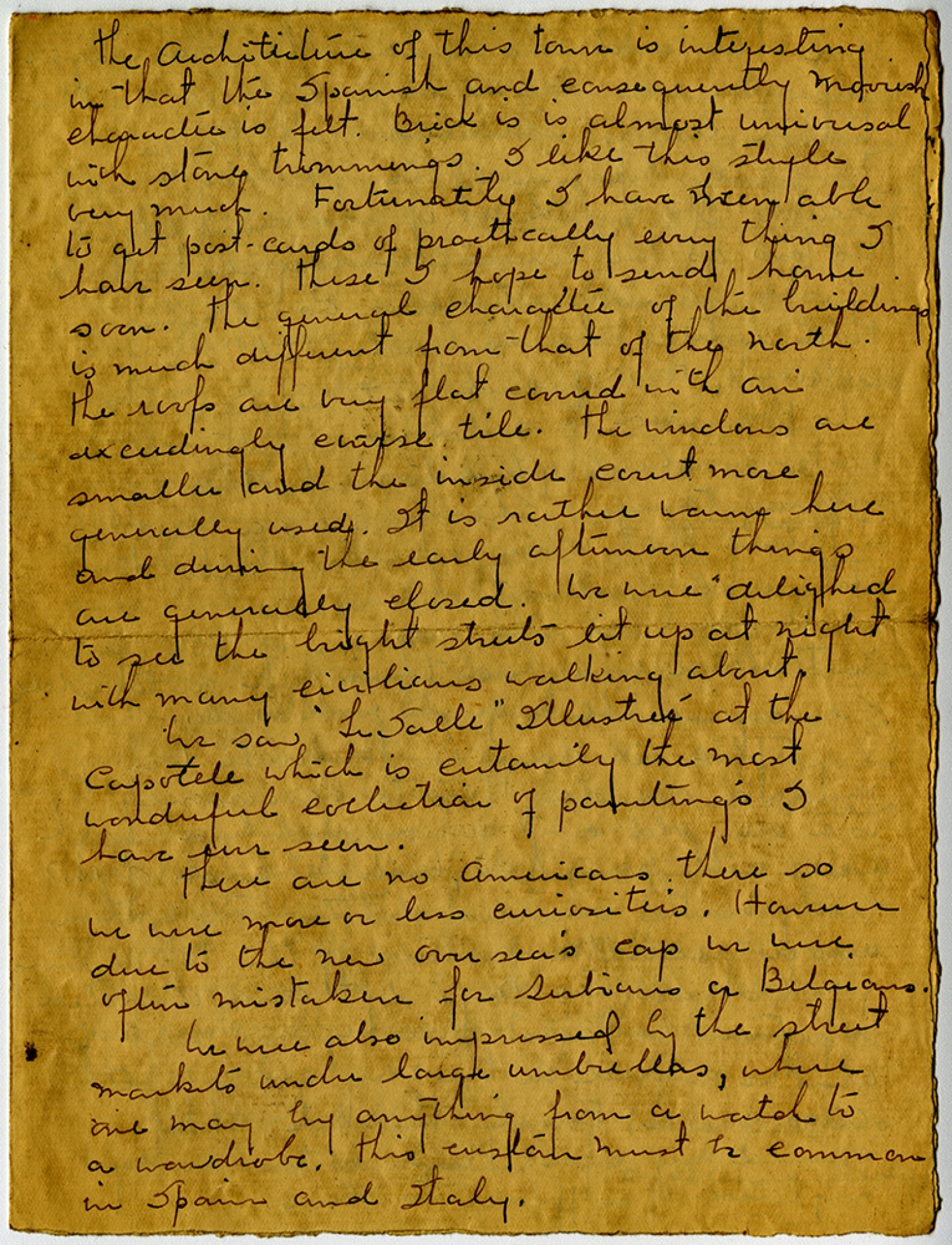
The architecture of this town is interesting in that the Spanish and consequently Moorish character is felt. Brick is is almost universal with strong trimmings. I like this style very much. Fortunately I have been able to get postcards of practically every thing I have seen. These I hope to send home soon. The general character of the buildings is much different from that of the North. The roofs are very flat covered with an exceedingly course tile. The windows are smaller and the inside court more generally used. It is rather warm here and during the early afternoon things are generally closed. We were delighted to see the bright streets lit up at night with many civilians walking about. We saw “Le Salle” Illustree at the Capotele which is certainly the most wonderful collection of paintings I have ever seen. There are no Americans there so we were more or less curiosities. However due to the new oversea’s cap we were often mistaken for Serbians or Belgians. We were also impressed by the street markets under large umbrellas, where one may buy anything from a watch to a wardrobe. This custom must be common in Spain and Italy.
Transcript
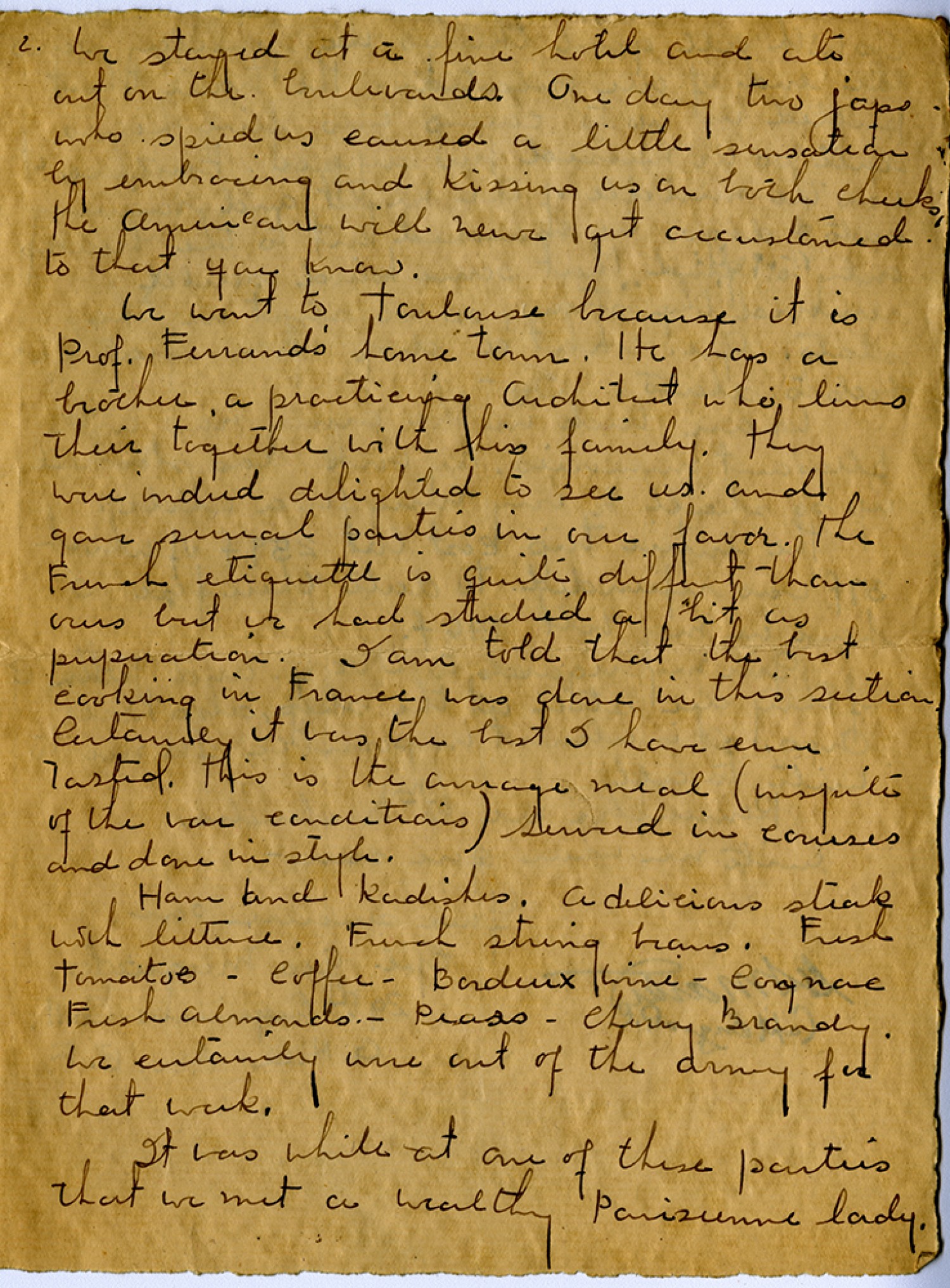
2. We stayed at a fine hotel and ate out on the boulevards. One day two japs who spied us caused a little sensation by embracing and kissing us on both cheeks. The American will never get accustomed to that you know. We went to Toulouse because it is Prof. Ferrand’s home town. He has a brother, a practicing architect who lives their together with his family. They were indeed delighted to see us and gave several parties in our favor. The French etiquette is quite different than ours but we had studied a bit as preperation. I am told that the best cooking in France was done in this section. Certainly it was the best I have ever tasted. This is the average meal (inspite of the war conditions) Served in courses done in style. Ham and Radishes, a delicious steak with lettuce. French string beans. Fresh tomatoes – coffee – Bordeaux Wine – Cognac Fresh almonds – Peas – Cherry Brandy. We certainly were out of the army for that week. It was while at one of these parties that we met a wealthy [Parisian] lady.
Transcript
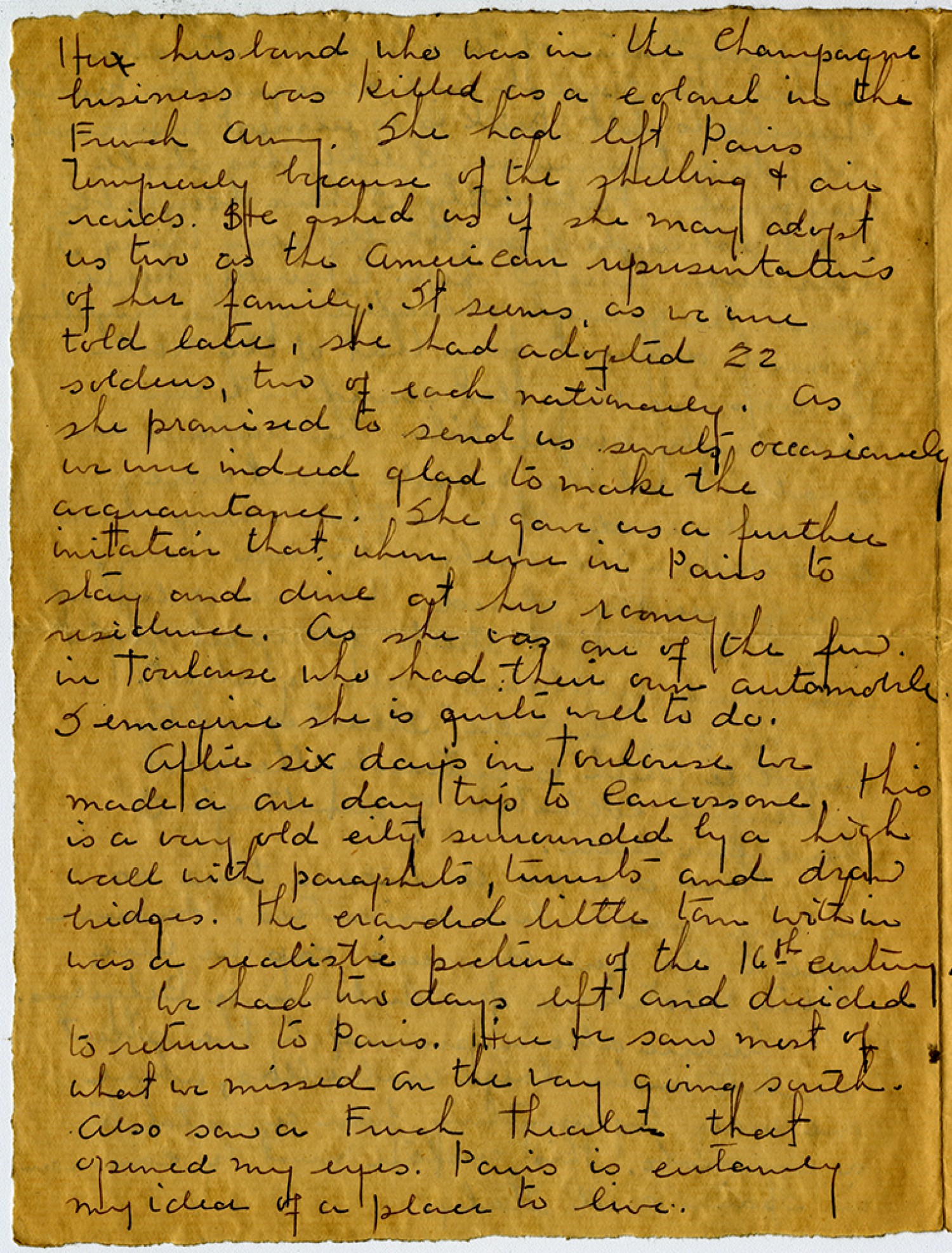
Her husband who was in the Champagne business was killed as a colonel in the French Army. She had left Paris temporarily because of the shelling & air raids. She asked us if she may adopt us two as the American representatives of her family. It seems, as we were told later, she had adopted 22 soldiers, two of each nationality. As she promised to send us sweets occasionally we were indeed glad to make the acquaintance. She gave us a further invitation that when ever in Paris to stay and dine at her roomy residence. As she was one of the few in Toulouse who had their own automobile. I imagine she is quite well to do. After six days in Toulouse we made a one day trip to [Carcassonne], this is a very old city surrounded by a high wall with paraphets, tunnels and draw bridges. The crowded little town within was a realistic picture of the 16th century. We had two days left and decided to return to Paris. Here we saw most of what we missed on the way going south. Also saw a French Theater that opened my eyes. Paris is certainly my idea of a place to live.
Transcript
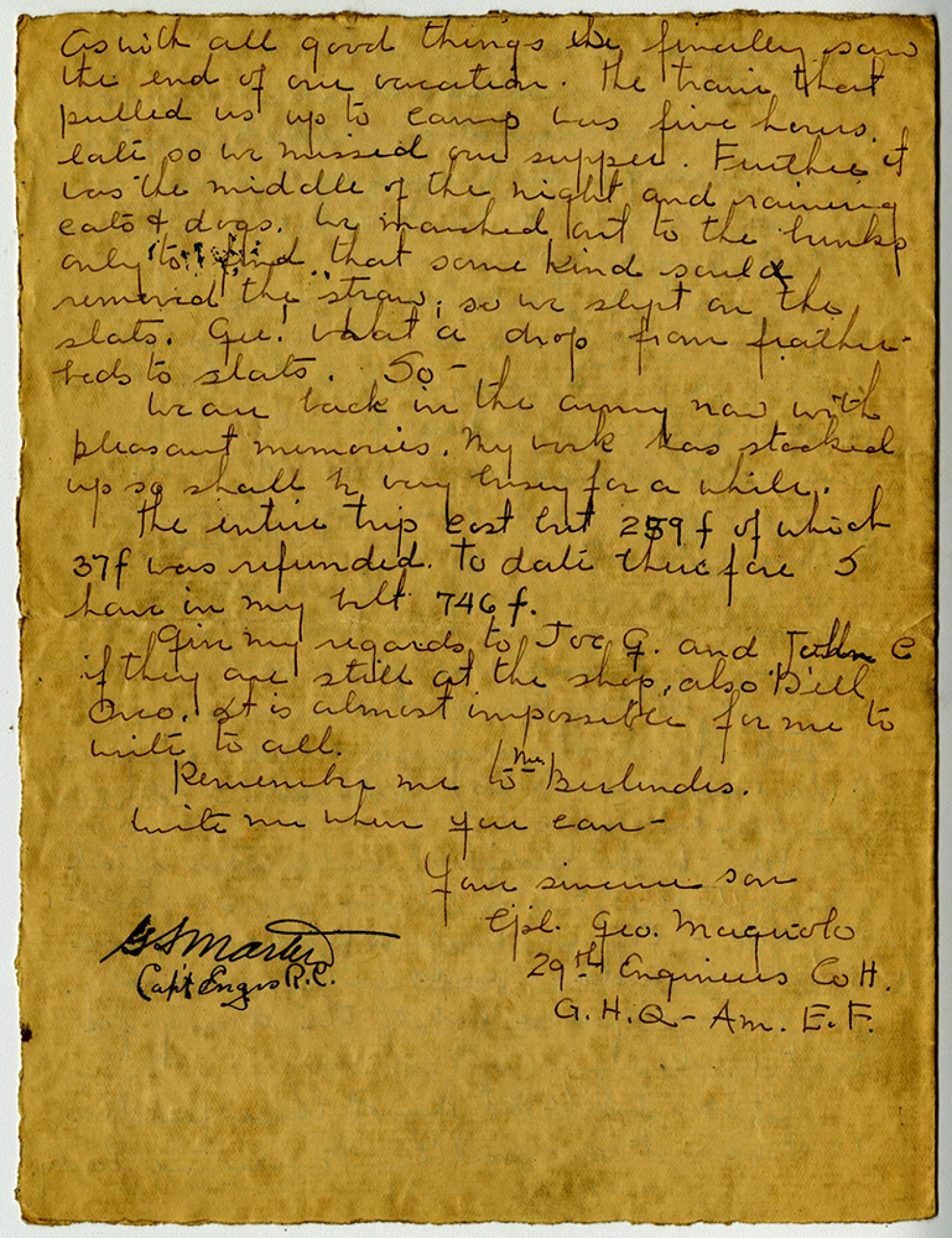
As with all good things we finally saw the end of our vacation. The train that pulled us up to camp was five hours late so we missed our supper. Further it was the middle of the night and raining cats & dogs. We marched out to the bunks only to find that some kind soul removed the straw; so we slept on the slats. gee! what a drop from feather beds to slats. So - we are back in the army now with pleasant memories. My work has stacked up so shall be very busy for a while. The entire trip cost but 259 [francs] of which 37 [francs] was refunded. To date therefore I have in my belt 746 [francs]. give my regards to Joe g. and John C if they are still at the shop, also Dill Oreo. It is almost impossible for me to write to all. Remember me to Mr. Berlendes. Write me when you can – Your sincere son [Corporal] [George] Maguolo 29th Engineers Co. H. [General Headquarters] [American Expeditionary Forces] [censor signature]
Details
| Title | George J. Maguolo letter to Father - August 5, 1918 |
| Creator | Maguolo, George J. |
| Source | Maguolo, George J. Letter to Father. 5 August 1918. George J. Maguolo Papers, 1917-1945. A0969. Missouri History Museum, St. Louis, Missouri. |
| Description | George J. Maguolo wrote a letter to his father on August 5, 1918 while in France. Maguolo was in the 29th Engineers Company H and served in France until 1919. In this letter Maguolo provided a detailed description of his trip while on a seven day furlough. He and Ray Herbert (a fellow St. Louisan) visited Paris, Toulouse and Carcassonne, France. |
| Subject LCSH | World War, 1914-1918; World War, 1914-1918--War Work--Y.M.C.A.; World War, 1914-1918--Refugees |
| Subject Local | WWI; World War I |
| Site Accession Number | A0969 |
| Contributing Institution | Missouri History Museum |
| Copy Request | Transmission or reproduction of items on these pages beyond those allowed by fair use requires the written permission of the Missouri History Museum: 314-746-4510 |
| Rights | The text and images contained in this collection are intended for research and educational use only. Duplication of any of these images for commercial use without express written consent is expressly prohibited. Contact the Missouri History Museum's Permissions Office at 314-746-4511 to obtain written consent. |
| Date Original | August 5, 1918 |
| Language | English |