George J. Maguolo letter to Dad - January 6, 1919
Transcript
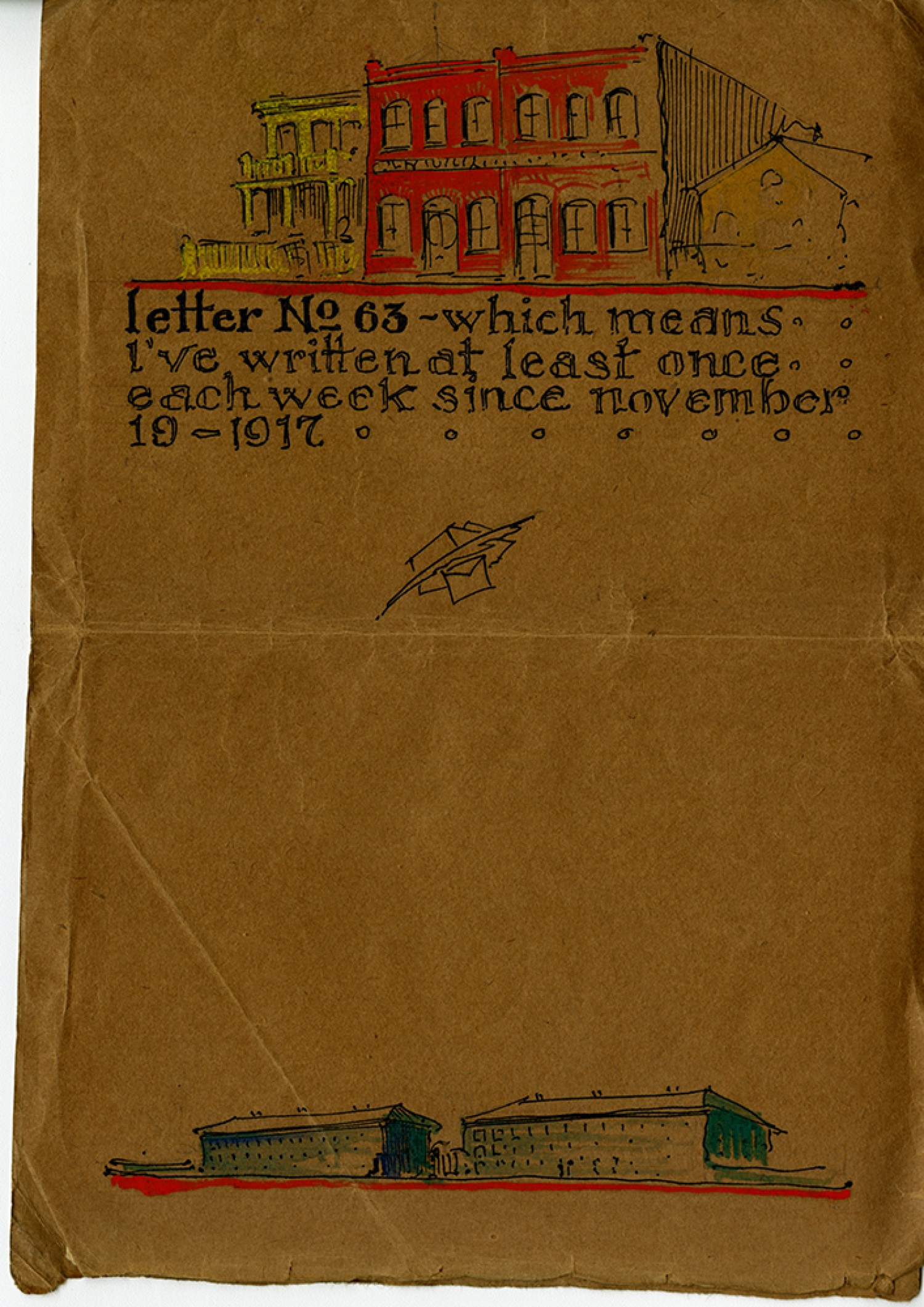
[colored sketch of buildings] Letter No 63 – which means I’ve written at least once each week since november 19 -1917
Transcript
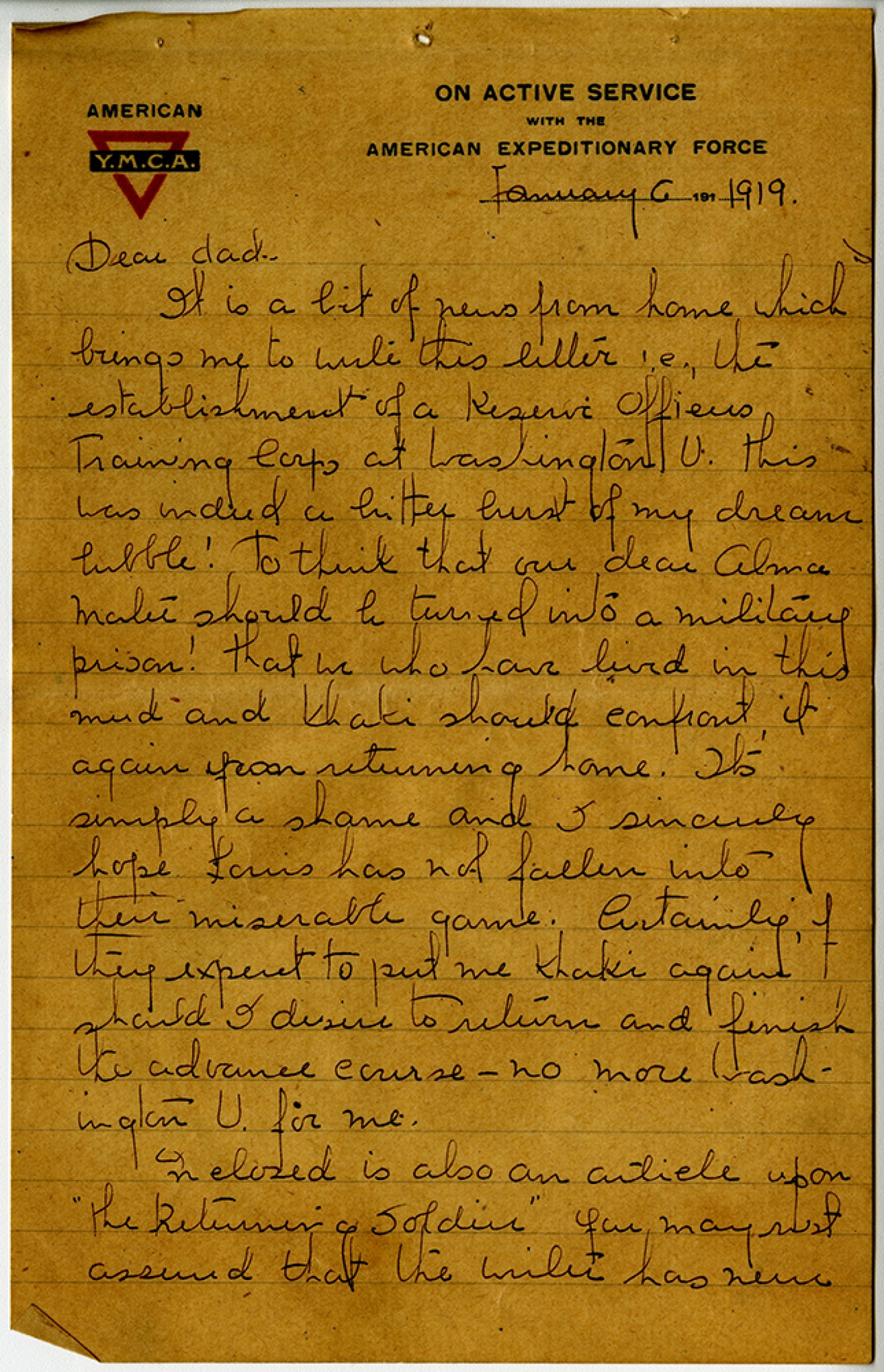
January 6, 1919. Dear dad. - It is a bit of news from home which brings me to write this letter i. e., the establishment of a Reserve Officers Training Corp at Washington [University]. this was indeed a bitter bust of my dream bubble! To think that our dear Alma Mater should be turned into a military prison! That we who have lived in this mud and khaki should confront it again returning home. Its simply a shame and I sincerely hope Louis has not fallen into their miserable game. Certainly, if they expect to put me khaki again should I desire to return and finish the advance course – no more Washington [University] for me. Inclosed is also an article upon “The Returning Soldier” you may rest assured that the writer has never
Transcript
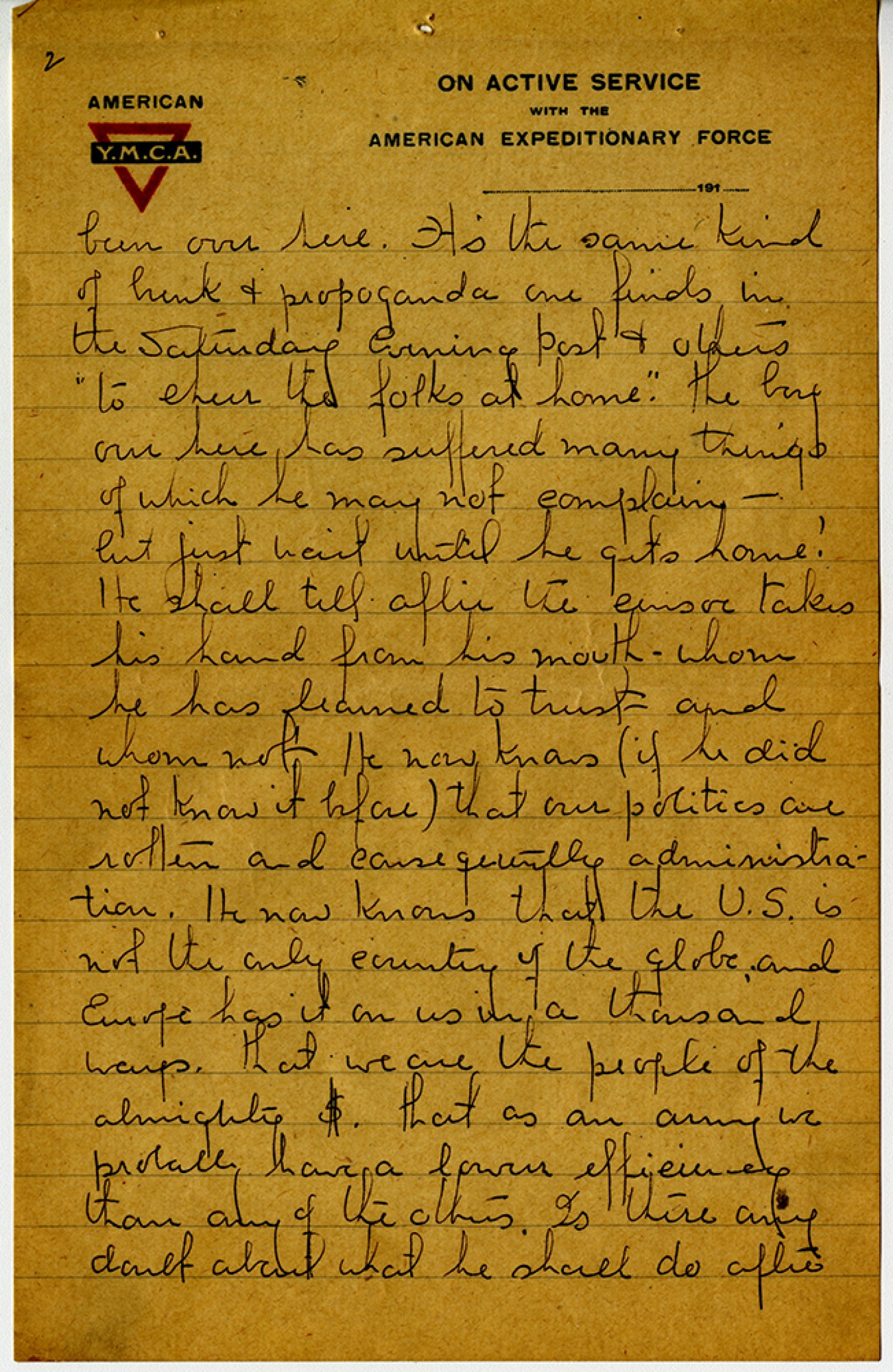
[page 2] been over here. It’s the same kind of bunk & propoganda one finds in the Saturday Evening Post & others “to cheer the folks at home.” The boy over here has suffered many things of which he may not complain – but just wait until he gets home! He shall tell after the censor takes his hand from his mouth – whom he has learned to trust and whom not. He now knows (if he did not know it before) that our politics are rotten and consequently adminstration. He now knows that the U.S. is not the only country of the globe, and Europe has it on us in a thousand ways. That we are the people of the almighty $. That as an army we probably have a lower efficiency than any do the others. Is there any doubt about what he shall do after
Transcript
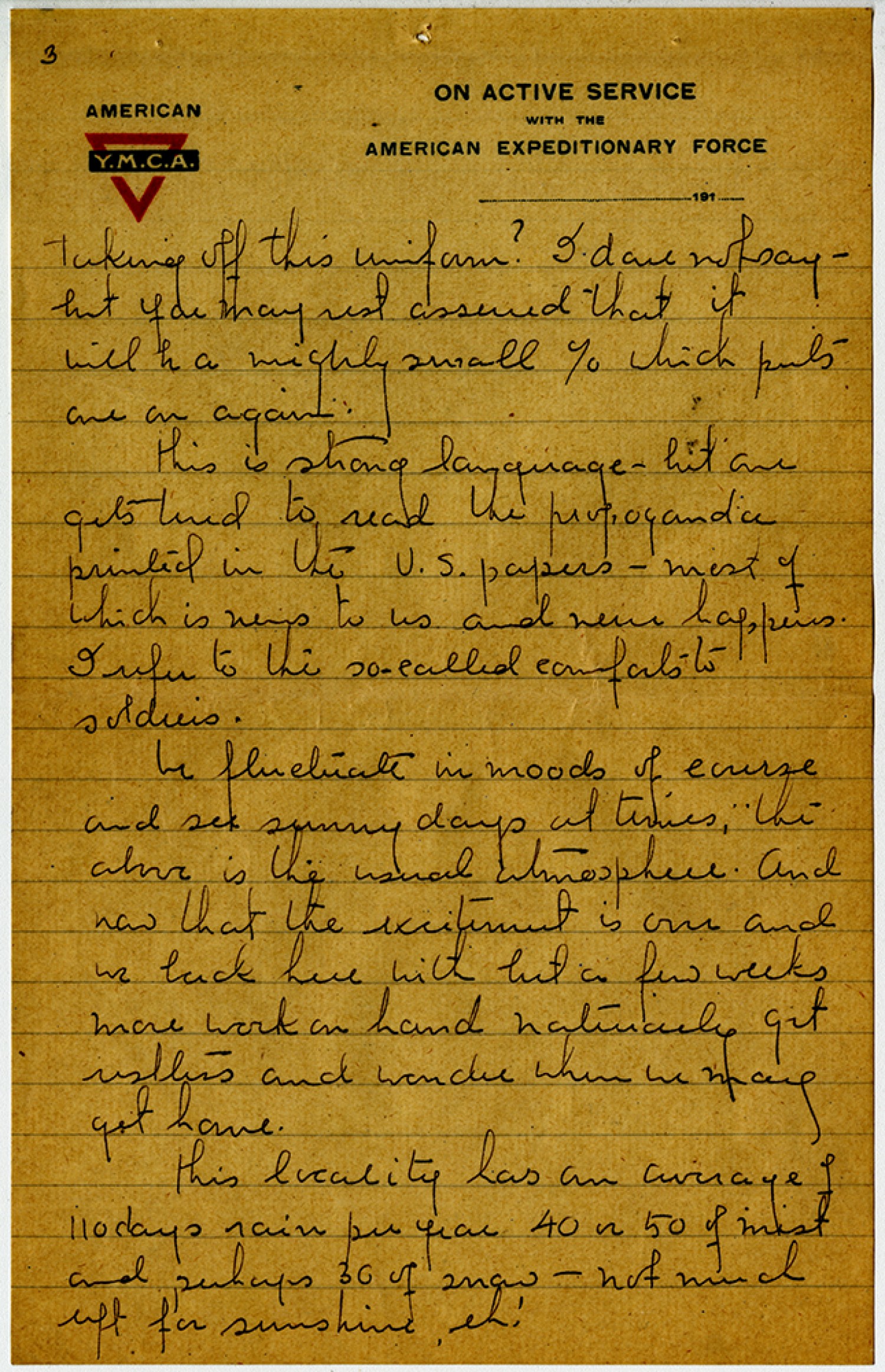
[page 3] taking off his uniform? I dare not say – but you may rest assured that it will be a mighty small % which puts one on again. This is strong language - but one gets tired to read the propoganda printed in the U.S. papers – most of which is news to us and never happens. I refer to the so-called comforts to soldiers. We fluctuate in moods of course and see sunny days at times, the above is the usual atmosphere. And now that the excitement is over and we back here with but a few weeks more on hand naturally get restless and wonder when we may get home. This locality has an average of 110 days rain per year 40 or 50 of mist and perhaps 30 of snow – not much left for sunshine, eh!
Transcript
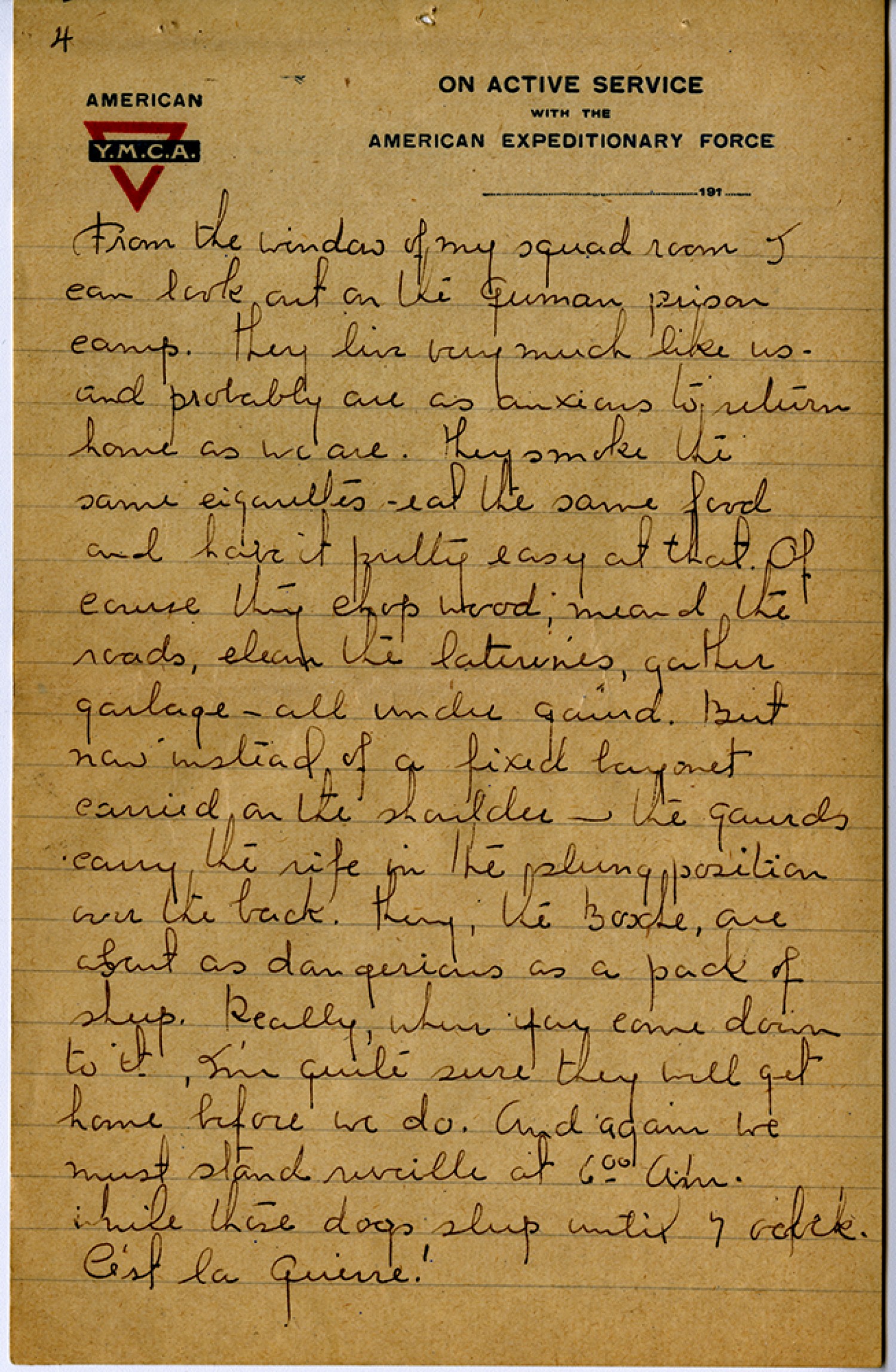
[page 4] From the window of my squad room I can look out on the german prison camp. They live very much like us and probably are as anxious to return home as we are. They smoke the same cigarettes - eat the same food and have it pretty easy at that. Of course they chop wood, meand the roads, clean the laterines, gather garbage - all under gaurd. But now instead of a fixed bayonet carried in the shoulder – the gaurds carry the rife in the slung position over the back. They, the Bosche, are about as dangerous as a pack of sheep. Really, when you come down to it, I’m quite sure they will get home before we do. And again we must stand reville at 600 am. While those dogs sleep until 7 oclock. Ce’st la guerre!
Transcript
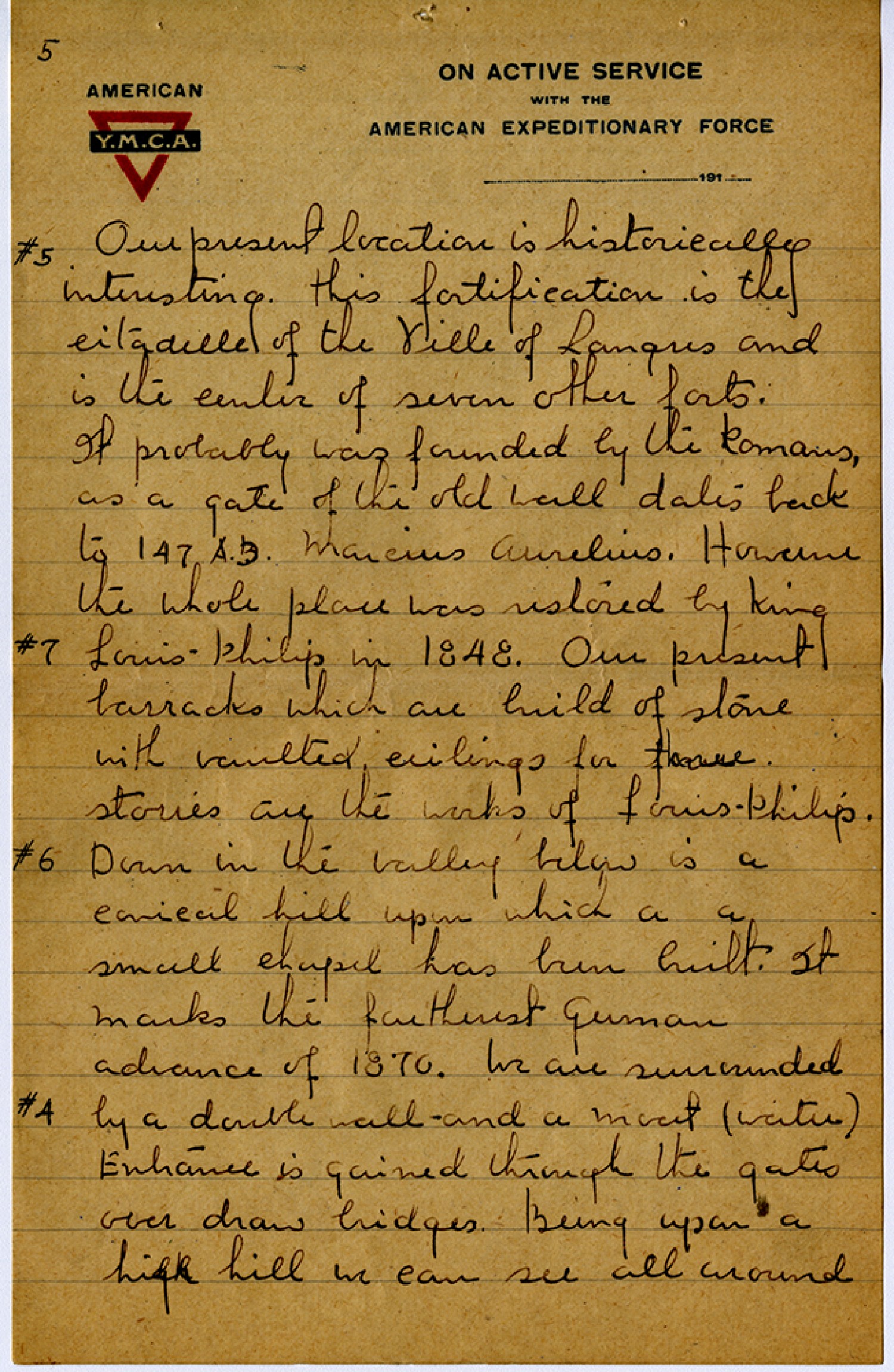
[page 5] #5 Our present location is historically interesting. This fortification is the citadelle of the Ville of Langres and is the center of seven other forts. It probably was founded by the Romans, as a gate of the old wall dates back to 147 A.D. Marcus Aurelius. However the whole place was restored by King Louis-Philip in 1848. #7 Our present barracks which are build of stone with vaulted ceilings for three stories are the works of Louis-Philip. #6 Down in the valley below is a comical hill upon which a a small chapel has been built. It marks the fartherest german advance of 1870. #4 We are surrounded by a double wall and a moat (water) Entrance is gained through the gates over draw bridges. Being upon a high hill we can see all around
Transcript
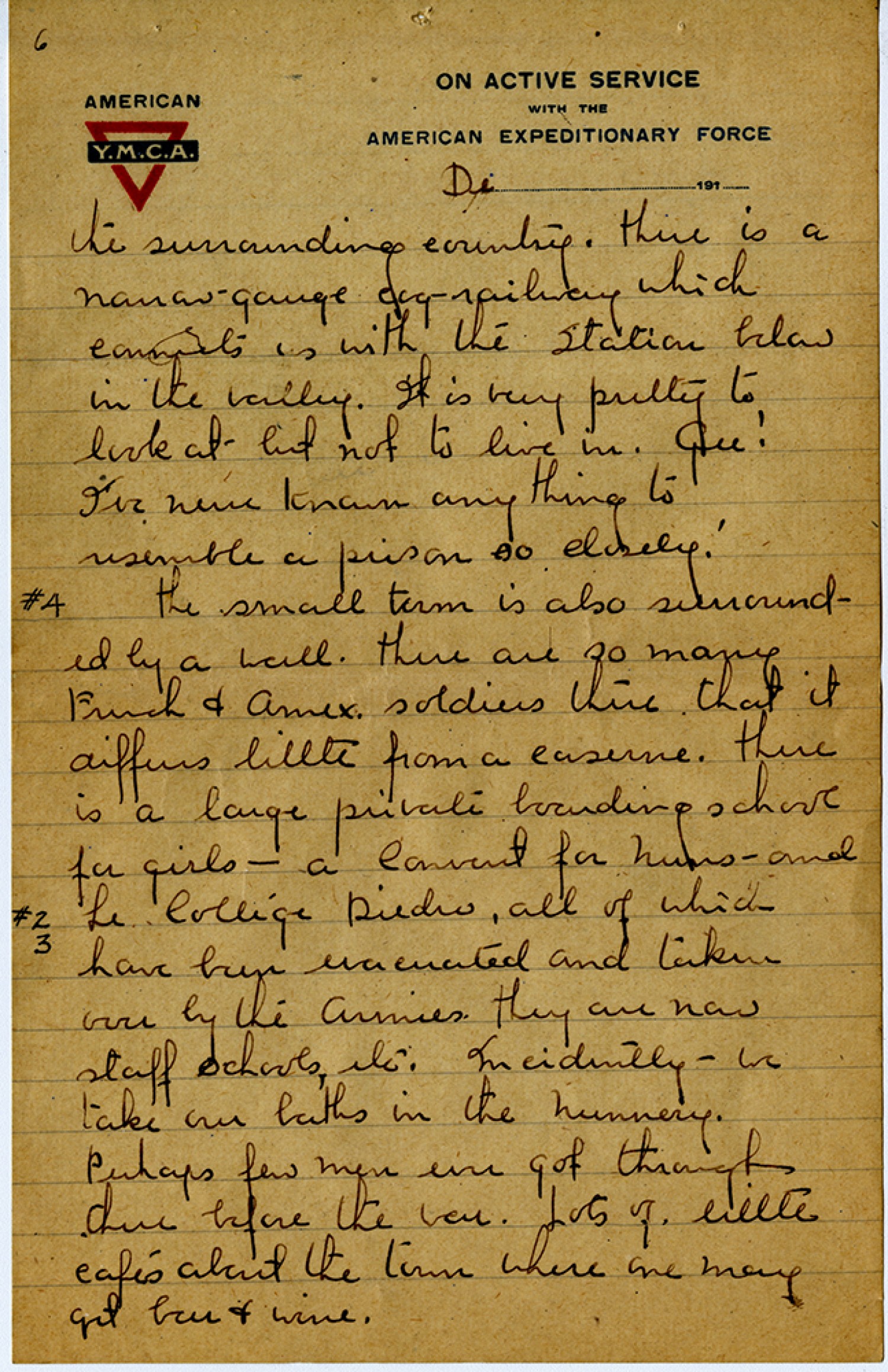
[page 6] the surrounding country. There is a narrow gauge [ms illegible: 1 wd]-railway which connects us with the Station below in the valley. It is very pretty to look at but not to live in. gee! I’ve never known anything to resemble a prison so closely. #4 The small town is also surrounded by a wall. There are so many French & [American] soldiers there that it differs little from a caserne. There is a large private boarding school for girls - a Convent for nuns – and #2 Le College Diedro, all of which 3 have been evacuated and taken over by the Armies. They are now staff schools, etc. Incidently – we take our baths in the Nunnery. Perhaps few men ever got through there before the war. Lots of little cafe’s about the town where one may get beer & wine.
Transcript
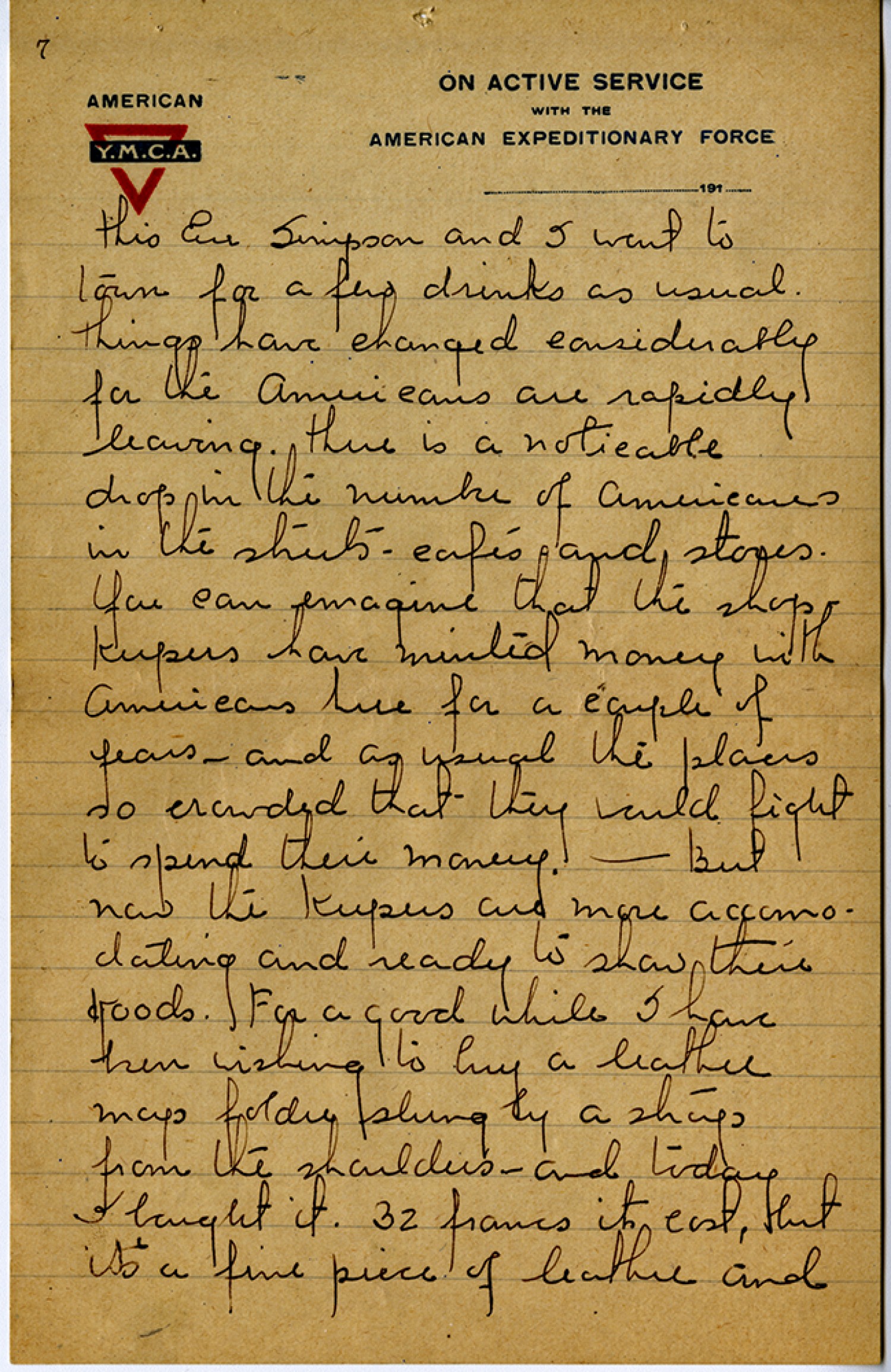
[page 7] this Eve Simpson and I went to town for a few drinks as usual. Things have changed considerably for the Americans are rapidly leaving. There is a noticable drop in the number of Americans in the streets - cafe’s and stores. You can imagine that the shopkeepes have minted money with Americans here for a couple of years - and as usual the places so crowded that they would fight to spend there money. – But now the keepers are more accomodating and ready to show their goods. For a good while I have been wishing to buy a leather map folder slung by a strap from the shoulders – and today I bought it. 32 francs it cost, but it’s a fine piece of leather and
Transcript
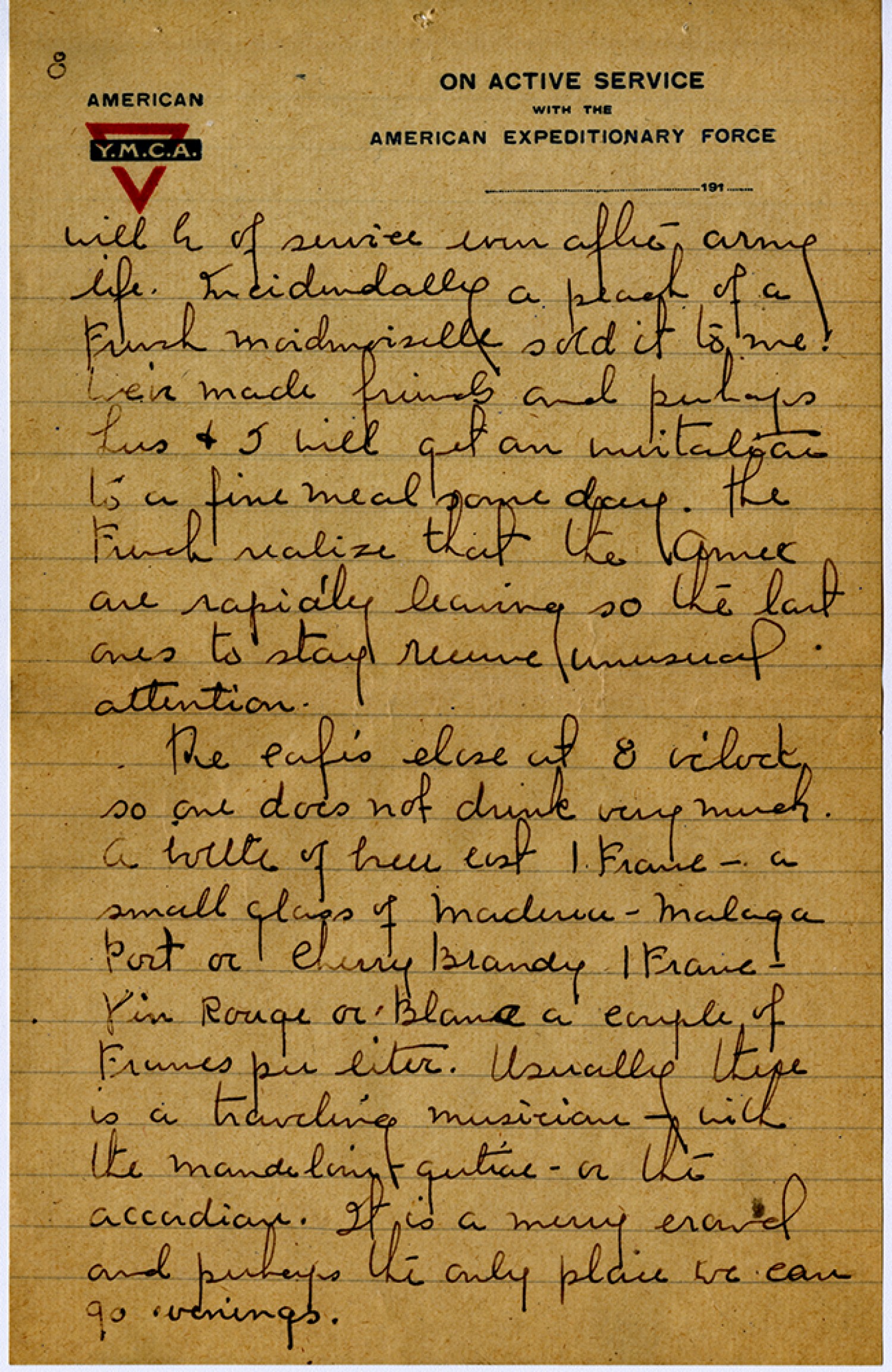
[page 8] will be of service even after army life. Incidentally a peach of a French Maidmoiselle sold it to me. We’ve made friends and perhaps Lus & I well get an invitation to a fine meal some day. The French realize that the [Americans] are rapidly leaving so the last ones to stay receive unusual attention. The cafe’s close at 8 o’clock so one does not drink very much. A bottle of beer cost 1 Franc – a small glass of Maderia – Malaga Port or Cherry Brandy 1 Franc- Vin Rouge or Blanc a couple of Francs per liter. Usually there is a traveling musician – with the Mandelin – guitar – or the accordion. It is a merry crowd and perhaps the only place we can go evenings.
Transcript
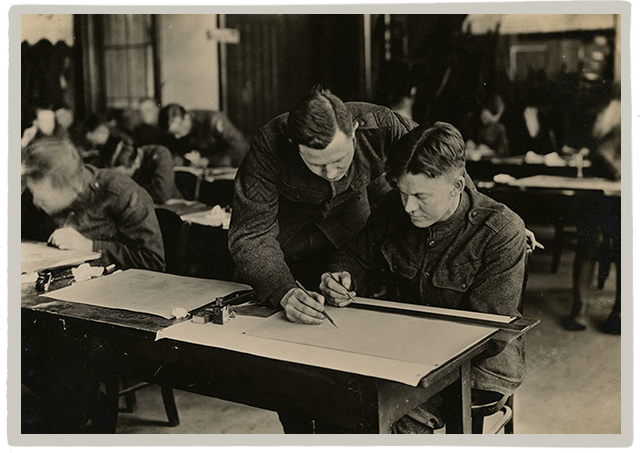
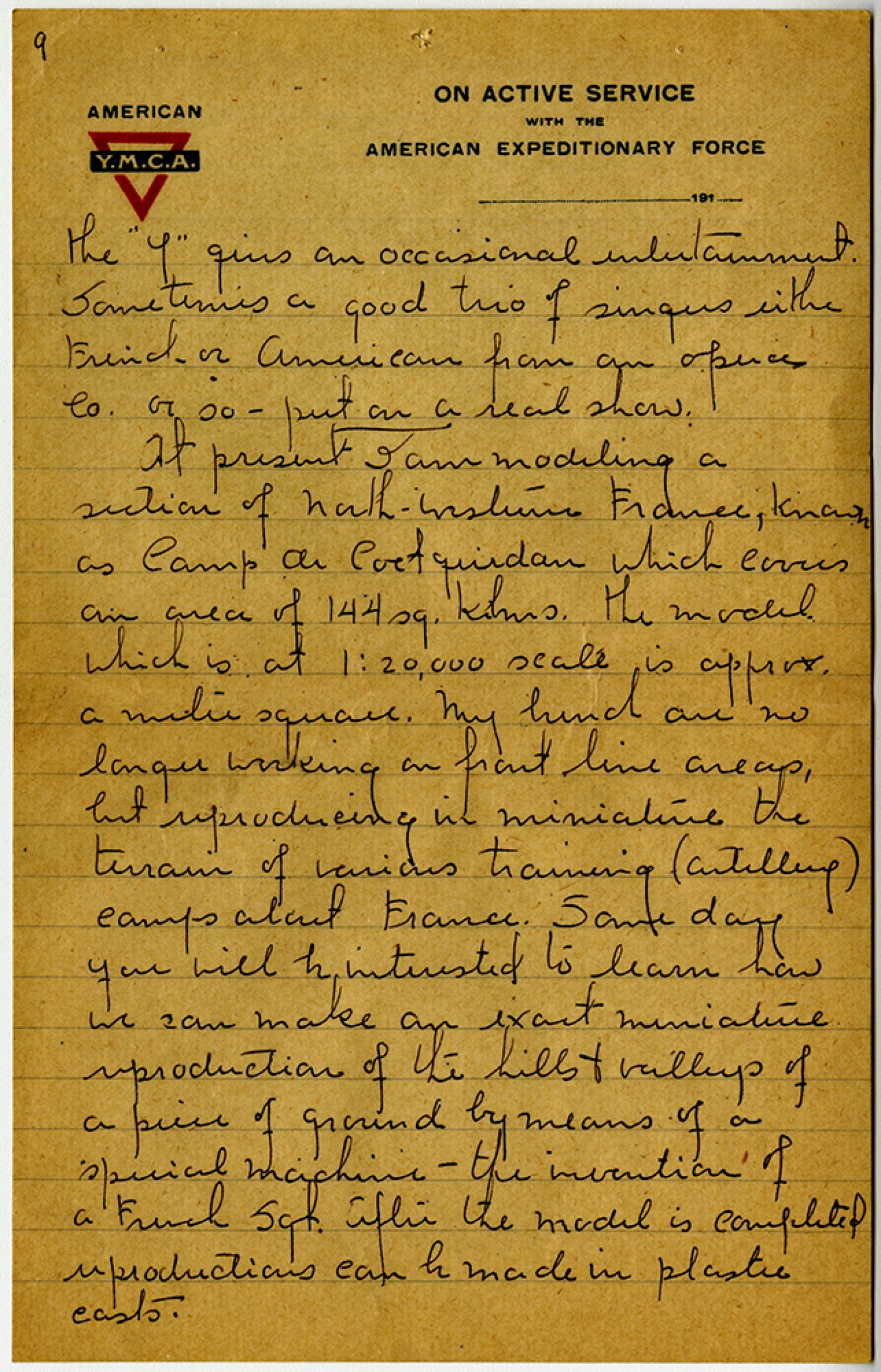
[page 9] the “Y” gives an occasional entertainment. Sometimes a good trio of singers either French or American from an opera Co. or so – put on a real show. At present I am modeling a section of North-western France, known as Camp de Coetquidan which covers an area of 144 sq. klms. The model which is at 1:20,000 scale is approx. a meter square. My branch are no longer working on front line areas, but reproducing in miniature the terrain of various training (artillery) camps about France. Some day you will be interested to learn how we can make an exact miniature reproduction of the hills & valleys of a piece of ground by means of a special machine – the invention of a French Sgt. After the model is complete reproductions can be made in plastic casts.
Transcript
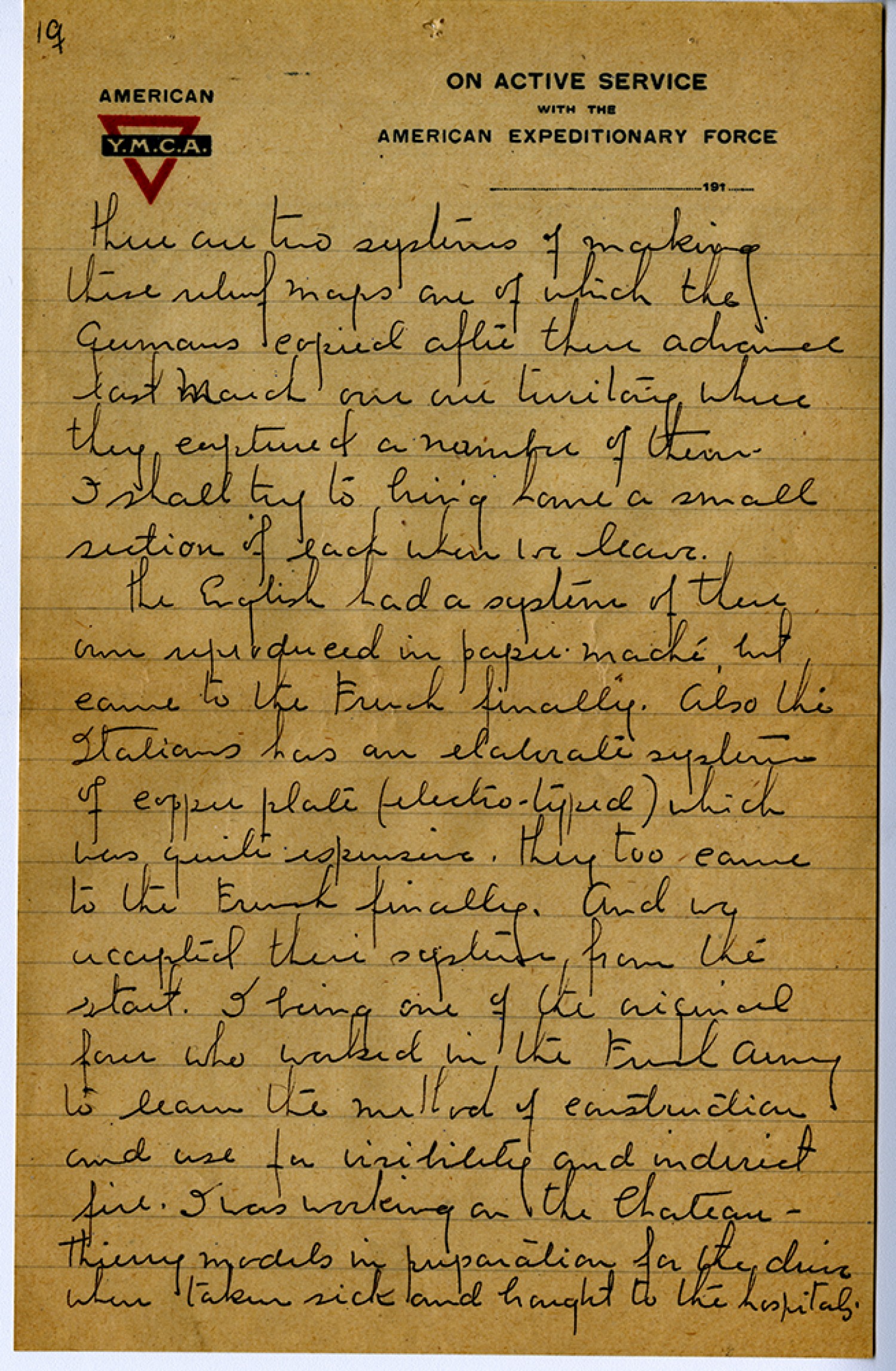
[page 10] there are two systems of making these relief maps one of which the germans copied after there advance last March over our territory where they captured a number of them. I shall try to bring home a small section of each when we leave. The English had a system of there own reproduced in paper mache’, but came to the French finally. Also the Italians had an elaborate system of copper plate (electro-typed) which was quite expensive. They too came to the French finally. And we accepted there system from the start. I being one of the original four who worked in the French Army to learn the method of construction and use for visibility and indirect fire. I was working on the Chateau – Thierry models in preparation for the drive when taken sick and brought to the hospitals.
Transcript
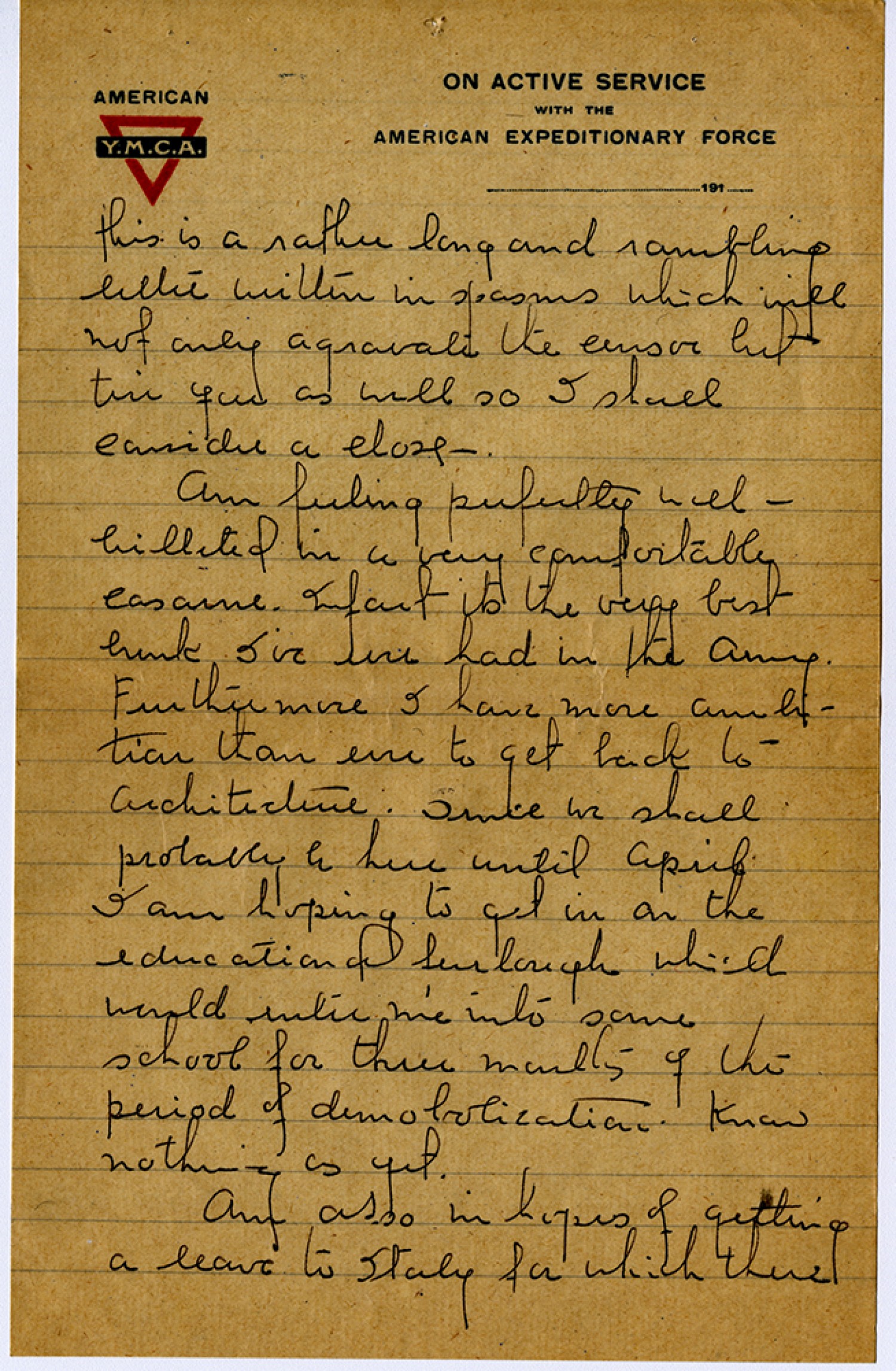
this is a rather long and rambling letter written in spasms which will not only agravate the censor but tire you as well so I shall consider a close -. Am feeling perfectly well – billeted in a very comfortable caserne. In fact its the very best bunk I’ve ever had in the Army. Furthermore I have more ambition than ever to get back to architecture. Since we shall probably be here until April I am hoping to get in on the educational furlough which would enter me into some school for three months of the period of demobilization. Know nothing as yet. Am also in hopes of getting a leave to Italy for which there
Transcript
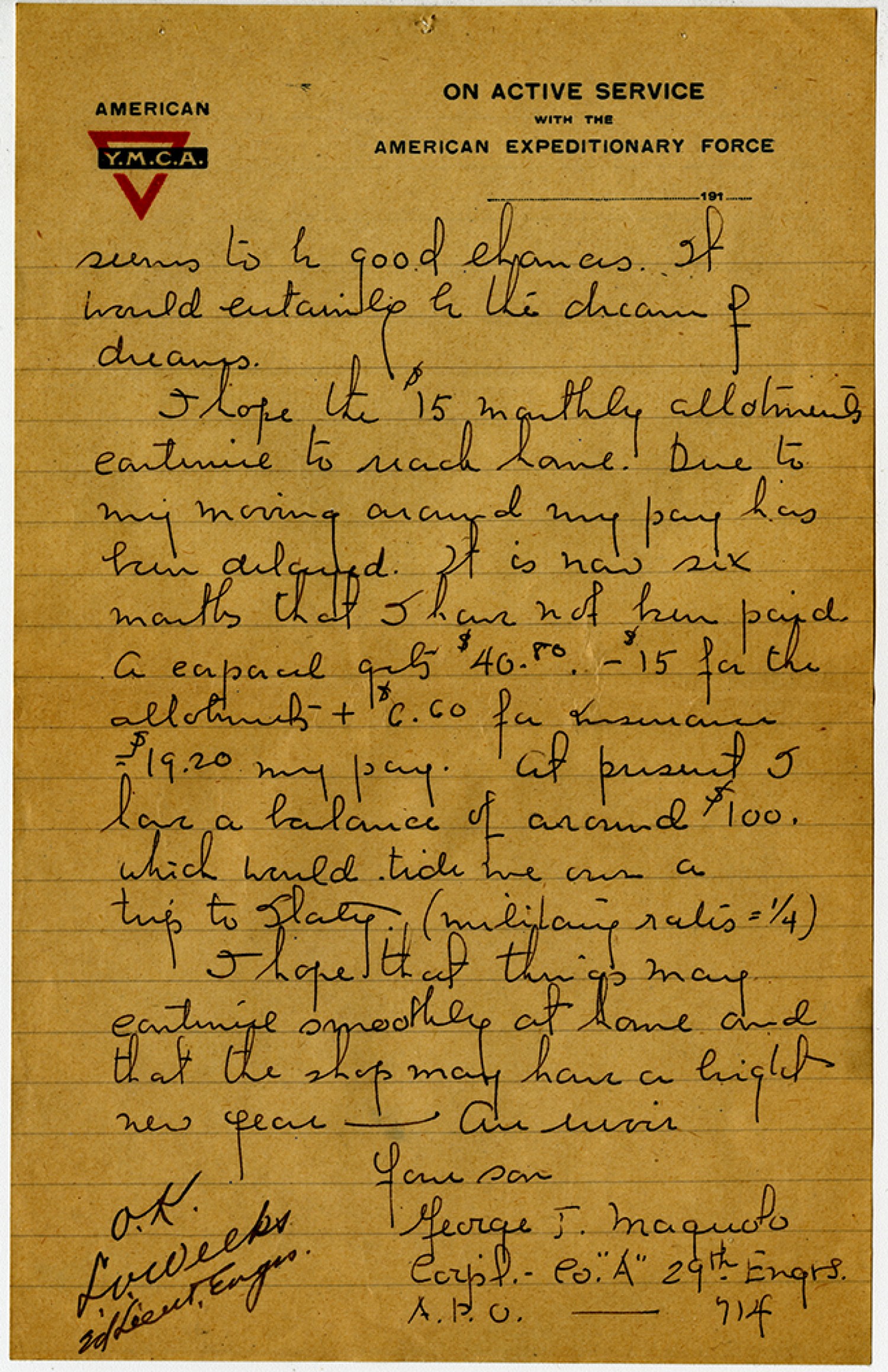
seems to be good chances. It would certainly be the dream of dreams. I hope $15 monthly allotments continue to reach home. Due to my moving around my pay has been delayed. It is now six months that I have not been paid. A corporal gets $40.80. - $15 for the allotments + $6.60 for Insurance = $19.20 my pay. At present I have a balance of around $100. which would tide me over a trip to Italy. (military rates = ¼) I hope that things may continue smoothly at home and that the shop may have a bright new year – Au revoir Your son George J. Maguolo [Corporal] Co. “A” 29th [Engineers] A. P. O. - 714 [censor’s signature]
Details
| Title | George J. Maguolo letter to Dad - January 6, 1919 |
| Creator | Maguolo, George J. |
| Source | Maguolo, George J. Letter to Dad. 6 January 1919. George J. Maguolo Papers, 1917-1945. A0969. Missouri History Museum, St. Louis, Missouri. |
| Description | George J. Maguolo wrote a letter to his dad on January 6, 1919 while in France. Maguolo was in the 29th Engineers Company A and served in France until 1919. In this letter Maguolo described the fortress that his barracks was located in and the surrounding town. Maguolo also discussed the amenities the town had to offer and how he and his peers spent their free time. This letter was written on American Y.M.C.A. letterhead. |
| Subject LCSH | World War, 1914-1918; World War, 1914-1918-Propaganda; Soldiers billeting |
| Subject Local | WWI; World War I |
| Site Accession Number | A0969 |
| Contributing Institution | Missouri History Museum |
| Copy Request | Transmission or reproduction of items on these pages beyond those allowed by fair use requires the written permission of the Missouri History Museum: 314-746-4510 |
| Rights | The text and images contained in this collection are intended for research and educational use only. Duplication of any of these images for commercial use without express written consent is expressly prohibited. Contact the Missouri History Museum's Permissions Office at 314-746-4511 to obtain written consent. |
| Date Original | January 6, 1919 |
| Language | English |