George J. Maguolo A Short Discussion on the Work of the 29th Engineers - n.d.
Transcript
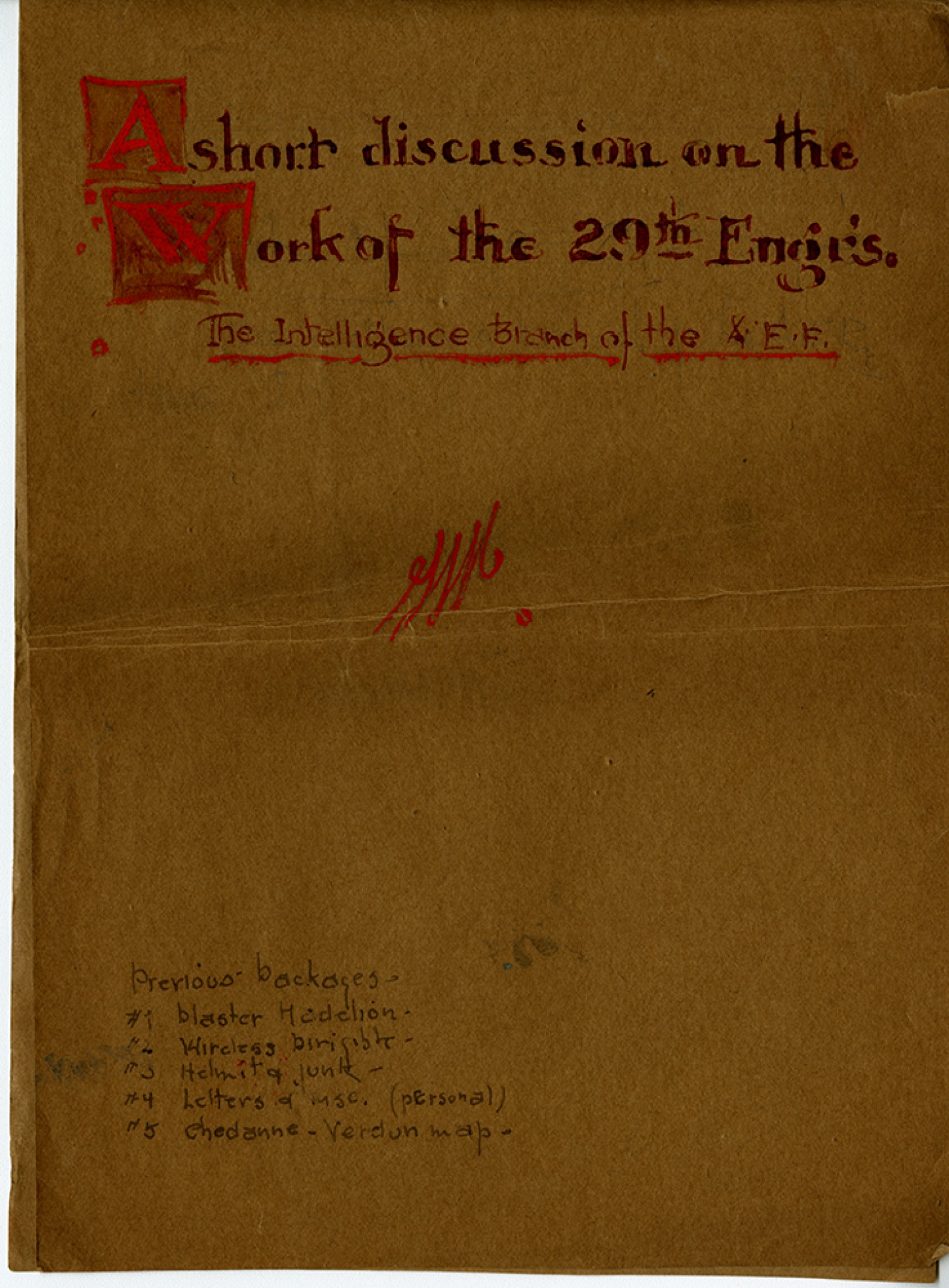
A short discussion on the Work of the 29th [Engineers]. The Intelligence Branch of the A.E.F. [George Maguolo] Previous Packages - #1 blaster Medelion - #2 Wireless Dirigible - #3 Helmet & Junk - #4 Letters and Misc. (personal) #5 Chedanne – Verdun Map
Transcript
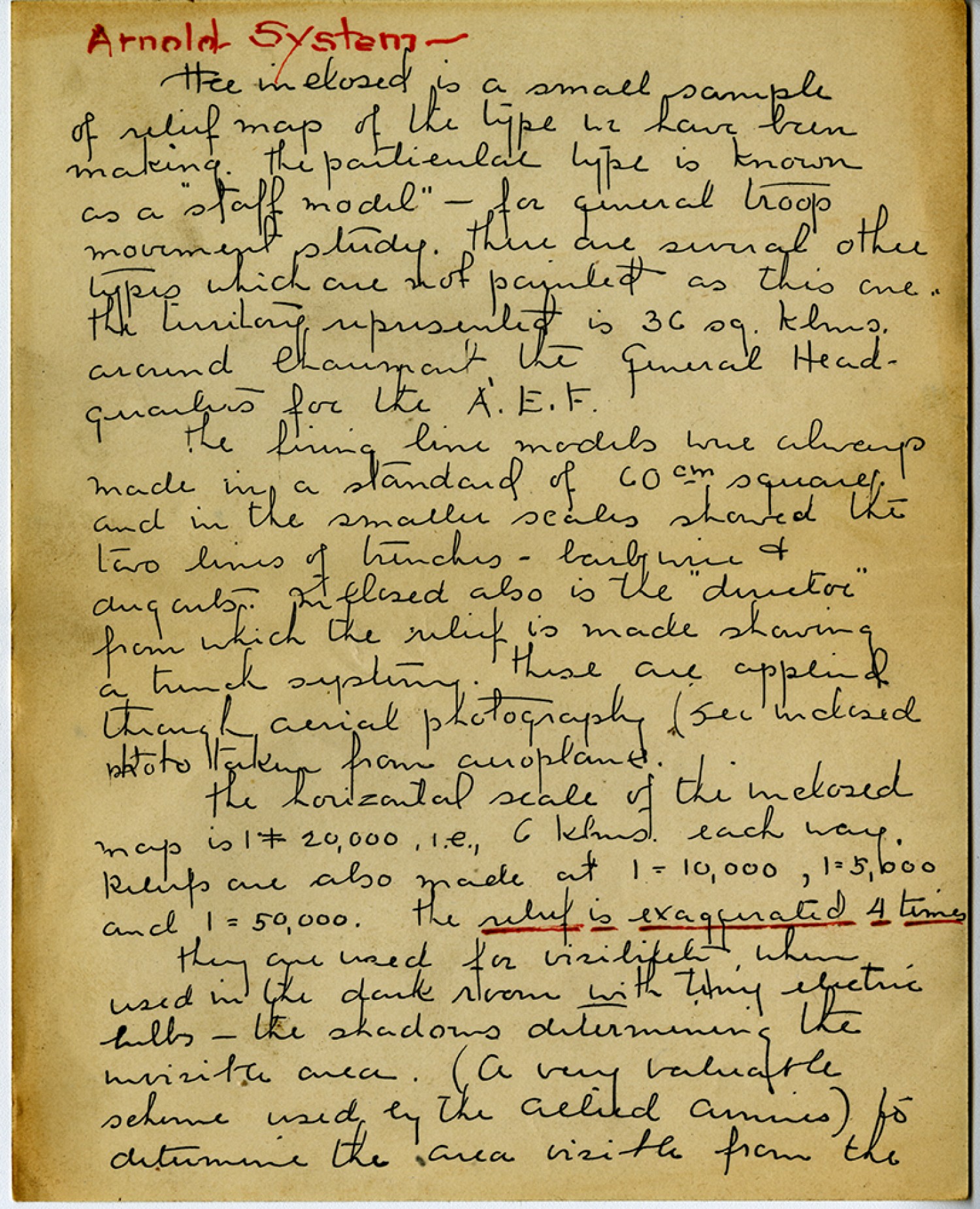
Arnold System – The inclosed is a small sample of relief map of the type we have been making. The particular type is known as a “staff model’ – for general troop movement study. There are several other types which are not painted as this one. The territory represented is 36 sq. klms. around Chaumont, the general Headquarters for the A.E.F. The firing line models were always made in a standard of 60 cm square and in the smaller scales showed the two lines of trenches – barbwire & dugouts. Inclosed also is the “director” from which the relief is made showing a trench system. these are applied through aerial photography (see inclosed photo taken from aeroplane. the horizontal scale of the inclosed map is 1 = 20,000, i.e. 6 klms. each way. Reliefs are also made at 1 = 10,000, 1 = 5,000 and 1 = 50,000. The relief is exaggerated 4 times. They are used for visibility when used in the dark room with tiny electric bulbs – the shadows determining the invisible area. (A very valuable scheme used by the Allied Armies) to determine the area visible from the
Transcript
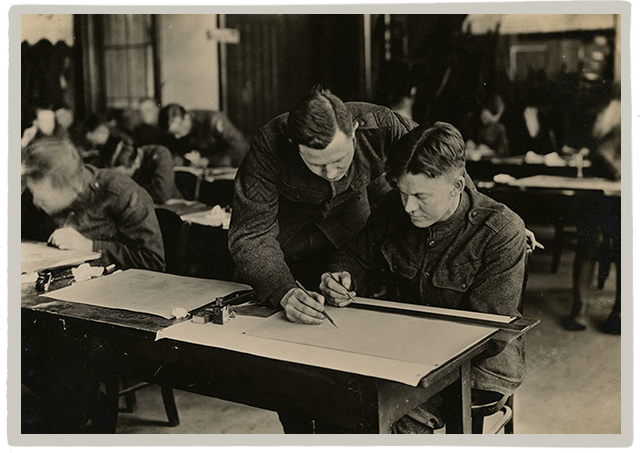
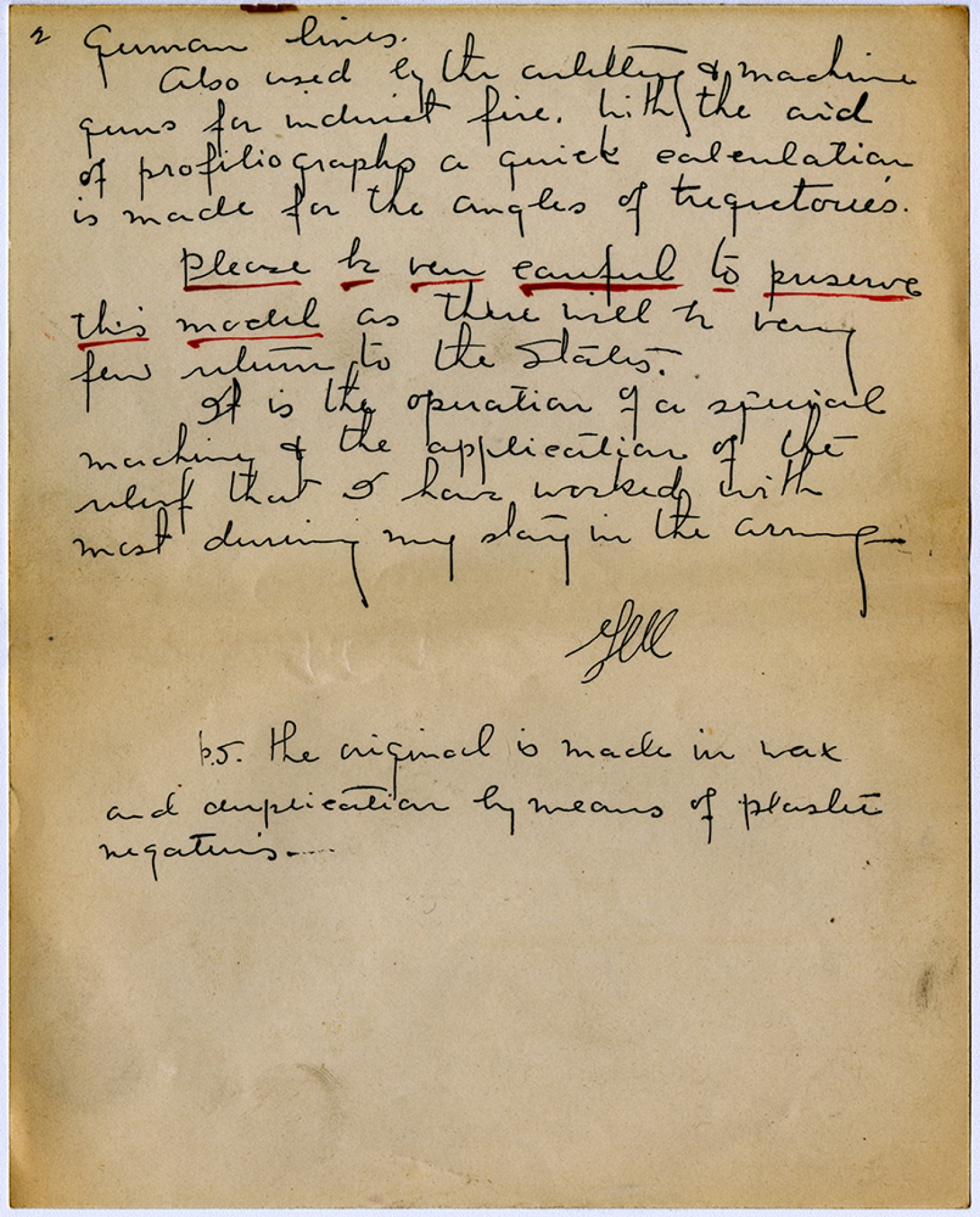
[page 2] german lines. Also used by the artillery & machine guns for indirect fire. With the aid of profilio graphs a quick calculation is made for the angles of tregectories. Please be very careful to preserve this model as there will be very few return to the States. It is the operation of a special machine & the application of the relief that I have worked with most during my stay in the Army. [George Maguolo] P.S. The original is made in wax and duplication by means of plastic negatives.
Transcript
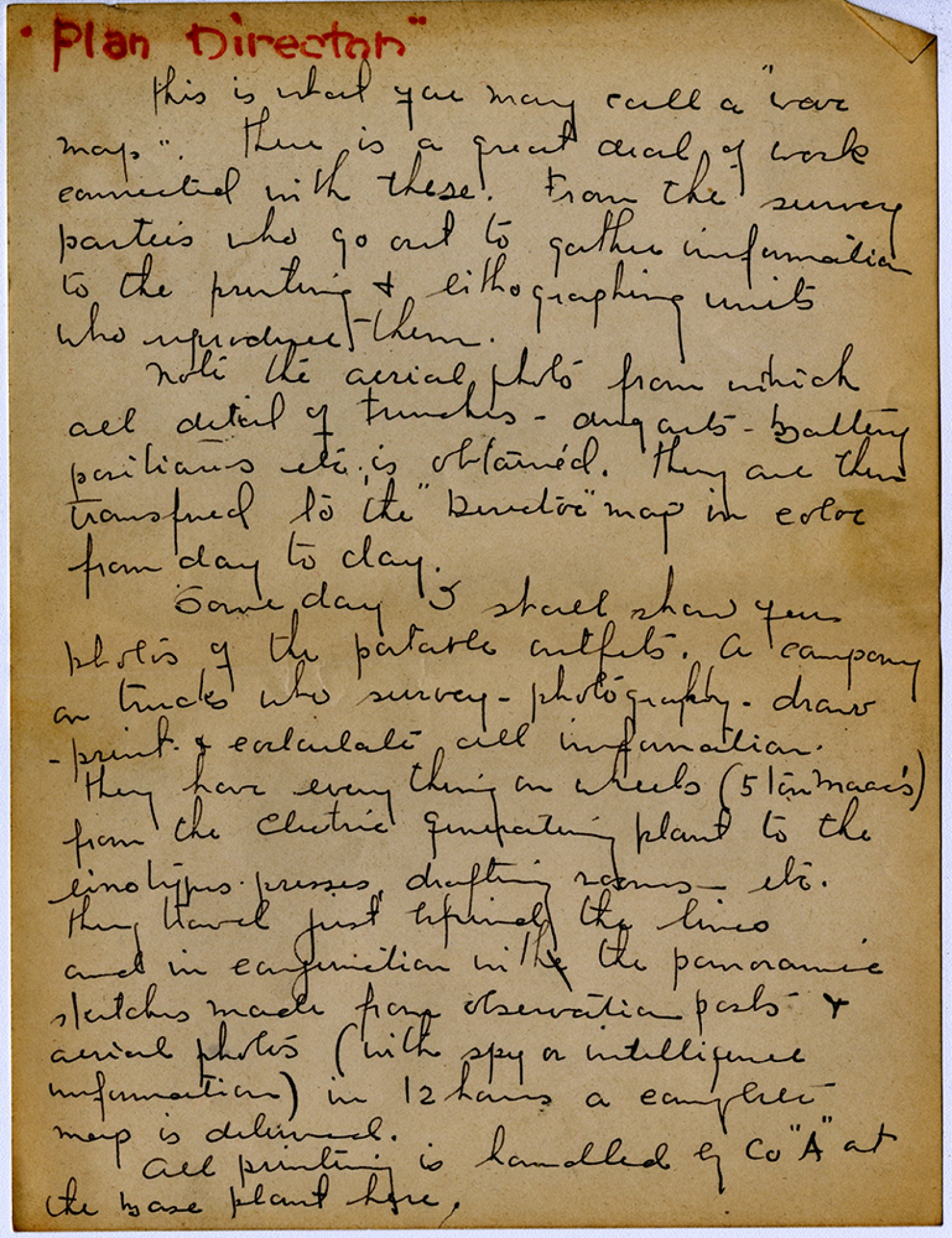
“Plan Direction” This is what you call a “war map.” There is a great deal of work connected with these. From the survey parties who go out to gather information to the printing & lithography units who reproduce them. Note the aerial photo from which all detail of trenches – dugouts – Battery positions etc. is obtained. they are then transferred to the “Director” map in color from day to day. Some day I shall show you photos of the protable outfits. A company on trucks who survey – photography – draw – print and calculate all information. they have every this on wheels (5 ton Mace’s) from the Electric generating plant to the linotypes presses drafting rooms – etc. they travel just behind the lines and in conjunction with the panoramic sketches made from observation posts & aerial photos (with spy or intelligence information) in 12 hours a complete map is delivered. All printing is handled by Co “A” at the base plant here.
Transcript
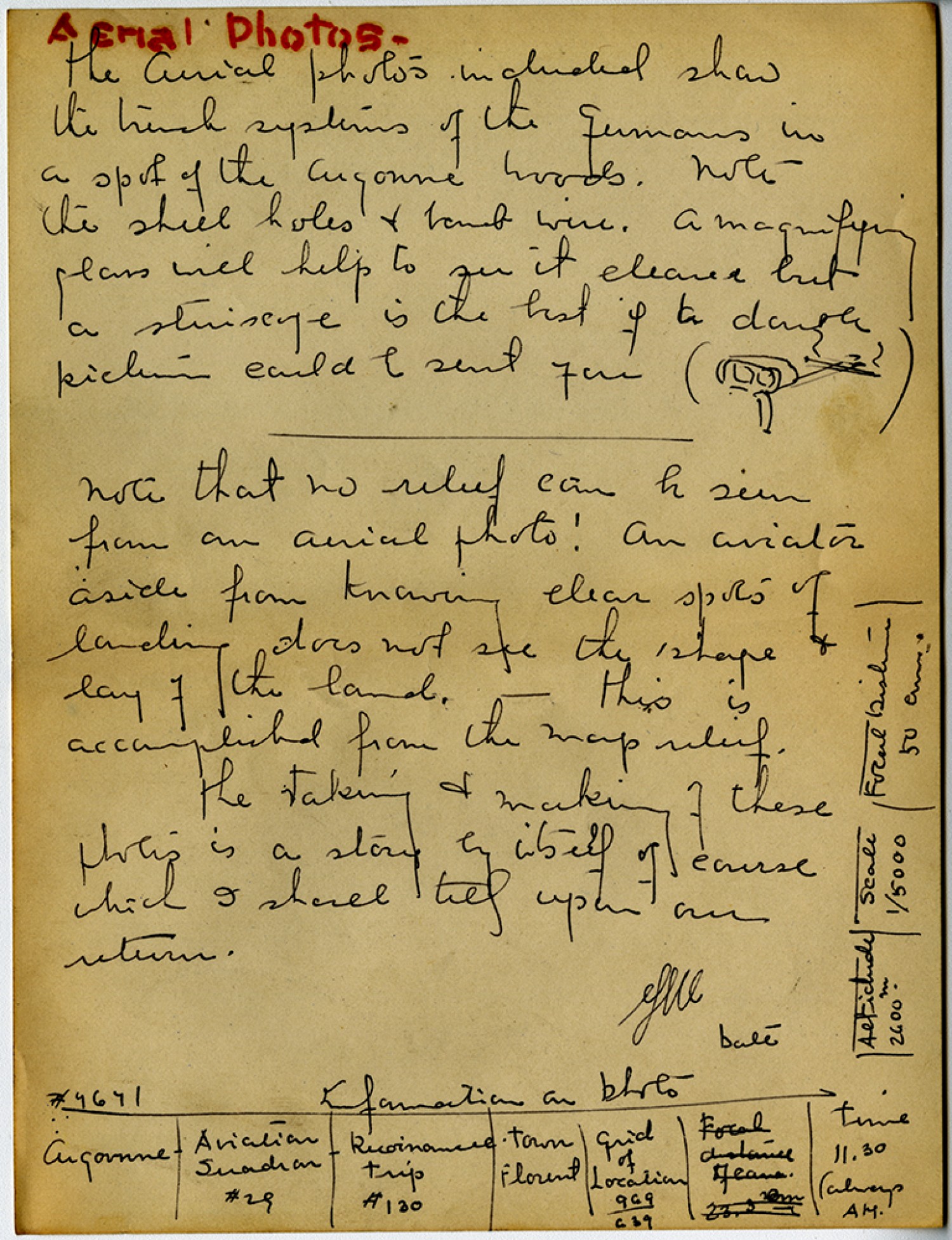
Aerial Photos – the aerial photos show the trench systems of the germans in a spot of the Argonne woods. Note the shell holes & barb wire. A magnifying glass will help to see it clearer but a steriscope is the best if a double picture could be sent you [sketch] - note that no relief can be seen from an aerial photo! An aviator aside from knowing clear spots of landing does not see the shape & lay of the land. - this is accomplished from the map relief. The taking & making of these photos is a story by itself of course which I shall tell upon our return. [George Maguolo] Date #4671 Explanation of photos [chart] Argonne Aviation Squadron #29 Recoinance Trip #130 Town Florent grid of location 969/639 Time 11.30 (Always A.M. Altitude 2600 m. Scale 1/5000 Focal Distance 50 cm.
Transcript
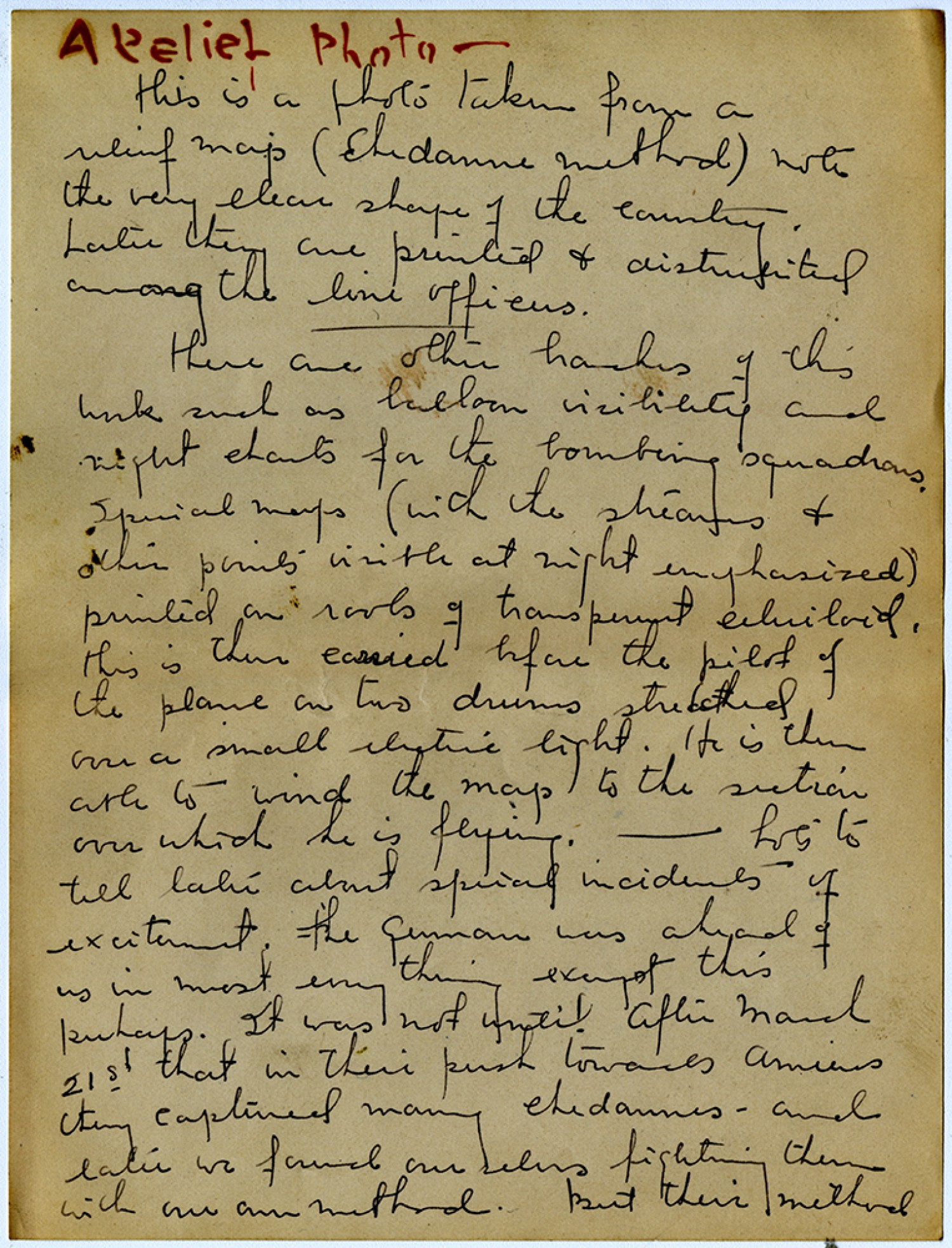
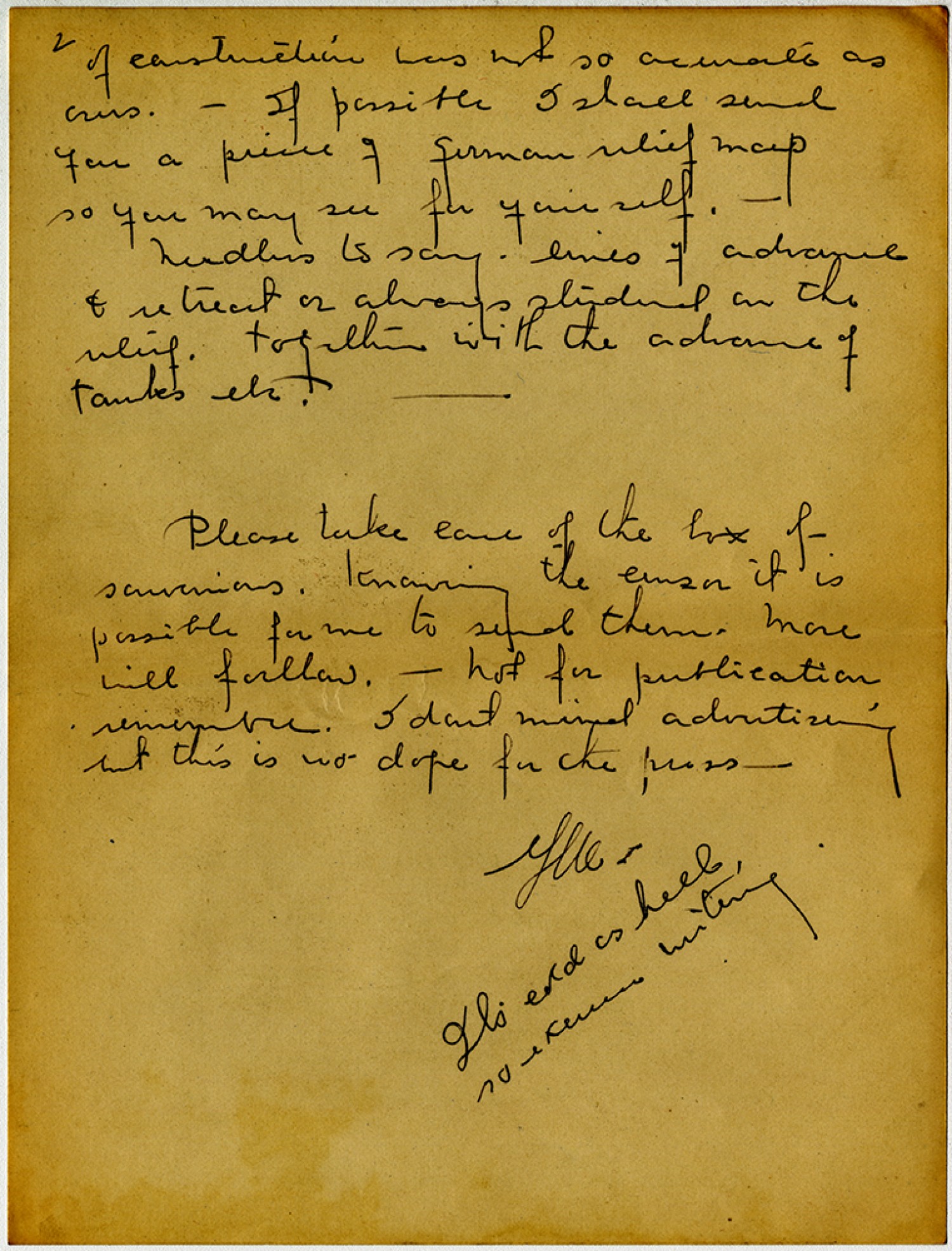
A Relief Photo – this is a photo taken from a relief map (Chedanne Method) note the very clear shape of the country. Later they are printed & distributed among the line officers. there are other branches of this work such as balloon visibility and night charts for the bombing squadrons. Special maps (with the streams & the points visible at night emphasized) printed on rolls of transparent celuiloid. This is then carried before the pilot of the plane on two drums stretched over a small electric light. He is then able to wind the maps to the section over which he is flying. - Lots to tell later about special incidents of excitement. the german was ahead of us in most every thing except this perhaps. It was not until after March 21st that in their push towards Amiens they captured many Chedannes – and later we found ourselves fighting them with our own method. But their method
Transcript
2 of construction was not so accurate as ours. - If possible I shall send you a piece of german relief map so you may see for yourself. – Needless to say, lines of advance & retreat are always standard on the relief. together with the advance of tanks etc. - Please take care of the box of souvenires. Knowing the censor it is possible for me to send them. More will follow. – not for publication remember. I don’t mind advertising but this is no dope for the press. [George Maguolo] It’s cold as hell, so excuse writing.
Details
| Title | George J. Maguolo A Short Discussion on the Work of the 29th Engineers - n.d. |
| Creator | Maguolo, George J. |
| Source | Maguolo, George J. A Short Discussion on the Work of the 29th Engineers. n.d. George J. Maguolo Papers, 1917-1945. A0969. Missouri History Museum, St. Louis, Missouri. |
| Description | George J. Maguolo wrote this short undated booklet while in France. Maguolo was in the 29th Engineers Company A and served in France until 1919. In this booklet, Maguolo provided information on his job and his unit. |
| Subject LCSH | World War, 1914-1918; World War, 1914-1918--Maps |
| Subject Local | WWI; World War I |
| Site Accession Number | A0969 |
| Contributing Institution | Missouri History Museum |
| Copy Request | Transmission or reproduction of items on these pages beyond those allowed by fair use requires the written permission of the Missouri History Museum: 314-746-4510 |
| Rights | The text and images contained in this collection are intended for research and educational use only. Duplication of any of these images for commercial use without express written consent is expressly prohibited. Contact the Missouri History Museum's Permissions Office at 314-746-4511 to obtain written consent. |
| Date Original | n.d. |
| Language | English |