Skinny Johnson and the Argonne Offensive by Otto P. Higgins - April 5
Transcript
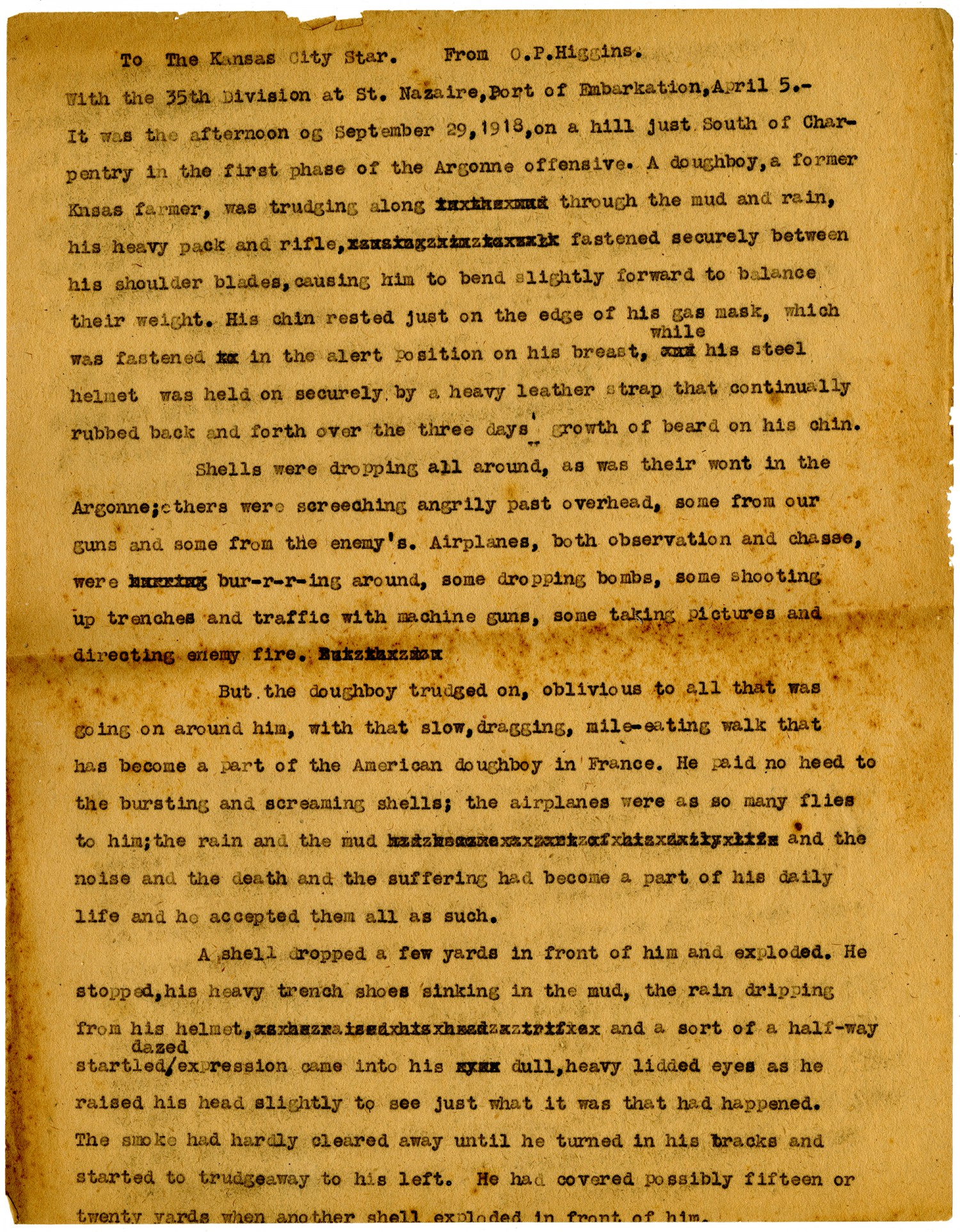
To The Kansas City Star. Form O.P Higgins. With the 35th Division at St. Nazaire, Port of Embarkation, April 5.- It was the afternoon og September 29, 1918, on a hill just South of Charpentry in the first phase of the Argonne offensive. A doughboy, a former Kansas farmer, was trudging along through the mud and rain, his heavy pack and rifle, fastened securely between his shoulder blades, causing him to bend slightly forward to balance their weight. His chin rested just on the edge of his gas mask, which was fastened in the alert position on his breast, while his steel helmet was held on securely by a heavy leather strap that continually rubbed back and forth over the three days; growth of beard on his chin. Shells were dropping all around, as was their wont in the Argonne; there were screeching angrily past overhead, some from our guns and some from the enemy
Transcript
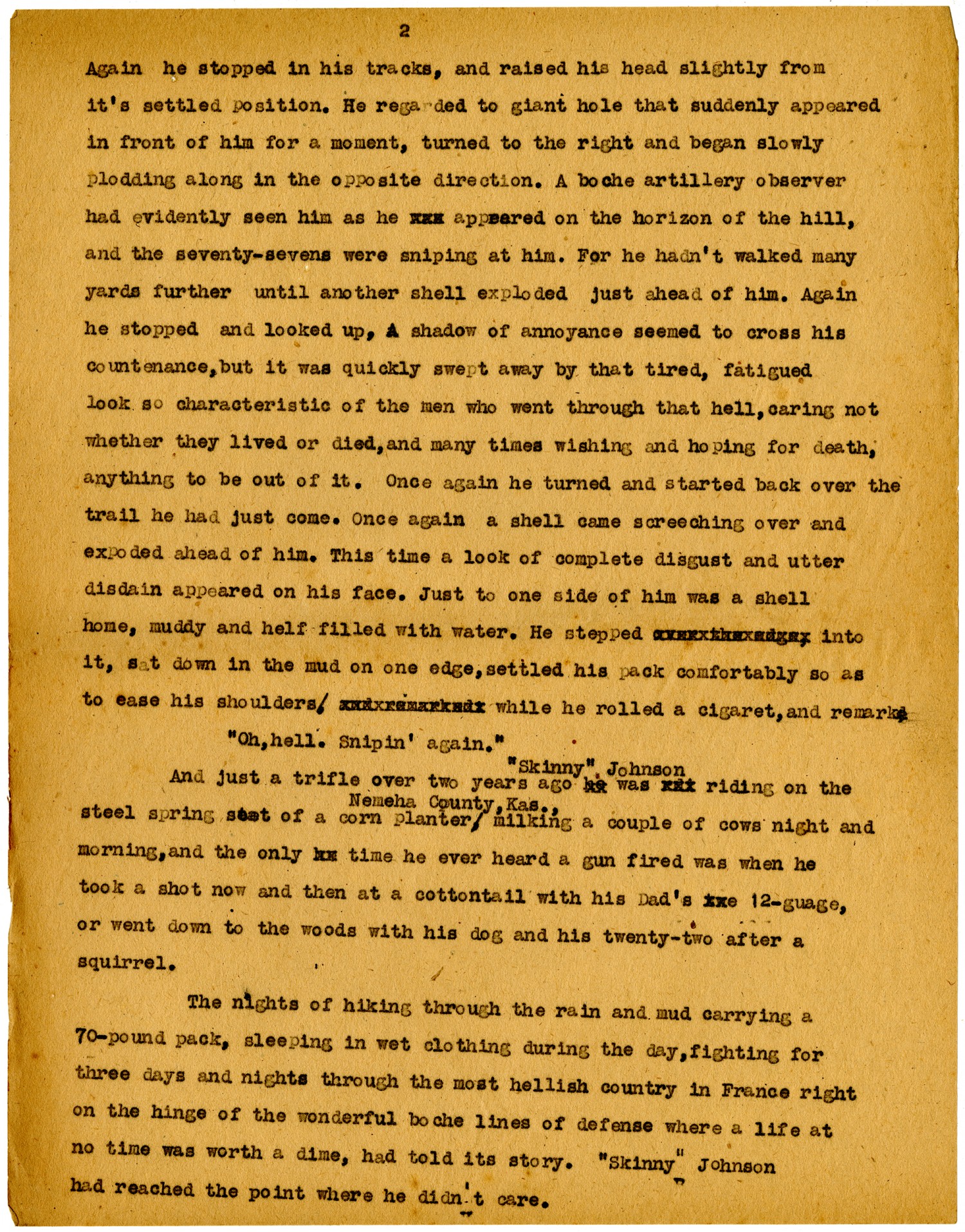
[page 2] Again he stopped in his tracks, and raised his head slightly from it
Transcript
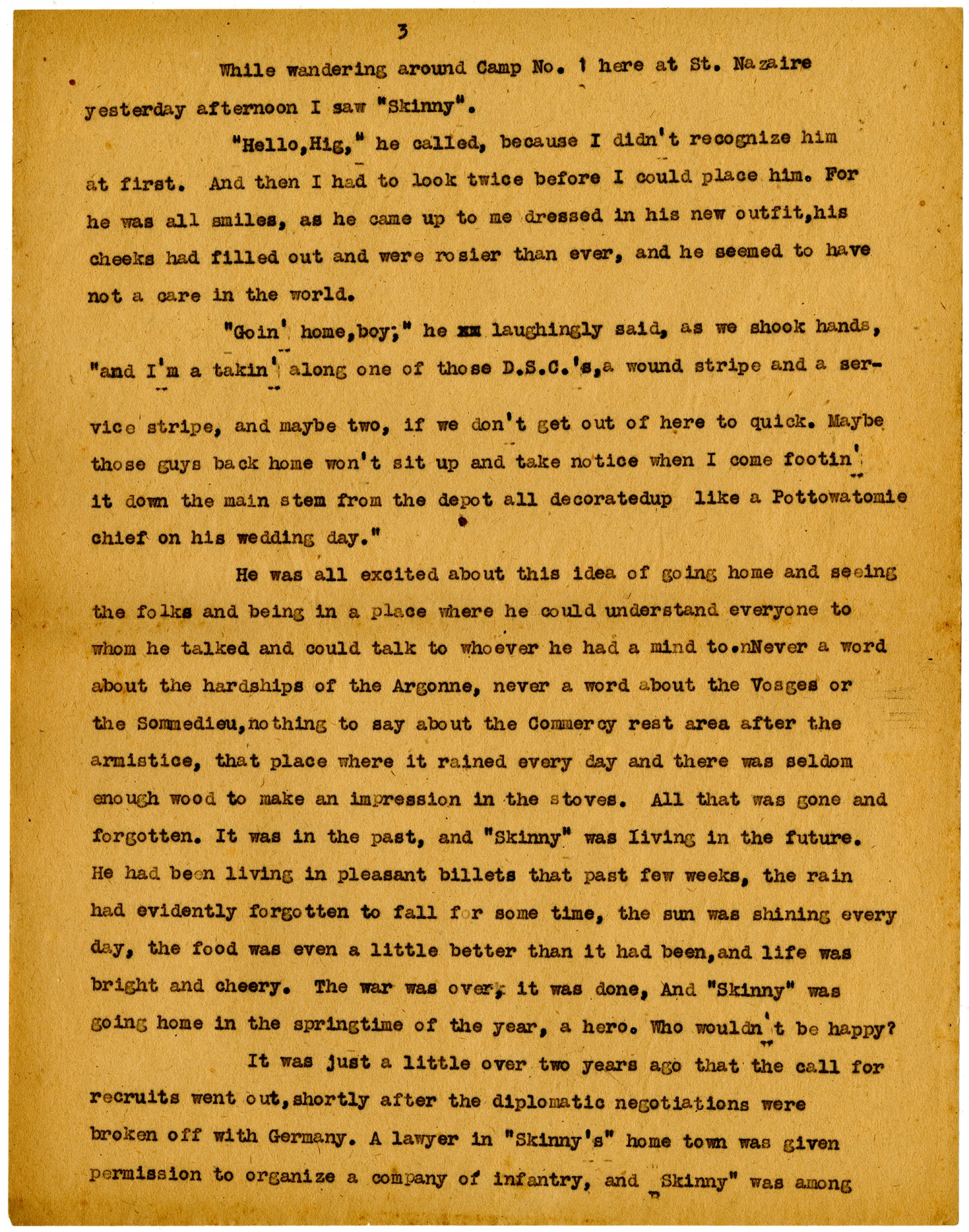
[page 3] While wandering around Camp No. 1 here at St. Nazaire yesterday afternoon I saw
Transcript
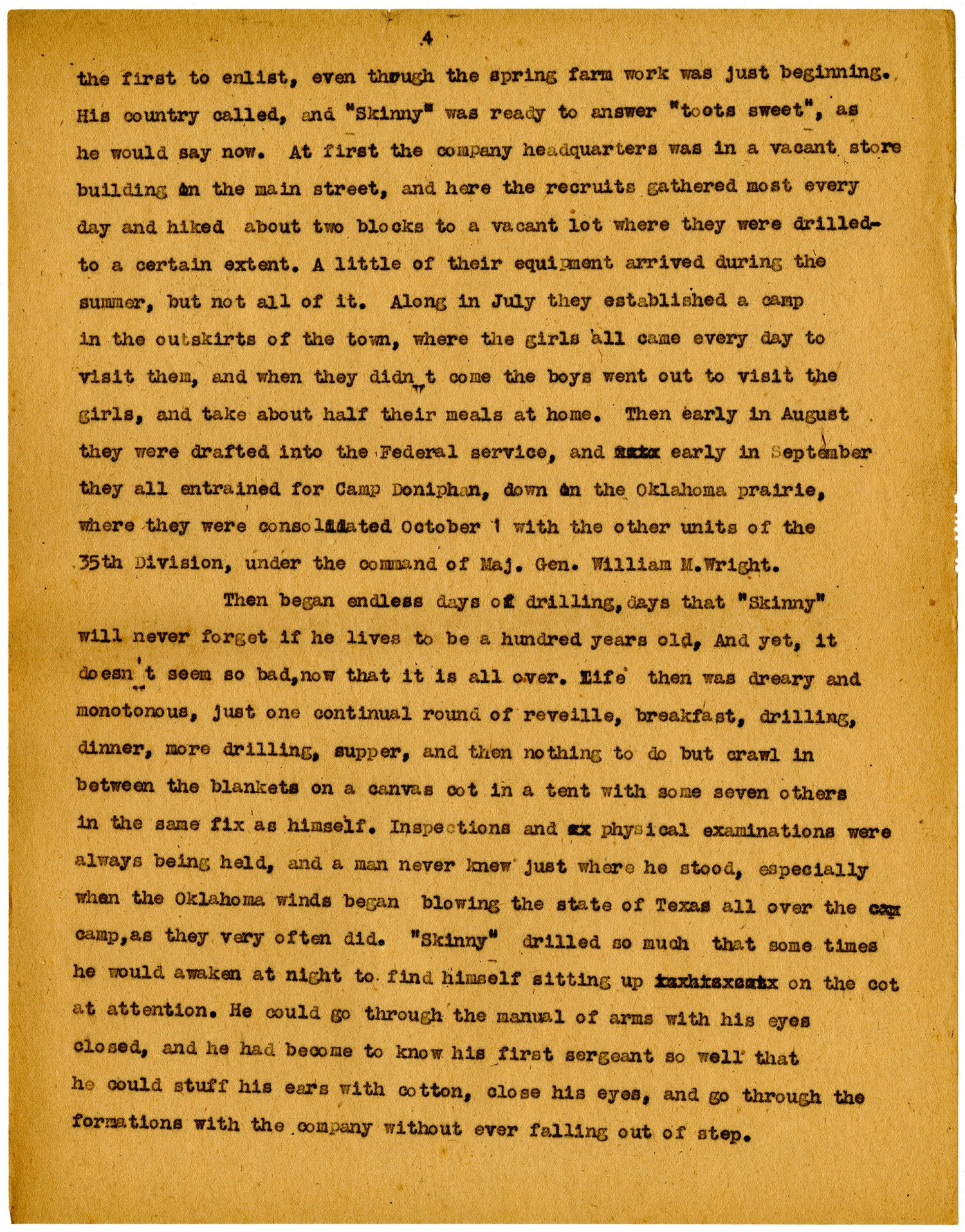
[page 4] the first to enlist, even though the spring farm work was just beginning. His country called, and
Transcript
[page 5] Back on the farm he had always been normally healthy. In fact, he had never been sick a day. But no one seemed to believe it at camp, for they were always examining him. There was one doctor who came around and didn
Transcript
[page 6] And
Transcript
[page 7] Wouldn
Transcript
[page 8] It was along towards the last of February when
Transcript
[page 9] The men were loaded in tourist sleepers and chair cars. They were happy at the prospect of getting to France at last, but, like all soldiers, they grumbled about riding in chair cars and sitting up all the way from Oklahoma to New York. Little did they dream of what was in store form them when the landed in France and began to travel, At Camp Mills, those who weren
Transcript
[page 10] The first shock came at Liverpool. I don
Transcript
[page 11] Finally, on May 7, the brigade cleared Camp Doniphan on its trip to France, where they were to be equipped with French artillery. At La Havre the men were having their troubles. They were scheduled to go with the British for training, so their American equipment was taken away and they were given British guns. Then they were taken out by British non-coms and given training in branches in which they felt they already were efficient. Besides, the city was only a mile or so away, and there was infinitely more adventure in a good sized city in a strange country than there was in an army camp. I was busily engaged in arguing in English with a French taxi driver who spoke only French, trying to impress upon him that I wanted to go to Camp No. 1, when I heard my name called. It was

Transcript
[page 12] Instead, sometimes when we would be sitting in the living room talking about war, and other things, she would squeeze my hand and say:
Transcript
[page 13] Orders to entrain for Eu came that afternoon. The men were piled helter skelter into little cars that were marked on the outside: Hommes 40 Chevaux 8 Which, translated means, forty men or eight horses. Straw, scattered on the floors of the freight cars, made it a trifle more comfortable, but every man there longed for the tourist and chair cars they were accustomed to in the States. It took some of the troops and entire night, and some of them a day and a night to make the trip, depending upon how many times their trains were shunted to one side to let others pass. But it was a wonderful ride for those who made it during the day. It was springtime in France, and the country was wonderfully green and beautiful. The villages, just a cluster of stone houses with high stone walls surrounding them, for the most part, the acres of tilled field laid out as neatly and as accurately as the lines on a checkerboard, the lack of the familiar barb wire fences, the old men and women working in the fields behind their oxen, a chateau now and then in the distance, everything was new and interesting and the boys crowded the doors of the tiny freight cars. The novelty of having Americans in France was still a novelty, and everytime the trains passed a French man, woman or child, there was a yelling and a waving of hands, for France was in dire straits at that time and the Americans were doubly welcome and hailed as saviors of the country, At Eu the men went into barracks, and another period of training began. Some of the men were sent into the line with the Australians,
Transcript
[page 14] The men all enjoyed their stay in the British sector. The weather was fine, the billets good, and more than all else, everything was strange and new to them. The only thing they couldn
Transcript
[page 15] It was a wonderful war in the Vosges in those days, and some queer stories were told about the fighting-or rather, the lack of fighting. One story said that both the boche and the French would hang their washing on the barb wire entanglements in front of their tranches. Another story said that there was a certain spring in No Man
Transcript
[page 16] were all glad to see the boys, for they were all a happy go lucky, care free sort, who make friends any place they go, and Saulxures [Saulzures] was a nice place to go. And on June 11 when the third battalion was loaded into trucks on their was to relieve the 138th both the natives and the soldiers were sorry. The two other battalions followed in a few days. During all this time the artillery was on its way over. The first section moved out of Doniphan May 7, and by the Tenth all three regiments were on their way East to the port of embarkation. They were shot right through and over to France, where they were sent to an artillery training camp St. Nazaire, where they received additional instruction from the French. Hostilities were formally opened in the sector the night of July 6, when, after an intense barrage lasting more than an hour, Company H of the 138th raided the boche lines at Hilsenfirst and brought back seven prisoners. This was the first raid put on by the 35th, and it was the first real artillery barrage the men had ever heard. But it wasn
Transcript
[page 17] Major Davis, myself and one officer from each company of his battalion composed the advance guard of the 140th that went up into the mountains to familiarize ourselves with the sector, then being held by the 138th, prepratory to relieving the St. Louis regiment. We drove Saulzures to Fellering in motor trucks, and form there took a G.S. wagon, which means general service, for our trip up the mountainside. War or no war, it was one of the most scenic roads in France. It followed the valley for about two kilometers, and then began to wind up the mountain like a ladder, one side going straight up and on the other a precipice. The tall slender pines were so thick that the sun rarely was able to penetrate the heavy shadows. After four hours of steady climbing the trees ceased, and we began to see the war. Barb wire entanglements, shell holes, dugouts, camouflaged roads, camouflaged batteries, little clusters of dugouts here and there that housed both French and American troops shell scarred trees, and the other things that go to make up a front line. It was dark when we reached regimental headquarters, and almost 11 p
Transcript
[page 18] And stumbling along there in the darkness that thing called fear crept into us, and later, they all admitted having been scared. It seemed that we were halted every five minutes by a voice that came out of the darkness. Three times we had to stop while sentries removed barb wire entanglements form the footpath, for at night every path is doubly guarded, both by sentries and by wire, for no one wanted any boche spies slipping into the woods and sniping during the day. It was about 1 o
Transcript
[page 19] Nothing I could say seemed to have any effect upon him, and I finally had to go away, leaving him sitting on a rock at the roadside, with his face buried in the palms of his hands, a disconsolate and forlorn solider. The battalion was established at Fellering, waiting for orders to begin their hike up the mountain to make the relief. I made the town at sunset, and decided to remain over for the night and attend the festivities. The town was gaily decorated with the French and American colors, two stages had been erected for celebrations, one for the children and one for the grown-ups, athletic contests had been staged in the afternoon, and every one was having a great time. It was France
Transcript
[page 20 ] It was France
Transcript
[page 21] Gen. Peter E. Traub then took command and had charge of the division from then on until after the armistice when it was occupying the Commercy area. General Wright organized three army corps, was placed in command of the Eighty-ninth Division just prior to the St. Mihiel drive, and remained with it until the day the armistice was signed, when he again was placed in charge of a corps after having piloted the division successfully through the St. Mihiel and the Meuse-Argonne scrap. The boys were getting pretty well fed up on living in the trenches. When one brigade was in, it wasn
Transcript
[page 22] The men were wet nearly all the time. No fires were allowed during the day, and not much cooking was done. You didn
Transcript
[page 23] after daylight. Every time a shell would come whizzing over I would drop to the side of the road. But the others, who were under fire for the first time in their lives, seemed to enjoy it. None of them seemed to be as frightened as I, and I had been living under similar conditions most of the summer. I thought they would learn better after they had been through it for a while, but later, in the Argonne, I was with them again and they paid no more heed to Jerry
Transcript
[page 24] The 137th and the 138th jumped off the first day, leaving the 139th and the 140th to follow in reserve. How they ever got through none of them know. Acres and acres of bar wire entanglements, entanglements as only the boche know how to make; machine gun nests every place where one could possibly be concealed; shells dropping all the time, in every place. It was every man for himself, almost, No one had time for prisoners. It was just go, go, go, annihilating machine guns nests and machine gunners all the way. It was the first of five terrible, horrible, hellish days and nights; days and nights of fighting, dying, rain, shells, bullets, gas, bully beef and hard tack, for none of the units were able to get their kitchens up, or cook hot food. Remember, the men were eating their way through the famous Hindenburg line, that string of defenses, both natural and artificial, that the boche said never could be penetrated. And the first days advance led them through about six kilometers of it, taking in Vauquois Hill, that famous hill that cost so many French lives and still they were unable to even scratch it. But our men went right around it, and then swarmed over it like rats on a sinking ship, regardless of machine guns, mines, traps, and artillery. Nothing made them stop or duck, and the boche couldn
Transcript
[page 25] strongly fortified positions, places that the boche considered impregnable. Varennes was outside of the division area, but that didn
Transcript
[page 26] The second day the 139th and the 140th pushed through the 137th and the 138th, and attacked, leaving the other two regiments to follow in support. The going was much heavier. The boche kew what was going on by that time, and the boche artillery, using shrapnel, high explosive and gas shells, was working all the time. Only about three kilometers were made on the second day, but the towns of Baulny and Charpentry were taken, two other positions the boche never expected to give up. And, if you had had an opportunity to walk over the ground since the battle, as I have done, you wouldn
Transcript
[page 27] I know of a priest, a regimental chaplain, who went around, a .45 caliber automatic in one hand and a cane in the other, rounding up men and appointing non-coms as captains to take charge of them. I know a captain who led a regiment. There wasn
Transcript
[page 28] That will give you some idea of how the men worked in the Argonne and what they went through. The above incident has never been printed, and I don
Transcript
[page 29]
Transcript
[page 30] it isn
Transcript
[page 31] Supplies could wait, but the artillery had to have shells and the machine guns bullets if the war was to be won. Time after time I have seen the M.P.
Transcript
[page 32] We stopped for two nights and a day at a French camp, as soon as we were well out of range of the long range funs. I was walking down the road the first night with the padre, the same one who ran up and down the front line with his .45 reorganizing the men. The 140th had gone into camp on a hillside, where the boys pitched their pup tents. I think they mustered about 650 men that morning, when, only a week before there was about three thousand of them. Supper was over and it was just getting dark. The boys were, for the most part sitting in front of their little tents smoking, or lying inside rolled up in their blankets. Fires were forbidden, because they were an open invitation to boche bombing planes. All was as quiet as a church. What little talking there was was so low it was inaudible to us. Not even a song was heard.
Transcript
[page 33] Given a week of rest, food, good billets, and outwardly the men will be just as before. But inwardly, wre the heart is, they will be different. They will be pure and clean, due to the refining influences of living five days and nights in hell.
Transcript
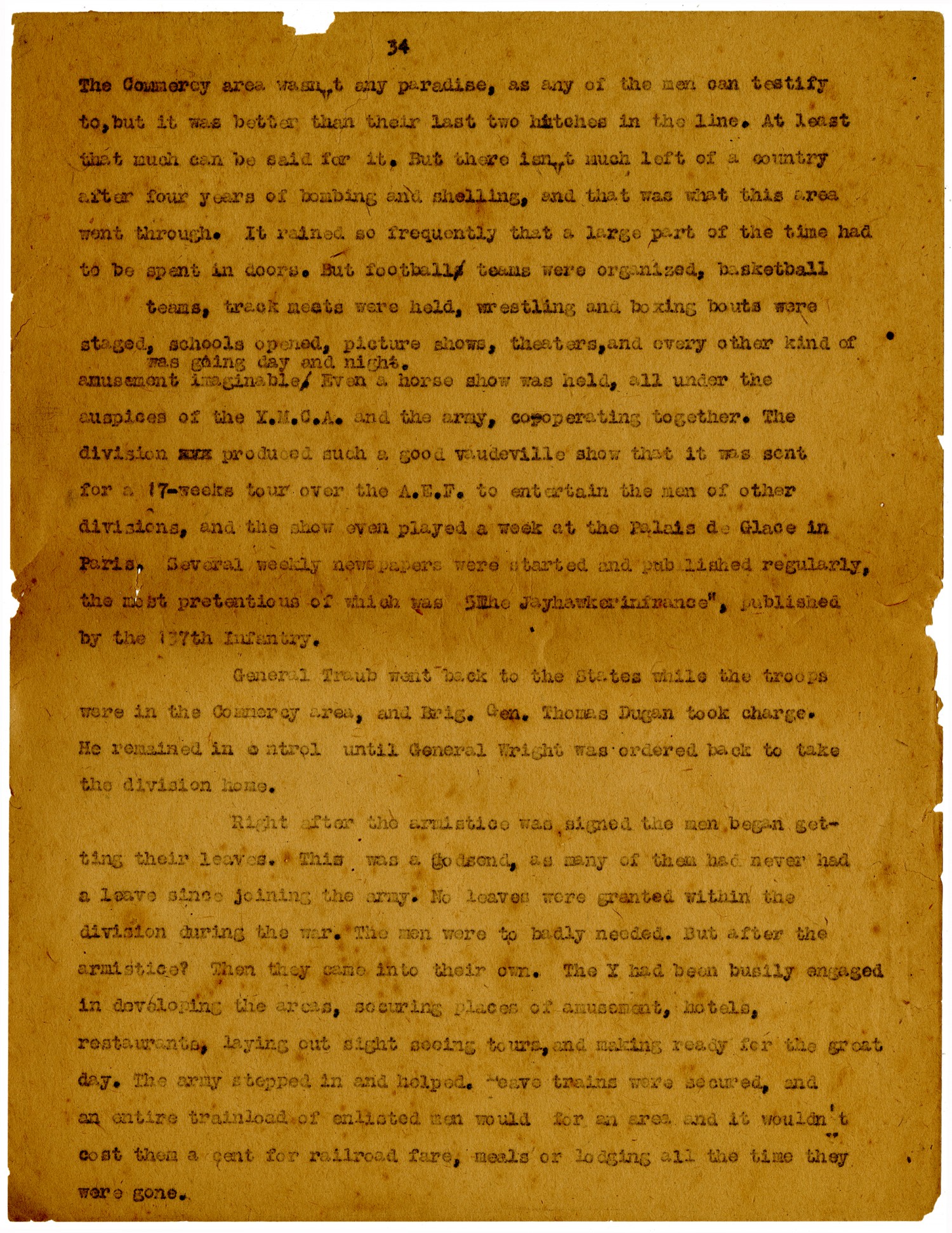
[page 34] The Commercy area wasnt any paradise, as any of the men can testify to, but it was better than their last two hitches in the line. At least that much can be said for it. But there isnt much left of a country after four years of bombing and shelling, and that was what this area went through. It rained so frequently that a large part of the time had to be spent in doors. But football teams were organized, basketball teams, track meats were held, wrestling and boxing bouts were staged, schools opened, picture shows, theaters, and every other kind of amusement imaginable was going day and night. Even a horse show was held, all under the auspices of the Y.M.C.A. and the army, cooperating together. The division produced such a good vaudeville show that it was sent for a 17-weeks tour over the A.E.F. to entertain the men of other divisions, and the show even played a week at the Palais de Glace in Paris. Several weekly newspapers were started and published regularly, the most pretentious of which was The Jayhawker infrance
Transcript
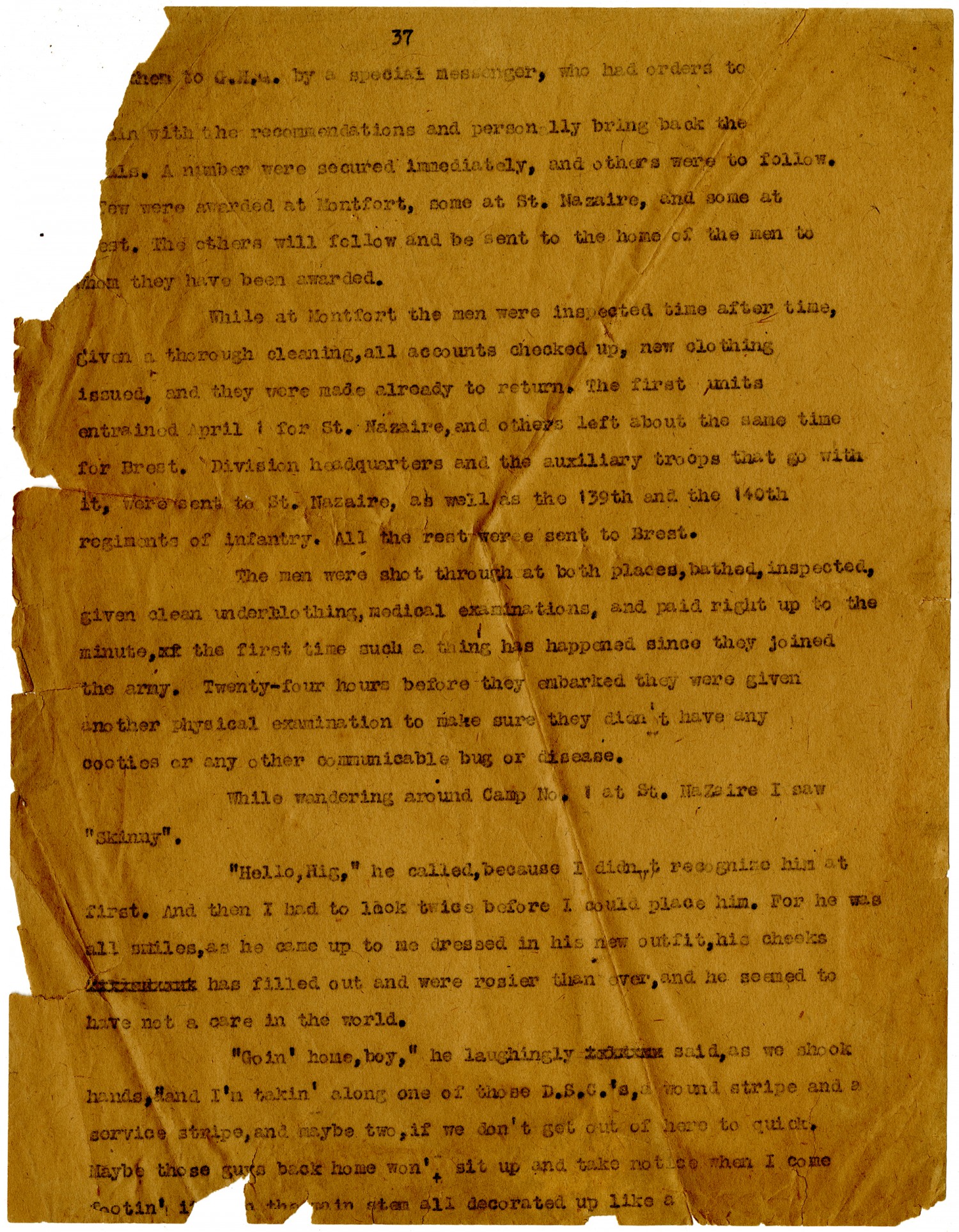
[page 37] [m.s. torn] to G.H. G.by a special messenger, who had orders to [m.s. torn] with the recommendations and personally bring back the [m.s. torn] A number were secured immediately, and others were to follow. [m.s. torn] were awarded at Montfort, some at St. Nazaire, and some at [m.s. torn] The others will follow and be sent to the home of the men to whom they have been warded. While at Montfort the men were inspected time after time, given a thorough cleaning, all accounts checked up, new clothing issued, and they were made already to return. The first units entrained April 1 for St. Nazaire, and others left about the same time for Brest. Division headquarters and the auxiliary troops that go with it, were sent to St. Nazaire, as well as the 139th and the 140th regiments of infantry. All the rest were sent to Brest. The men were shot through at both places, bathed, inspected, given clean underclothing, medical examinations, and paid right up to the minute, the first time such a thing has happened since they joined the army. Twenty-four hours before they embarked they were given another physical examination to make sure they didn
Transcript
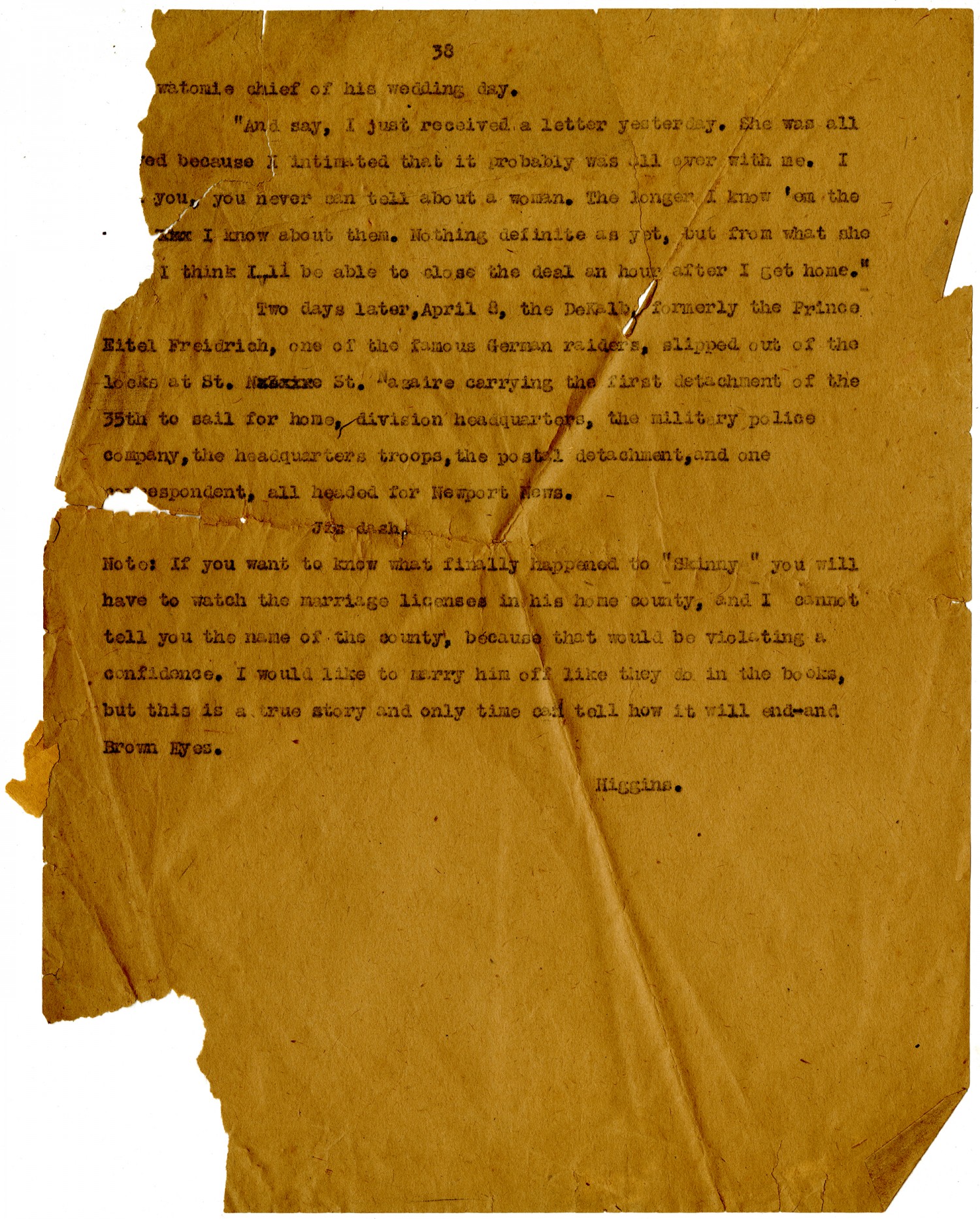
[page 38] [m.s. torn] chief of his wedding day.
Details
| Title | Skinny Johnson and the Argonne Offensive by Otto P. Higgins - April 5 |
| Creator | Higgins, Otto P. |
| Source | Higgins, Otto P. Skinny Johnson and the Argonne Offensive. 05 April. Higgins, Otto P. Collection. 2010.145. The National World War I Museum, Kansas City, Missouri. |
| Description | Otto P. Higgins gives an account of the Argonne offensive through the character "Skinny" Johnson. Higgins follows Johnson's story from the beginning days at Camp Doniphan, through the Argonne Offensive, and finally to Johnson's embarkation. Higgins provides a detailed description of the termoil soldiers encountered on the Argonne offensive. |
| Site Accession Number | 2010.145 |
| Contributing Institution | National World War I Museum and Memorial |
| Copy Request | Transmission or reproduction of items on these pages beyond that allowed by fair use requires the written permission of the National World War I Museum and Memorial: (816) 888-8100. |
| Rights | The text and images contained in this collection are intended for research and educational use only. Duplication of any of these images for commercial use without express written consent is expressly prohibited. |
| Language | English |