James E. Henschel letter to Mrs. Leopold H. Henschel - July 14, 1919
Transcript
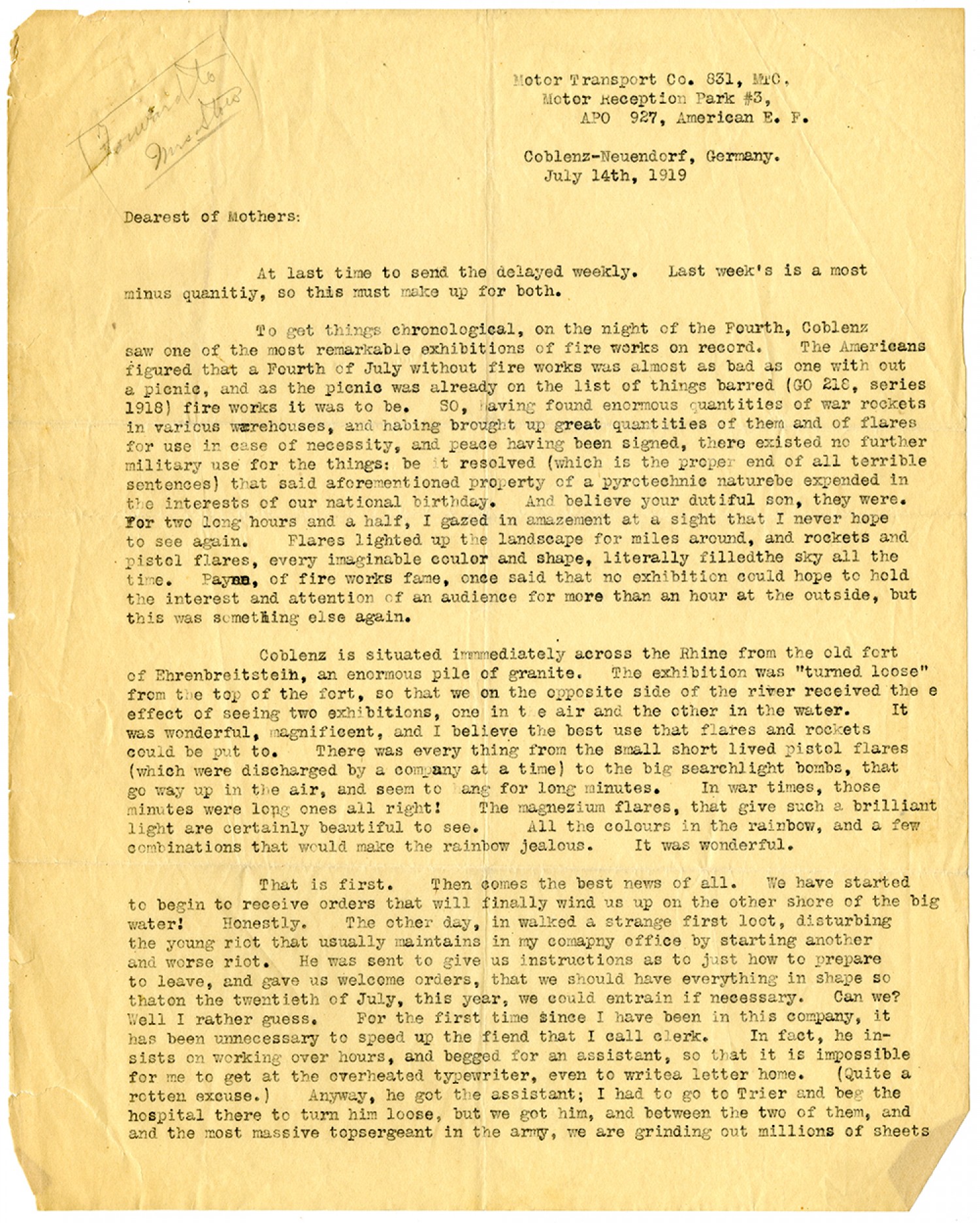
Forward to Mrs. Stoes Motor Transport Co. 831, MTC, Motor Reception Park #3, APO 927, American E. F. Coblenz-Neuendorf, Germany. July 14th, 1919 Dearest of Mother: At last time to send the delayed weekly. Last week's is a most minus quantity, so this must make up for both. To get things chronological, on the night of the Fourth, Coblenz saw one of the most remarkable exhibitions of fire works on record. The Americans figured that a Fourth of July without fire works was almost as bad as one with out a picnic, and as the picnic was already on the list of things barred (GC 218, series 1918) fire works it was to be. SO, having found enormous quantities of war rockets in various warehouses, and having brought up great quantities of them and of flares for use in case of necessity, and peace having been signed, there exited no further military use for the things: be is resolved (which is the proper end of all terrible sentences) that said aforementioned property of the pyrotechnic nature be expanded in the interests of our national birthday. And believe your dutiful son, they were. For two long hours and a half, I gaze in amazement at a sigh that I never hope to see again. Flares lighted up the landscape for miles around, and rockets and pistol flares, every imaginable colour and shape, literally filled the sky all the time. Pay, of fire works fame, once said that no exhibition could hope to hold the interest and attention of an audience for more than an house at the outside, but this was something else again. Coblenz is situated immediately across the Rhine from the old fort of Ehrenbreistein, an enormous pile of granite. The exhibition was "turned loose" from the top of the fort, so that we on the opposite side of the river received the e effect of seeing two exhibitions, one in the air and the other in the water. It was wonderful, magnificent, and I believe the best use that flares and rockets could be put to. There was every thing from the small short lived pistol flares (which were discharged by a company at a time) to the big searchlight bombs, that go way up in the air, and seem to hang for long minutes. In war time, those minutes were long ones all right! The magnezium flares, that give such a brilliant light are certainly beautiful to see. All the colours in the rainbow, and a few combinations that would make the rainbow jealous. It was wonderful. That is first. Then comes the best news of all. We have started to begin to receive orders that will finally wind us up on the other shore of the big water! Honestly. The other day, in walked a strange first loot, disturbing the young riot that usually maintains in my company office by starting another and worse riot. He was sent to give us instructions as to just how to prepare to leave, and gave us welcome orders, that we should have everything in shape so that on the twentieth of July, this year, we could entrain if necessary. Can we? Well I rather guess. For the first time since I have been in this company, it has been unnecessary to speed up the fiend that I call clerk. In fact, he insists on working over hours, and begged for an assistant, so that it is impossible for me to get at the overheated typewriter, even to write a letter home. (Quite a rotten excuse.) Anyway, he got the assistant; I had to go to Trier and beg the hospital there to turn him loose, but we got him, and between the two of them, and and the most massive topsergeant in the army, we are grinding out millions of sheets
Transcript
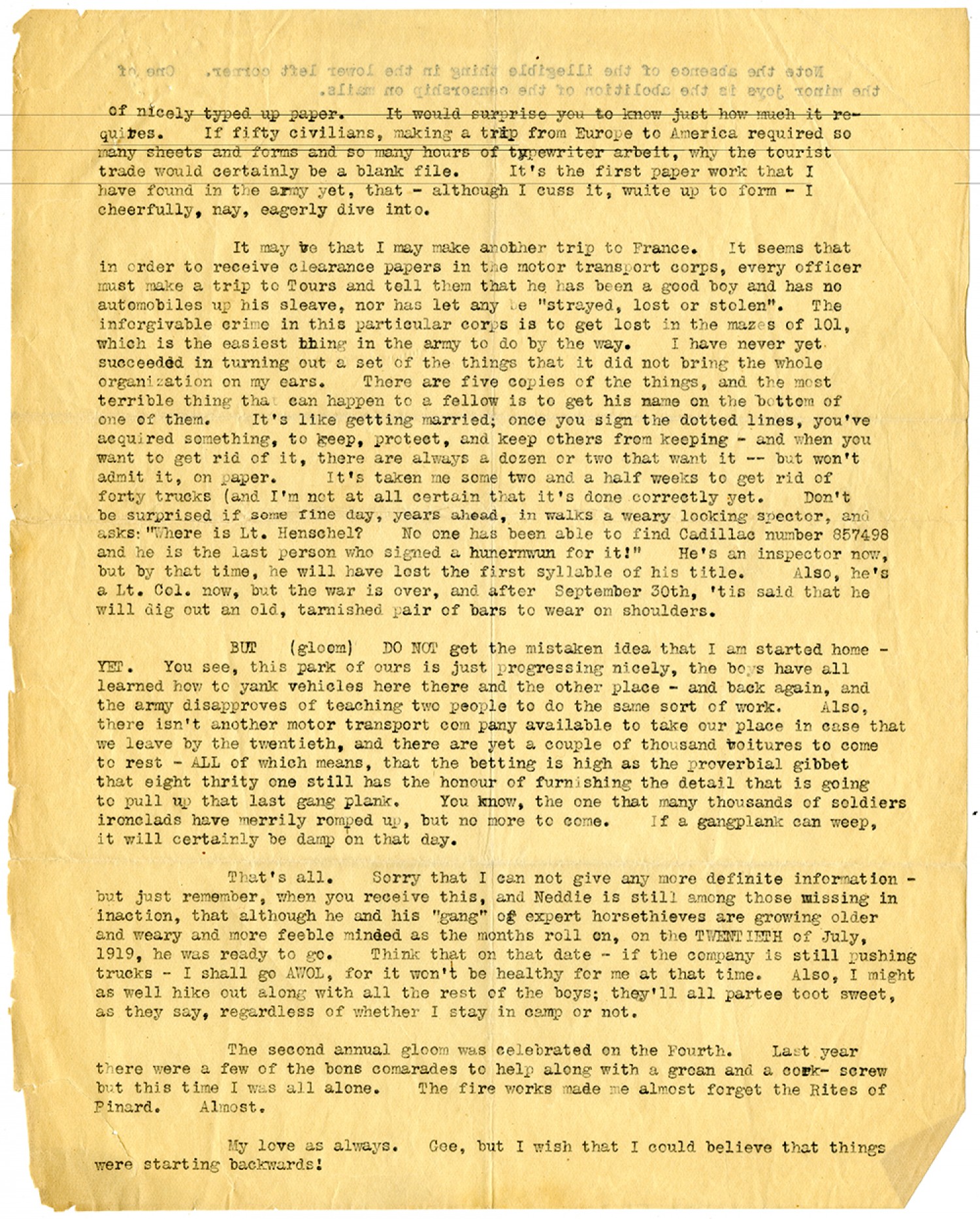
of nicely typed up paper. It would surprise you to know just how much it requires. If fifty civilians, making a trip from Europe to American required so many sheets and forms and so many hours of typewriter arbeit, why the tourist trade would certainly be a blank file. It's the first paper work that I have found in the army yet, that - although I cuss it, write up to form - I cheerfully, nay, eagerly dive into. It may be that I may make another trip to France. it seems that in order to receive clearance papers in the motor transport corps, every officer must make a trip to Tours and tell them that he has been a good boy and has no automobiles up his sleave, no has let any be "strayed, lost or stolen". The inforgivable crime in this particular corps is to get lost in the mazes of 101, which is the easiest thing in the army to do by the way. I have never yet succeeded in turning out a set of the things that it did not bring the whole organization on my ears. There are five copies of the things, and the most terrible thing that can happen to a fellow is to get his name on the bottom one of them. It's like getting married; once you sign the dotted lines, you've acquired something, to keep, protect, and keep others from keeping - and when you want to get rid of it, there are always a dozen or two that want it -- but won't admit it, on paper. It's taken me some two and a half weeks to get rid of forty trucks (and I'm not at all certain that it's done correctly yet. Don't be surprised if some fine day, years ahead, in walks a weary looking spector, and asks: "Where is Lt. Henschel? No one has been able to find Cadillac number 857498 and he is the last person who signed a hunderwun for it!" he's an inspector now, but by that time, he will have lost the first syllable of his title. Also, he's a Lt. Col. now, but the war is over, and after September 30th, 'tis said that he will dig out an old, tarnished pair of bars to wear on shoulders. BUT (gloom) DO NOT get the mistaken idea that I am started home - YET. You see, this park of ours is just progressing nicely, the boys have all learned how to yank vehicles here there and the other place - and back again, and the army disapproves of teaching two people to do the same sort of work. Also, there isn't another motor transport company available to take our place in case that we leave by the twentieth, and there are yet a couple of thousand voitures to come to rest - ALL of which means, that the betting is high as the proverbial gibbet that eight thirty one still has the honour of furnishing the detail that is going to pull up that last gang plank. You know, the one that many thousands of soldiers ironclads have merrily romped up, but no more to come. If a gangplank can weep, it will certainly be damp on that day. That's all. Sorry that I can not give any more definite information - but just remember, when you receive this, and Neddie is still among those missing in inaction, that although he and his "gang" of expert horsethieves are growing older and weary and more feeble minded as the months rolls on, on the TWENTIETH of July, 1919, he was ready to go. Think that on that date - if the company is still pushing trucks - I shall go AWOL, for it won't be healthy for me at that time. Also, I might as well hike out along with all the rest of the boys; they'll all partee toot sweet, as they say, regardless of whether I stay in camp or not. The second annual gloom was celebrated on the Fourth. Last year there were a few of the bons comarades to help along with a groan and a cork-screw but this time I was all alone. The fire works made me almost forget the Rites of Pinard. Almost. My love as always. Gee, but I wish that I could believe that things were starting backwards!
Transcript
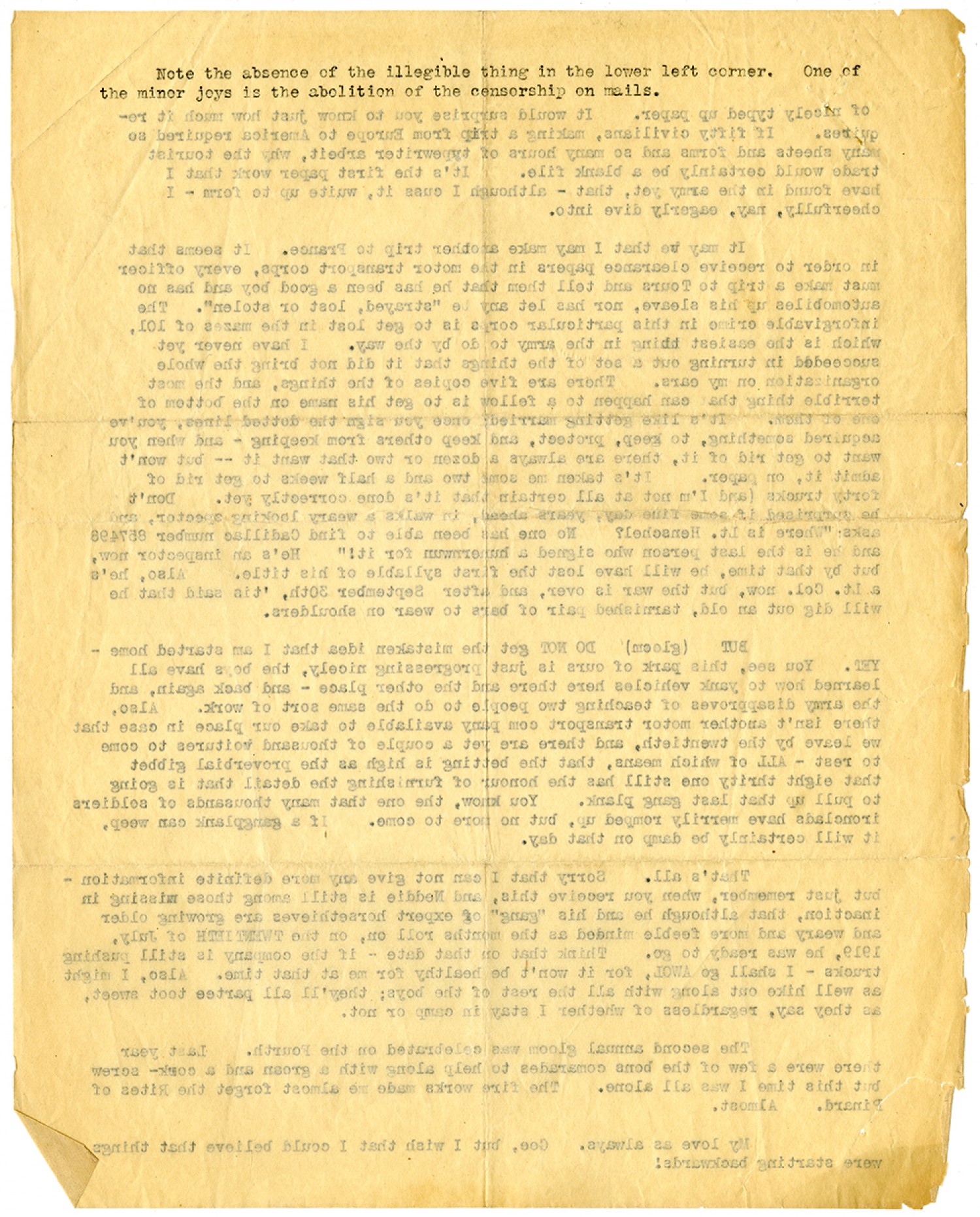
Note the absence of the illegible thing in the lower left corner. One of the minor joys is the abolition of the censorship on mails.
Details
| Title | James E. Henschel letter to Mrs. Leopold H. Henschel - July 14, 1919 |
| Creator | Henschel, James E. |
| Source | Henschel, James E. Letter to Mrs. Leopold H. Henschel. 14 July 1919. James Edward Henschel Collection, 1917-1919. 1996.51. The National World War I Museum, Kansas City, Missouri. |
| Description | In this letter dated July 14, 1919, Henschel wrote his mother concerning the Independence Day celebrations for the United States and France. Henschel talked about the amount of work he and his clerk had accomplished. Henschel also noted the absence of a censor signature on the mail. |
| Subject LCSH | American Field Service; Missouri. National Guard; United States. Army. Motor Transport Corps; Fourth of July; Bastille Day; World War, 1914-1918--Censorship |
| Subject Local | WWI; World War I; Celebrations |
| Site Accession Number | 1996.51 |
| Contributing Institution | National World War I Museum and Memorial |
| Copy Request | Transmission or reproduction of items on these pages beyond that allowed by fair use requires the written permission of the National World War I Museum and Memorial: (816) 888-8100. |
| Rights | The text and images contained in this collection are intended for research and educational use only. Duplication of any of these images for commercial use without express written consent is expressly prohibited. |
| Date Original | July 14, 1919 |
| Language | English |