
James E. Henschel letter to Mrs. Leopold H. Henschel - January 26, 1919
Transcript
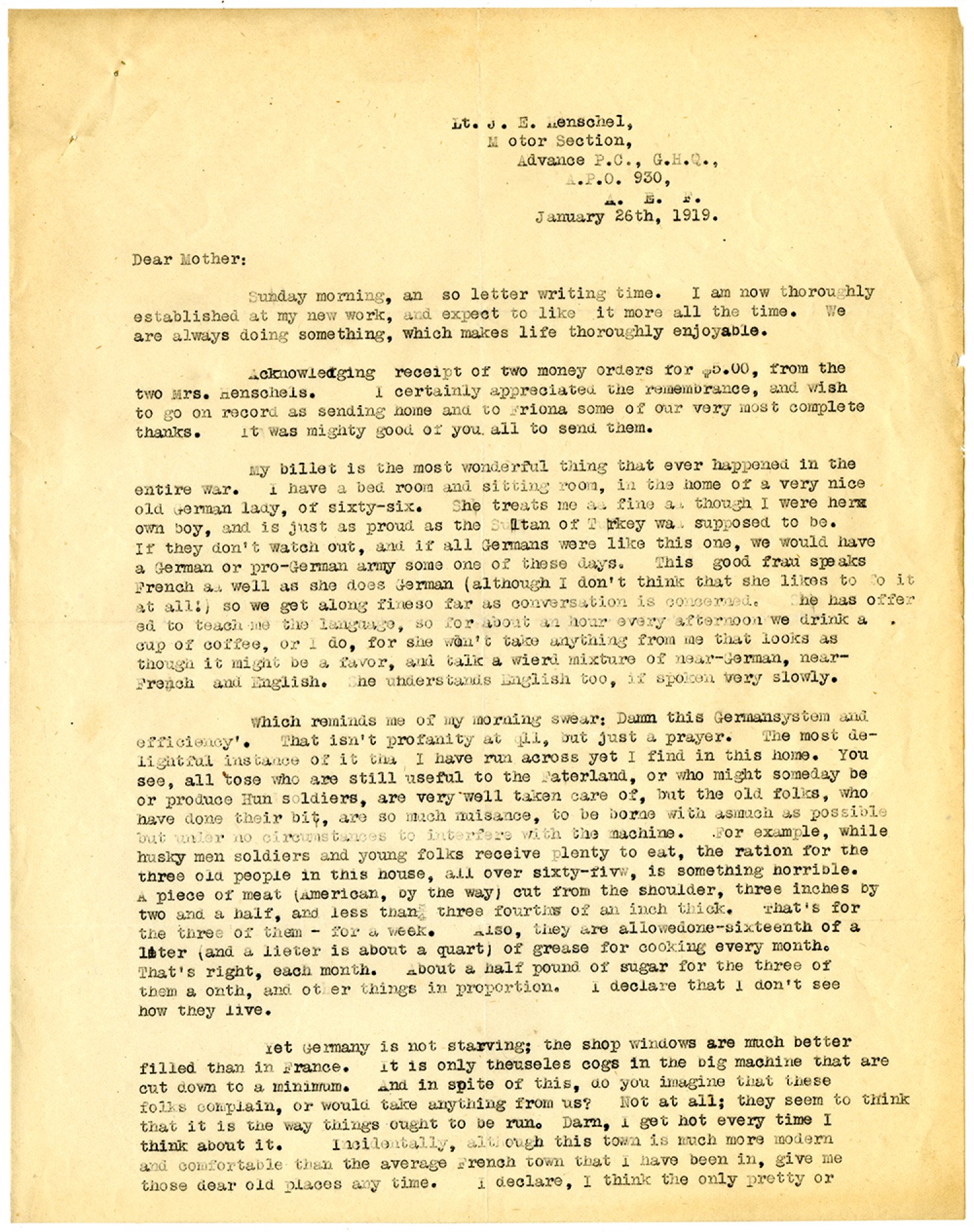
Lt. J.E. Henschel, Motor Section, Advance P.C., G.H.Q., A.P.O. 930, A.E.F. January 26th, 1919. Dear Mother: Sunday morning, and so letter writing time. I am now thoroughly established at my new work, and expect to like it more all the time. We are always doing something, which makes life thoroughly enjoyable. Acknowledging receipt of two money orders for $5.00, from the two Mrs. Henschels. I certainly appreciated the remembrance, and wish to go on record as sending home and to Friona some of our very most complete thanks. It was mighty good of you all to send them. My billet is the most wonderful thing that ever happened in the entire war. I have a bed room and sitting room, in the home of a very nice old Germany lady, of sixty-six. She treats me as fine as though I were her own boy, and is just as proud as the Sultan of Turkey was supposed to be. If they don't watch out, and if all Germans were like this one, we would have a German or pro-German army some one of these days. This good frau speaks French as well as she does German (although I don't think that she likes to do it at all!) so we get along fine so far as conversation is concerned. She has offered to teach me the language, so for about an hour every afternoon we drink a cup of coffee, or I do, for she won't take anything from me that looks as though it might be a favor, and talk a wierd mixture of near-German, near-French and English. She understands English too, if spoken very slowly. Which reminds me of my morning swear: Damn this German system and efficiency'. That isn't profanity at all, but just a prayer. The most delightful instance of it that I have run across yet I find in this home. You see, all those who are still useful to the Fatherland, or who might someday be or produce Hun soldiers, are very well taken care of, but the old folks, who have done their bit, are so much nuisance, to be borne with as much as possible but under no circumstances to interfere with the machine. For example, while husky men soldiers and young folks receive plenty to eat, the ration for the three old people in this house, all over sixty-five, is something horrible. A piece of meat (American, by the way) cut from the shoulder, three inches by two and a half, and less than three fourths of an inch thick. That's for the three of them - for a week. Also, they are allowed one-sixteenth of a liter (and a liter is about a quart) of grease for cooking every month. That's right, each month. About a half pound of sugar for the three of them a onth, and other things in proportion. I declare that I don't see how they live. Yet Germany is not starving; the shop windows are much better filled than in France. It is only the useless cogs in the big machine that are cut down to a minimum. And in spite of this, do you imagine that these folks complain, or would take anything from us? Not at all; they seem to think that it is the way things out to be run. Darn, I get hot every time I think about it. Incidentally, although this town is much more modern and comfortable than the average French town that I have been in, give me those dear old places any time. I declare, I think the only pretty or
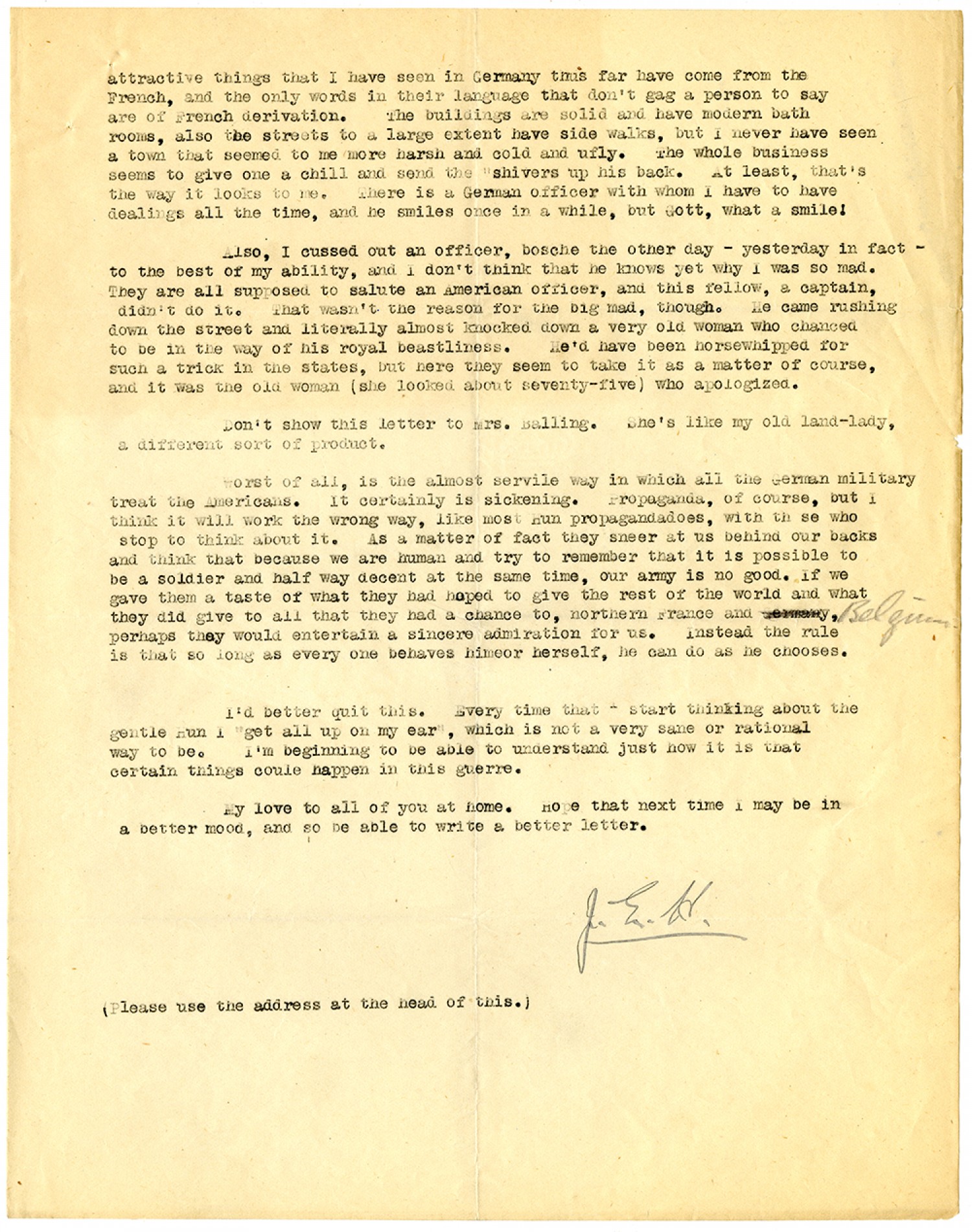
Transcript
attractive things that I have seen in Germany thus far have come from the French, and the only words in their language that don't gag a person to say are of French derivation. The buildings are solid and have modern bath rooms, also the streets to a large extent have side walks, but I never have seen a town that seemed to me more harsh and cold and ufly. The whole business seems to give one a chill and send the "shivers up his back. At least, that's the way it looks to me. There is a German officer with whom I have to have dealings all the time, and he smiles once in a while, but Gott, what a smile! Also, I cussed out an officer, bosche the other day - yesterday in fact - to the best of my ability, and I don't think that he knows yet why I was so mad. They are all supposed to salute an American officer, and this fellow, a captain, didn't do it. That wasn't the reason for the big mad, though. He came rushing down the street and literally almost knocked down a very old woman who chanced to be in the way of his royal beastliness. He'd have been horsewhipped for such a trick in the states, but here they seem to take it as a matter of course, and it was the old women (she looked about seventy-five) who apologized. Don't show this letter to Mrs. Balling. She's like my old land-lady, a different sort of product. Worst of all, is the almost servile way in which all the German military treat the Americans. It certainly is sickening. Propaganda, of course, but I think it will work the wrong way, like most Hun propaganda does, with those who stop to think about it. As a matter of fact they sneer at us behind our backs and think that because we are human and try to remember that it is possible to be a soldier and half way decent at the same time, our army is no good. If we gave them a taste of what they had hoped to give the rest of the world and what they did give to all that they had a chance to, northern France and Belgium, perhaps they would entertain a sincere admiration for us. Instead the rule is that so long as every one behaves him or herself, he can do as he chooses. I'd better quite this. Every time that - start thinking about the gentle Hun I "get all up on my ear", which is not a very sane or rational way to be. I'm beginning to be able to understand just how it is that certain things could happen in this guerre. My love to all of you at home. Hope that next time I may be in a better mood, and so be able to write a better letter. J.E.H. (Please use the address at the head of this.)
Details
| Title | James E. Henschel letter to Mrs. Leopold H. Henschel - January 26, 1919 |
| Creator | Henschel, James E. |
| Source | Henschel, James E. Letter to Mrs. Leopold H. Henschel. 26 January 1919. James Edward Henschel Collection, 1917-1919. 1996.51. The National World War I Museum, Kansas City, Missouri. |
| Description | In this letter dated January 26, 1919, Henschel wrote his mother thanking his family again for the gifts he recently received. Henschel was billeted with a German that treated him well but spoke little English. He also discussed the meager rations allowed the elderly in Germany. |
| Subject LCSH | American Field Service; Missouri. National Guard; United States. Army. Motor Transport Corps |
| Subject Local | WWI; World War I |
| Site Accession Number | 1996.51 |
| Contributing Institution | National World War I Museum and Memorial |
| Copy Request | Transmission or reproduction of items on these pages beyond that allowed by fair use requires the written permission of the National World War I Museum and Memorial: (816) 888-8100. |
| Rights | The text and images contained in this collection are intended for research and educational use only. Duplication of any of these images for commercial use without express written consent is expressly prohibited. |
| Date Original | January 26, 1919 |
| Language | English |