
James E. Henschel letter to Family - October 6, 1918
Transcript
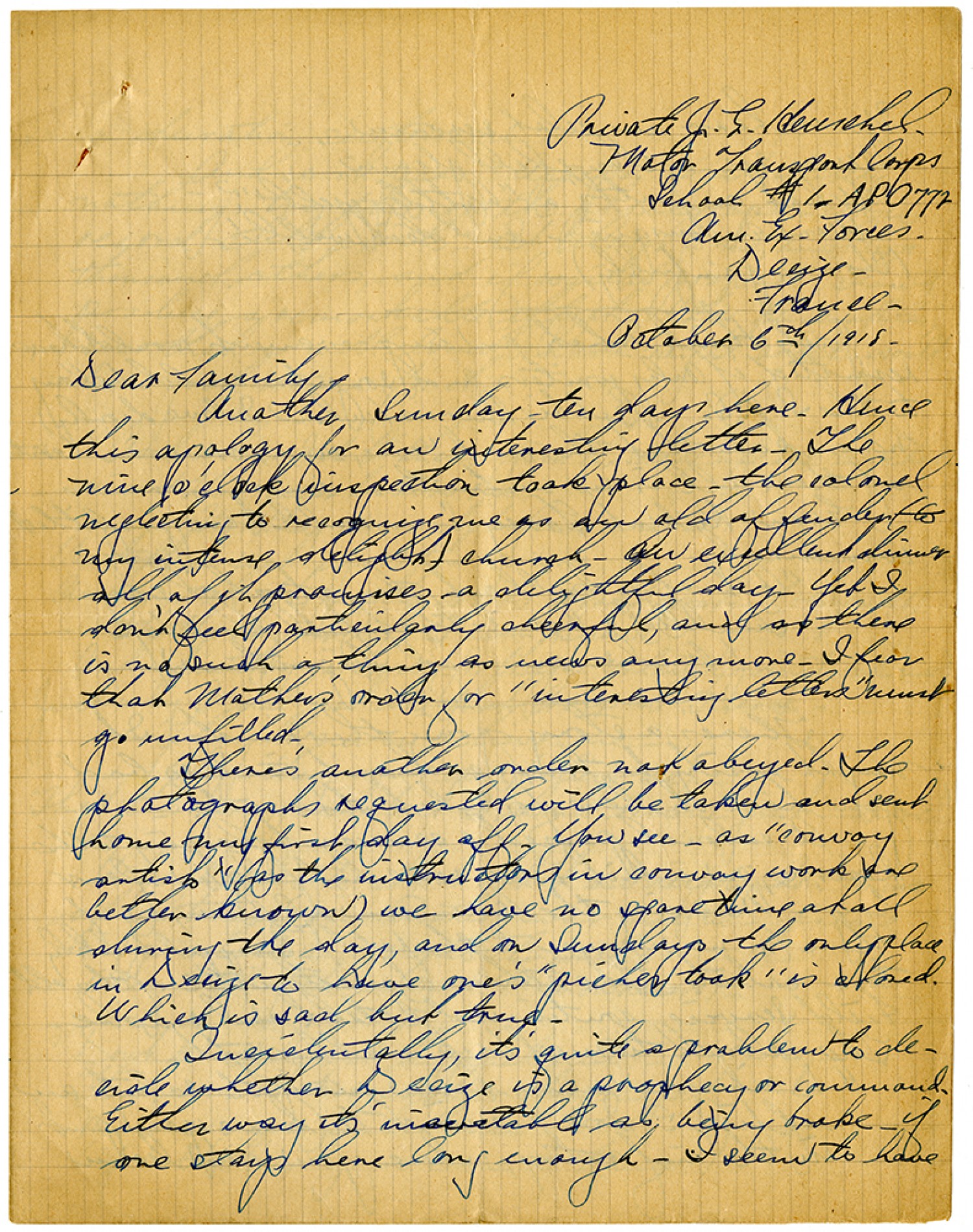
Private J.E. Henschel. Motor Transport Corps School #1. APO 772 Am. Ex. Forces. Decize - France - October 6th/1918 - Dear Family - Another Sunday - ten days here. Hence this apology for an interesting letter. The nine o'clock inspection took place - the colonel neglecting to recognize me as an old offender (to my intense delight) - church. An excellent dinner all of it promises a delightful day. Yet I don't feel particularly cheerful, and as there is no such a thing as news any more - I fear that Mother's order for "interesting letters" must go unfilled. There's another order not obeyed. The photographs requested will be taken and sent home my first day off. You see - as "convoy artist" (as the instructors in convoy work are better known) we have no spare time at all during the day, and on Sundays the only place in Decize to have one's "picher took" is closed. Which is sad but true. Incidentally, it's quite a problem to decide whether Decize is a prophecy or command. Either way it's [ms illegeible: 1 wd] as being broke - if one stays here long enough. I seem to have
Transcript
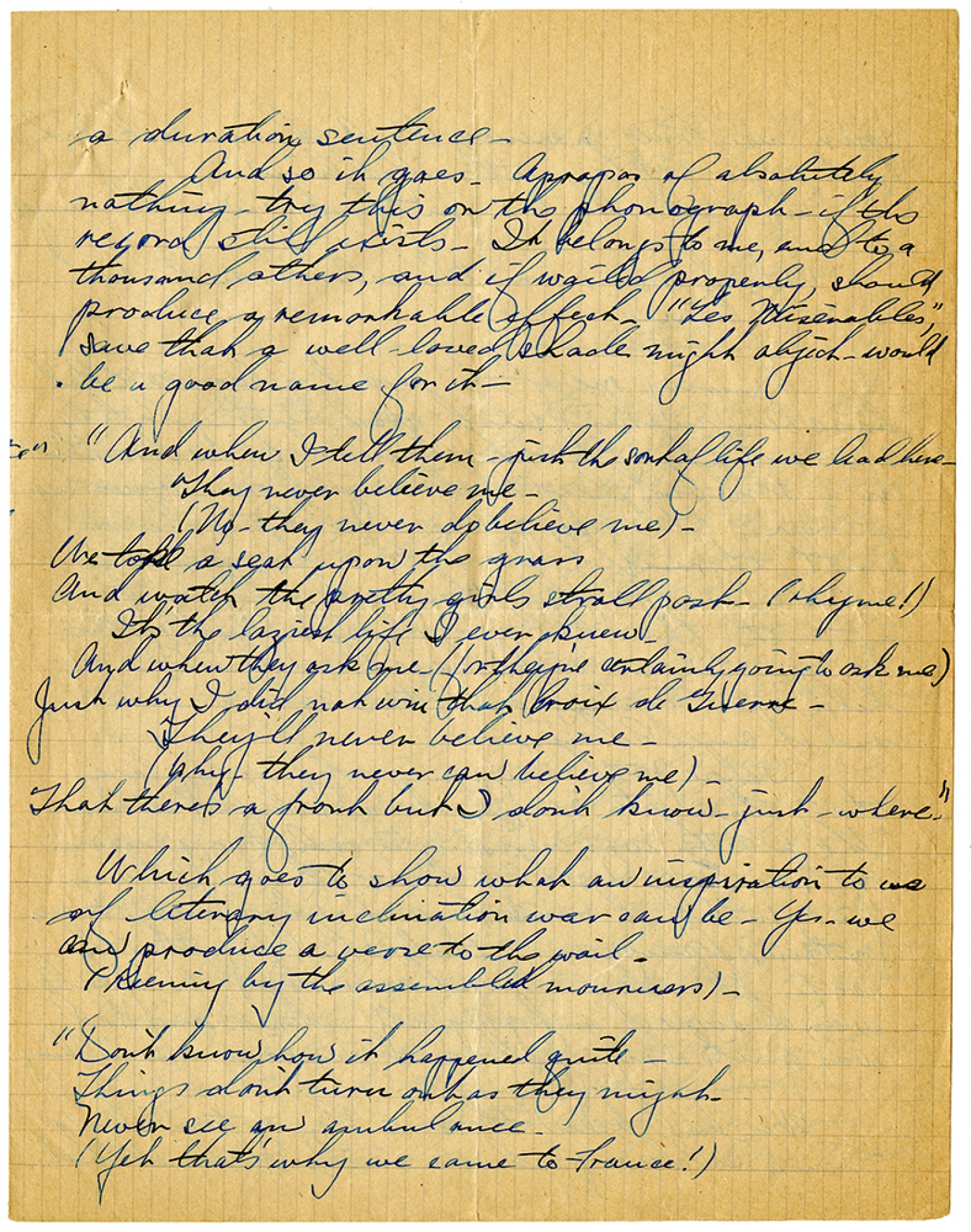
a duration sentence. And so it goes. Apropos of absolutely nothing - try this on the phonograph - if the record still exists. It belongs to me, and to a tousand others, and if wailed properly, should produce a remarkable effect. "Les Miserables", save that a well-loved shade might object - would be a good name for it. "And when I tell them - just the sort of life we had here - They never believe me. (No - they never do believe me). We took a set upon the grass and watch the pretty girls stroll past (rhyme!) It's the laziest life I ever knew - And when they ask me (for they're certainly going to ask me) Just why I did not win that Croix de Guerre - They’ll never believe me - (why - they never can believe me) - That there's a front but I don't know - just - where." Which goes to show what an inspiration to us of literary inclination war can be. Yes - we can produce a verse to the wail. (Kenny by the assembled monsieurs). "Don't know how it happened quite - Things don't turn out as they might. Never see an ambulance - (Yet that's why we came to France!)
Transcript
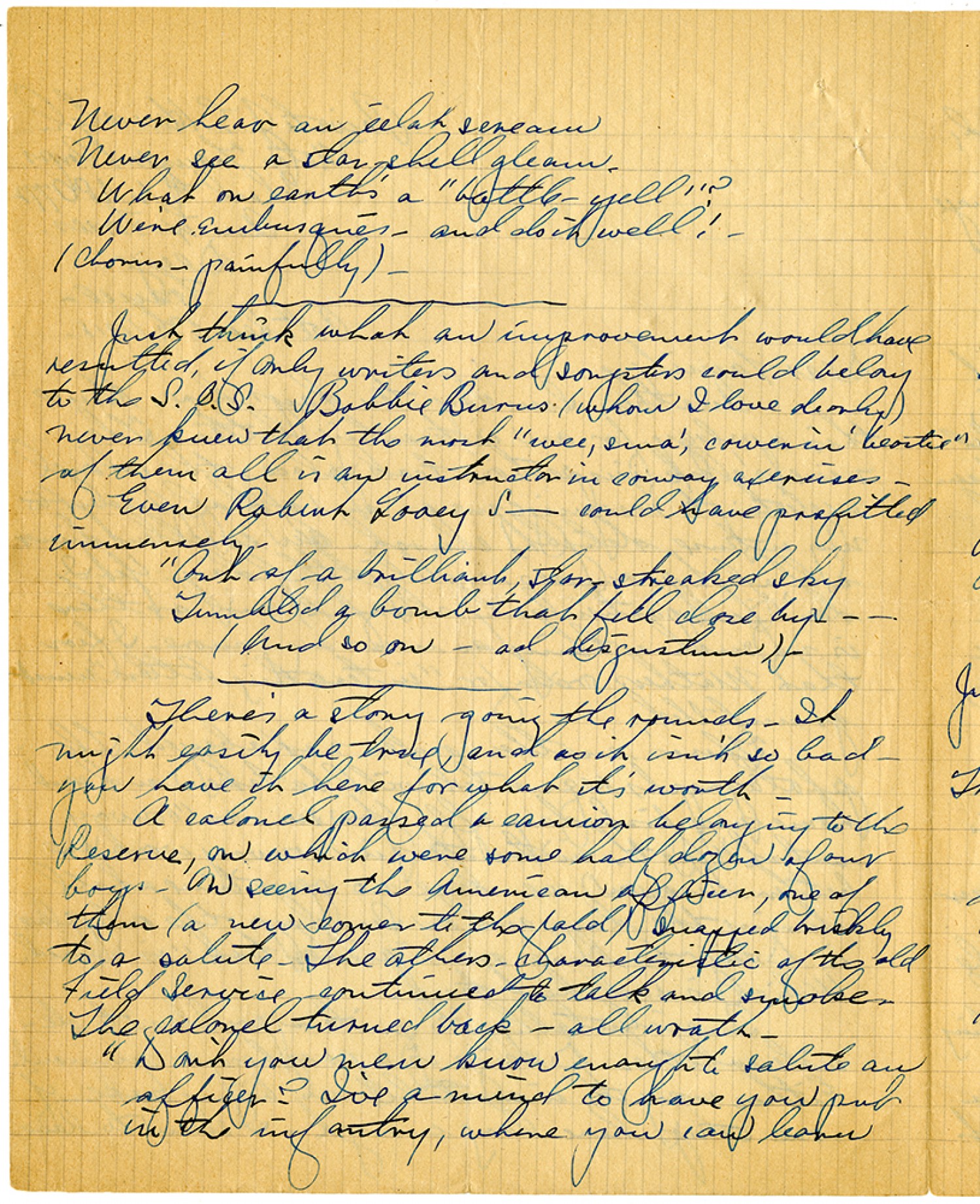
Never hear an celat scream Never see a star-shell gleam. What on earth's a "battle-yell"? We're emburques - and do it well! - (chorus - painfully) - Just think what an improvement would have resulted if only writers and songsters could belay to the S.O.S. Bobbie Burns (whom I love dearly) never knew that the most "wee, sma', cowerin', beastee" of them all is an instructor in convoy exercises. Even Robert Looey S- could have profitted immensely. "Out of a brilliant, star-streaked sky Tumbled a bomb that fell close by - - - (And so on - ad disgustum). There's a story going the rounds. It might easily be true, and so it isn't so bad - you have it here for what it's worth. A colonel passed a camion belonging to the Reserve, on which were some half dozen of our boys. On seeing the American officer, one of them (a new-comer to the fold) snapped briskly to a salute. The others - characteristic of the old Field Service continued to talk and smoke. The colonel turned back - all wrath. "Don't you men know enough to salute an officer? I've a mind to have you put in the infantry, where you can learn
Transcript
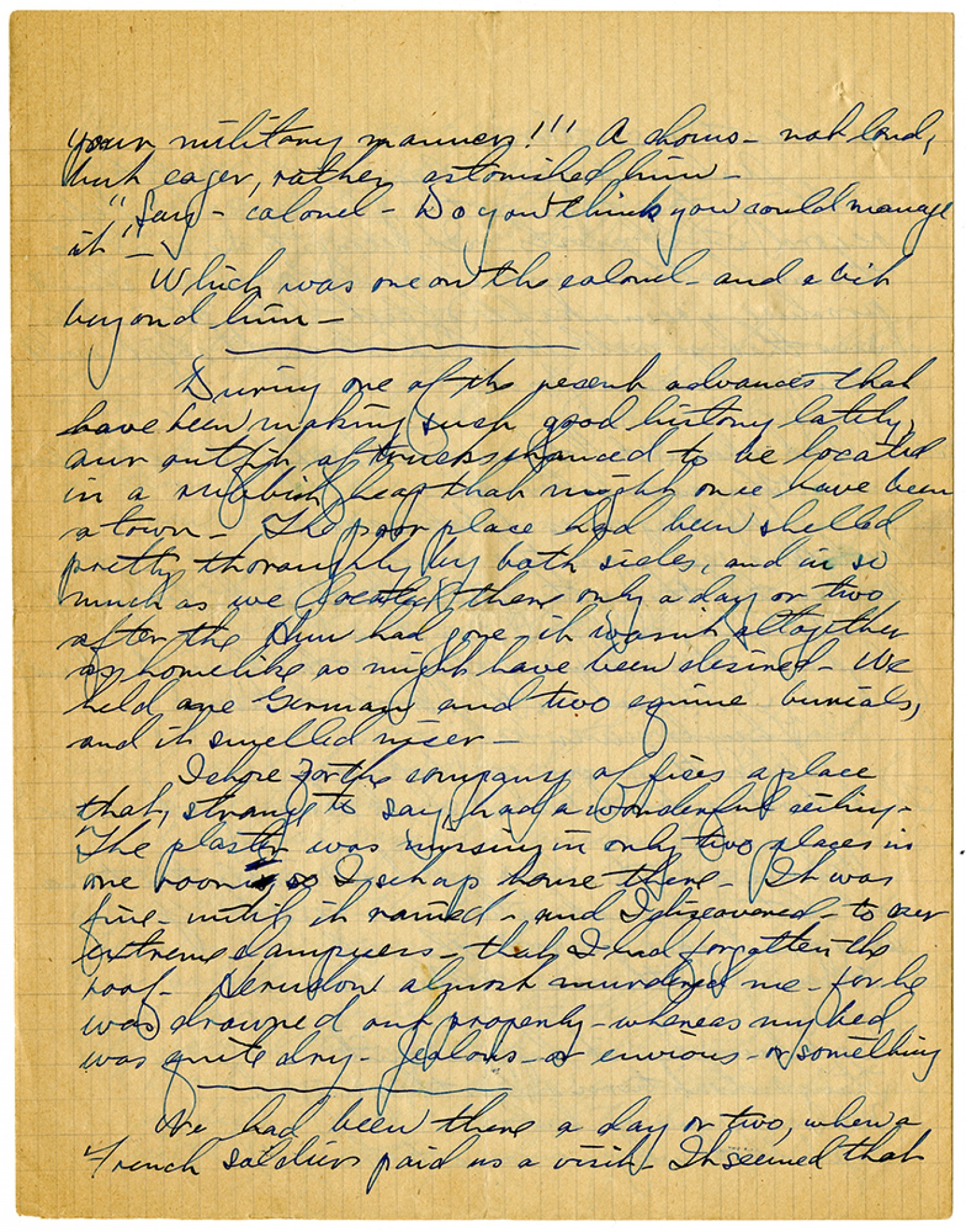
your military manners!" A chorus - not loud, but eager, rather astonished him. "Say - colonel - Do you think you could manage it". Which was one on the colonel - and a bit beyond him. During one of the resent advances that have been making such good history lately, our outfit of trucks chanced to be located in a rubbish heap that might once have been a town. The poor place had been shelled pretty thoroughly by both sides, and in so much as we located them only a day or two after the Hun had gone - it wasn't altogether as homelike as might have been desired. We held one German and two equine burials, and it smelled nicer. I chose for the company offices a place that, strange to say, had a wonderful ceiling. The plaster was missing in only two places in one room, so I set up house there. It was fine - until it rained - and I discovered - to our extreme dampness - that I had forgotten the roof. Herndon almost murdered me - for he was drowned out properly - whereas my bed was quite dry/. Jealous - or envious - or something We have been there a day or two, when a French soldier paid us a visit. It seemed that
Transcript
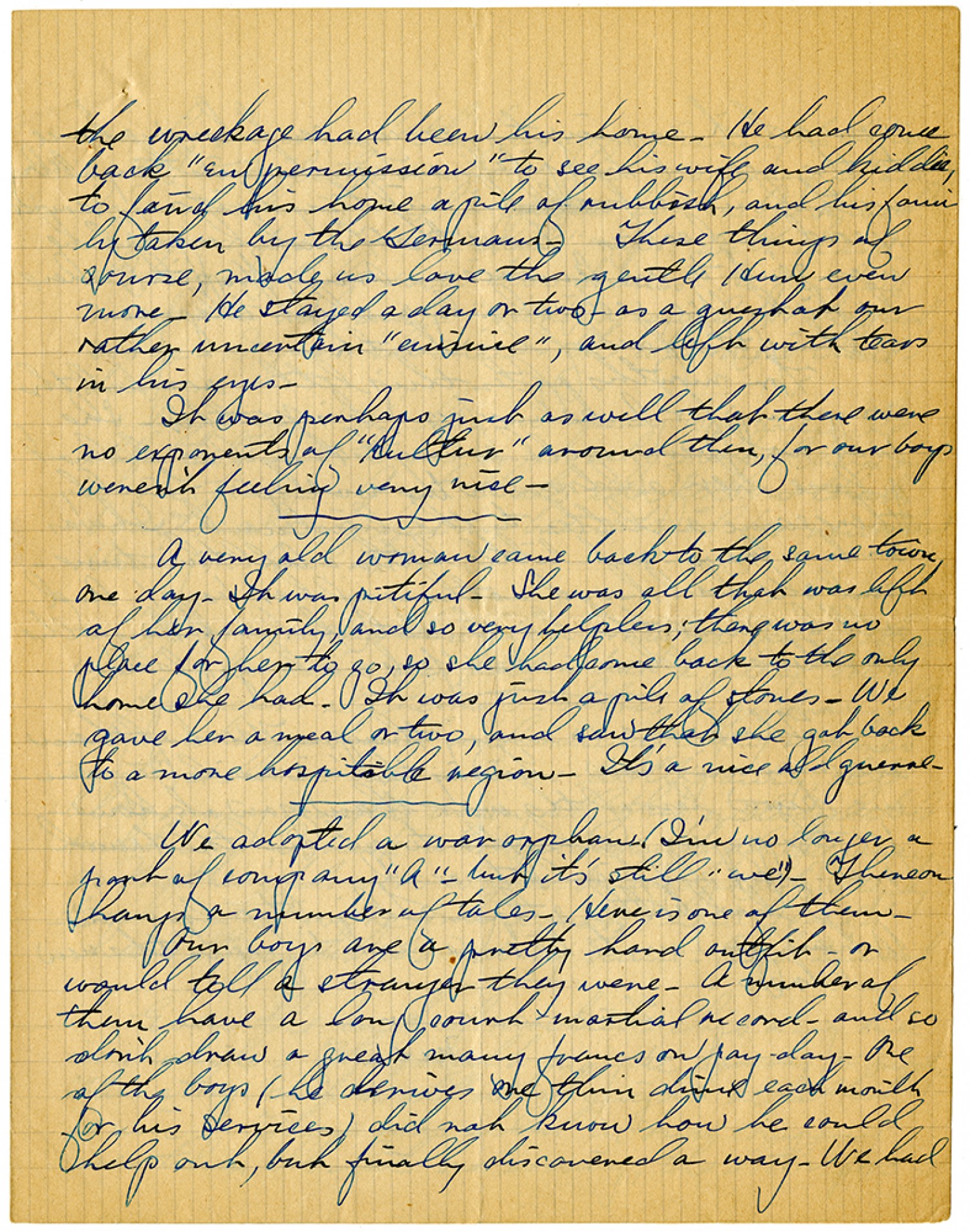
the wreckage had been his home. He had come back "En permission" to see his wife and kiddie, to find his house a pile of rubbish, and his family taken by the Germans. These things of course, made us love the gentle Hun even more. He stayed a day or two - as a guest at our rather uncertain "[ms illegible: 1 wd]", and left with tears in his eyes. It was perhaps just as well that there were no exponents of "Kultur" around then, for our boys weren't feeling very nice. A very old woman came back to the same town one day. It was pitiful. She was all that was left of her family, and so very helpless; there was no place for her to go, so she had come back to the only home she had. It was just a pile of stones. We gave her a meal or two, and saw that she got back to a more hospitable region. It's a nice old guerre. We adopted a war orphan (I'm no longer a part of company "A" - but it's still we"). Thereon hangs a number of tales. Here is one of them. Our boys are a pretty hard outfit - or would tell a stranger they were. A number of them have a long court martial record - and so don't draw a great many francs on pay-day. One of the boys (he drives one thin dime each month for his services) did not know how he could help out, but finally discovered a way. We had
Transcript
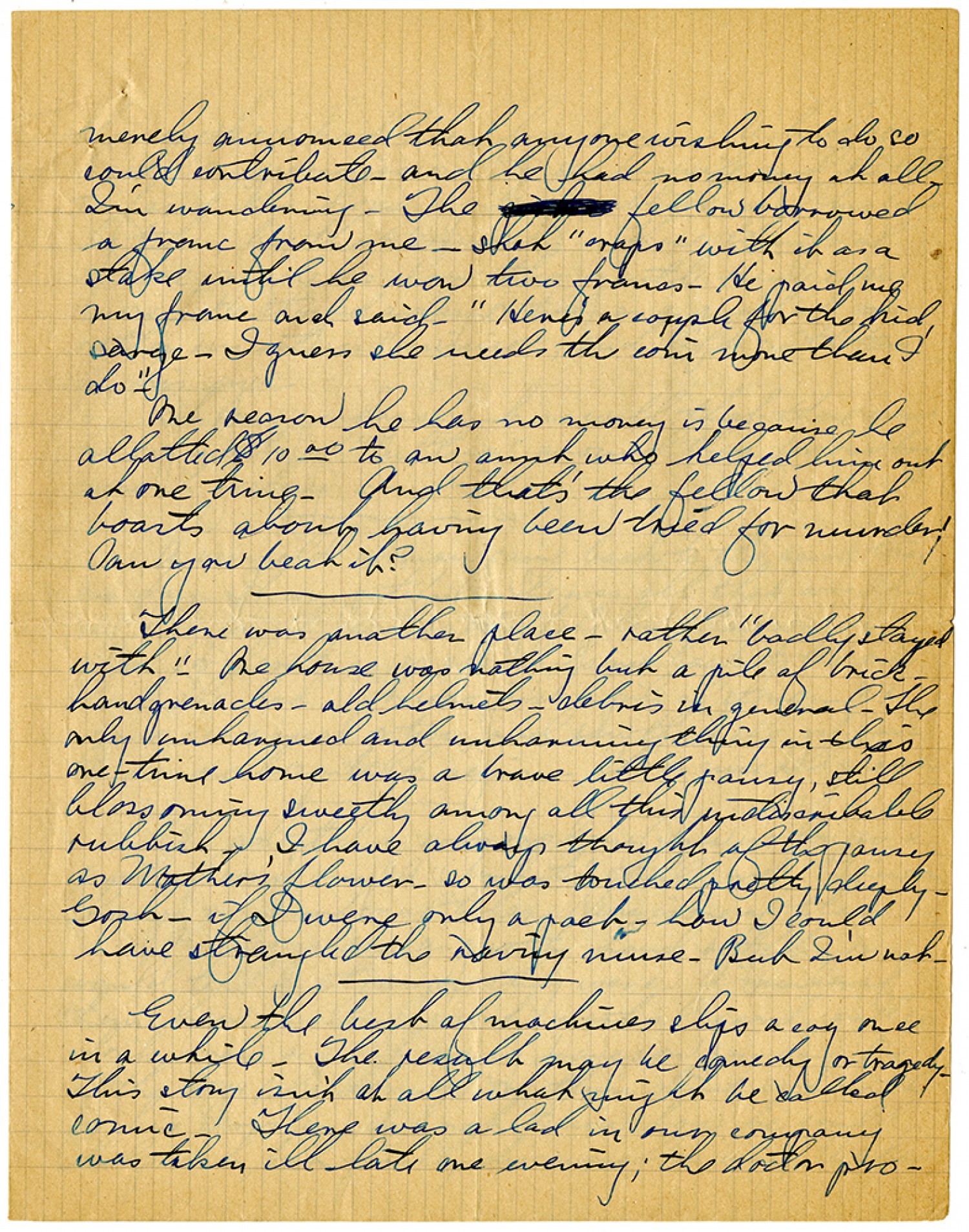
merely announced that anyone wishing to do so could contribute - and he had no money at all. I'm wondering - The fellow borrowed a franc from me - shot "craps" with it as a stake until he won two francs. He paid me my franc and said - "Here's a couple for the kid, serge. I guess she needs the coin more than I do". One reason he has no money is because he allotted $10.00 to an aunt who helped him out at one time. And that's the fellow that boasts about having been tried for murder! Can you beat it? There was another place - rather "badly stayed with". One house was nothing but a pile of brick - hand grenades - old helmets - debris in general. The only unharmed and unharming thing in this one-time home was a brave little pansy still blossoming sweetly among all this undiscribably rubbish. I have always thought of the pansy as Mother's flower - so was touched pretty deeply. Gosh - if I were only a pact - how I could have strangled the raving muse - But I'm not. Even the best of machines ships a cog once in a while. The result may be comedy or tragedy. This story isn't at all what might be called comic. There was a lad in our company was taken ill late one evening; the doctor pro-
Transcript
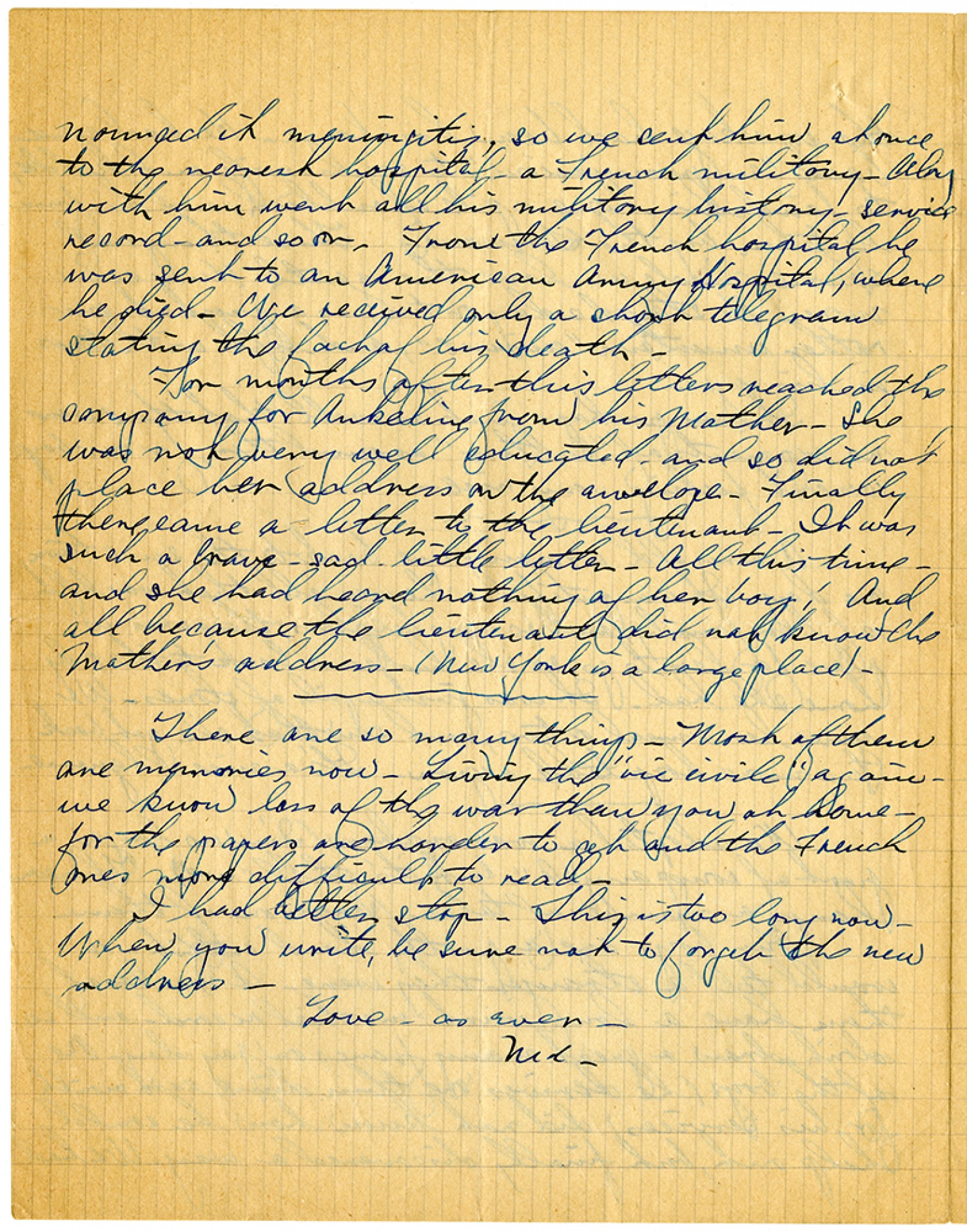
nounced it meningitis, so we sent him at once to the nearest hospital - a French military. Along with him went all his military history - service record - and so on. From the French hospital he was sent to an American Army Hospital, where he died. We received only a short telegram stating the fact of his death. For months after this letter reached the company for Ankeline from his Mother. She was not very well educated - and so did not place her address on the envelope. Finally there came a letter to the lieutenant. It was such a brave - sad - little letter. All this time - and she had heard nothing of her boy; And all because the lieutenant did not know the Mother's address. (New York is a large place). There are so many things. Most of them are memories now. Living the "vie civile" again - we know less of the war than you at home - for the papers are harder to get and the French ones more difficult to read. I had better stop. This is too long now. When you write, be sure not to forget the new address. Love - as ever- Ned.
Details
| Title | James E. Henschel letter to Family - October 6, 1918 |
| Creator | Henschel, James E. |
| Source | Henschel, James E. Letter to Family. 6 October 1918. James Edward Henschel Collection, 1917-1919. 1996.51. The National World War I Museum, Kansas City, Missouri. |
| Description | In this letter dated October 6, 1918, Henschel wrote to his family about his time before the motor transport corps school. |
| Subject LCSH | American Field Service; Missouri. National Guard; United States. Army. Motor Transport Corps |
| Subject Local | WWI; World War I; Motor Transport Corps School |
| Site Accession Number | 1996.51 |
| Contributing Institution | National World War I Museum and Memorial |
| Copy Request | Transmission or reproduction of items on these pages beyond that allowed by fair use requires the written permission of the National World War I Museum and Memorial: (816) 888-8100. |
| Rights | The text and images contained in this collection are intended for research and educational use only. Duplication of any of these images for commercial use without express written consent is expressly prohibited. |
| Date Original | October 6, 1918 |
| Language | English |