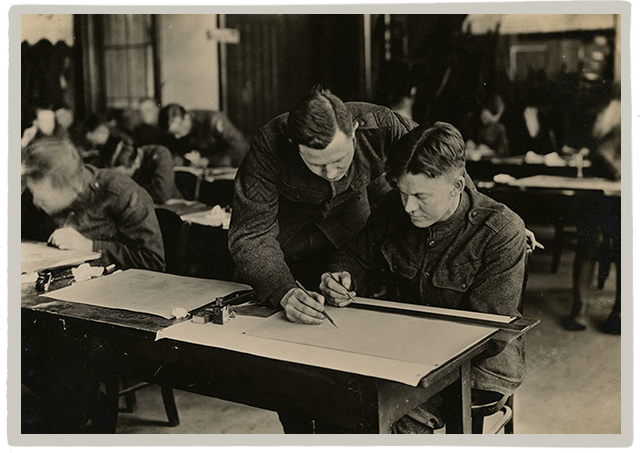
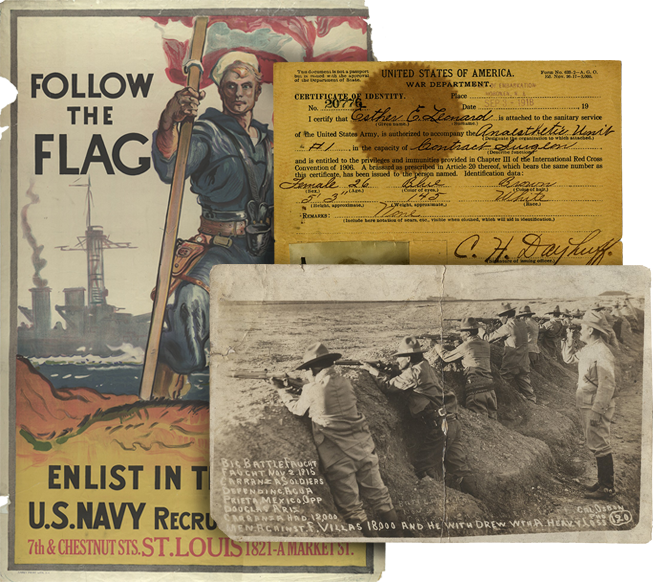
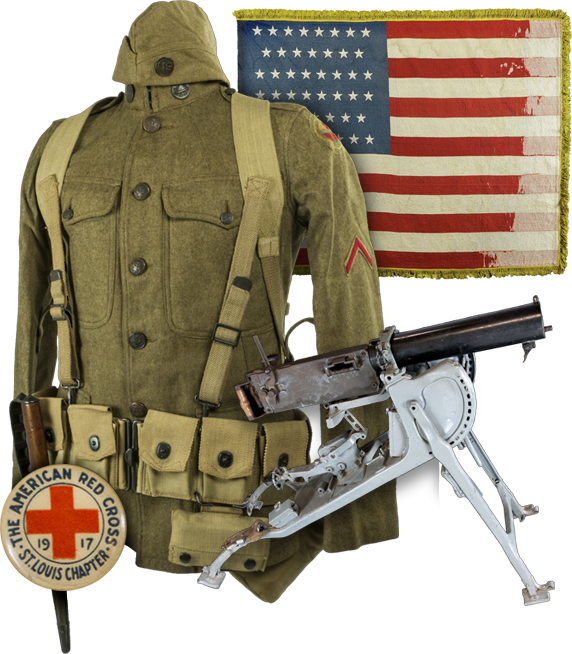

Memorandum from the Provost Marshal General to the Chief of Staff - November 11, 1918
Transcript
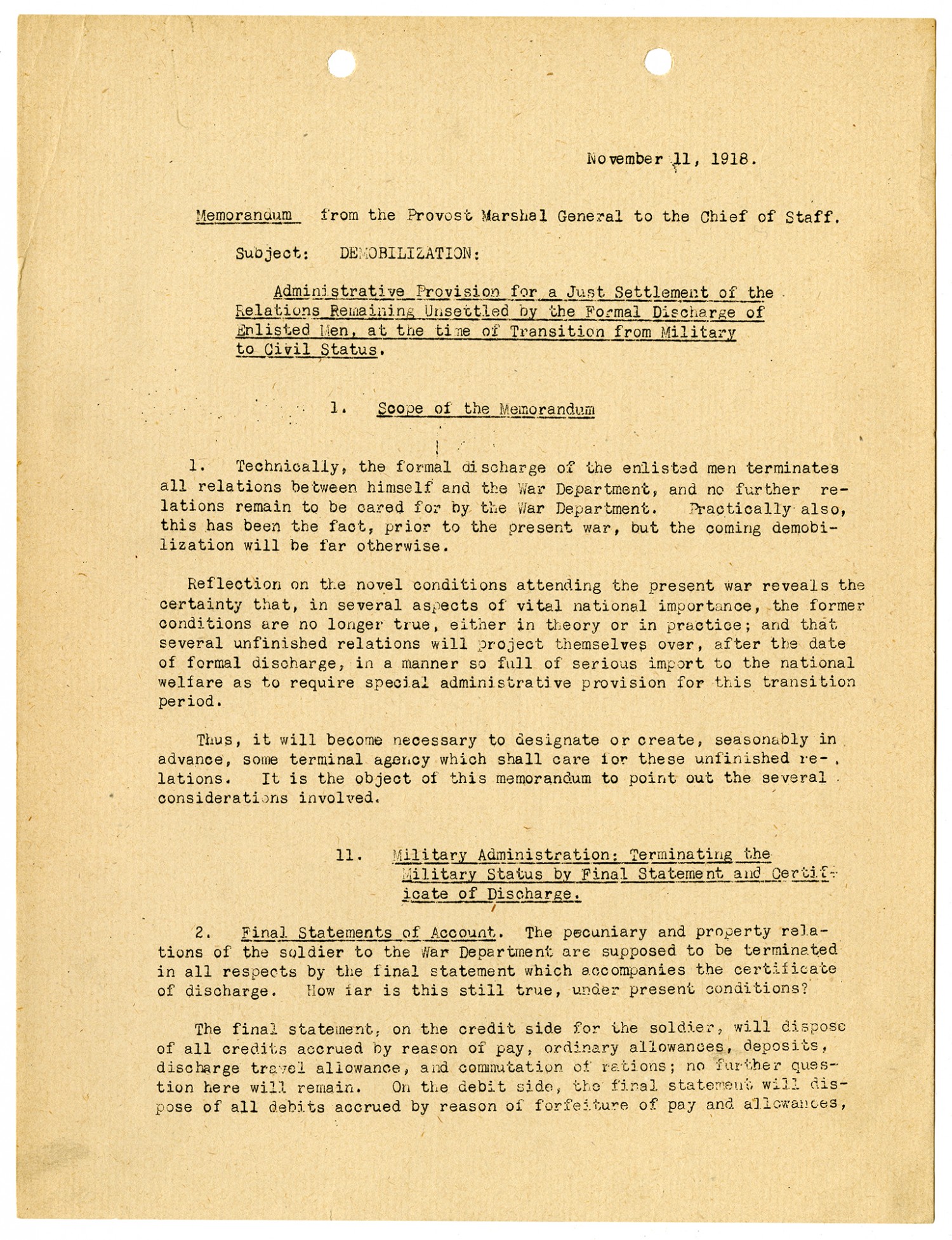
November 11, 1918. Memorandum from the Provost Marshal General to the Chief of Staff. Subject: Demobilization: Administrative Provision for a Just Settlement of the Relations Remaining Unsettled by the Formal Discharge of Enlisted Men, at the time of Transition from Military to Civil Status. 1. Scope of the Memorandum 1. Technically, the formal discharge of the enlisted men terminates all relations between himself and the War Department, and no further relations remain to be cared for by the War Department. Practically also, this has been the fact, prior to the present war, but the coming demobilization will be far otherwise. Reflection on the novel conditions attending the present war reveals the certainty that, in several aspects of vital national importance, the former conditions are no longer true, either in theory or in practice; and that several unfinished relations will project themselves over, after the date of formal discharge, in a manner so full of serious import to the national welfare as to require special administrative provision for this transition period. Thus, it will become necessary to designate or create, seasonably in advance, some terminal agency which shall care for these unfinished relations. It is the object of this memorandum to point out the several considerations involved. 11. Military Administration: Terminating the Military Status by Final Statement and Certificate of Discharge. 2. Final Statements of Account. The pecuniary and property relations of the soldier to the War Department are supposed to be terminated in all respects by the final statement which accompanies the certificate of discharge. How far is this still true, under present conditions? The final statement on the credit side for the soldier, will dispose of all credits accrued by reason of pay, ordinary allowances, deposits, discharge travel allowance, and commutation of rations; no further question here will remain. On the debit side, the final statement will dispose of all debits accrued by reason of forfeiture of pay and allowances,
Transcript
[page 2] Stoppages, uniform clothing in custody, and deductions for absence without leave, etc. If this were all, the final statement would be indeed final, i.e., it would have no unsettled relations capable of gibing rise to later dispute and requiring administrative provision for investigations and settlement. But in fact, under the conditions of the present war, there will remain at least six important items as to which the final statement cannot expect to be effectively final in the foregoing sense. (a) Family Allotment. The first of these is the compulsory allotment of pay to dependents. These allotments presuppose that the soldier, at some prior time, has designated a dependent as allottee, and that thereafter the War Department has withheld a portion of his pay for payment to the allottee. In two ways this will involve a projection over the unfinished relation, after discharge. In the first place, thousands of these payments are in arrears; the settlement of the details of these arrears will require many months. Necessarily, the allottees and the discharged men, scattered all over the country, have at present no resort but correspondence by mail with the Washington headquarters; and similarly the Warhington headquarters have no resort but by mail with the thousands of scattered individuals, for negotiating the settlement. In the second place, the validity of many of these allotments is in issue; it is estimated that one hundred thousand of the allotment designations name persons not actually entitled. Conversely, many thousands of dependents, entitled to a compulsory allotment, were not designated for such by the soldiers bound to make them. The combined volume of these cases is enormous, and will require patient and extensive investigation. Delay and error in these settlements would inevitably lead to popular distress and discontent on a large scale, as well as to Government loss of many millions of dollars. What is needed is an administrative provision for localizing the process of settlement, and for thus securing prompt and correct action. The final statement will here be anything but final; only a new and additional agency will suffice. (b) Term Insurance. The final statement will cover the debits for deductions of pay, to date of discharge, for term insurance taken under the War Risk Insurance Act. But there will remain two non-terminated features. The first is the disputes arising out of these deductions; for under a recent Treasury ruling the insurance is to continue, once the solider has directed payment of the premium by deduction of pay, even though he fails in ensuing months to renew the direction; and there are here possibilities on a large scale of unfinished relations. The second feature is the privilege of conversion into an ordinary life policy, given under the Act. The terms of this policy have not yet been formulated by the Treasury Department; but the soldier
Transcript
[page 3] (c) Liberty Bond Allotments. In the same way, the instalments still due on Liberty Bond purchases will involve a balance still due beyond the debits in the final statement. Again, the continuing relation will involve dealings on a large scale. (d) Government Allowance to Families. These are made by the Treasury Department, but they are inseparably connected with the soldier
Transcript
[page 4] wanted is a local official who can serve the Government, on the one hand, by acting as its agent for investigation and for delivering and receiving papers of settlement, and who can serve the soldier or his family, on the other hand, by acting as adviser and as medium of ready local communication. Such an agency, being local, in every community, can promptly get at the facts; being official, it can supplant the unscrupulous private claim agents, and can preserve propular confidence in the Government
Transcript
[page 5] tificate, say 20 to 30 days, -using the analogy of A.R. 155 (notification of discharge at places where no pay officer is available). A notification of discharge should be mailed to the Local Board designated; and on presentation of the final statement and exhibition of the certificate of discharge, the remaining payment would be made. Meanwhile the soldier would be on a furlough status from the date of embarkation homewards. By the foregoing method, it is certain that the discharged soldier will be definitely located by the Government at a specific Local Board, -usually that Board which already knows all about him personally; thereafter it will be a relatively simple matter to complete any dealings with him if necessary. 8. The foregoing considerations may be thus summed up: (a) The final statement will be far from representing the termination of relations with the Government for most of the three million discharged soldiers; (b) To prevent widespread distress and discontent, arising in the course of adjusting these unterminated relations, it is imperative to employ some single official agency, localized in each community, to serve as the local intermediary between the Government and the soldier or his family; (c) The natural and efficient agency for this purpose is found already existing in the Local Boards of the Selective Service System. III. Civic and Economic Relations. All that is said above arises solely out of the unavoidable administrative aspects of demobilization as a strictly military problem, i.e. the discharge of the soldier and his return from the army in the field to his home. But it so happens that other urgent problems, not strictly of military administration, arise out of the same situation, and that their solution focusses on the use of the same agency, viz. the Local Boards. the coincidence of advantage to be gained by thus utilizing the Local Boards is so striking that these other advantages will be here outlined. They serve to corroborate strongly the prudence, convenience, and economy of using the Local Boards for the strictly military administrative purpose above set forth. 9. Economic Needs. The economic need of finding the job for the man, and of replenishing industry and agriculture at the points of depletion is an obvious one. But its complexities are so vast that any solution on a National scale will be many months in coming. In the meantime, the problem will be more or less a local one. These returned men will be with-
Transcript
[page 6] out jobs, their places having been filled in their old establishments, or the old establishments having changed their product and organization. The immediate task will be to find the suitable man for an existing vacancy, and to find a vacancy for the man who otherwise finds no place. There is only one agency which is most obviously fitted to do this. That agency is the one which, in the first place, took them out of their jobs. Every Local Board virtually now knows just where every man came from and just what opportunities exist in his community for re-employing him, Moreover, the District Boards are familiar with the large and mass aspects of the problems in their districts. For the purpose of adjusting the local and temporary urgency on the return of soldiers, there could not be a better agency. The U.S. Employment Agency exists in only relatively few regions; moreover, its members have little or no personal acquaintance with the individual soldiers. On the other hand, Local boards exist in 4500 communities; and they possess virtually a personal acquaintance with every returned soldier (except the enlisted ones, and event these are usually well known to the Boards). Furthermore, the Boards take a patriotic interest in the returned members of their community, and would be, not merely willing, but eager to render this crowning service to the Nation
Transcript
[page 7] proposing it in every quarter. Nor do they look at it in a selfish way. They have devoted themselves earnestly, as a part of their task hitherto, to the smoothing out of the economic situation. They perceive plainly that the same situation has now to be smoothed out in the reserve order. The needs are so obvious to them, and the lack of any other agency is so equally obvious, that they naturally expect, in a perfectly patriotic way, to be charged with this duty. No measure could be more popular to the responsible interests of this country than the one here mentioned. These Boards include representatives of agriculture, banking, manufacturing, commerce, labor, and the professions. They possess the confidence of their own communities in an unexampled degree. To charge them with the proposed task would meet with unanimous popular approval. 10. Future Military Organization. Whatever be the military system adopted by our Government as its permanent form of military preparedness, it is certain that the final adoption will not take place till full consideration has been given by Congress; and this must signify at least six months, and more likely a years, of lapse of time from the present date. During this time, the experienced soldiers, now veterans, who will have been disbanded, will be lost and swallowed up in the local and national life. The Adjutant General
Transcript
[page 8] or three years, and without any interference with the traditions of the Nation. To establish a compulsory registration system for every American individual would be contrary to National traditions. But to preserve the present registration system for discharged soldiers would be quite in keeping with the tradition now established for registered men. The details afford no difficulty. The present system of transferring cards, upon transfer of domicile by a registrant, could easily be adapted to the cases of discharged soldiers. There would be no compulsion as to the place where a man would go and settle down upon discharge; he would merely report to the Local Board at the place of his new settlement, if it was not his original home, and his card would be transferred to the new Board. Moreover his present record in the Board, plus a brief record of his military service, would thus be available in the Board Records; relieving from the necessity of a vast central file in Washington, and enabling a decentralized military system to function efficiently on the bases of the military records of the man. It would not even be necessary to rely upon compulsion to secure the working of this machinery. Both the Boards and the men would cooperate voluntarily, in ninety percent of the cases; which would be a sufficient proportion for making available this enormous asset of military experience. The foregoing military reason is one which, if given effect, will spare us bitter regrets, a year from now, at our failure to avail ourself in good season of this extraordinary opportunity. The goregoing considerations are valid, irrespective of whether the demobilization takes place by organizations or by zones or by trades. In any event, there should be a terminal official agency at which the relation of the War Department and the soldier is finally and formally settled and where a record is kept for the purpose of finding him again when needed. 11. Individual Welfare. The returned soldier,
Transcript
[page 9] economic welfare. It is not easy to describe, but it is a very real thing. Merely for this alone, it would be difficult to constitute formally the Local Board in any definite administrative status. But to the above mentioned functions of the Local Board this one should be added, as making a very positive additional contribution to its usefulness. Any one who has been in touch with the Local Boards and knows how they look upon their soldier boys and how the boys look upon the Local Board, will realize that the returned soldier will need some definite committee or body of persons to look after him, and that the Local Board is precisely the one to do this. 12. National Sentiment and Feeling. Looking away from the cosmopolitan city of Washington, with its transitory population, and fixing the imagination on the typical small town or rural community, one will realize the intense patriotic sense of possession felt by every such community in its returned soldiers. They are
Transcript
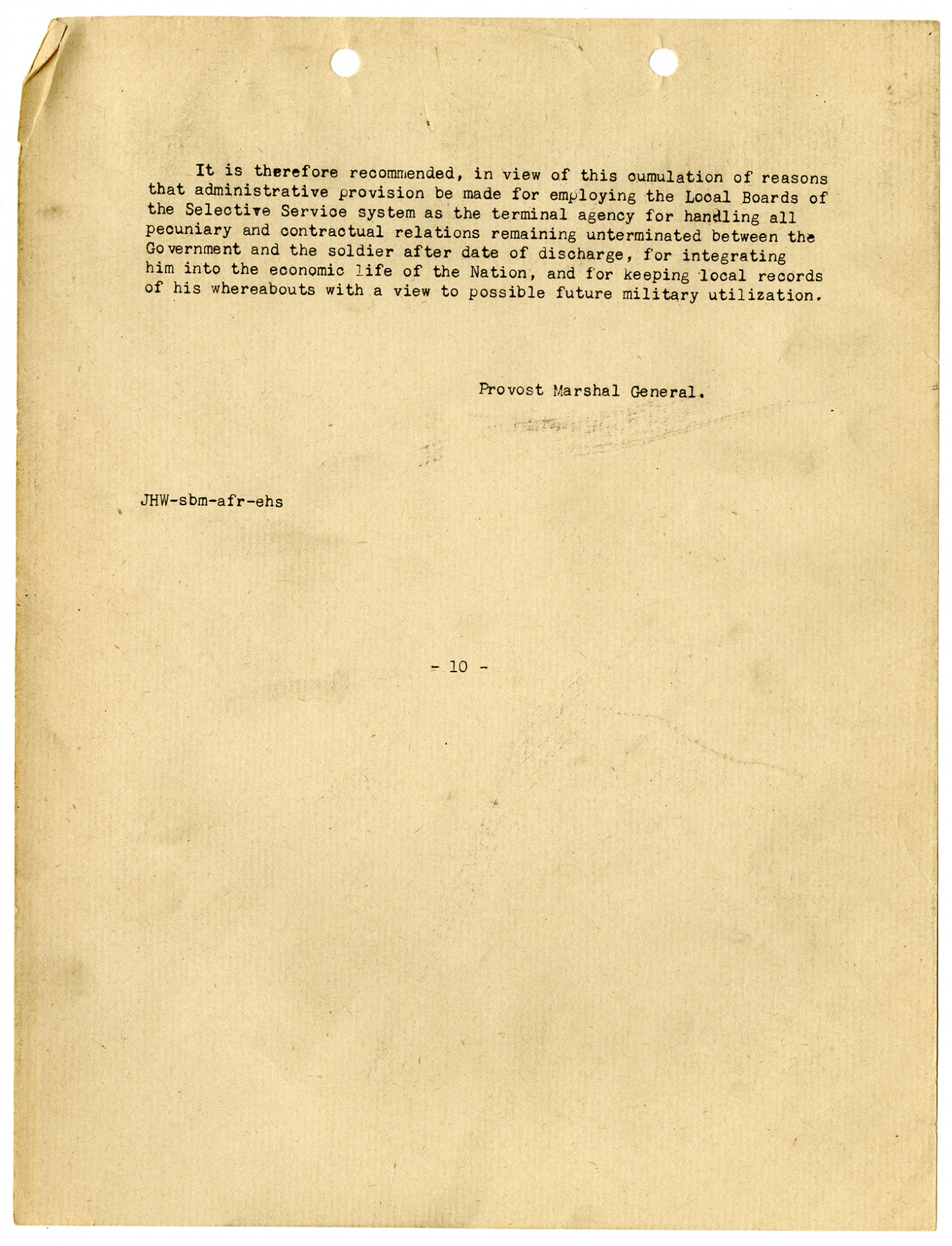
[page 10] It is therefore recommended, in view of this cumulation of reasons that administrative provision be made for employing the Local Boards of the Selective Service system as the terminal agency for handling all pecuniary and contractual relations remaining unterminated between the Government and the soldier after date of discharge, for integrating him into the economic life of the Nation, and for keeping local records of his whereabouts with a view to possible future military utilization. Provost Marshal General. JHW-sbm-aft-ehs
Details
| Title | Memorandum from the Provost Marshal General to the Chief of Staff - November 11, 1918 |
| Creator | Crowder, Enoch H. |
| Source | Unknown. Memorandum from the Provost Marshal General to the Chief of Staff. 11 November 1918. Crowder, Enoch H. (1859-1932), Papers, 1884-1942. C1046. The State Historical Society of Missouri, Columbia, MO. |
| Description | Memorandum written by General Enoch H. Crowder to the Chief of Staff Peyton C. March concerning demobilization of the armed forces. He discussed administrative provision for a just settlement of the relations remaining unsettled by the formal discharge of enlisted men, and transitioning them from military to civil status. This document is part of a collection compiled by Enoch Herbert Crowder, the Edinburg, Grundy County, Missouri native who served as Judge Advocate General. Crowder devised the Selective Service Act in 1917 which drafted America's forces during World War I. |
| Subject LCSH | Crowder, E. H. (Enoch Herbert), 1859-1932; Draft; Draft--Law and legislation; United States--Armed Forces--Demobilization; United States. War Department; War risk insurance; Liberty bonds; Military commissions |
| Subject Local | WWI; World War I; Selective Service Act of 1917; Selective Draft Act |
| Site Accession Number | C1046 |
| Contributing Institution | The State Historical Society of Missouri |
| Copy Request | Transmission or reproduction of items on these pages beyond that allowed by fair use requires the written permission of the State Historical Society of Missouri: 1020 Lowry Street, Columbia, Missouri, 65201-7298. (573) 882-7083. |
| Rights | The text and images contained in this collection are intended for research and educational use only. Duplication of any of these images for commercial use without express written consent is expressly prohibited. |
| Date Original | November 11, 1918 |
| Language | English |