

Memorandum for the Secretary of War - January 31, 1918
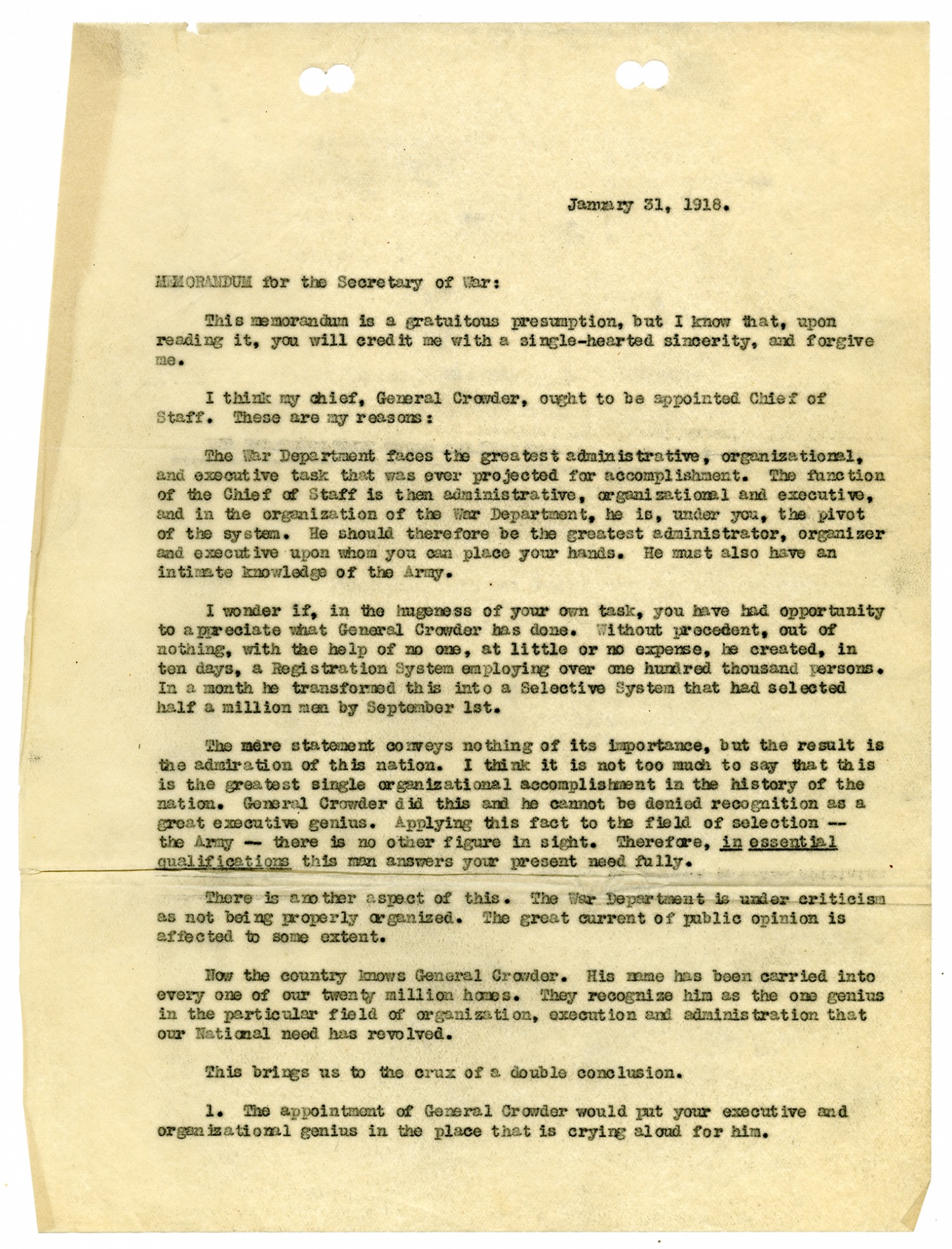
Transcript
January 31, 1918. Memorandum for the Secretary of War: This memorandum is a gratuitous presumption, but I know that, upon reading it, you will credit me with a single-hearted sincerity, and forgive me. I think my chief, General Crowder, out to be appointed Chief of Staff. These are my reasons: The War Department faces the greatest administrative, organizational, and executive task that was ever projected for accomplishment. The function of the Chief of Staff is then administrative, organizational and executive, and in the organization of the War Department, he is, under you, the pivot of the system. He should therefore be the greatest administrator, organizer and executive upon whom you can place your hands. He must also have an intimate knowledge of the Army. I wonder if, in the hugeness of your own task, you have had opportunity to appreciate what General Crowder has done. Without precedent, out of nothing, with the help of no one, at little or no expense, he created, in ten days, a Registration System employing over one hundred thousand persons. In a month he transformed this into a Selective System that had selected half a million men by September 1st. There mere statement conveys nothing of its importance, but the result is the admiration of this nation. I think it is not too much to say that this is the greatest single organizational accomplishment in the history of the nation. General Crowder did this and he cannot be denied recognition as a great executive genius. Applying this fact to the field of selection--the Army-- there is no other figure in sight. Therefore, in essential qualifications this man answers your present need fully. There is another aspect of this. The War Department is under criticism as not being properly organized. The great current of public opinion is affected to some extent. Now the country knows General Crowder. His name has been carried into every one of our twenty million homes. They recognize him as the one genius in the particular field of organization, execution and administration that our National need has revolved. This brings us to the crux of a double conclusion. 1. The appointment of General Crowder would put your executive and organizational genius in the place that is crying aloud for him.
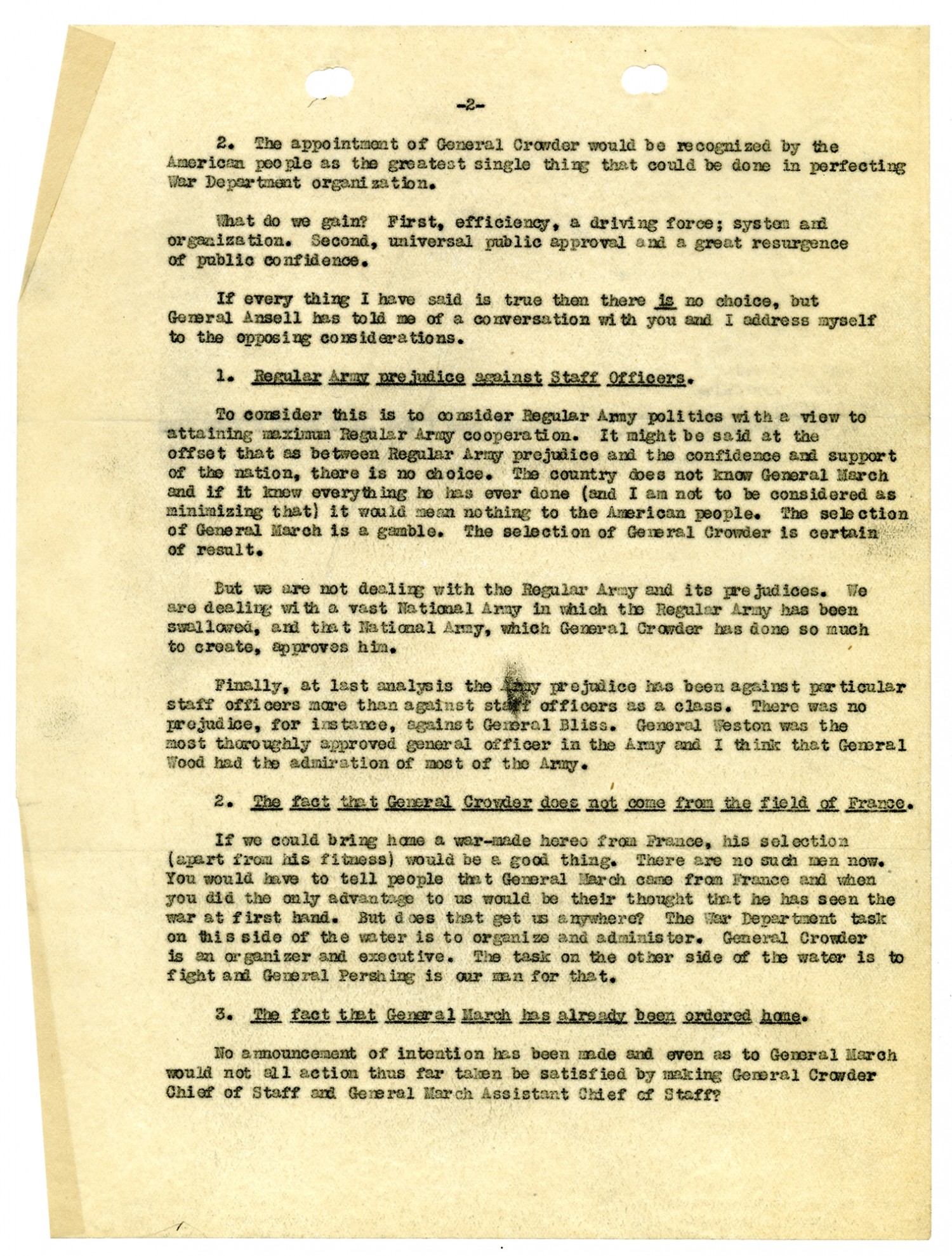
Transcript
[page 2] 2. The appointment of General Crowder would be recognized by the American people as the greatest single thing that could be done in perfecting War Department organization. What do we gain? First, efficiency, a driving force; system and organization. Second, universal public approval and a great resurgence of public confidence. If every thing I have said is true then there is no choice, but General Ansell has told me of a conversation with you and I address myself to the opposing considerations. 1. Regular Army prejudice against Staff Officers. To consider this is to consider Regular Army politics with a view to attaining maximum Regular Army cooperation. It might be said at the offset that as between Regular Army prejudice and the confidence and support of the nation, there is no choice. The country does not know General March and if it knew everything he has ever done (and I am not to be considered as minimizing that) it would mean nothing to the American people. The selection of General March is a gamble. The selection of General Crowder is certain of result. But we are not dealing with the Regular Army and its prejudices. We are dealing with a vast National Army in which the Regular Army has been swallowed, and that National Army, which General Crowder has done so much to create, approves him. Finally, at last analysis the Army prejudice has been against particular staff officers more than against staff officers as a class. There was no prejudice, for instance, against General Bliss. General Weston was the most thoroughly approved general officer in the Army and I think that General Wood had the admiration of most of the Army. 2. The fact that General Crowder does not come from the field of France. If we could bring home a war-made hereo from France, his selection (apart from his fitness) would be a good thing. There are no such men now. You would have to tell people that General March came from France and when you did the only advantage to us would be their thought that he has seen the war at first hand. But does that get us anywhere? The War Department task on this side of the water is to organize and administer. General Crowder is an organizer and executive. The task on the other side of the water is to fight and General Pershing is our man for that. 3. The fact that General March has already been ordered home. No announcement of intention has been made and even as to General March would not all action thus far taken be satisfied by making General Crowder Chief of Staff and General March Assistant Chief of Staff?
Details
| Title | Memorandum for the Secretary of War - January 31, 1918 |
| Creator | Unknown |
| Source | Unknown. Memorandum for the Secretary of War. 31 January 1918. Crowder, Enoch H. (1859-1932), Papers, 1884-1942. C1046. The State Historical Society of Missouri, Columbia, MO. |
| Description | In this memorandum to the Secretary of War, Newton D. Baker, the author wrote about the promotion of General Enoch H. Crowder to Chief of Staff. This document is part of a collection compiled by Enoch Herbert Crowder, the Edinburg, Grundy County, Missouri native who served as Judge Advocate General. Crowder devised the Selective Service Act in 1917 which drafted America's forces during World War I. |
| Subject LCSH | Crowder, E. H. (Enoch Herbert), 1859-1932; United States. War Department; Promotions, Military; United States. Army--Promotions. |
| Subject Local | WWI; World War I |
| Site Accession Number | C1046 |
| Contributing Institution | The State Historical Society of Missouri |
| Copy Request | Transmission or reproduction of items on these pages beyond that allowed by fair use requires the written permission of the State Historical Society of Missouri: 1020 Lowry Street, Columbia, Missouri, 65201-7298. (573) 882-7083. |
| Rights | The text and images contained in this collection are intended for research and educational use only. Duplication of any of these images for commercial use without express written consent is expressly prohibited. |
| Date Original | January 31, 1918 |
| Language | English |