Memorandum for the Secretary of War from General Crowder - November 22, 1917
Transcript
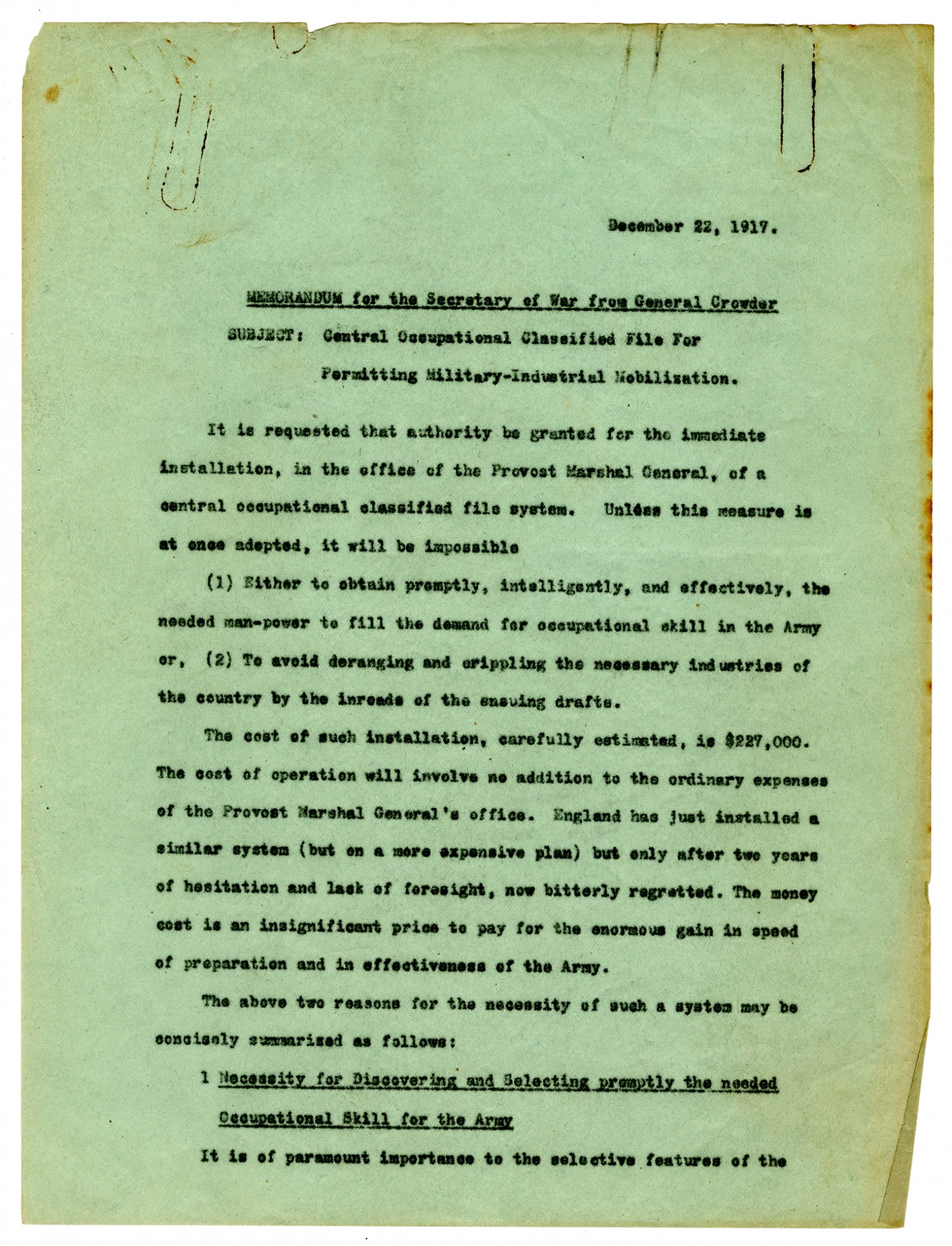
December 22, 1917. Memorandum for the Secretary of War from General Crowder Subject: Central Occupational Classified File For Permitting Military-Industrial Mobilization. It is requested that authority be granted for the immediate installation, in the office of the Provost Marshal General, of a central occupational classified file system. Unless this measure is at once adopted, it will be impossible. (1) Either to obtain promptly, intelligently, and effectively, the needed man-power to fill the demand for occupational skill in the Army or, (2) To avoid deranging and crippling the necessary industries of the country by the inreads of the ensuing drafts. The cost of such installation, carefully estimated, is $227,000. The cost of operation will involve no addition to the ordinary expenses of the Provost Marshal General
Transcript
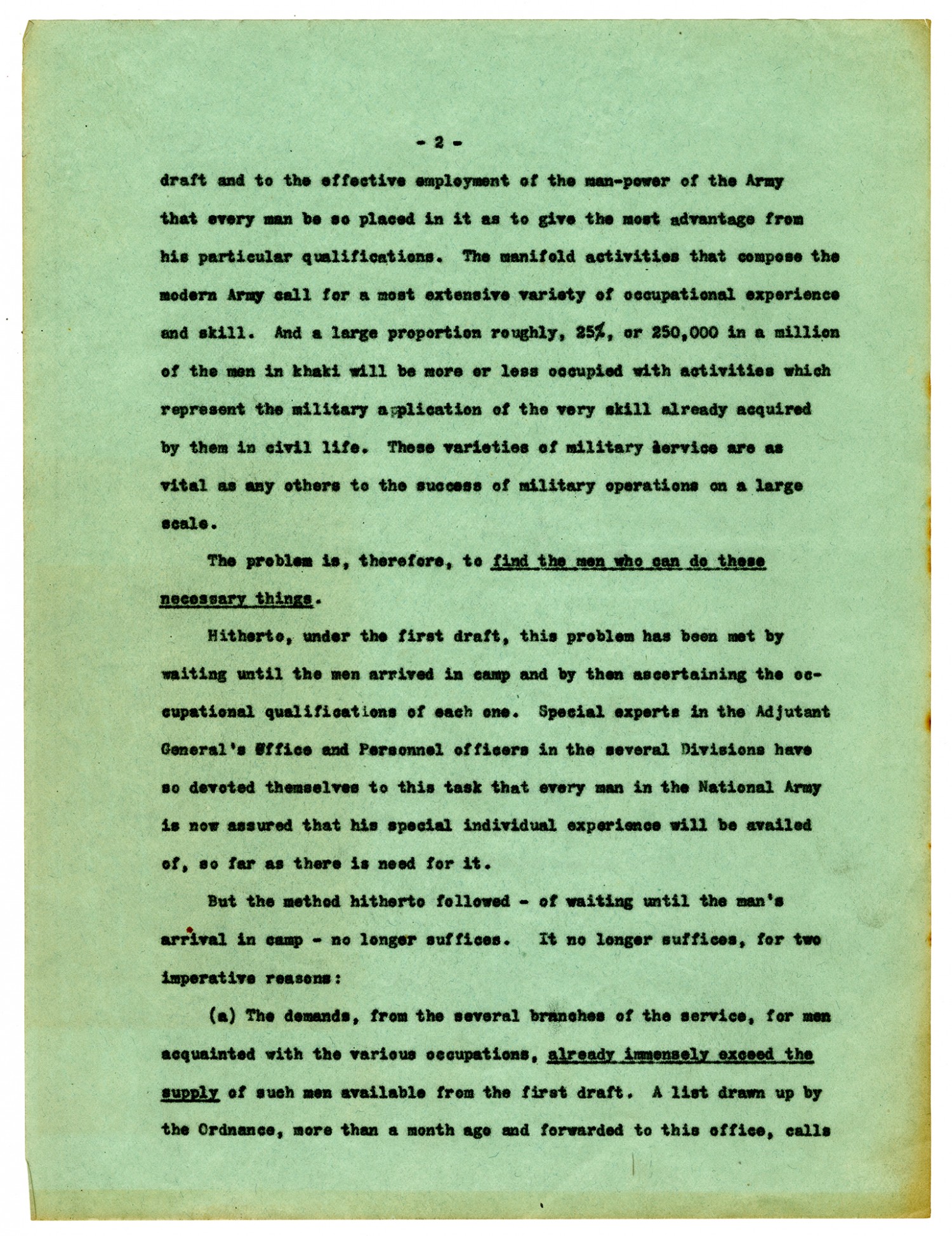
[page 2] draft and to the effective employment of the man-power of the Army that every man be so placed in it as to give the most advantage fro his particular qualifications. The manifold activities that compose the modern Army call for a most extensive variety of occupational experience and skill. And a large proportion roughly, 25%, or 250,000 in a million of the men in khaki will be more or less occupied with activities which represent the military application of the very skill already acquired by them in civil life. These varieties of military service are as vital as any others to the success of military operations on a large scale. The problem is, therefore, to find the men who can do these necessary things. Hitherto, under the first draft, this problem has been met by waiting until the men arrived in camp and by then ascertaining the occupational qualifications of each one. Special experts in the Adjutant General
Transcript
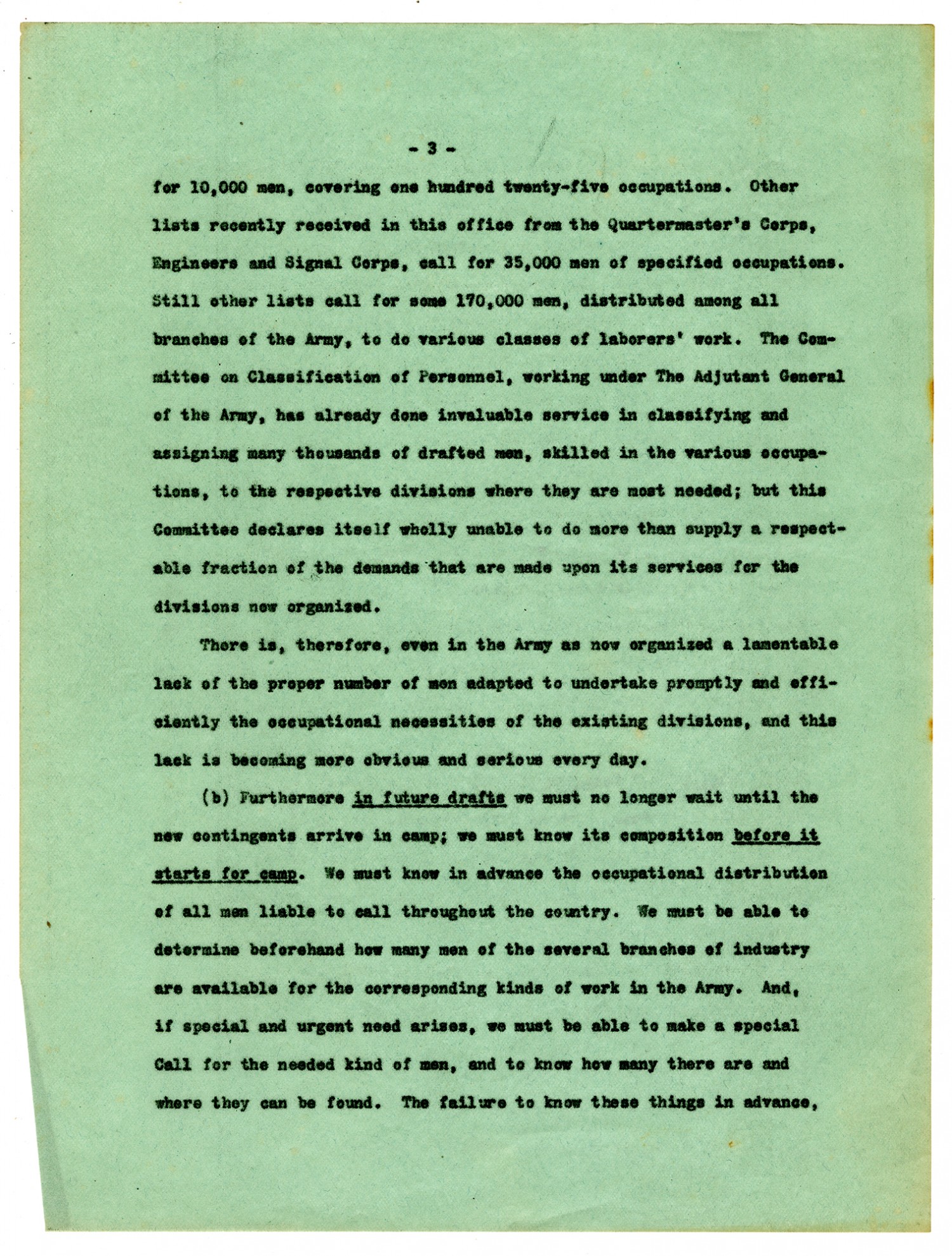
[page 3] for 10,000 men, covering one hundred twenty-five occupations. Other lists recently received in this office from the Quartermaster
Transcript
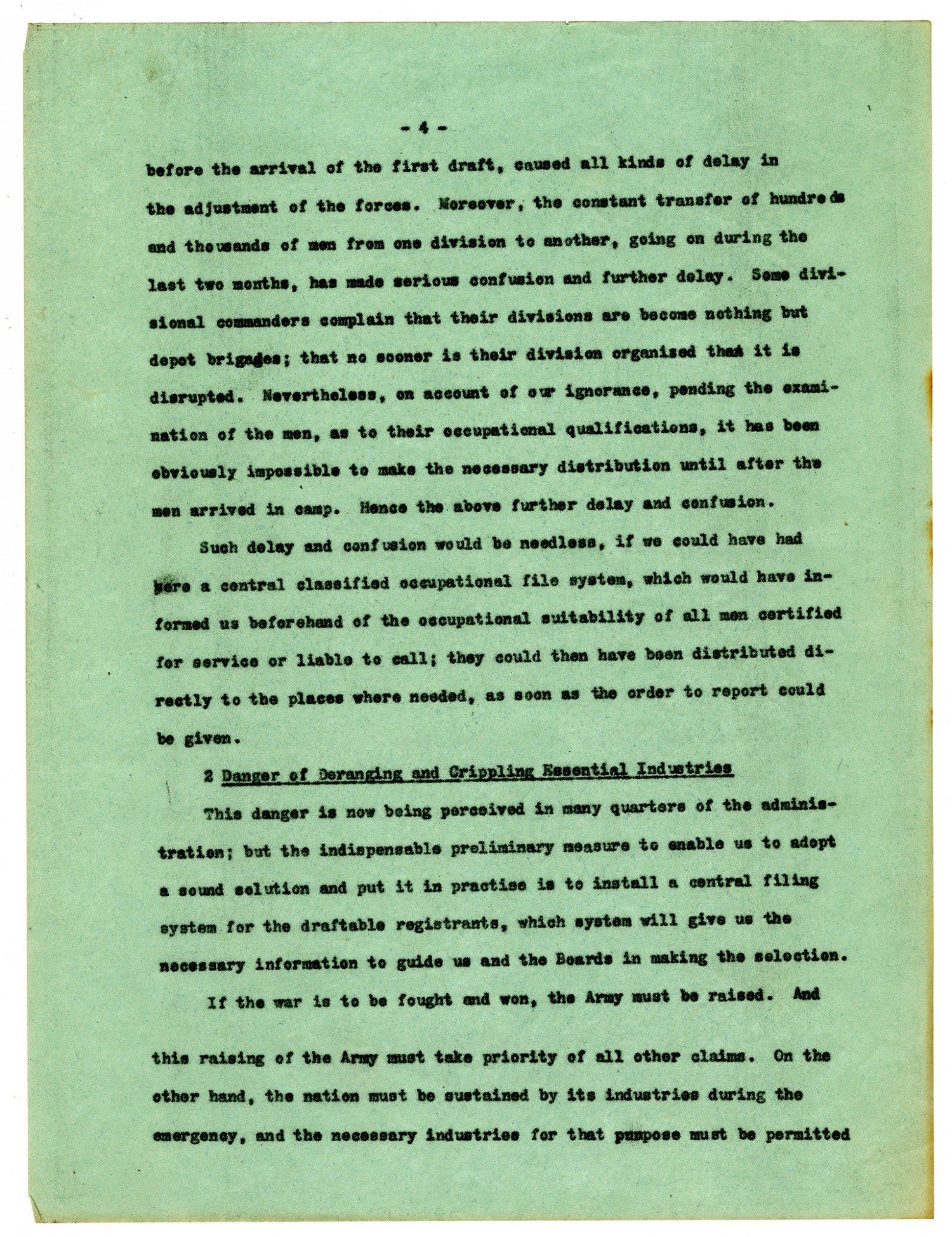
[page 4] before the arrival of the first draft, caused all kinds of delay in the adjustment of the forces. Moreover, the constant transfer of hundreds and thousands of men from one division to another, going on during the last two months, has made serious confusion and further delay. Some divisional commanders complain that their divisions are become nothing but depot brigades; that no sooner is their division organized that it is disrupted. Nevertheless, on account of our ignorance, pending the examination of the men, as to their occupational qualifications, it has been obviously impossible to make the necessary distribution until after the men arrived in camp. Hence the above further delay and confusion. Such delay and confusion would be needless, if we could have had were a central classified occupational file system, which would have informed us beforehand of the occupational suitability of all men certified for service or liable to call; they could then have been distributed directly to the places where needed, as soon as the order to report could be given. 2. Danger of Deranging and Crippling Essential Industries This danger is now being perceived in many quarters of the administration; but the indispensable preliminary measure to enable us to adopt a sound solution and put it in practice is to install a central filing system for the draftable registrants, which system will give us the necessary information to guide us and the Boards in making the selection. If the war is to be fought and won, the Army must be raised. And this raising of the Army must take priority of all other claims. On the other hand, the nation must be sustained by its industries during the emergency, and the necessary industries for that purpose must be permitted.
Transcript
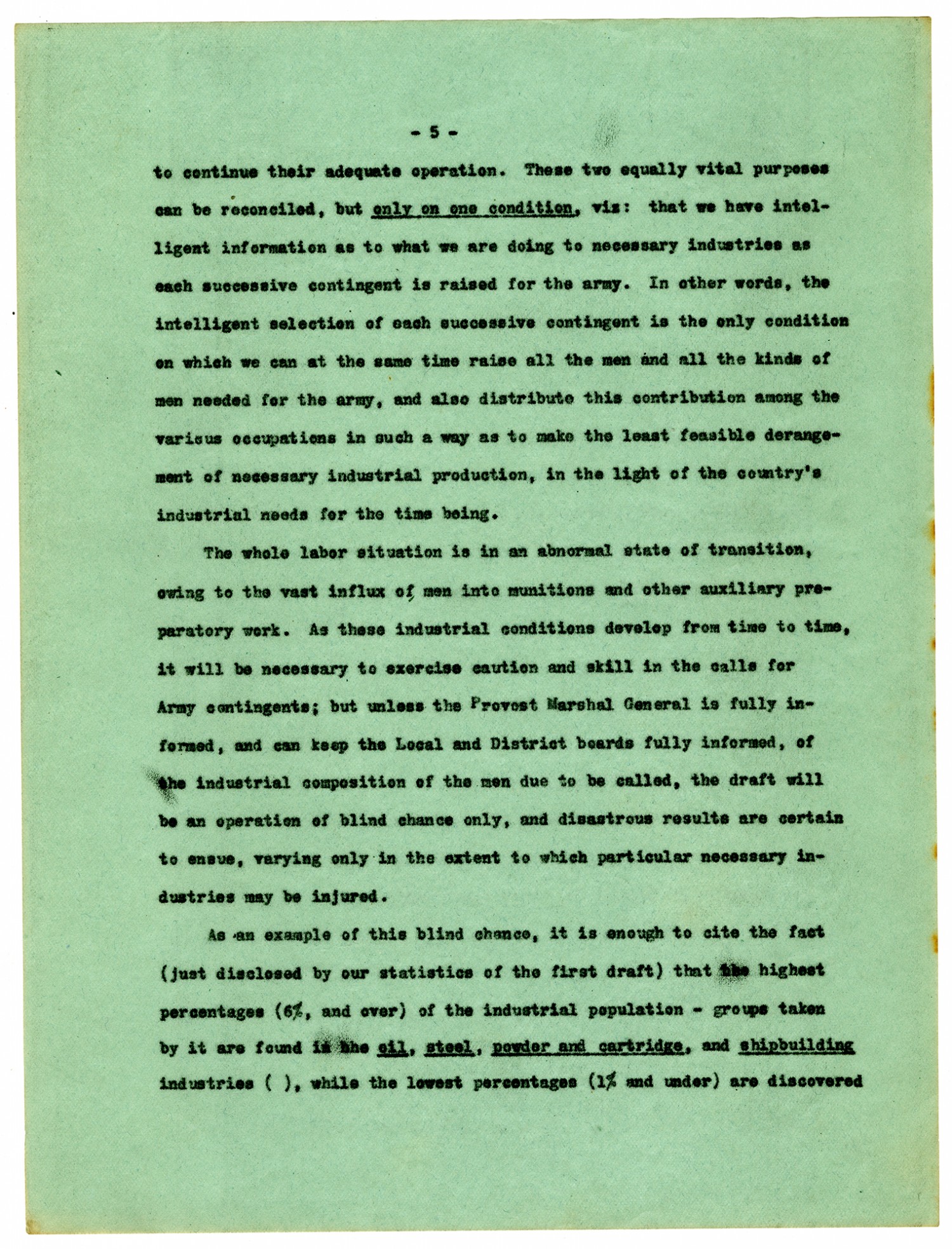
[page 5 ] to continue their adequate operation. These two equally vital purposes can be reconciled, but only on one condition, vis: that we have intelligent information as to what we are doing to necessary industries as each successive contingent is raised for the army. In other words, the intelligent selection of each successive contingent is the only condition on which we can at the same time raise all the men and all the kinds of men needed for the army, and also distribute this contribution among the various occupations in such a way as to make the least feasible derangement of necessary industrial production, in the light of the country
Transcript
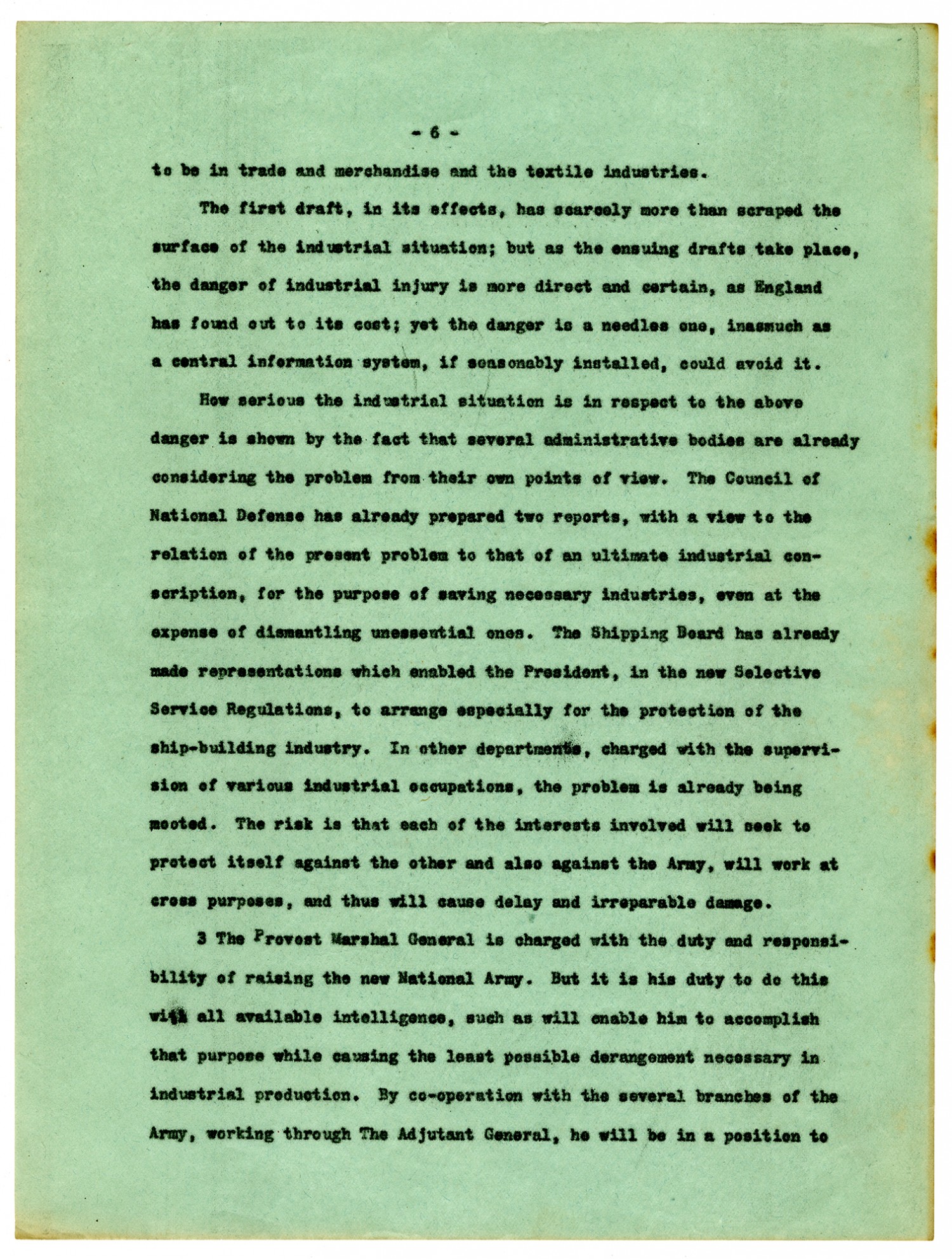
[page 6] to be in trade and merchandise and the textile industries. The first draft, in its effects, has scarcely more than scraped the surface of the industrial situation; but as the ensuing drafts take place, the danger of industrial injury is more direct and certain, as England has found out to its cost; yet the danger is a needless one, inasmuch as a central information system, if seasonably installed, could avoid it. How serious the industrial situation is in respect to the above danger is shown by the fact that several administrative bodies are already considering the problem from their own points of view. The Council of National Defense has already prepared two reports, with a view to the relation of the present problem to that of an ultimate industrial conscription, for the purpose of saving necessary industries, even at the expense of dismantling unessential ones. The Shipping Board has already made representations which enabled the President, in the new Selective Service Regulations, to arrange especially for the protection of the ship-building industry. In other departments, charged with the supervision of various industrial occupations, the problem is already being mooted. The risk is that each of the interests involved will seek to protect itself against the other and also against the Army, will work at cross purposes, and thus will cause delay and irreparable damage. 3 The Provost Marshal General is charged with the duty and responsibility of raising the new National Army. But it is his duty to do this with all available intelligence, such as will enable him to accomplish that purpose while causing the least possible derangement necessary in industrial production. By co-operation with the several branches of the Army, working through the Adjutant General, he will be in a position to
Transcript
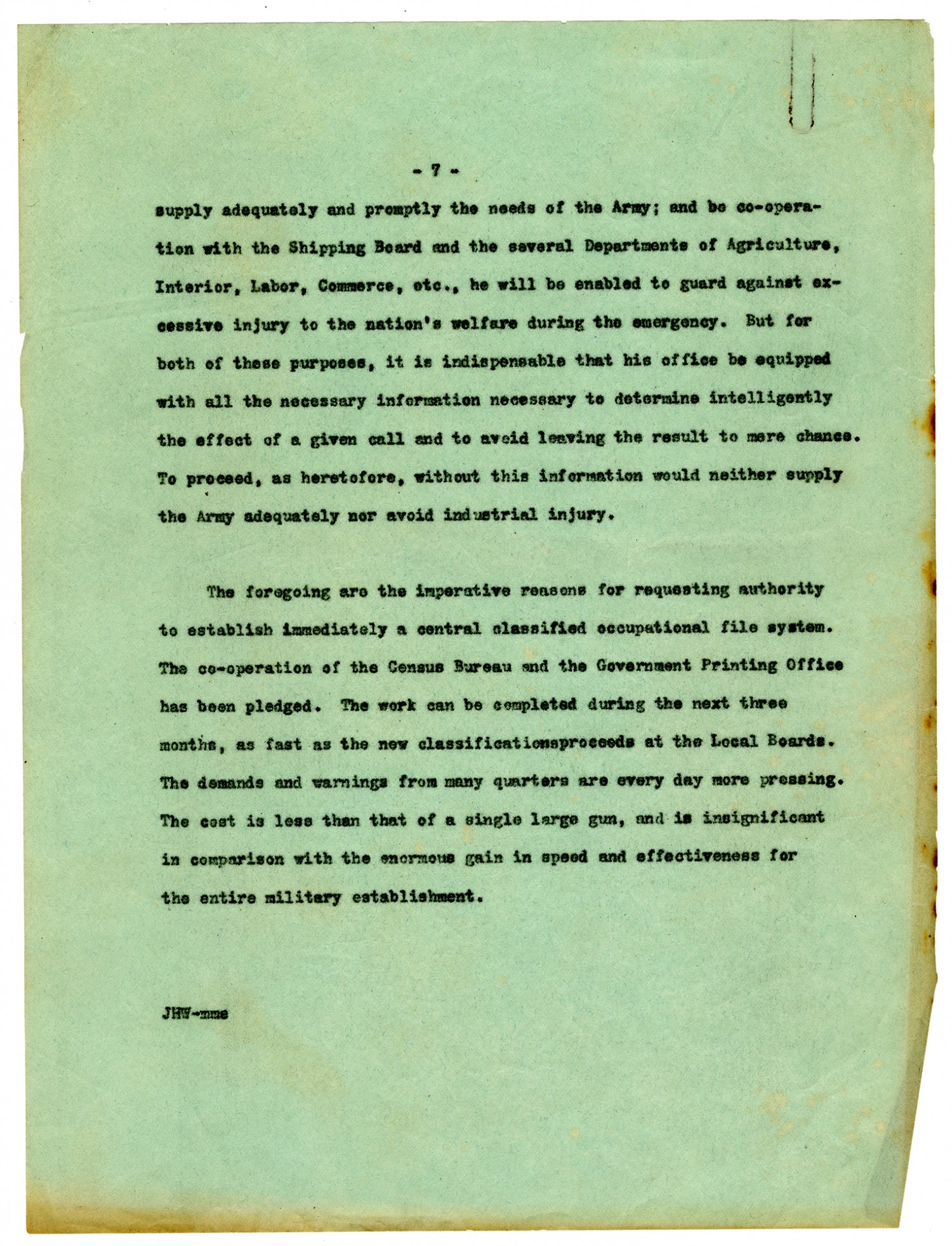
[page 7 ] supply adequately and promptly the needs of the Army; and be co-operation with the Shipping Board and the several Departments of Agriculture, Interior, Labor, Commerce, etc., he will be enabled to guard against excessive injury to the nation
Details
| Title | Memorandum for the Secretary of War from General Crowder - November 22, 1917 |
| Creator | Crowder, Enoch H. |
| Source | Crowder Enoch H. Memorandum for the Secretary of War. 22 December 1917. Crowder, Enoch H. (1859-1932), Papers, 1884-1942. C1046. The State Historical Society of Missouri, Columbia, MO. |
| Description | In this memorandum, Provost Marshal General, Enoch H. Crowder wrote the Secretary of War and asked for the authority to install a central occupational classified file system. This document is part of a collection compiled by Enoch Herbert Crowder, the Edinburg, Grundy County, Missouri native who served as Judge Advocate General. Crowder devised the Selective Service Act in 1917 which drafted America's forces during World War I. |
| Subject LCSH | Crowder, E. H. (Enoch Herbert), 1859-1932; United States. War Department; Baker, Newton, 1871-1937 |
| Subject Local | WWI; World War I |
| Site Accession Number | C1046 |
| Contributing Institution | The State Historical Society of Missouri |
| Copy Request | Transmission or reproduction of items on these pages beyond that allowed by fair use requires the written permission of the State Historical Society of Missouri: 1020 Lowry Street, Columbia, Missouri, 65201-7298. (573) 882-7083. |
| Rights | The text and images contained in this collection are intended for research and educational use only. Duplication of any of these images for commercial use without express written consent is expressly prohibited. |
| Date Original | December 22, 1917 |
| Language | English |