Memorandum for the Secretary of War from General Crowder - August 1, 1918
Transcript
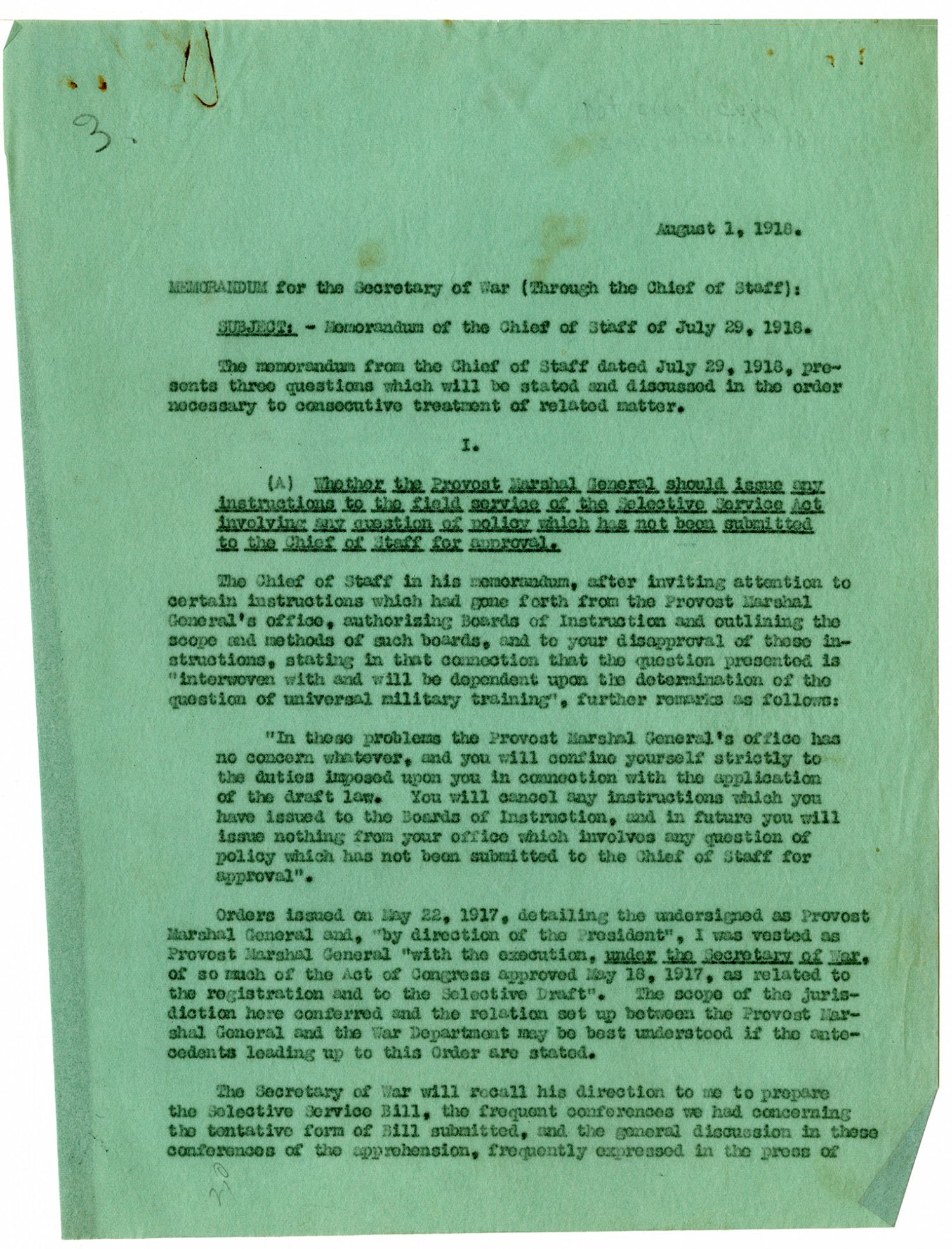
August 1, 1918. Memorandum for the Secretary of War (Through the Chief of Staff): Subject:-Memorandum of the Chief of Staff of July 29, 1918. The memorandum from the Chief of Staff dated July 29, 1918, presents three questions which will be stated and discussed in the order necessary to consecutive treatment of related matter. I. (A) Whether the Provost Marshal General should issue any instructions to the field service of the Selective Service Act involving any question of policy which has not been submitted to the Chief of Staff for approval. The Chief of Staff in his memorandum, after inviting attention to certain instructions which had gone forth from the Provost Marshal General
Transcript
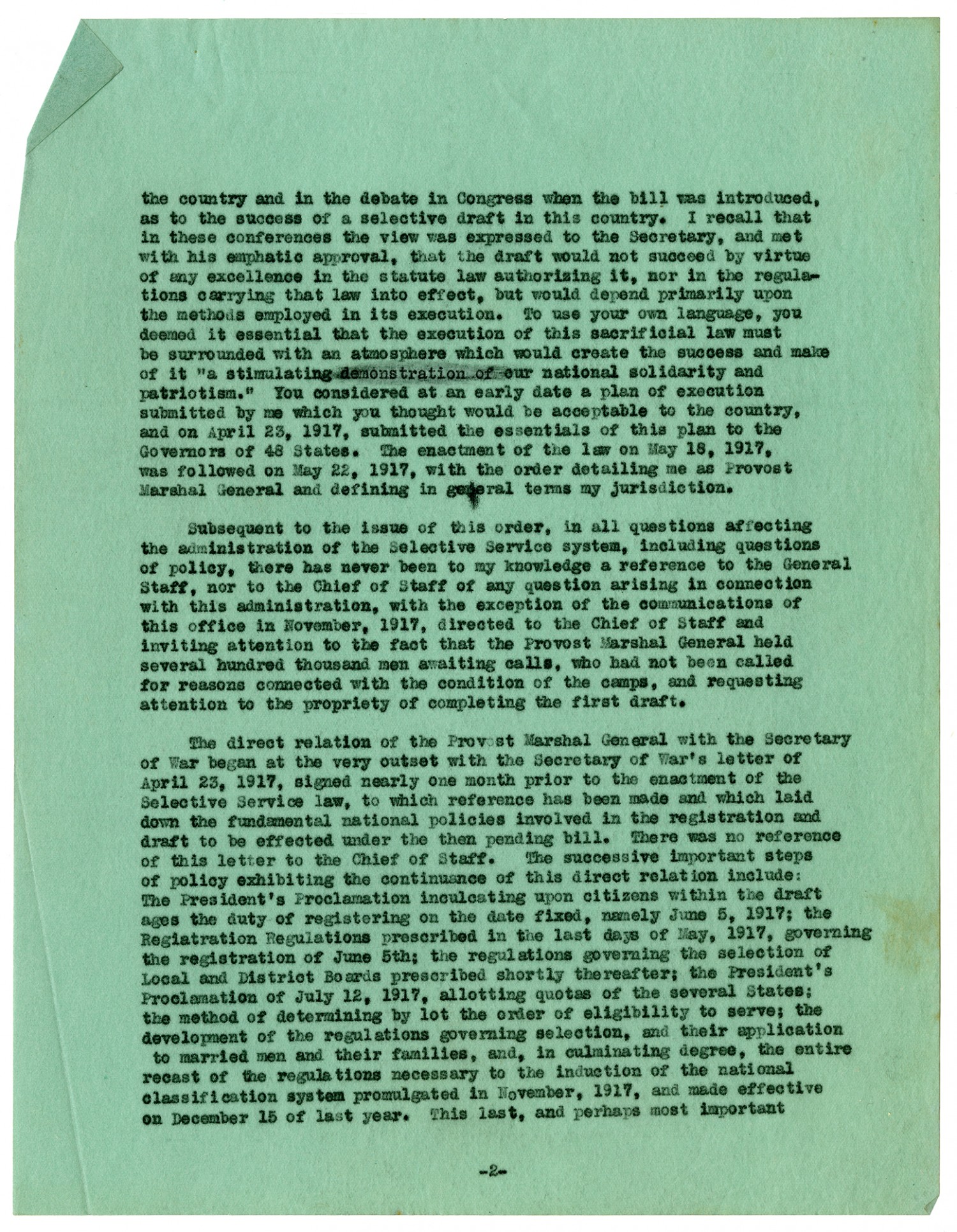
[page 2] the country and in the debate in Congress when the bill was introduced, as to the success of a selective draft in this country. I recall that in these conferences the view was expressed to the Secretary, and met with his emphatic approval, that the draft would not succeed by virtue of any excellence in the statute law authorizing it, nor in the regulations carrying that law into effect, but would depend primarily upon the methods employed in its execution. To use your own language, you deemed it essential that the execution of this sacrificial law must be surrounded with an atmosphere which would create the success and make of it
Transcript
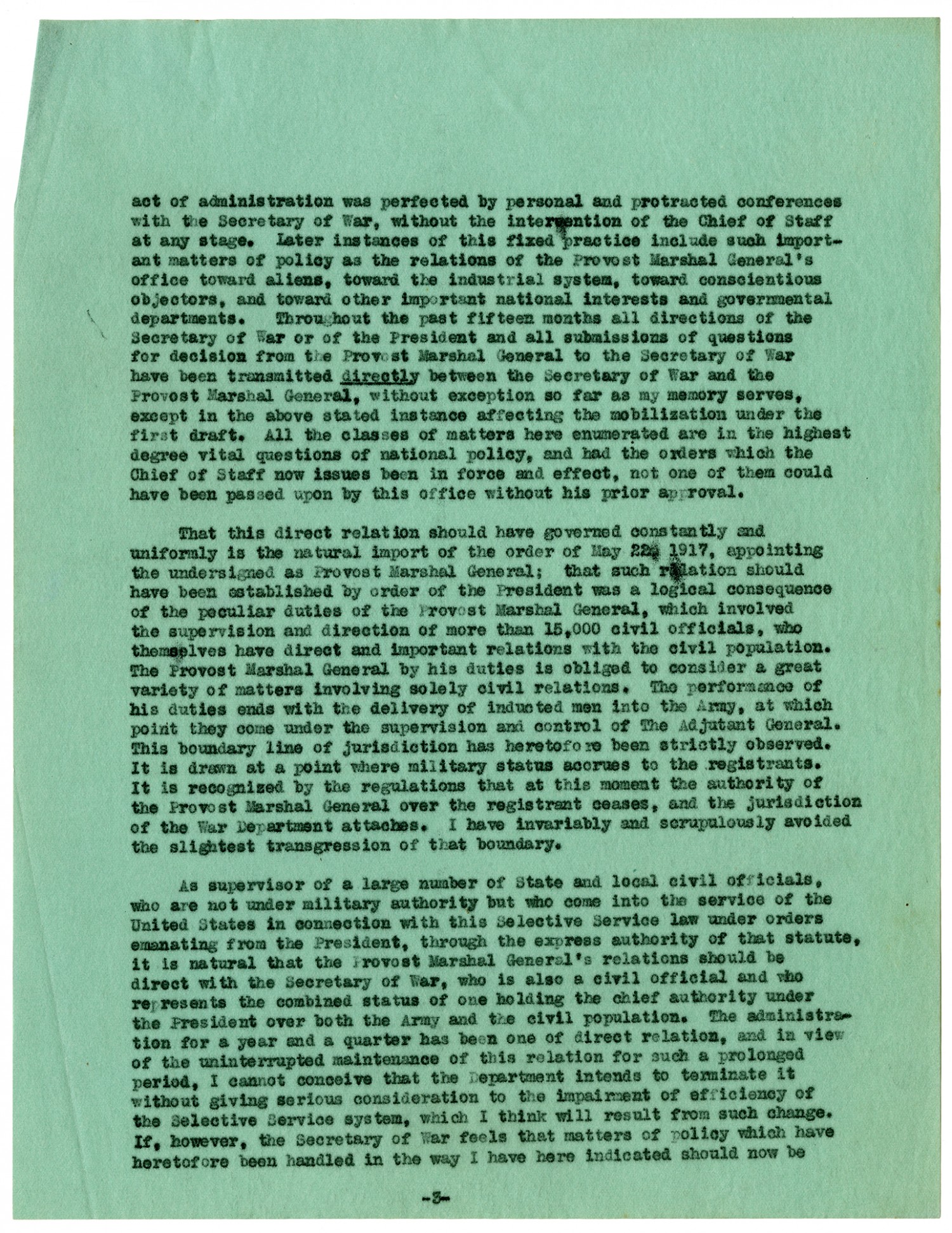
[page 3] act of administration was perfected by personal and protracted conferences with the Secretary of War, without the intervention of the Chief of Staff at any stage. Later instances of this fixed practice include such important matters of policy as the relations of the Provost Marshal General
Transcript
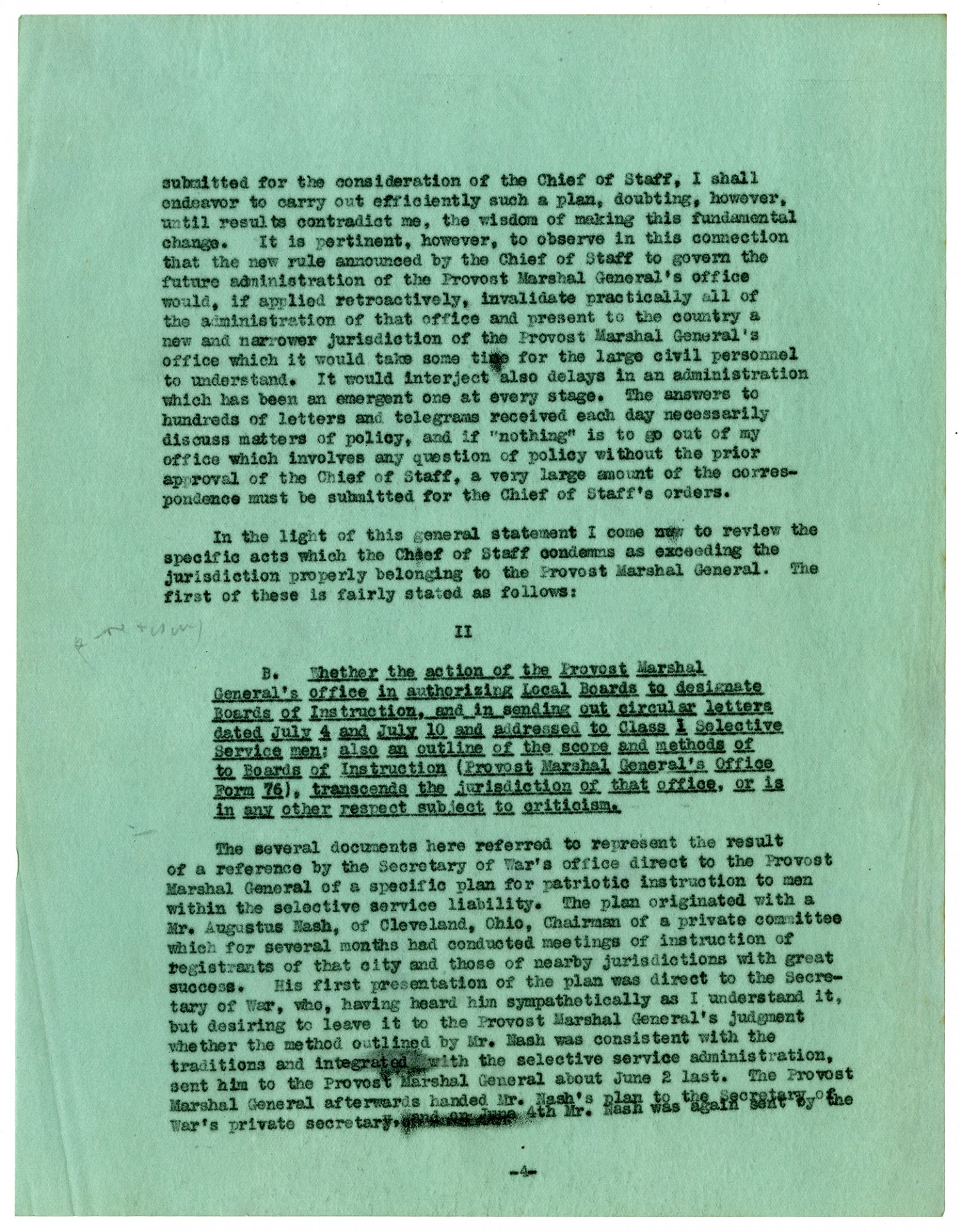
[page 4] submitted for the consideration of the Chief of Staff, I shall endeavor to carry out efficiently such a plan, doubting, however, until results contradict me, the wisdom of making this fundamental change. It is pertinent, however, to observe in this connection that the new rule announced by the Chief of Staff to govern the future administration of the Provost Marshal General
Transcript
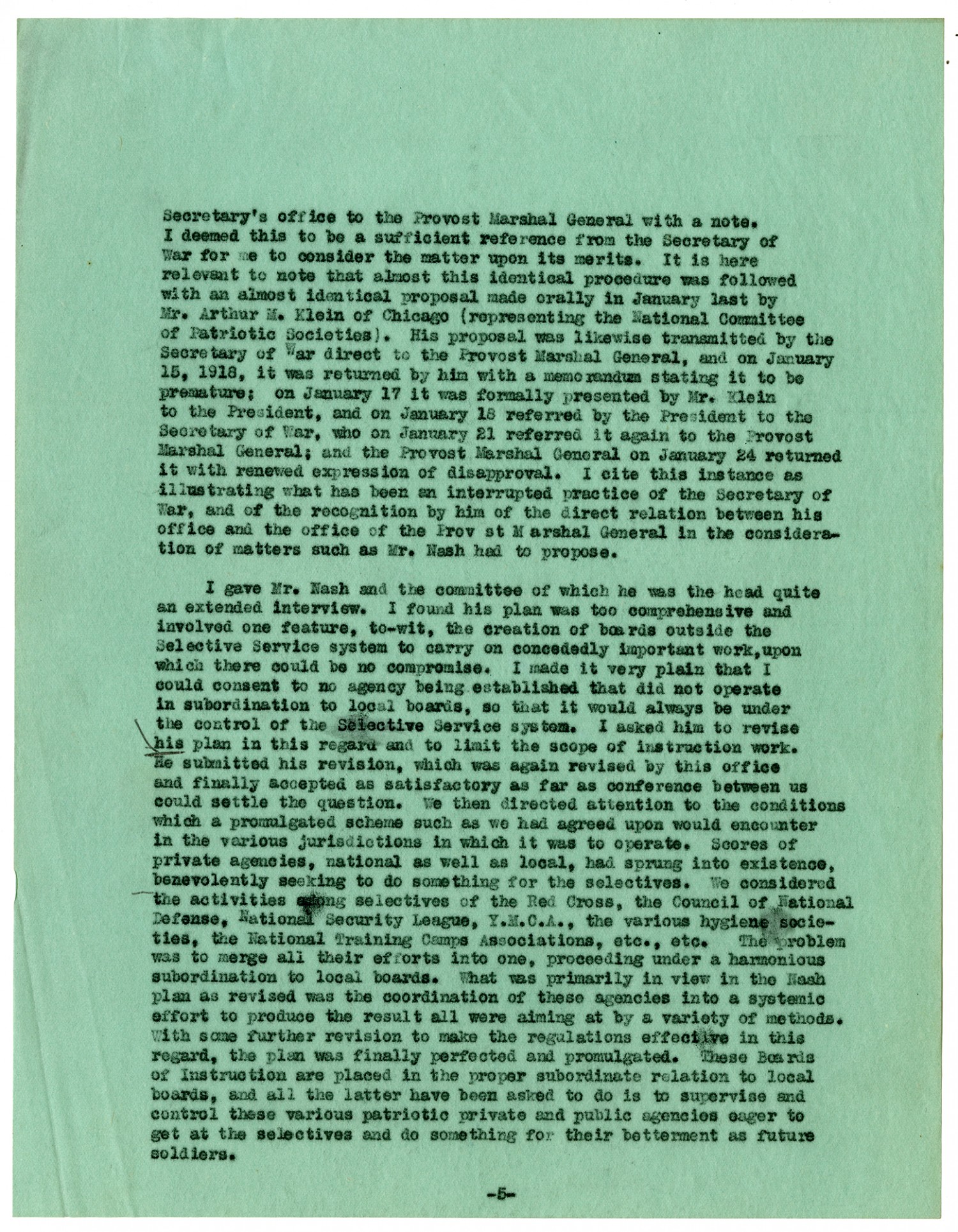
[page 5] Secretary
Transcript
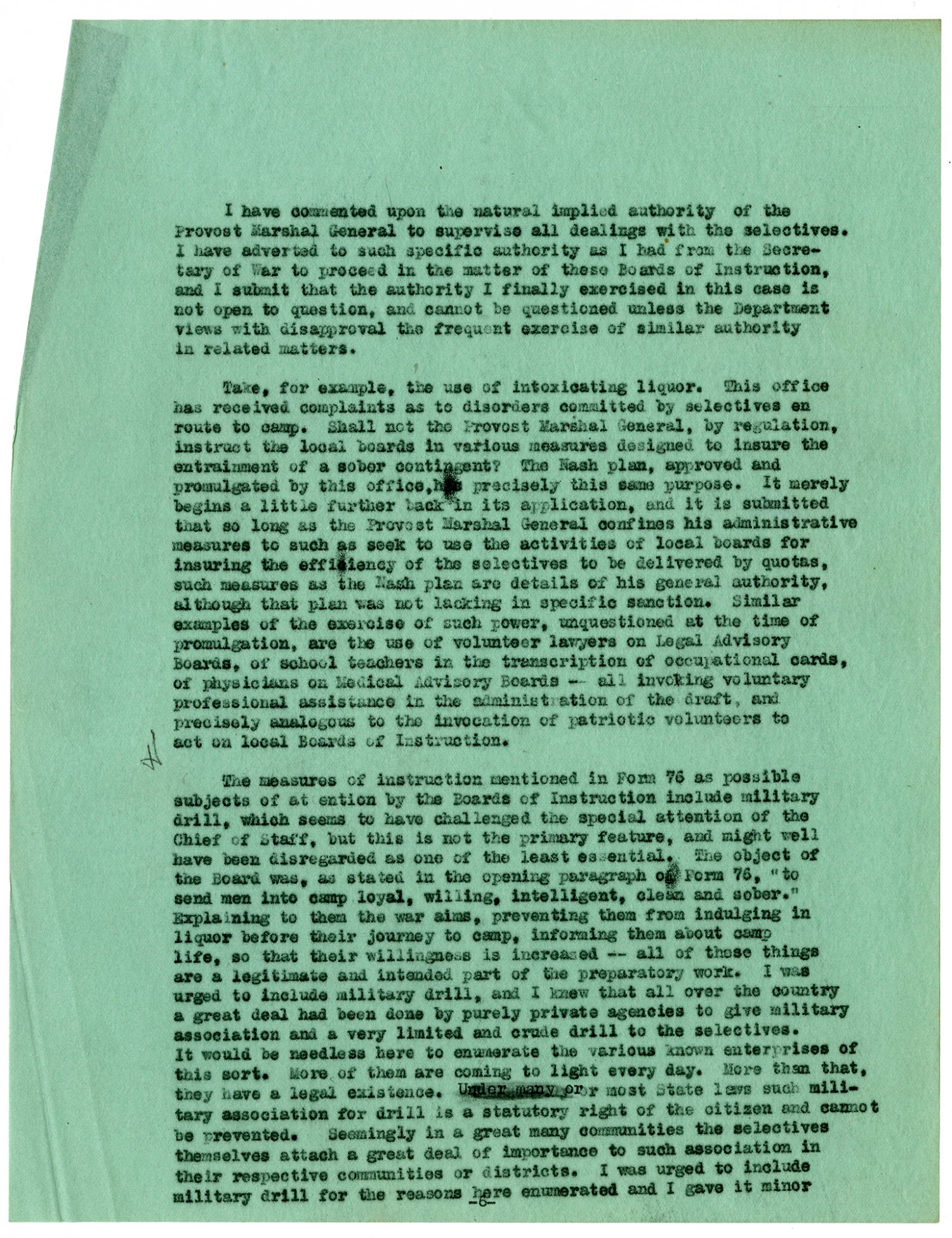
[page 6] I have commented upon the natural implied authority of the Provost Marshal General to supervise all dealings with the selectives. I have adverted to such specific authority as I had from the Secretary of War to proceed in the matter of these Boards of Instruction, and I submit that the authority as I had from the Secretary of War to proceed in the matter of these Boards of Instruction, and I submit that the authority I finally exercised in this case is not open to question, and cannot be questioned unless the Department views with disapproval the frequent exercise of similar authority in related matters. Take, for example, the use of intoxicating liquor. This office has received complaints as to disorders committed by selectives an route to camp. Shall not the Provost Marshal General, by regulation, instruct the local boards in various measures designed to insure the entrainment of a sober contingent? The Nash plan, approved and promulgated by this office, has precisely this same purpose. It merely begins a little further back in its application, and it is submitted that so long as the Provost Marshal General confines his administrative measures to such as seek to use the activities of local boards for insuring the efficiency of the selectives to be delivered by quotas, such measures as the Nash plan are details of his general authority, although that plan was not lacking in specific sanction. Similar examples of the exercise of such power, unquestioned at the time of promulgation, are the use of volunteer lawyers on Legal Advisory Boards, of school teachers in the transcription of occupational cards, of physicians on Medical Advisory Boards-all invoking voluntary professional assistance in the administration of the draft, and precisely analogous to the invocation of patriotic volunteers to act on local Boards of Instruction. The measure of instruction mentioned in Form 76 as possible subjects of at ention by the Boards of Instruction include military drill, which seems to have challenged the special attention of the Chief of Staff, but this is not the primary feature, and might well have been disregarded as one of the least essential. The object of the Board was, as stated in the opening paragraph of Form 76,
Transcript
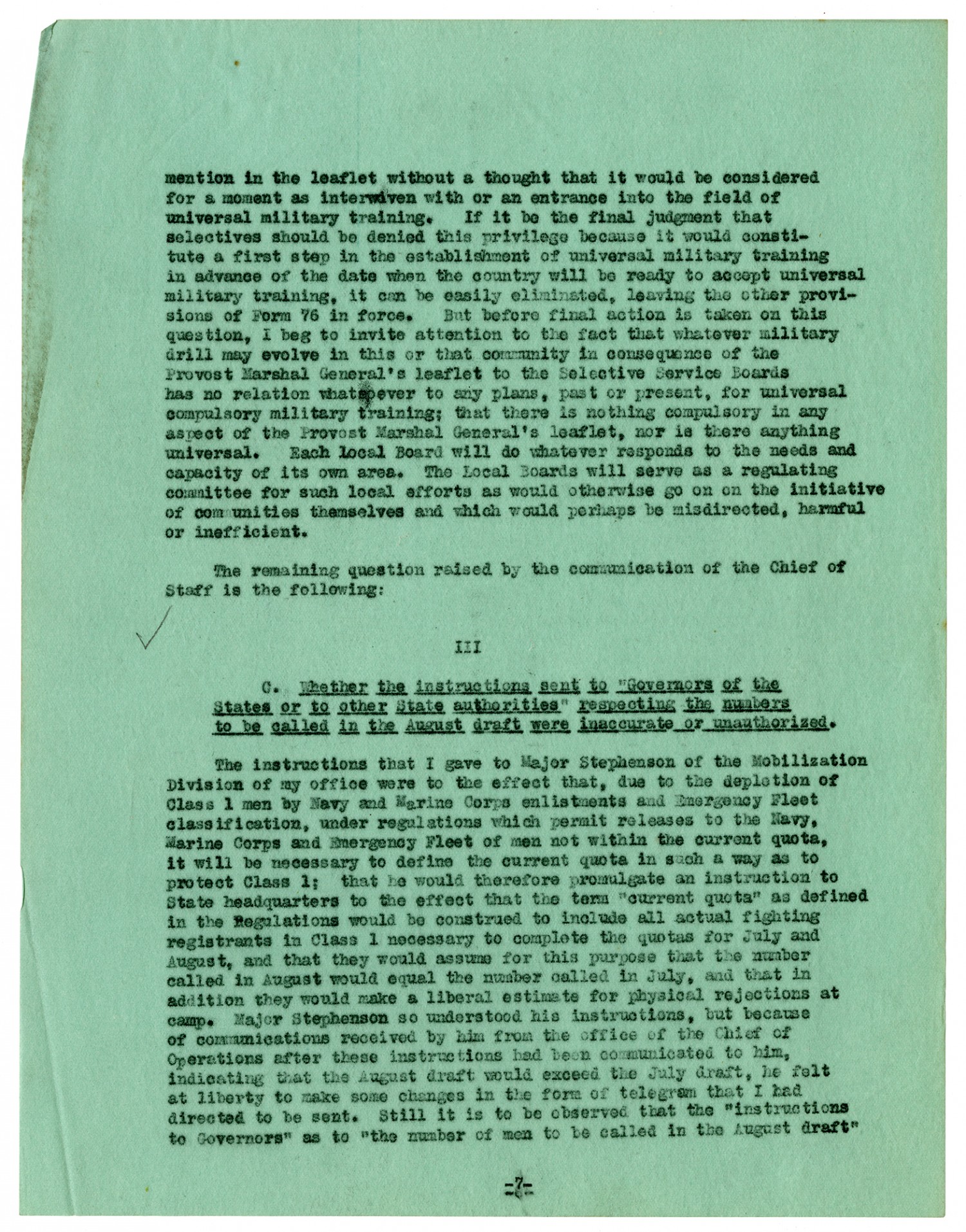
[page 7] mention in the leaflet without a thought that it would be considered for a moment as interwoven with or an entrance into the field of universal military training If it be the final judgment that selectives should be denied this privilege because it would constitute a first step in the establishment of universal military training in advance of the date when the country will be ready to accept universal military training, it can be easily eliminated, leaving the other previsions of Form 76 in force. But before final action is taken on this question, I beg to invite attention to the fact that whatever military drill may evolve in this or that community in consequence of the Provost Marshal General
Transcript
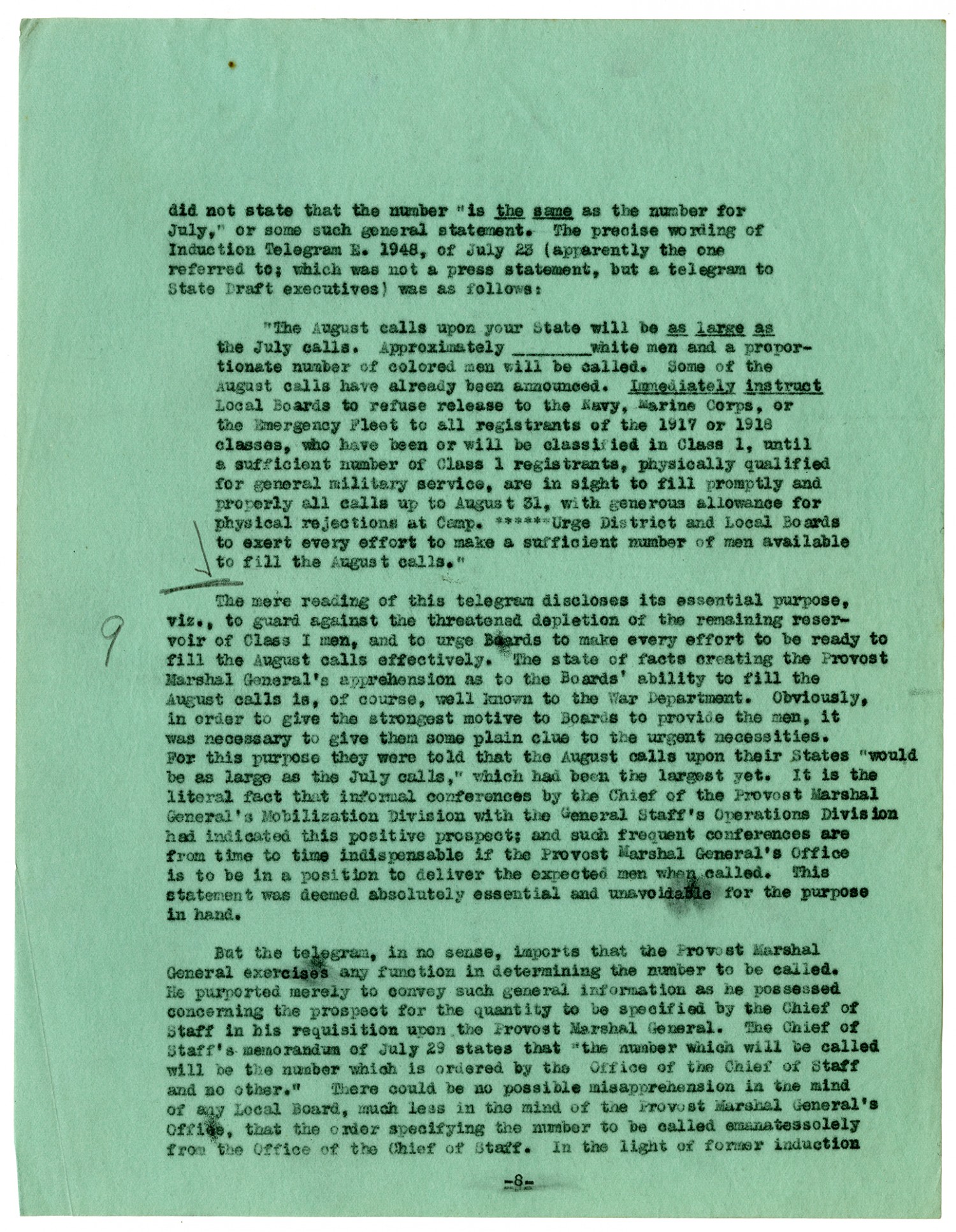
[page 8] did not state that the number
Transcript
[page 9] telegram from this office, it is simply impossible that the State Executives or the Local Boards could entertain the slightest misunderstanding. The Provost Marshal General acts merely as the medium of communication for sending the call to the Local Boards. It is believed that the terms of the telegram import not the slightest assumption of any authority to initiate a requisition or a call. Any impression of that sort must be due to the brief press notices which, presumably, stated the matter in popular language; for these statements, of course, the Provost Marshal General is not responsible. You will recall that I reported to you promptly on the date that I sent the telegram above mentioned the substance of the telegram, but in the form in which I had conveyed the instructions to Major Stephenson. You instantly approved the act and instructed me to at once issue an order denying releases to the Navy, Marine Corps and Emergency Fleet of all remaining actual fighting men in Class I, which I did with promptness. Of course an inquiry from the office of the Chief of Staff prior to sending his letter would have elicited these facts, and I must express my regret that this course was not pursued rather than the writing of a letter which bases a conclusion and an order upon press reports. Conclusion a few minutes after I received the order of the Chief of Staff I telegraphed Mr. Nash to cease all his activities in connection with Boards of Instruction and requested him to report at once at Washington for conference. I shall not be able to determine effective methods of cancelling instructions issued until after conference with him and have delayed full compliance with the Order of the Chief of Staff in order that I might give it a complete execution and for this purpose only. The effort of the order of the Chief of Staff that
Transcript
[page 10] have the statutory duty, as Judge Advocate General, of advising generally on such questions, and when I was available for such consultation at any hour of the day or night of each of the seven days of the week. It would be difficult to discover, on the files of the War Department, a precedent for such a communication as I have received. There is, of course, no difficulty in discovering precedent for communications expressing disapproval or censure, but such communications are rarely directed to an officer whose duties lie entirely in the field of an untried experiment and ninety per cent of whose duties are discretionary and never, it is believed, will it be found that such communications have issued except after conference, where conference is available as it was in this case, and then only after such conference had failed to produce the result desired by superior authority. I submit for the judgment of superior authority the question whether this communication is one calculated to promote efficiency or whether, on the contrary, it is not calculated to destroy efficiency by killing initiative. E. H. Crowder Provost Marshal General. EHC-vbr
Details
| Title | Memorandum for the Secretary of War from General Crowder - August 1, 1918 |
| Creator | Crowder, Enoch H. |
| Source | Crowder, Enoch H. Memorandum for the Secretary of War. 01 August 1918. Crowder, Enoch H. (1859-1932), Papers, 1884-1942. C1046. The State Historical Society of Missouri, Columbia, MO. |
| Description | In this letter to the Secretary of War Newton D. Baker, General Enoch H. Crowder discussed the letter he received from Chief of Staff, General March. Crowder described his role as Provost Marshal General and explained the duties that were in his job description. This document is part of a collection compiled by Enoch Herbert Crowder, the Edinburg, Grundy County, Missouri native who served as Judge Advocate General. Crowder devised the Selective Service Act in 1917 which drafted America's forces during World War I. |
| Subject LCSH | Crowder, E. H. (Enoch Herbert), 1859-1932; Draft; Draft--Law and legislation; Baker, Newton, 1871-1937; United States. War Department |
| Subject Local | WWI; World War I; Selective Service Act of 1917; Selective Draft Act |
| Site Accession Number | C1046 |
| Contributing Institution | The State Historical Society of Missouri |
| Copy Request | Transmission or reproduction of items on these pages beyond that allowed by fair use requires the written permission of the State Historical Society of Missouri: 1020 Lowry Street, Columbia, Missouri, 65201-7298. (573) 882-7083. |
| Rights | The text and images contained in this collection are intended for research and educational use only. Duplication of any of these images for commercial use without express written consent is expressly prohibited. |
| Date Original | August 1, 1918 |
| Language | English |