
Memorandum for the Secretary of War - February 14, 1918
Transcript
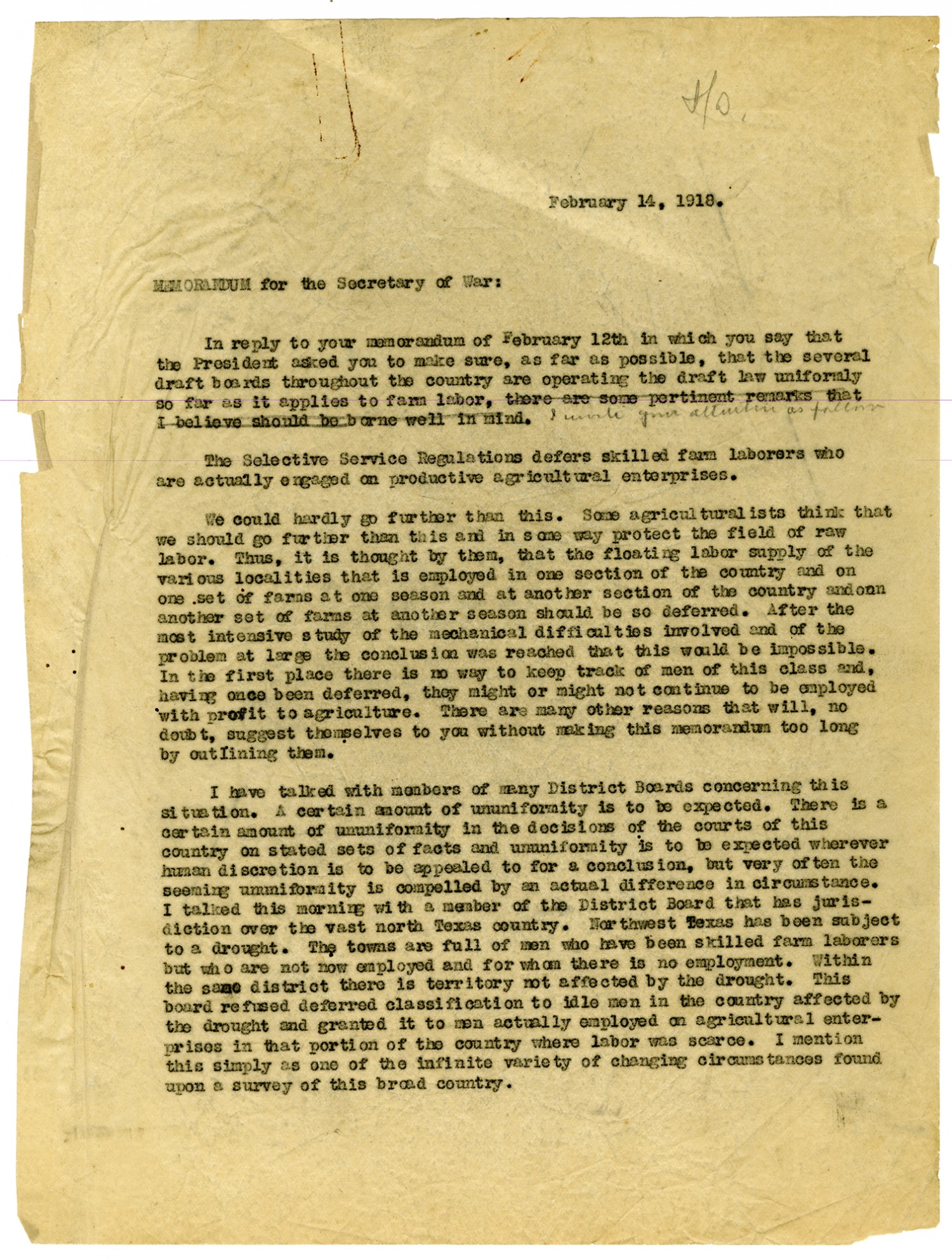
February 14, 1918. Memorandum for the Secretary of War: In reply to your memorandum of February 12th in which you say that the President asked you to make sure, as far as possible, that the several draft boards throughout the country are operating the draft law uniformly so far as it applies to farm labor, there are some pertinent remarks that I believe should be borne well in mind. [handwritten] I write your attention as follow. The Selective Service Regulations defers skilled farm laborers who are actually engaged on productive agricultural enterprises. We could hardly go further than this. Some agriculturalists think that we should go further than this and in some way protect the field of raw labor. Thus, it is thought by them, that the floating labor supply of the various localities that is employed in one section of the country and on one set of farms at one season and at another section of the country and on another set of farms at another season should be so deferred. After the most intensive study of the mechanical difficulties involved and of the problem at large the conclusion was reached that this would be impossible. In the first place there is no way to keep track of men of this class and, having once been deferred, they might or might not continue to be employed with profit to agriculture. There are many other reasons that will, no doubt, suggest themselves to you without making this memorandum too long by outlining them. I have talked with members of many District Boards concerning this situation. A certain amount of ununiformity is to be expected. There is a certain amount of ununiformity in the decisions of the courts of this country on stated sets of facts and ununiformitty is to be expected wherever human discretion is to be appealed to for a conclusion, but very often the seeming ununiformity is compelled by an actual difference in circumstance. I talked this morning with a member of the District Board that has jurisdiction over the vast north Texas country. Northwest Texas has been subject to a drought. The towns are full of men who have been skilled farm laborers but who are not now employed and for whom there is no employment. Within the same district there is territory not affected by the drought. This board refused deferred classification to idle men in the country affected by the drought and granted it to men actually employed on agricultural enterprises in that portion of the country where labor was scarce. I mention this simply as one of the infinite variety of changing circumstances found upon a survey of this broad country.
Transcript
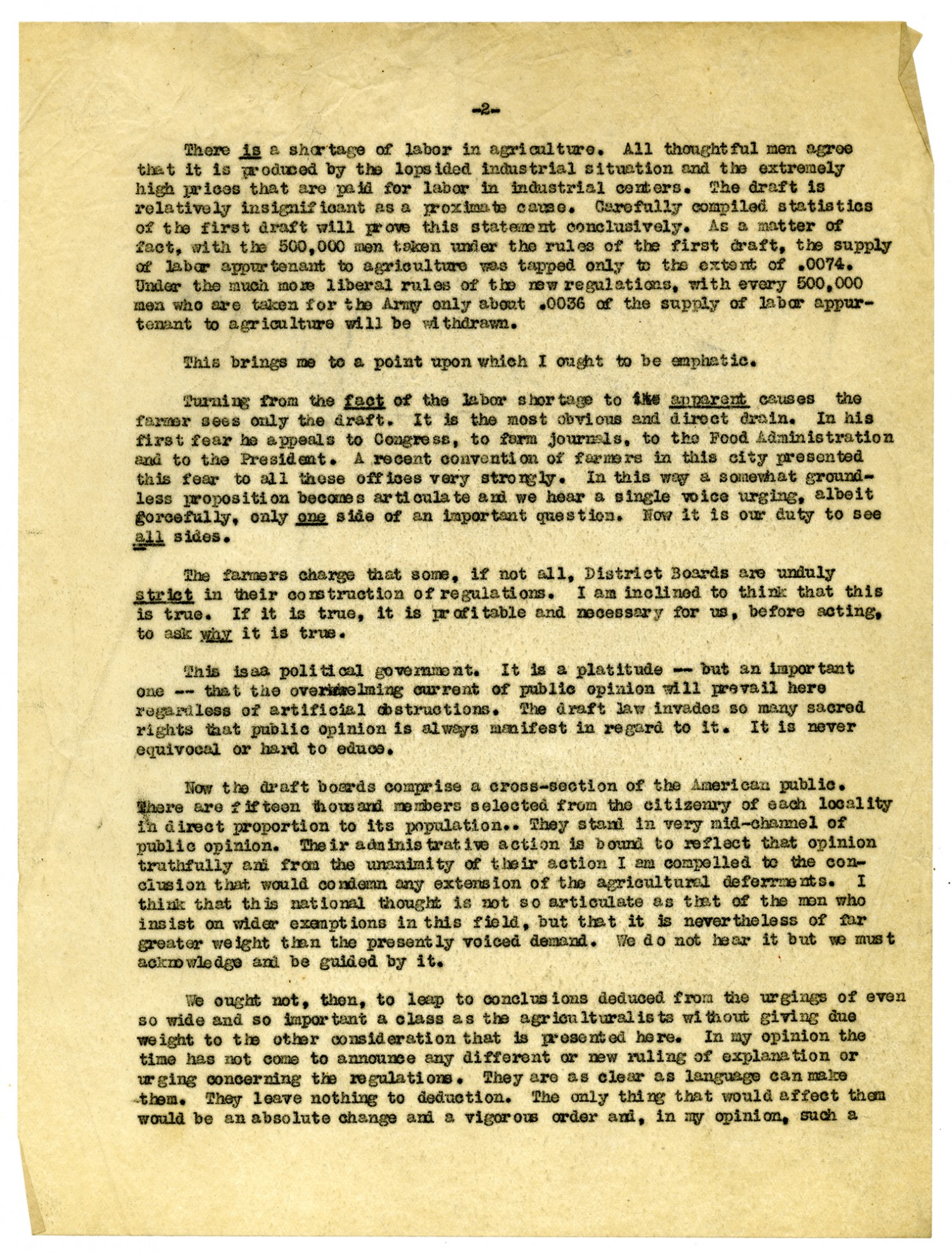
[page 2] There is a shortage of labor in agriculture. All thoughtful men agree that it is produced by the lopsided industrial situation and the extremely high prices that are paid for labor in industrial centers. The draft is relatively insignificant as a proximate cause. Carefully compiled statistics of the first draft will prove this statement conclusively. As a matter of fact, with the 500,000 men taken under the rules of the first draft, the supply of labor appurtenant to agriculture was tapped only to the extent of .0074. Under the much more liberal rules of the new regulations, with every 500,000 men who are taken for the Army only about .0036 of the supply of labor appurtenant to agriculture will be withdrawn. This brings me to a point upon which I ought to be emphatic. Turning from the fact of the labor shortage to apparent causes the farmer sees only the draft. It is the most obvious and direct drain. In his first fear he appeals to Congress, to farm journals, to the Food Administration and to the President. A recent convention of farmers in this city presented this fear to all these offices very strongly. In this was a somewhat groundless proposition becomes articulate and we hear a single voice urging, albeit forcefully, only one side of an important question. Now it is our duty to see all sides. The farmers charge that some, if not all, District Boards are unduly strict in their construction of regulations. I am inclined to think that this is true. If it is true, it is profitable and necessary for us, before acting, to ask why it is true. This is a political government. It is a platitude--but and important one-- that the overwhelming current of public opinion will prevail here regardless of artificial obstructions. The draft law invades so many sacred rights that public opinion is always manifest in regard to it. It is never equivocal or hard to educe. Now the draft boards comprise a cross-section of the American public. There are fifteen thousand members selected from the citizenry of each locality in direct proportion to its population.. They stand in very mid-channel of public opinion. Their administrative action is bound to reflect that opinion truthfully and from the unanimity of their action I am compelled to the conclusion that would condemn any extension of the agricultural deferrments. I think that this national thought is not so articulate as that of the men who insist on wider exemptions in their field, but that it is nevertheless of far greater weight than the presently voiced demand. We do not hear it but we must acknowledge and be guided by it. We ought not, then, to leap to conclusions deduced from the urgings of even so wide and so important a class as the agriculturalists without giving due weight to the other consideration that is presented here. In my opinion the time has not come to announce any different or new ruling of explanation or urging concerning the regulations. They are as clear as language can make them. They leave nothing to deduction. The only thing that would affect them would be an absolute change and a vigorous order and, in my opinion, such a
Transcript
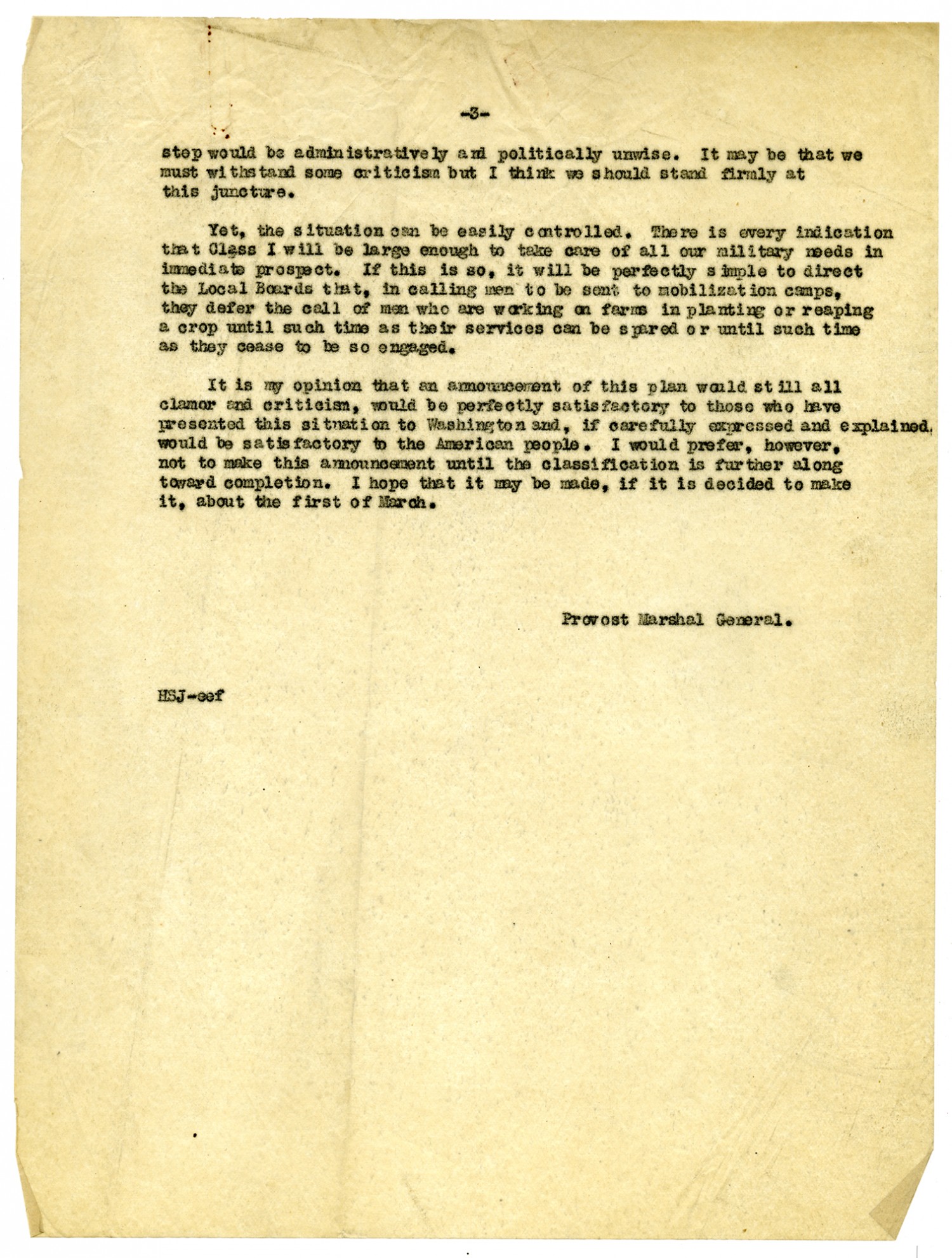
[page 3] stop would be administratively and politically unwise. It may be that we must withstand some criticism but I think we should stand firmly at this juncture. Yet, the situation can be easily controlled. There is every indication that Class I will be large enough to take care of all our military needs in immediate prospect. If this is so, it will be perfectly simple to direct the Local Boards that, in calling men to be sent to mobilization camps, they defer the call of men who are working on farms in planting or reaping a crop until such time as their services can be spared or until such time as they cease to be so engaged. It is my opinion that an announcement of this plan would still all clamor and criticism, would be perfectly satisfactory to those who have presented this situation to Washington and, if carefully expressed and explained, would be satisfactory to the American people. I would prefer, however, not to make this announcement until the classification is further along toward completion. I hope that it may be made, if it is decided to make it, about the first of March. Provost Marshal General. HSJ-eef
Details
| Title | Memorandum for the Secretary of War - February 14, 1918 |
| Creator | Johnson, Hugh S. |
| Source | Johnson, Hugh S. Memorandum for the Secretary of War. 14 February 1918. Crowder, Enoch H. (1859-1932), Papers, 1884-1942. C1046. The State Historical Society of Missouri, Columbia, MO. |
| Description | Memorandum for the Secretary of War, Newton D. Baker from the Provost Marshal General Hugh S. Johnson. Johnson discussed the uniformity of the draft across the country pertaining to farm labor and the protection of raw farm labor from the draft. This document is part of a collection compiled by Enoch Herbert Crowder, the Edinburg, Grundy County, Missouri native who served as Judge Advocate General. Crowder devised the Selective Service Act in 1917 which drafted America's forces during World War I. |
| Subject LCSH | Crowder, E. H. (Enoch Herbert), 1859-1932; Baker, Newton, 1871-1937; Draft--Law and legislation; Farmers |
| Subject Local | WWI; World War I; Selective Service Act of 1917; Selective Draft Act |
| Site Accession Number | C1046 |
| Contributing Institution | The State Historical Society of Missouri |
| Copy Request | Transmission or reproduction of items on these pages beyond that allowed by fair use requires the written permission of the State Historical Society of Missouri: 1020 Lowry Street, Columbia, Missouri, 65201-7298. (573) 882-7083. |
| Rights | The text and images contained in this collection are intended for research and educational use only. Duplication of any of these images for commercial use without express written consent is expressly prohibited. |
| Date Original | February 14, 1918 |
| Language | English |