
Memorandum for the Secretary of War - December 7, 1917
Transcript
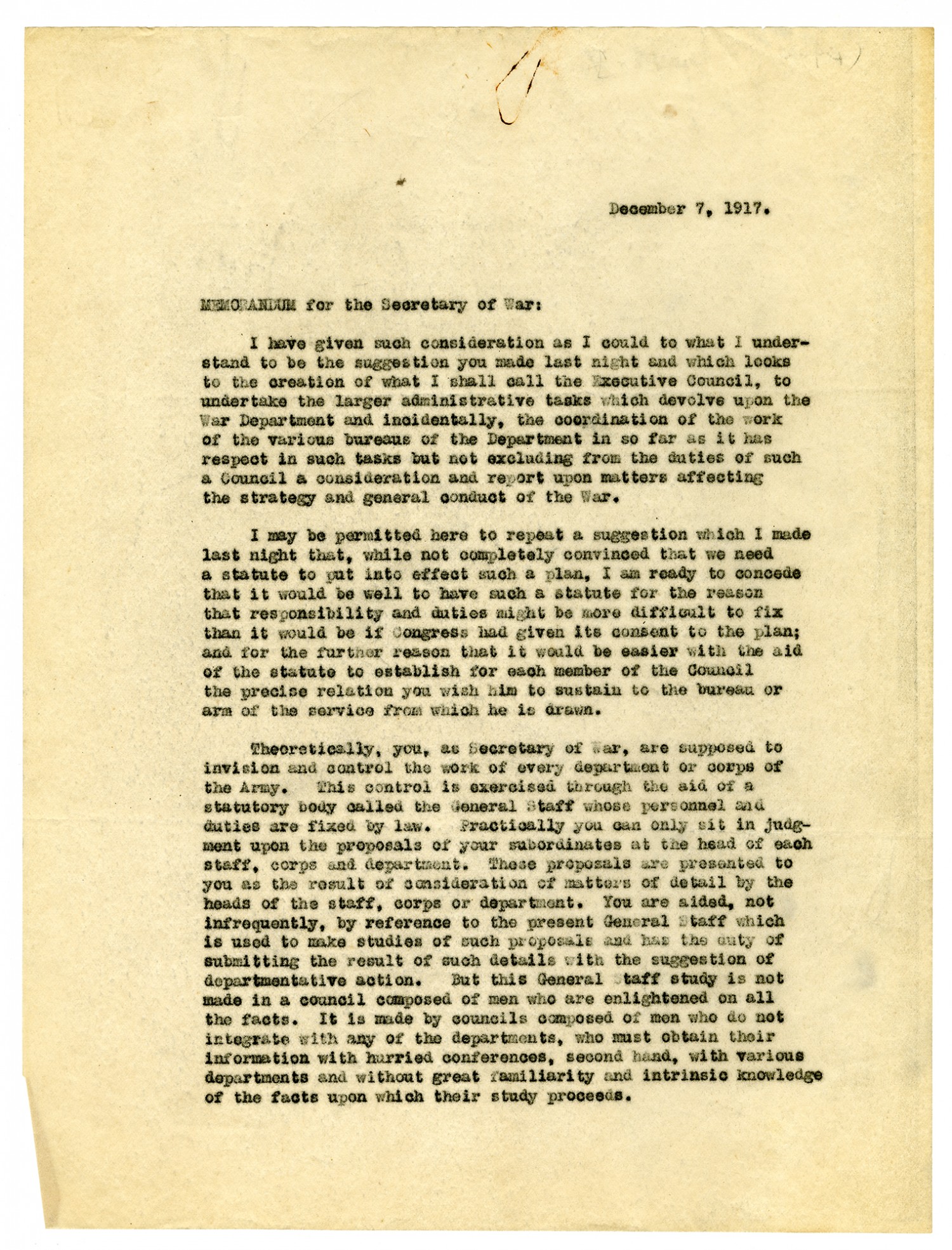
December 7, 1917. Memorandum for the Secretary of War: I have given such consideration as time allowed to your suggestion to create an Executive Council to coordinate the work of the War Department and I must say that the plan appears better and more effective with each moment
Transcript
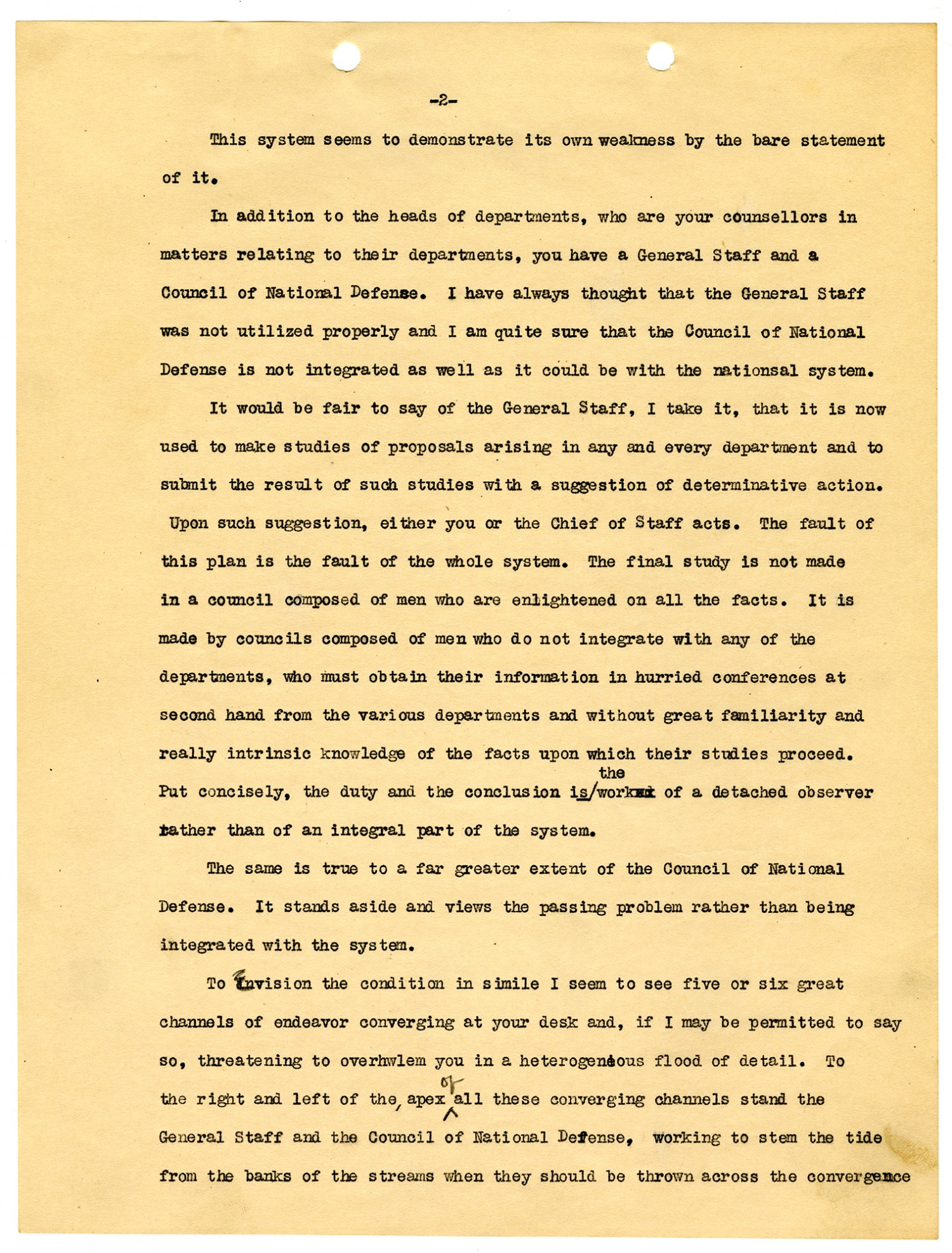
[Page 2] This system seems to demonstrate its own weakness by the bare statement of it. In addition to the heads of departments, who are your counsellors in matters relating to their departments, you have a General Staff and a Council of National Defense. I have always thought that the General Staff was not utilized properly and I am quite sure that the Council of National Defense is not integrated as well as it could be with the nationsal system. It would be fair to say of the General Staff, I take it, that it is now used to make studies of proposals arising in any and every department and to submit the result of such studies with a suggestion of determinative action. Upon such suggestion, either you or the Chief of Staff acts. The fault of this plan is the fault of the whole system. The final study is not made in a council composed of men who are enlightened on all the facts. It is made by councils composed of men who do not integrate with any of the departments, who must obtain their information in hurried conferences at second hand from the various departments and without great familiarity and really intrinsic knowledge of the facts upon which their studies proceed. Put concisely, the duty and the conclusion is the work of a detached observer rather than of an integral part of the system. The same is true to a far greater extent of the Council of National Defense. It stands aside and views the passing problem rather than being integrated with the system. To envision the condition in simile I seem to see five or six great channels of endeavor converging at your desk and, if I may be permitted to say so, threatening to overwlem you in a heterogeneous flood of detail. To the right and left of the apex of all these converging channels stand the General Staff and the Council of National Defense, working to stem the tide from the banks of the streams when they should be thrown across the convergence
Transcript
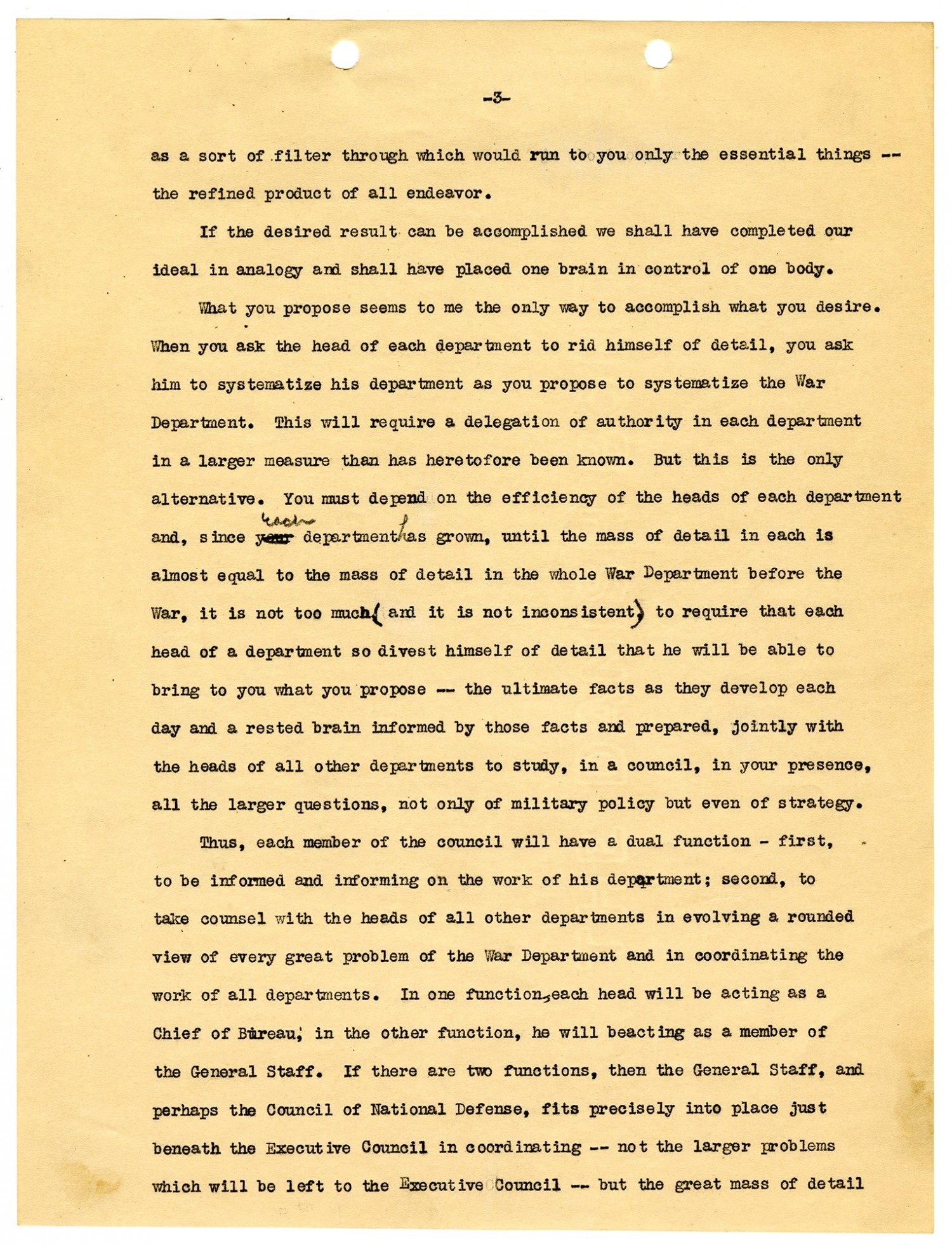
[Page 3] as a sort of filter through which would run to you only the essential things-- the refined product of all endeavor. If the desired result can be accomplished we shall have completed our ideal in analogy and shall have placed one brain in control of one body. What you propose seems to me the only way to accomplish what you desire. When you ask the head of each department to rid himself of detail, you ask him to systematize his department as you propose to systematize the War Department. This will require a delegation of authority in each department in a larger measure than has heretofore been known. But this is the only alternative. You must depend on the efficiency of the heads of each department and, since each department has grown, until the mass of detail in each is almost equal to the mass of detail in the whole War Department before the War, it is not too much (and it is not inconsistent) to require that each head of a department so divest himself of detail that he will be able to bring to you what you propose -- the ultimate facts as they develop each day and a rested brain informed by those facts and prepared, jointly with the heads of all other departments to study, in a council, in your presence, all the larger questions, not only of military policy but even of strategy. Thus, each member of the council will have a dual function - first, to be informed and informing on the work of his department; second, to take counsel with the heads of all other departments in evolving a rounded view of every great problem of the War Department and in coordinating the work of all departments. I one function, each head will be acting as a Chief of Bureau, in the other function, he will beacting as a member of the General Staff. If there are two functions, then the General Staff, and perhaps the Council of National Defense, fits precisely into place just beneath the Executive Council in coordinating -- not the larger problems which will be left to the Executive Council -- but the great mass of detail
Transcript
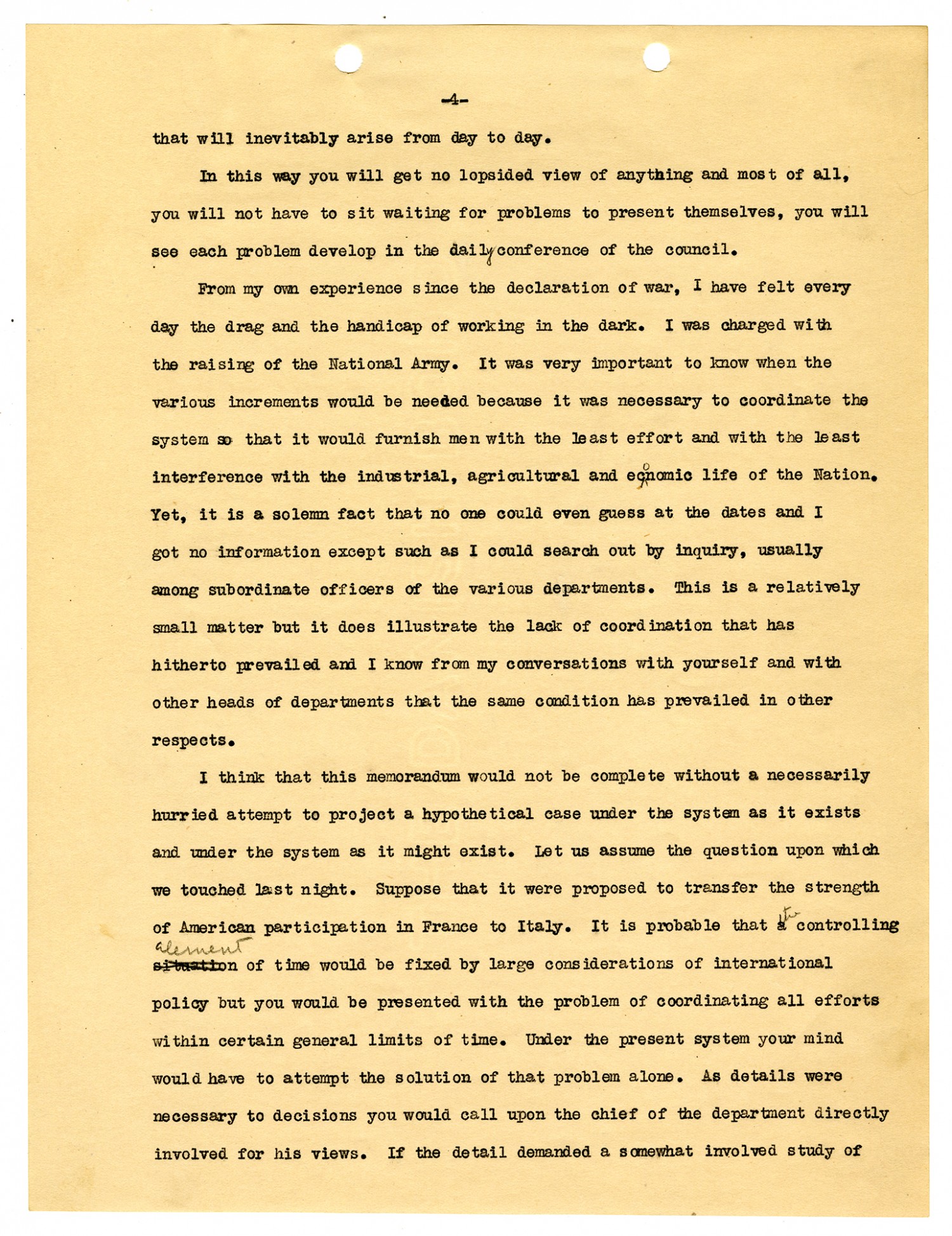
[Page 4] that will inevitably arise from day to day. In this way you will get no lopsided view of anything and most of all, you will not have to sit waiting for problems to present themselves, you will see each problem develop in the daily conference of the council. From my own experience since the declaration of war, I have felt every day the drag and the handicap of working in the dark. I was charged with the raising of the National Army. It was very important to know when the various increments would be needed because it was necessary to coordinate the system so that it would furnish men with the least effort and with the least interference with the industrial, agricultural and economic life of the Nation. Yet, it is a solemn fact that no one could even guess at the dates and I got no information except such as I could search out by inquiry, usually among subordinate officers of the various departments. This is a relatively small matter but it does illustrate the lack of coordination that has hitherto prevailed and I know from my conversations with yourself and with other heads of departments that the same condition has prevailed in other respects. I think that this memorandum would no be complete without a necessarily hurried attempt to project a hypothetical case under the system as it exists and under the system as it might exist. Let us assume the question upon which we touched last night. Suppose that it were proposed to transfer the strength of American participation in France to Italy. It is provably that the controlling element of time would be fixed by large considerations of international policy but you would be presented with the problem of coordinating all efforts within certain general limits of time. Under the present system your mind would have to attempt the solution of that problem alone. As details were necessary to decisions you would call upon the chief of the department directly involved for his views. If the detail demanded a somewhat involved study of
Transcript
December 7, 1917. Memorandum for the Secretary of War: I have given such consideration as time allowed to your suggestion to create an Executive Council to coordinate the work of the War Department and I must say that the plan appears better and more effective with each moment
Transcript
[Page 2] This system seems to demonstrate its own weakness by the bare statement of it. In addition to the heads of departments, who are your counsellors in matters relating to their departments, you have a General Staff and a Council of National Defense. I have always thought that the General Staff was not utilized properly and I am quite sure that the Council of National Defense is not integrated as well as it could be with the nationsal system. It would be fair to say of the General Staff, I take it, that it is now used to make studies of proposals arising in any and every department and to submit the result of such studies with a suggestion of determinative action. Upon such suggestion, either you or the Chief of Staff acts. The fault of this plan is the fault of the whole system. The final study is not made in a council composed of men who are enlightened on all the facts. It is made by councils composed of men who do not integrate with any of the departments, who must obtain their information in hurried conferences at second hand from the various departments and without great familiarity and really intrinsic knowledge of the facts upon which their studies proceed. Put concisely, the duty and the conclusion is the work of a detached observer rather than of an integral part of the system. The same is true to a far greater extent of the Council of National Defense. It stands aside and views the passing problem rather than being integrated with the system. To envision the condition in simile I seem to see five or six great channels of endeavor converging at your desk and, if I may be permitted to say so, threatening to overwlem you in a heterogeneous flood of detail. To the right and left of the apex of all these converging channels stand the General Staff and the Council of National Defense, working to stem the tide from the banks of the streams when they should be thrown across the convergence
Transcript
[Page 3] as a sort of filter through which would run to you only the essential things-- the refined product of all endeavor. If the desired result can be accomplished we shall have completed our ideal in analogy and shall have placed one brain in control of one body. What you propose seems to me the only way to accomplish what you desire. When you ask the head of each department to rid himself of detail, you ask him to systematize his department as you propose to systematize the War Department. This will require a delegation of authority in each department in a larger measure than has heretofore been known. But this is the only alternative. You must depend on the efficiency of the heads of each department and, since each department has grown, until the mass of detail in each is almost equal to the mass of detail in the whole War Department before the War, it is not too much (and it is not inconsistent) to require that each head of a department so divest himself of detail that he will be able to bring to you what you propose -- the ultimate facts as they develop each day and a rested brain informed by those facts and prepared, jointly with the heads of all other departments to study, in a council, in your presence, all the larger questions, not only of military policy but even of strategy. Thus, each member of the council will have a dual function - first, to be informed and informing on the work of his department; second, to take counsel with the heads of all other departments in evolving a rounded view of every great problem of the War Department and in coordinating the work of all departments. I one function, each head will be acting as a Chief of Bureau, in the other function, he will beacting as a member of the General Staff. If there are two functions, then the General Staff, and perhaps the Council of National Defense, fits precisely into place just beneath the Executive Council in coordinating -- not the larger problems which will be left to the Executive Council -- but the great mass of detail
Transcript
[Page 4] that will inevitably arise from day to day. In this way you will get no lopsided view of anything and most of all, you will not have to sit waiting for problems to present themselves, you will see each problem develop in the daily conference of the council. From my own experience since the declaration of war, I have felt every day the drag and the handicap of working in the dark. I was charged with the raising of the National Army. It was very important to know when the various increments would be needed because it was necessary to coordinate the system so that it would furnish men with the least effort and with the least interference with the industrial, agricultural and economic life of the Nation. Yet, it is a solemn fact that no one could even guess at the dates and I got no information except such as I could search out by inquiry, usually among subordinate officers of the various departments. This is a relatively small matter but it does illustrate the lack of coordination that has hitherto prevailed and I know from my conversations with yourself and with other heads of departments that the same condition has prevailed in other respects. I think that this memorandum would no be complete without a necessarily hurried attempt to project a hypothetical case under the system as it exists and under the system as it might exist. Let us assume the question upon which we touched last night. Suppose that it were proposed to transfer the strength of American participation in France to Italy. It is provably that the controlling element of time would be fixed by large considerations of international policy but you would be presented with the problem of coordinating all efforts within certain general limits of time. Under the present system your mind would have to attempt the solution of that problem alone. As details were necessary to decisions you would call upon the chief of the department directly involved for his views. If the detail demanded a somewhat involved study of
Transcript
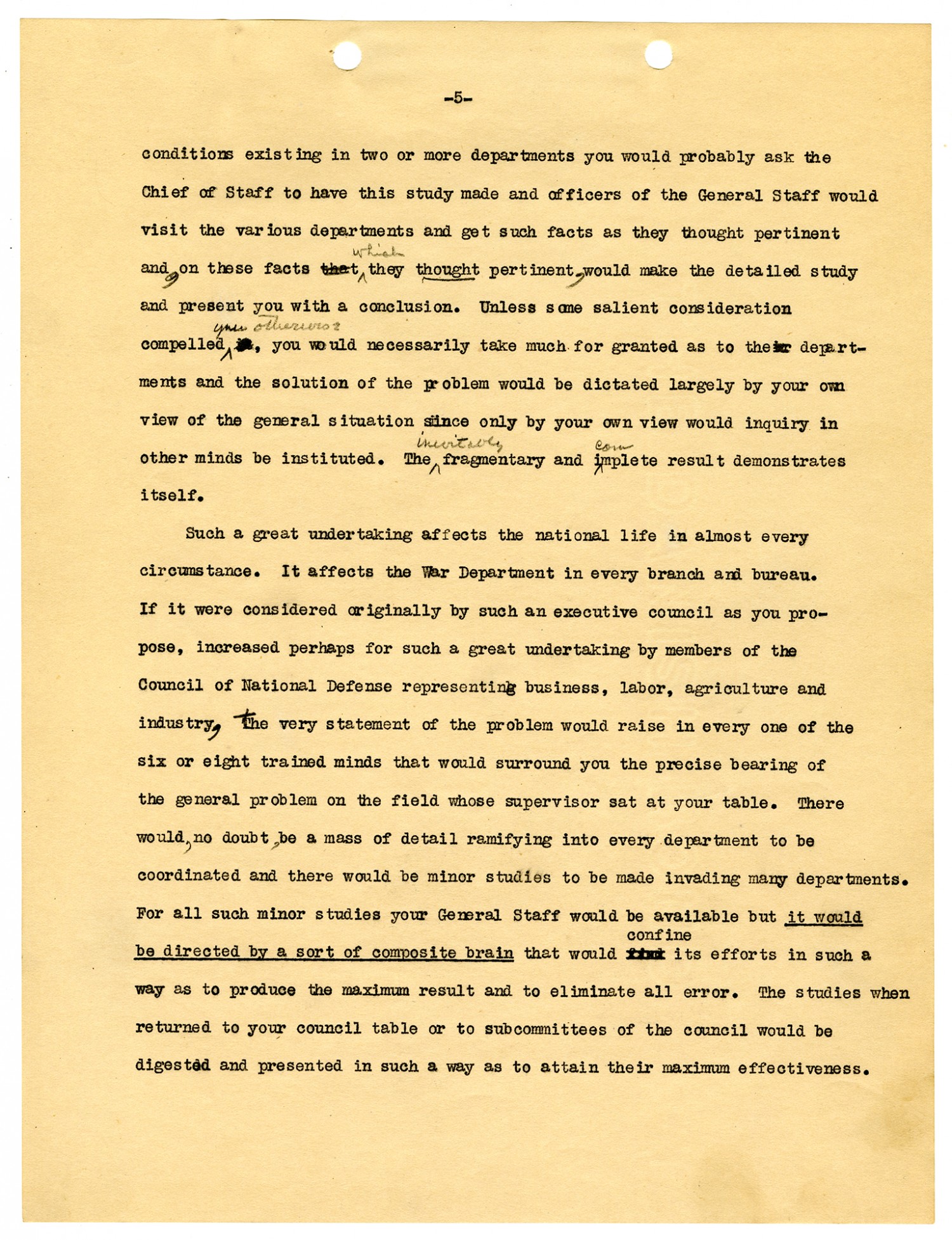
[Page 5] conditions existing in two or more departments you would probably ask the Chief of Staff to have this study made and officers of the General Staff would visit the various departments and get such facts as they thought pertinent and on these facts which they thought pertinent, would make the detailed study and present you with a conclusion. Unless some salient consideration compelled you otherwise, you would necessarily take much for granted as to the departments and the solution of the problem would be dictated largely by your own view of the general situation since only by your own view would inquiry in other minds by instituted. The fragmentary and incomplete result demonstrates itself. Such a great undertaking affects the national life in almost every circumstance. It affects the War Department in every branch and bureau. IF it were considered originally by such an executive council as you propose, increased perhaps for such a great undertaking by members of the Council of National Defense representing business, labor, agriculture and industry, the very statement of the problem would raise in every one of the six or eight trained minds that would surround you the precise bearing of the general problem on the field whose supervisor sat at your table. There would, no doubt, be a mass of detail ramifying into every department to be coordinated and there would be minor studies to be made invading many departments. For all such minor studies your General Staff would be available but it would be directed by a sort of composite brain that would confine its efforts in such a way as to produce the maximum result and to eliminate all error. The studies when returned to you council table or to subcommittees of the council would be digested and presented in such a way as to attain their maximum effectiveness.
Transcript
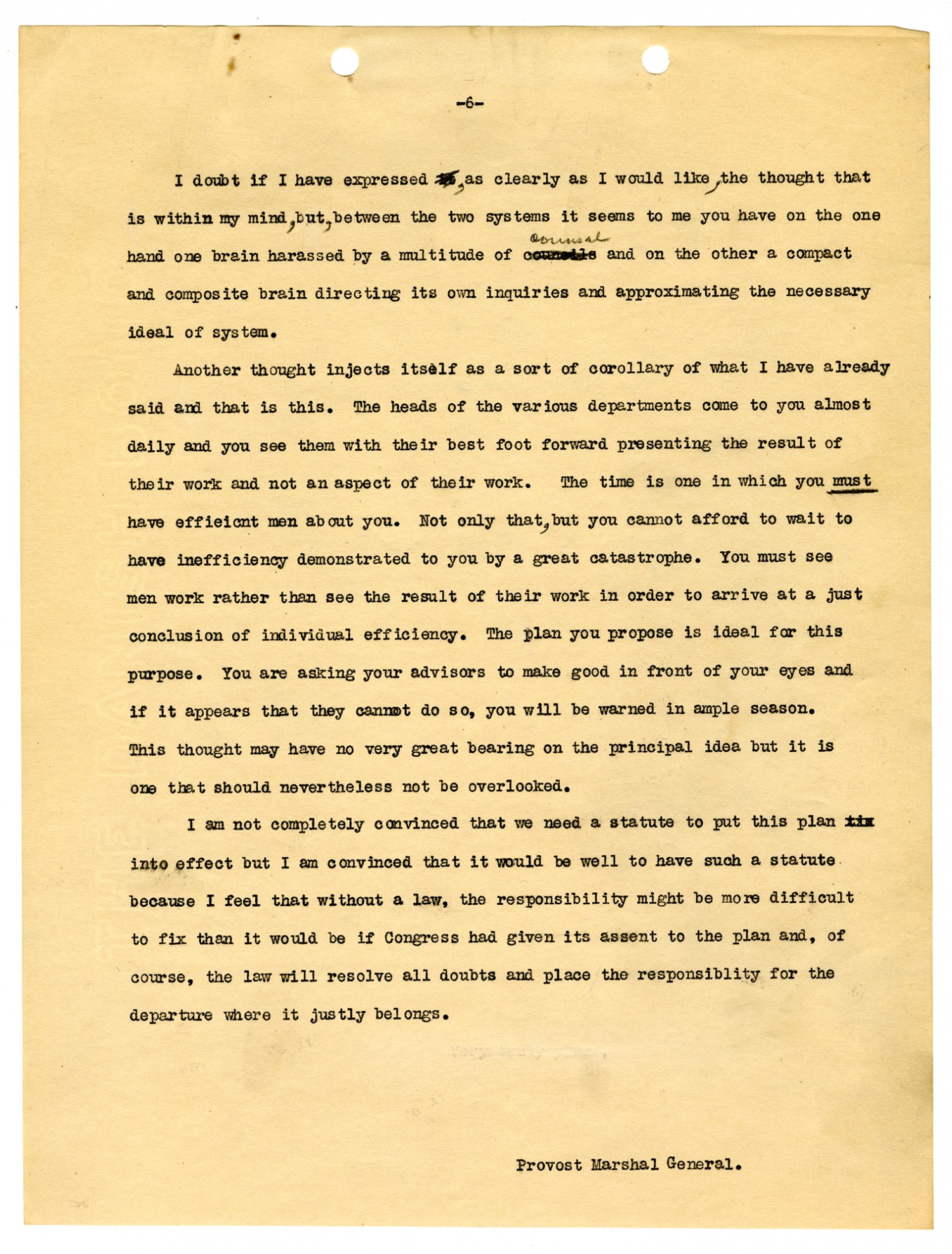
[Page 6] I doubt if I have expressed, as clearly as I would like, the thought that is within my mind, but, between the two systems it seems to me you have on the one hand one brain harassed by a multitude of counsel and on the other a compact and composite brain directing its own inquiries and approximating the necessary ideal of system. Another thought injects itself as a sort of corollary of what I have already said and that is this. The heads of the various departments come to you almost daily and you see them with their best foot forward presenting the result of their work and not an aspect of their work. The time is one in which you must have effieicnt men about you. Not only that, but you cannot afford to wait to have inefficiency demonstrated to you by a great catastrophe. You must see men work rather than see the result of their work in order to arrive at a just conclusion of individual efficiency. The plan you propose is ideal for this purpose. You are asking your advisors to make good in front of your eyes and if it appears that they cannot do so, you will be warned in ample season. This thought may have no very great bearing on the principal idea but it is one that should nevertheless not be overlooked. I am not completely convinced that we nee d a statute to put this plan into effect but I am convinced that it would be well to have such a statute because I feel that without a law, the responsibility might be more difficult to fix than it would be if Congress had given its assent to the plan and, of course, the law will resolve all doubts and place the responsibility for the departure where it justly belongs. Provost Marshal General.
Details
| Title | Memorandum for the Secretary of War - December 7, 1917 |
| Creator | Crowder, Enoch H. |
| Source | Crowder, Enoch H. Memorandum for the Secretary of War. 07 December 1917. Crowder, Enoch H. (1859-1932), Papers, 1884-1942. C1046. The State Historical Society of Missouri, Columbia, MO. |
| Description | In this memorandum, Enoch H. Crowder wrote the Secretary of War, Newton D. Baker, about the formation of an Executive Council to undertake the larger administrative tasks within the War Department. This document is part of a collection compiled by Enoch Herbert Crowder, the Edinburg, Grundy County, Missouri native who served as Judge Advocate General. Crowder devised the Selective Service Act in 1917 which drafted America's forces during World War I. |
| Subject LCSH | Crowder, E. H. (Enoch Herbert), 1859-1932; Draft--Law and legislation; Baker, Newton, 1871-1937; United States. War Department |
| Subject Local | WWI; World War I; Selective Service Act |
| Site Accession Number | C1046 |
| Contributing Institution | The State Historical Society of Missouri |
| Copy Request | Transmission or reproduction of items on these pages beyond that allowed by fair use requires the written permission of the State Historical Society of Missouri: 1020 Lowry Street, Columbia, Missouri, 65201-7298. (573) 882-7083. |
| Rights | The text and images contained in this collection are intended for research and educational use only. Duplication of any of these images for commercial use without express written consent is expressly prohibited. |
| Date Original | December 7, 1917 |
| Language | English |