Memorandum for the Secretary of War - December 27, 1917
Transcript
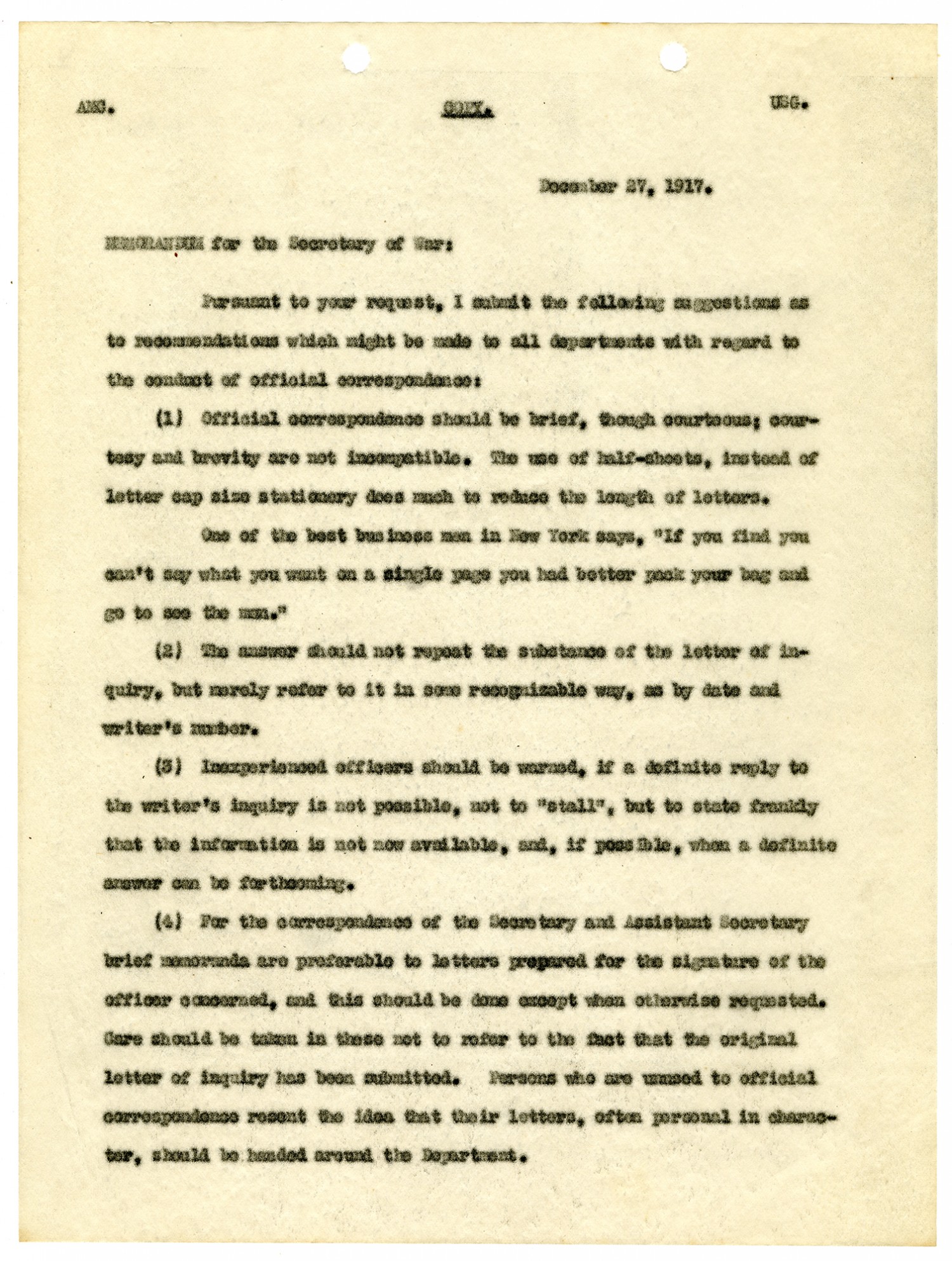
AMC. Copy. USG. December 27, 1917. Memorandum for the Secretary of War: Pursuant to your request, I submit the following suggestions as to recommendations which might be made to all departments with regard to the conduct of official correspondence: (1) Official correspondence should be brief, though courteous; courtesy and brevity are not incompatible. The use of half-shoots, instead of letter cap size stationary does much to reduce the length of letters. One of the best business men in New York says,
Transcript
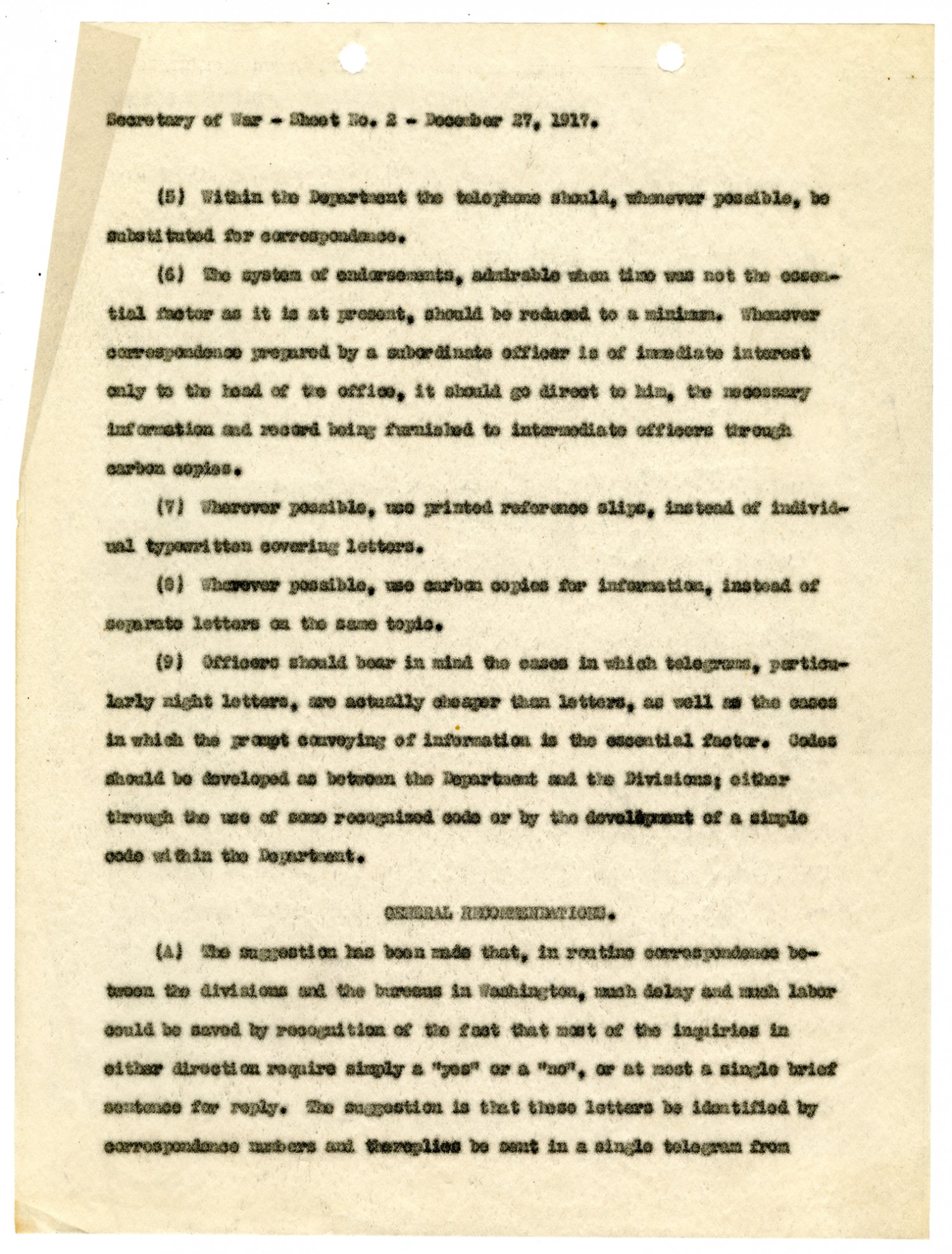
Secretary of War-Sheet No. 2-December 27, 1917. (5) Within the Department the telephone should, whenever possible, be substituted for correspondence. (6) The system of endorsements, admirable when time was not the essential factor as it is at present, should be reduced to a minimum. Whenever correspondence prepared by a subordinate officer is off immediate interest only to the head of the office, it should go direct to him, the necessary information and record being furnished to intermediate officers through carbon copies.(7) Wherever possible, use printed reference slips, instead of individual typewritten covering letters. (8) Wherever possible, use carbon copies for information, instead of separate letters on the same topic. (9) Officers should bear in mind the case in which telegrams, particularly night letters, are actually cheaper than letters, as well as the cases in which the prompt conveying of information is the essential factor. Codes should be developed as between the Department and the Divisions; either through the use of some recognized code or by the development of a simple code within the Department. General Recommendations. (A) The suggestion has been made that, in routine correspondence between the divisions and the bureaus in Washington, much delay and much labor could be saved by recognition of the fast that most of the inquiries in either direction require simply a
Transcript
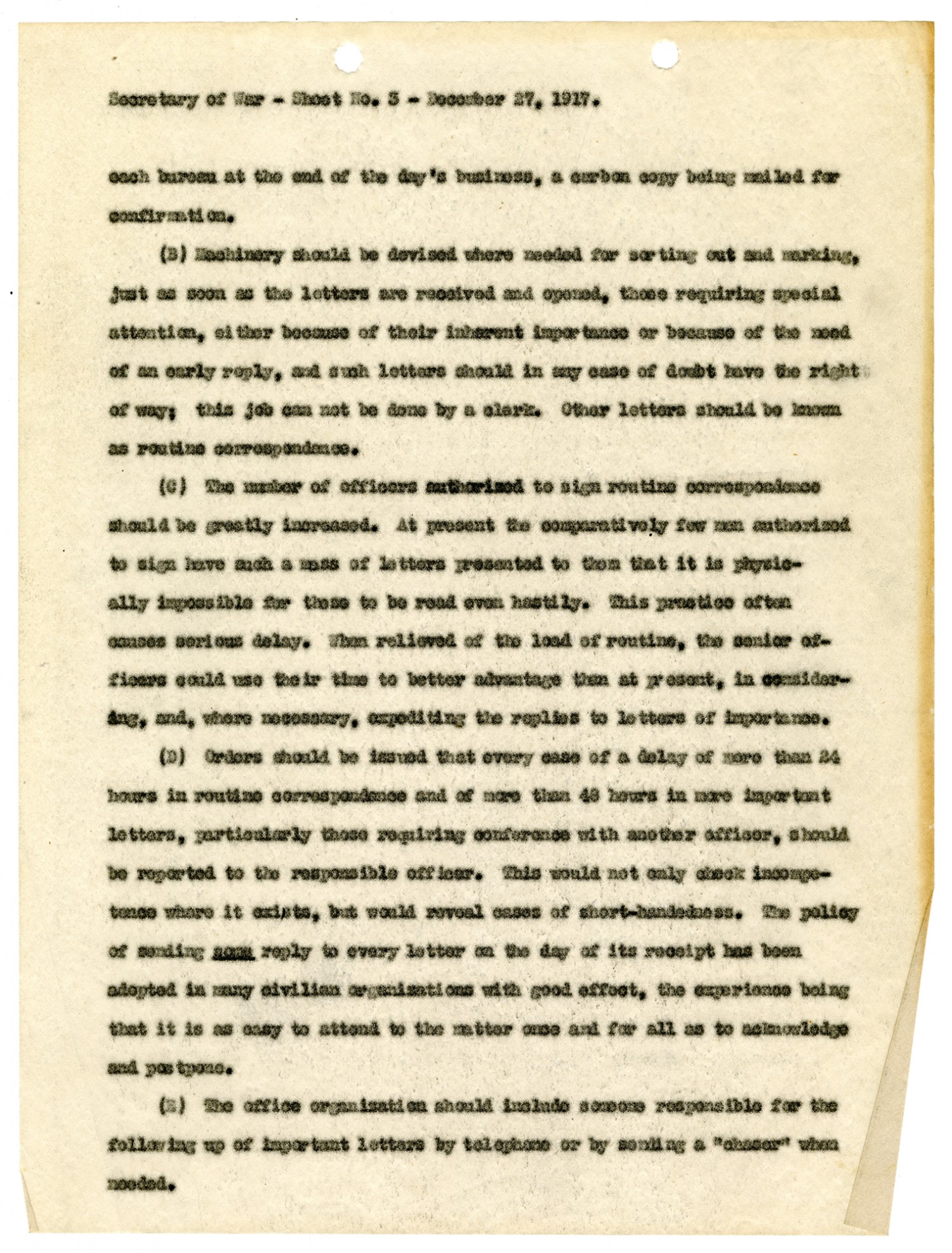
Secretary of War-Sheet No. 3- December 27, 1917. each bureau at the end of the day
Transcript
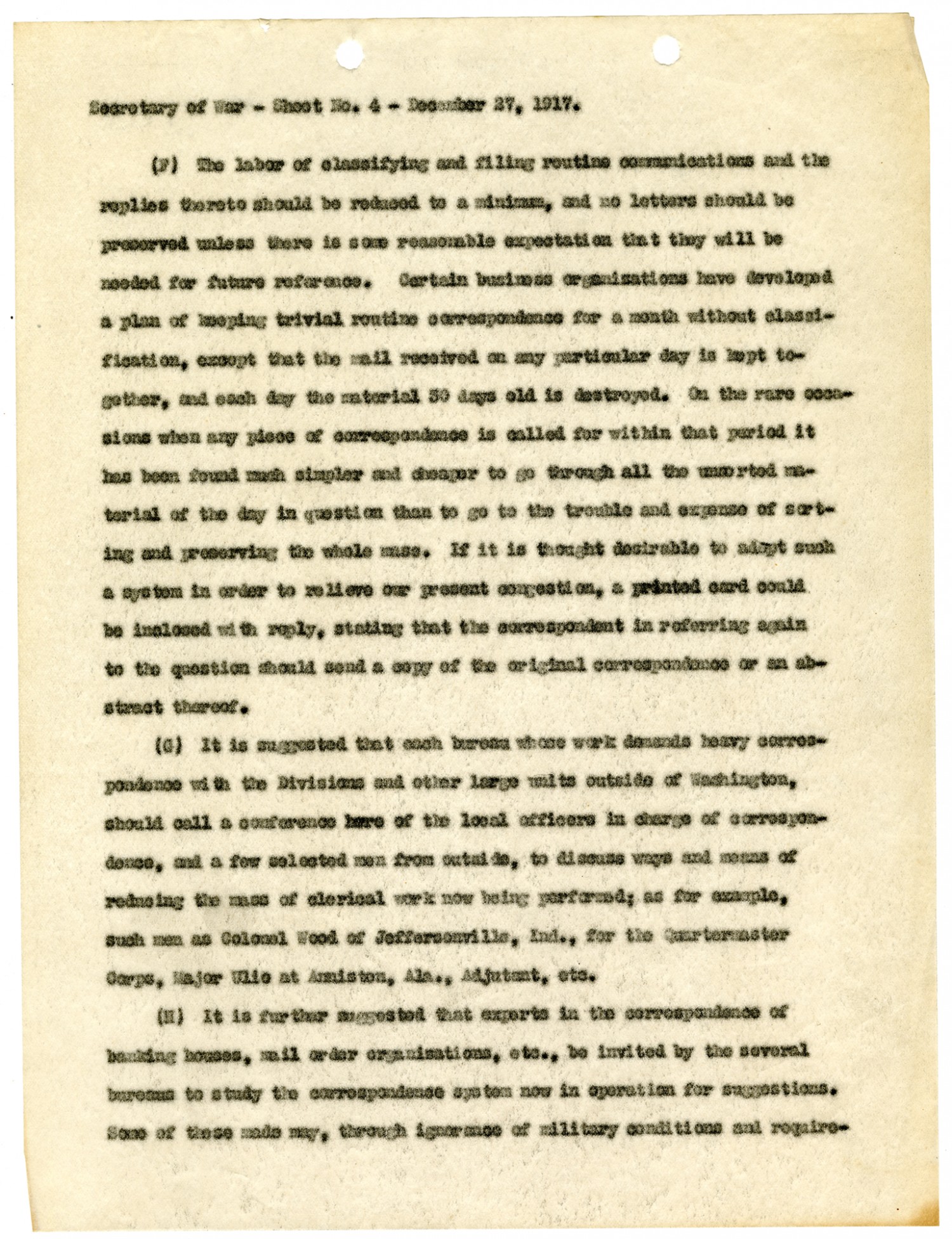
Secretary of War-Sheet No. 4-December 27, 1917. (F) The labor of classifying and filing routine communications and the replies thereto should be reduced to a minimum, and no letters should be preserved unless there is some reasonable expectation that they will be needed for future reference. Certain business organizations have developed a plan of keeping trivial routine correspondence for a month without classification, except that the mail received on any particular day is kept together, and each day the material 30 days old is destroyed. On the rare occasions when any piece of correspondence is called for within that period it has been found much simpler and cheaper to go through all the unsorted material of the day in question than to go to the trouble and expense of sorting and preserving the whole mass. If it is though desirable to adopt such a system in order to relieve our present congestion, a printed card could be inclosed with replay, stating that the correspondent in referring again to the question should send a copy of the original correspondence or an abstract thereof. (G) It is suggested that each bureau whose work demands heavy correspondence with the Divisions and other large units outside of Washington, should call a conference here of the local officers in charge of correspondence, and a few selected men from outside, to discuss ways and means of reducing the mass of clerical work now being performed; as for example, such men as Colonel Wood of Jeffersonville, [Indiana]., for the Quartermaster Corps, Major Ulie at Amiston, [Alabama], Adjutant, etc. (H) It is further suggested that experts in the correspondence of banking houses, mail order organizations, etc., be invited by the several bureaus to study the correspondence system now in operation for suggestions. Some of these made may, through ignorance of military conditions and require-
Transcript
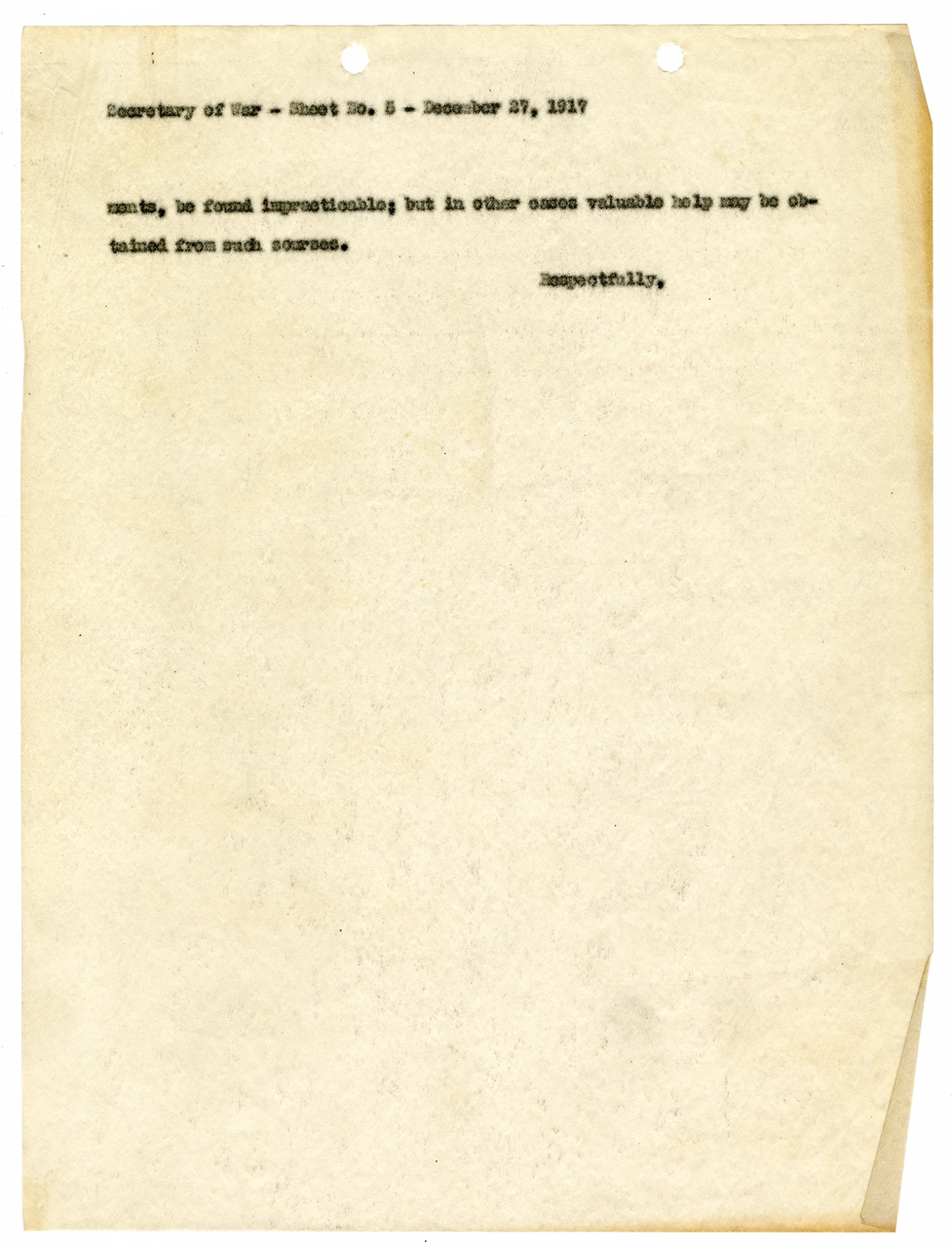
Secretary of War-Sheet No. 5-December 27, 1917. ments, be found impracticable; but in other cases valuable help may be obtained from such sources. Respectfully,
Details
| Title | Memorandum for the Secretary of War - December 27, 1917 |
| Creator | Unknown |
| Source | Unknown. Memorandum for the Secretary of War. 27 December 1917. Crowder, Enoch H. (1859-1932), Papers, 1884-1942. C1046. The State Historical Society of Missouri, Columbia, MO. |
| Description | This memorandum for the Secretary of War addressed the War department's official correspondence. The memorandum provided guidelines for correspondence. This document is part of a collection compiled by Enoch Herbert Crowder, the Edinburg, Grundy County, Missouri native who served as Judge Advocate General. Crowder devised the Selective Service Act in 1917 which drafted America's forces during World War I. |
| Subject LCSH | Crowder, E. H. (Enoch Herbert), 1859-1932; United States; United States. War Department; Baker, Newton, 1871-1937; United States. Army--Records and correspondence |
| Subject Local | WWI; World War I |
| Site Accession Number | C1046 |
| Contributing Institution | The State Historical Society of Missouri |
| Copy Request | Transmission or reproduction of items on these pages beyond that allowed by fair use requires the written permission of the State Historical Society of Missouri: 1020 Lowry Street, Columbia, Missouri, 65201-7298. (573) 882-7083. |
| Rights | The text and images contained in this collection are intended for research and educational use only. Duplication of any of these images for commercial use without express written consent is expressly prohibited. |
| Date Original | December 27, 1917 |
| Language | English |