
Memorandum for the Assistant Secretary of War - May 21, 1918
Transcript
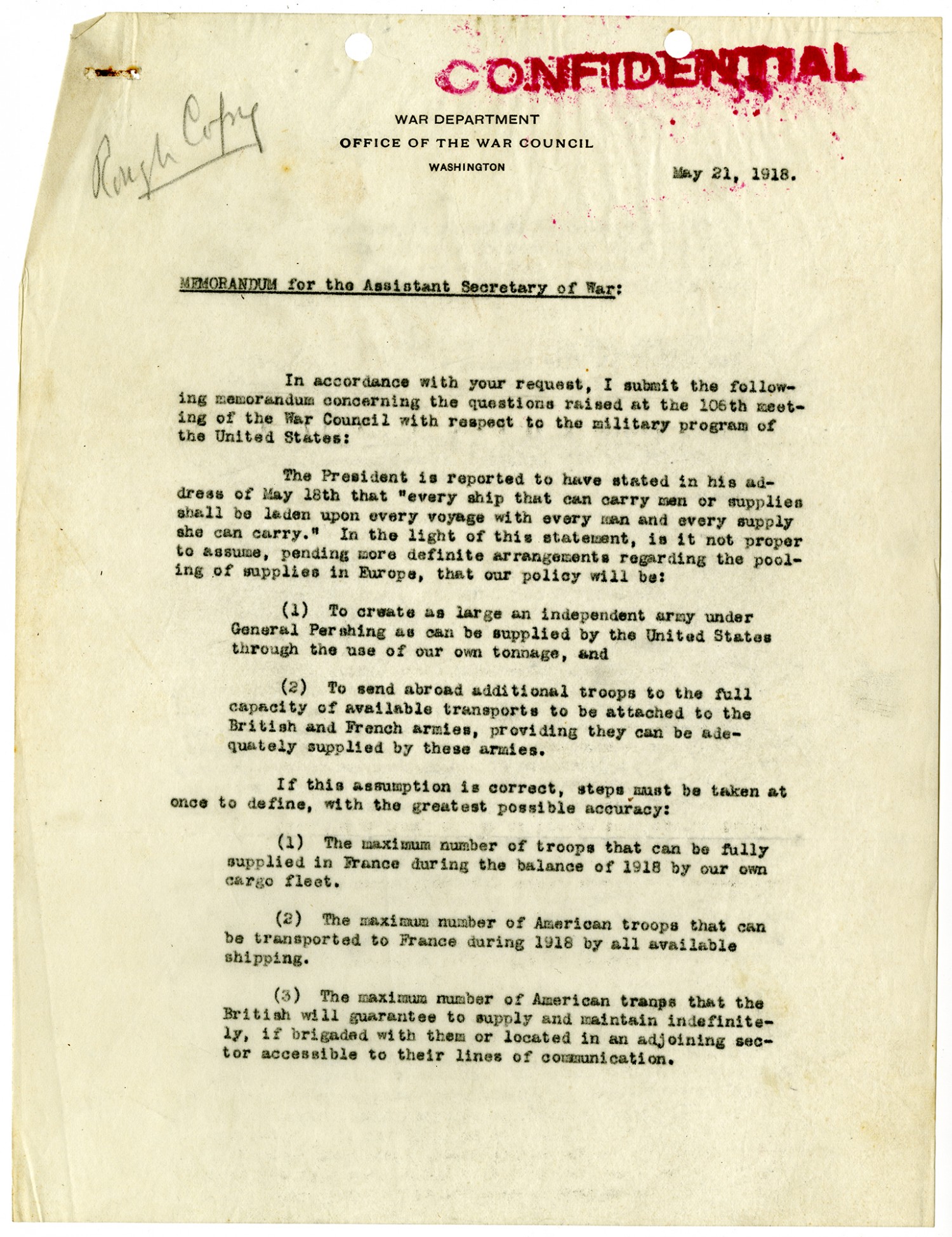
May 21, 1918. Memorandum for the Assistant Secretary of War: In accordance with your request, I submit the following memorandum concerning the questions raised at the 106th meeting of the War Council with respect to the military program of the United States: The President is reported to have stated in his address of May 18th that
Transcript
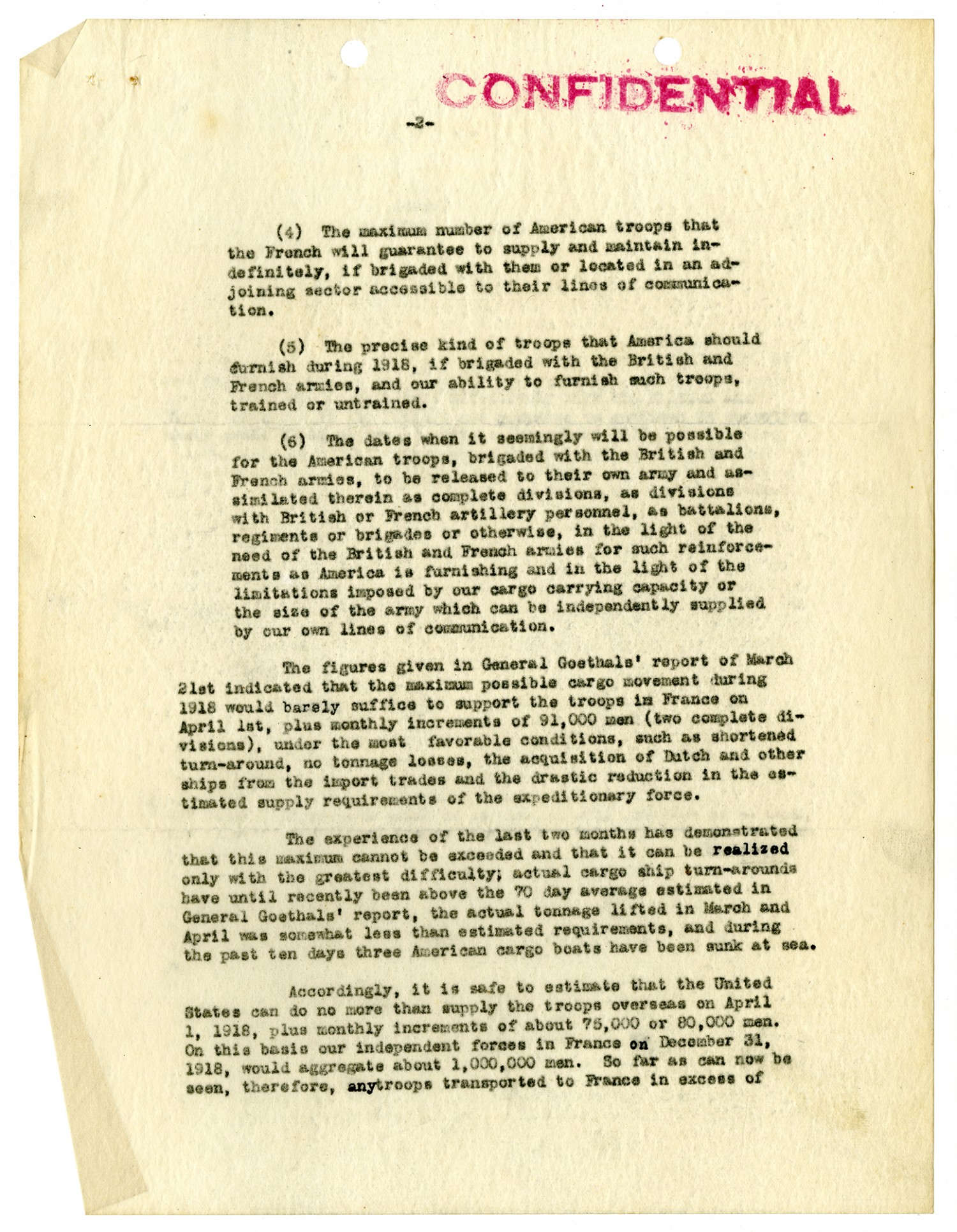
[page 2] (4) The maximum number of American troops that the French will guarantee to supply and maintain indefinitely, if brigaded with them or located in an adjoining sector accessible to their lines of communication. (5) The precise kind of troops that America should furnish during 1918, if brigaded with the British and French armies, and our ability to furnish such troops, trained or untrained. (6) The dates when it seemingly will be possible for the American troops, brigaded with the British and French armies, to be released to their own army and assimilated therein as complete divisions, as divisions with British or French artillery personnel, as battalions, regiments or brigades or otherwise, in the light of the need of the British and French armies for such reinforcements as America is furnishing and in the light of the limitations imposed by our cargo carrying capacity or the size of the army which can be independently supplied by our own lines of communication. The figures given in General Goethals
Transcript
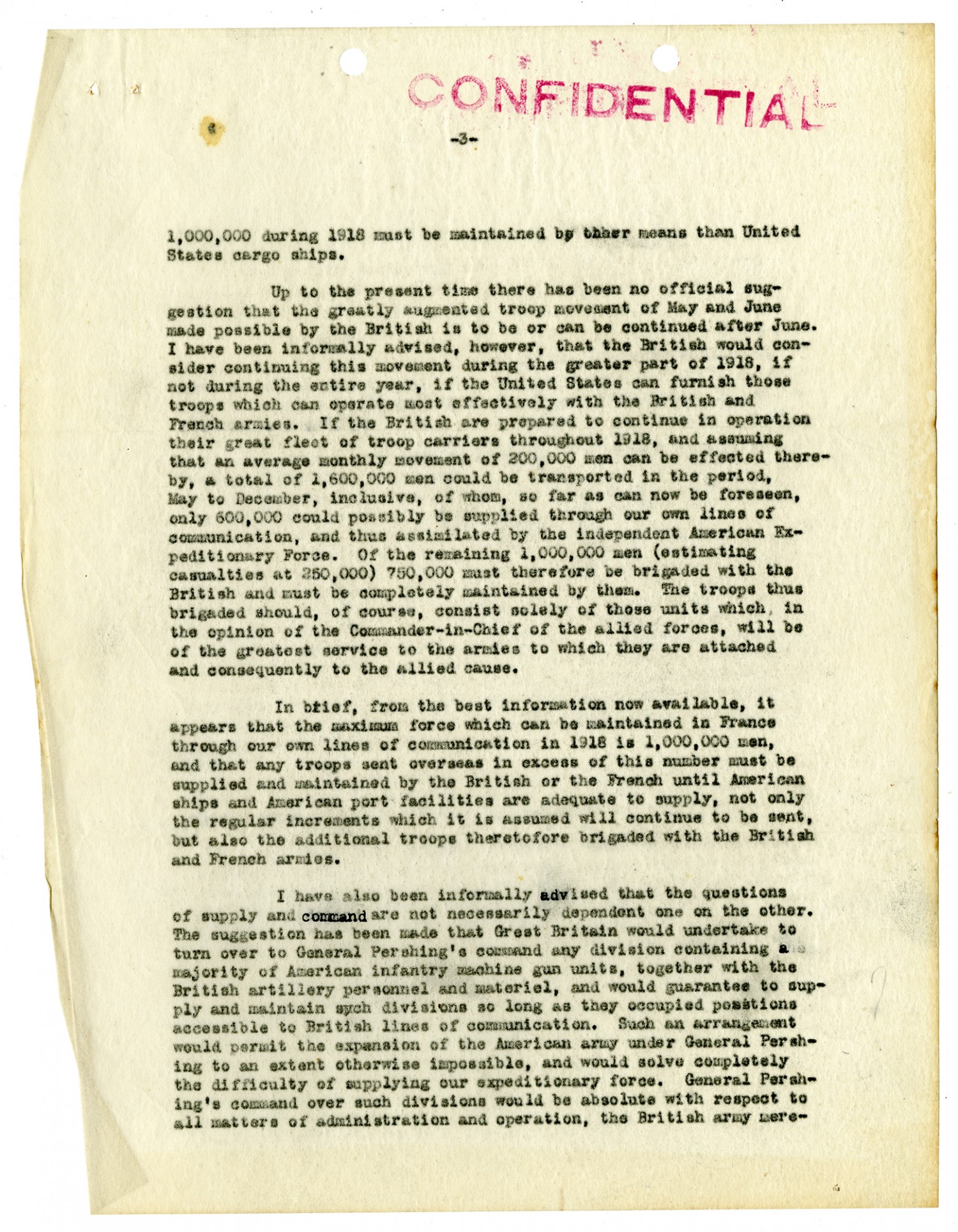
[page 3] 1,000,000 during 1918 must be maintained by their means than United States cargo ships. Up to the present time there has been no official suggestion that the greatly augmented troop movement of May and June made possible by the British is to be or can be continued after June. I have been informally advised, however, that the British would consider continuing this movement during the greater part of 1918, if not during the entire year, if the United Stages can furnish those troops which can operate most effectively with the British and French armies. If the British are prepared to continue in operation their great fleet of troop carriers throughout 1918, and assuming that an average monthly movement of 200,000 men can be effected thereby, a total of 1,600,000 men could be transported in the period, May to December, inclusive, of whom, so far as can now be foreseen, only 600,000 could possibly be supplied through our own lines of communication, and thus assimilated by the independent American Expeditionary Force. OF the remaining 1,000,000 men (estimating casualties at 250,000) 750,000 must therefore be brigaded with the British and must be completely maintained by them. The troops thus brigaded should, of course, consist solely of those units which in the opinion of the Commander-in-Chief of the allied forces, will be of the greatest service to the armies to which they are attached and consequently to the allied cause. In brief, from the best information now available, it appears that the maximum force which can be maintained in France through our own lines of communication in 1918 is 1,000,000 men, and that any troops sent overseas in excess of this number must be supplied and maintained by the British or the French until American ships and American port facilities are adequate to supply, not only the regular increments which it is assumed will continue to be sent, but also the additional troops theretofore brigaded with the British and French armies. I have also been informally advised that the questions of supply and command are not necessarily dependent one on the other. The suggestion has been made that Great Britain would undertake to turn over to General Pershing
Transcript
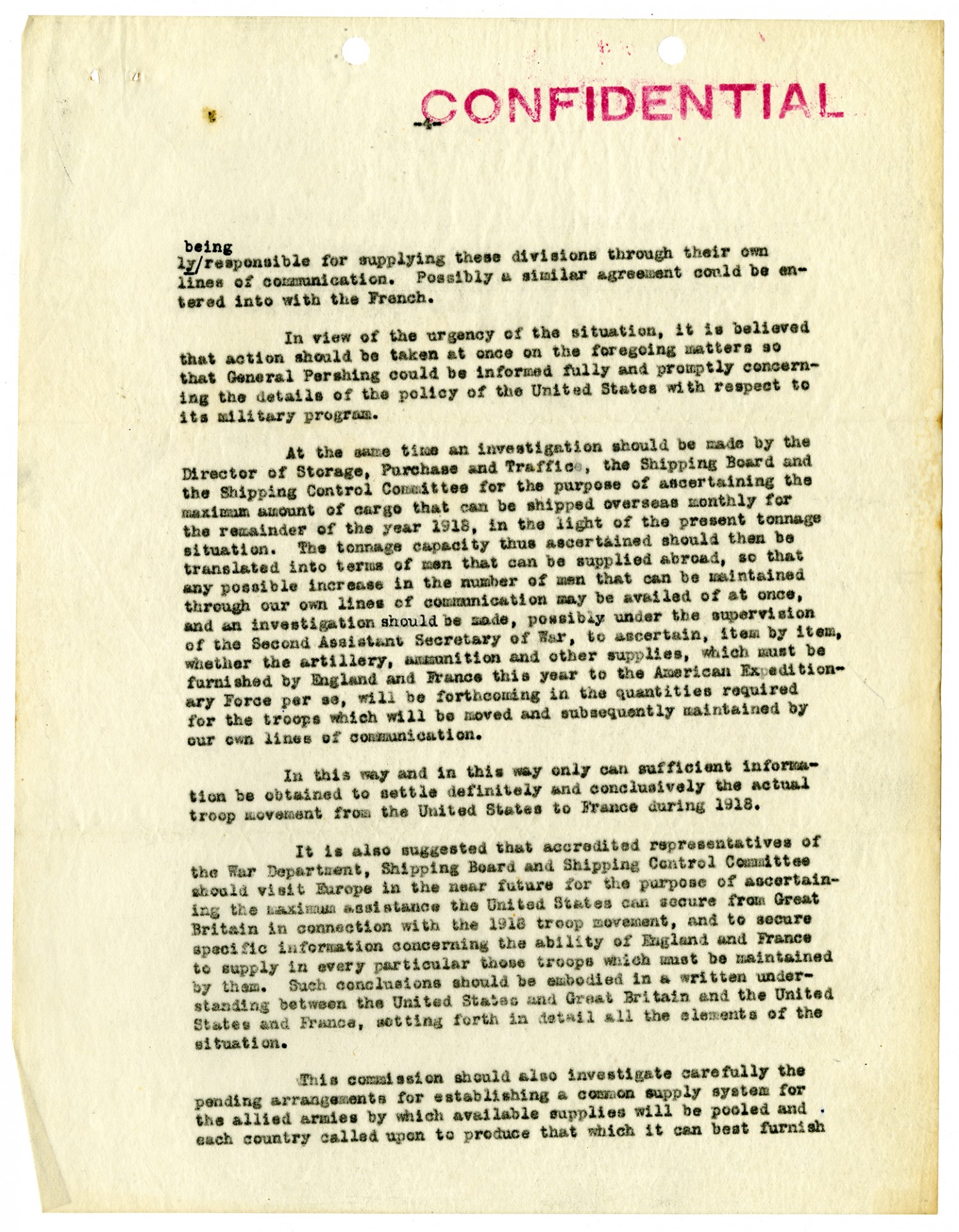
[page 4] ly being responsible for supplying these divisions through their own lines of communication. Possibly a similar agreement could be entered into with the French. In view of the urgency of the situation, it is believed that action should be taken at once on the foregoing matters so that General Pershing could be informed fully and promptly concerning the details of the policy of the United States with respect to its military program. At the same time an investigation should be made by the Director of Storage, Purchase and traffic, the Shipping Board and the Shipping Control Committee for the purpose of ascertaining the maximum amount of cargo that can be shipped overseas monthly for the remainder of the year 1918, in the light of the present tonnage situation. The tonnage capacity thus ascertained should then be translated into terms of men that can be supplied abroad, so that any possible increase in the number of men that can be maintained through our own lines of communication may be availed of a once, and an investigation should be made, possibly under the supervision of the Second Assistant Secretary of War, to ascertain, item by item, whether the artillery, ammunition and other supplies, which must be furnished by England and France this year to the American Expeditionary Force per se, will be forthcoming in the quantities required for the troops which will be moved and subsequently maintained by our own lines of communication. In this way and in this way only can sufficient information be obtained to settle definitely and conclusively the actual troop movement from the United States to France during 1918. It is also suggested that accredited representatives of the War Department, Shipping Board and Shipping Control Committee should visit Europe in the near future for the purpose of ascertaining the maximum assistance the United States can secure from Great Britain in connection with the 1918 troop movement, and to secure specific information concerning the ability of England and France to supply in every particular those troops which must be maintained by them. Such conclusions should be embodied in a written understanding between the United States and Great Britain and the United States and France, setting forth in detail all the elements of the situation. This commission should also investigate carefully the pending arrangements for establishing a common supply system for the allied armies by which available supplies will be pooled and each country called upon to produce that which it can best furnish
Transcript
[page 5] with a view to formulating a definite production program for the United States upon the basis of requirements so ascertained, and defining specifically the contribution to the common supply which must be made by the United States.
Details
| Title | Memorandum for the Assistant Secretary of War - May 21, 1918 |
| Creator | Unknown |
| Source | Unknown. Memorandum for the Assistant Secretary of War. 21 May 1918. Crowder, Enoch H. (1859-1932), Papers, 1884-1942. C1046. The State Historical Society of Missouri, Columbia, MO. |
| Description | In this memorandum to the Assistant Secretary of War, the author outlined ways to get as many troops and supplies to France given the United States' resources. This document is part of a collection compiled by Enoch Herbert Crowder, the Edinburg, Grundy County, Missouri native who served as Judge Advocate General. Crowder devised the Selective Service Act in 1917 which drafted America's forces during World War I. |
| Subject LCSH | Crowder, E. H. (Enoch Herbert), 1859-1932; Pershing, John J. (John Joseph), 1860-1948; World War, 1914-1918--Equipment and supplies; Operational rations (Military supplies) |
| Subject Local | WWI; World War I |
| Site Accession Number | C1046 |
| Contributing Institution | The State Historical Society of Missouri |
| Copy Request | Transmission or reproduction of items on these pages beyond that allowed by fair use requires the written permission of the State Historical Society of Missouri: 1020 Lowry Street, Columbia, Missouri, 65201-7298. (573) 882-7083. |
| Rights | The text and images contained in this collection are intended for research and educational use only. Duplication of any of these images for commercial use without express written consent is expressly prohibited. |
| Date Original | May 21, 1918 |
| Language | English |