
Memorandum for Secretary of War from Samuel Tilden Ansell - January 11, 1918
Transcript
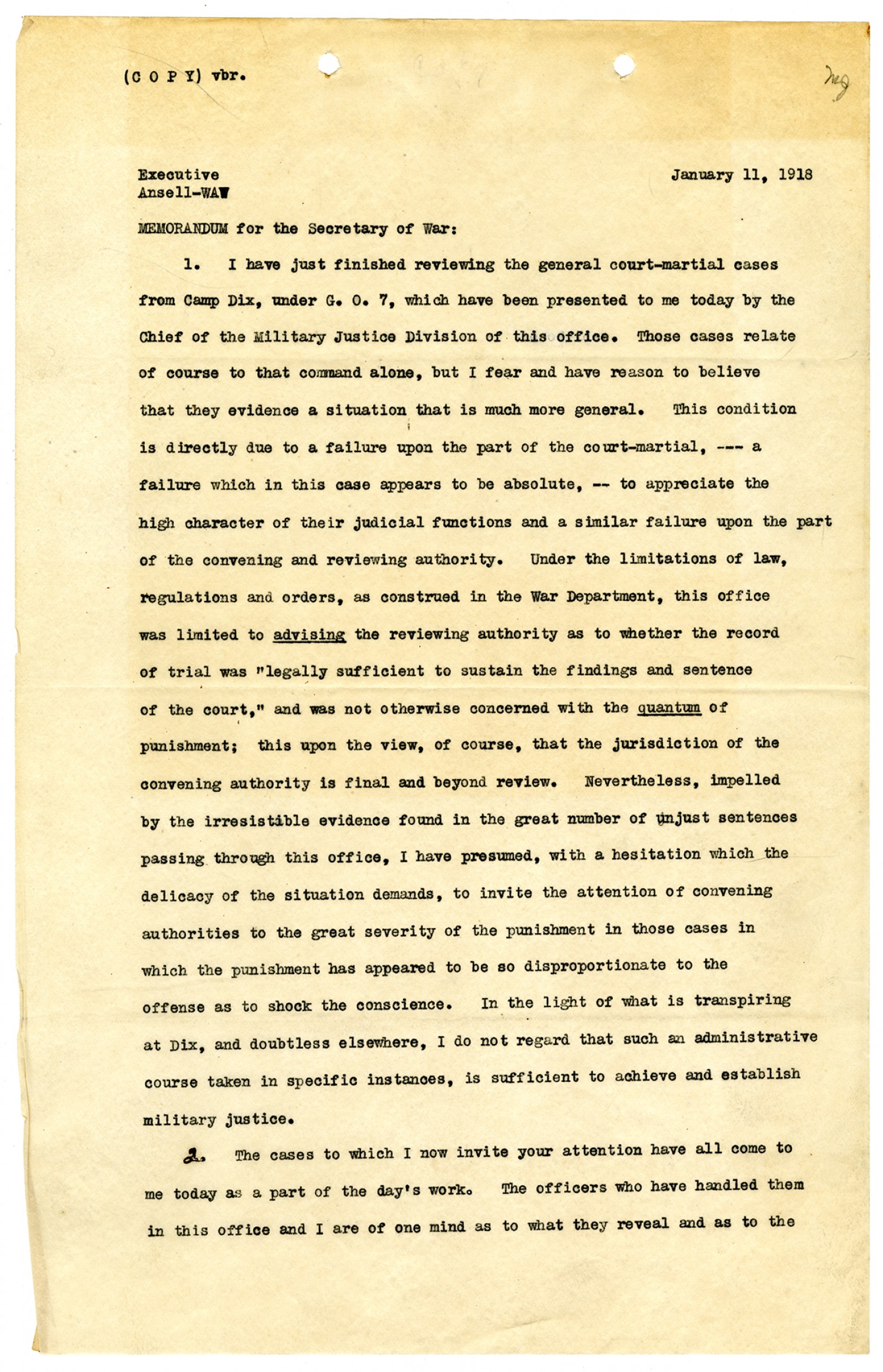
(Copy) vbr. January 11, 1918 Executive Ansell-Waw Memorandum for the Secretary of War: 1. I have just finished reviewing the general court-martial cases from Camp Dix, under G.O.7, which have been presented to me today by the Chief of the Military Justice Division of this office. Those cases relate of course to that command alone, but I fear and have reason to believe that they evidence a situation that is much more general. This condition is directly due to a failure upon the part of the court-martial, ---a failure which in this case appears to be absolute, -- to appreciate the high character of their judicial functions and a similar failure upon the part of the convening and reviewing authority. Under the limitations of law, regulations and order, as construed in the War Department, this office was limited to advising the reviewing authority as to whether the record of trial was
Transcript
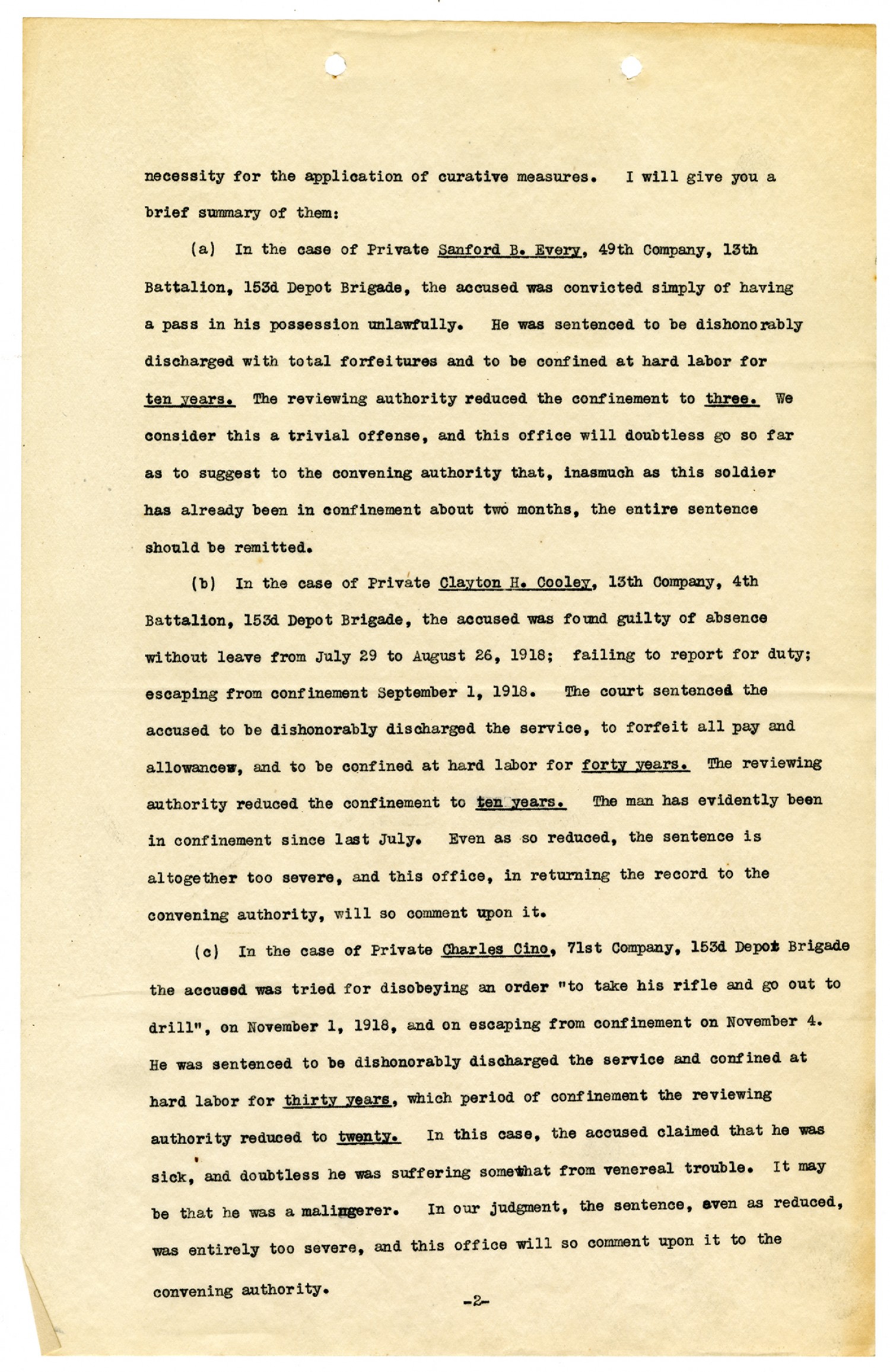
[page 2] necessity for the application of curative measures. I will give you a brief summary of them: (a) In the case of Private Sanford B. Every, 49th Company, 13th Battalion, 153d Depot Brigade, the accused was convicted simply of having a pass in his possession unlawfully. He was sentenced to be dishonorably discharged with total forfeitures and to be confined at hard labor for ten years. The reviewing authority reduced the confinement to three. We consider this a trivial offense, and this office will doubtless go so far as to suggest to the convening authority that, inasmuch as this soldier has already been in confinement about two months, the entire sentence should be remitted. (b) In the case of Private Clayton H. Cooley, 13th Company, 4th Battalion, 153d Depot Brigade, the accused was found guilty of absence without leave from July 29 to August 26, 1918; failing to report for duty; escaping from confinement September 1, 1918. The court sentenced the accused to be dishonorably discharged the service, to forfeit all pay and allowance, and to be confined at hard labor for forty years. The reviewing authority reduced the confinement to ten years. The man has evidently been in confinement since last July. Even as so reduced, the sentence is altogether too severe, and this office, in returning the record to the convening authority, will so comment upon it. (c) In the case of Private Charles Cino, 71st Company, 153d Depot Brigade the accused was tried for disobeying an order
Transcript
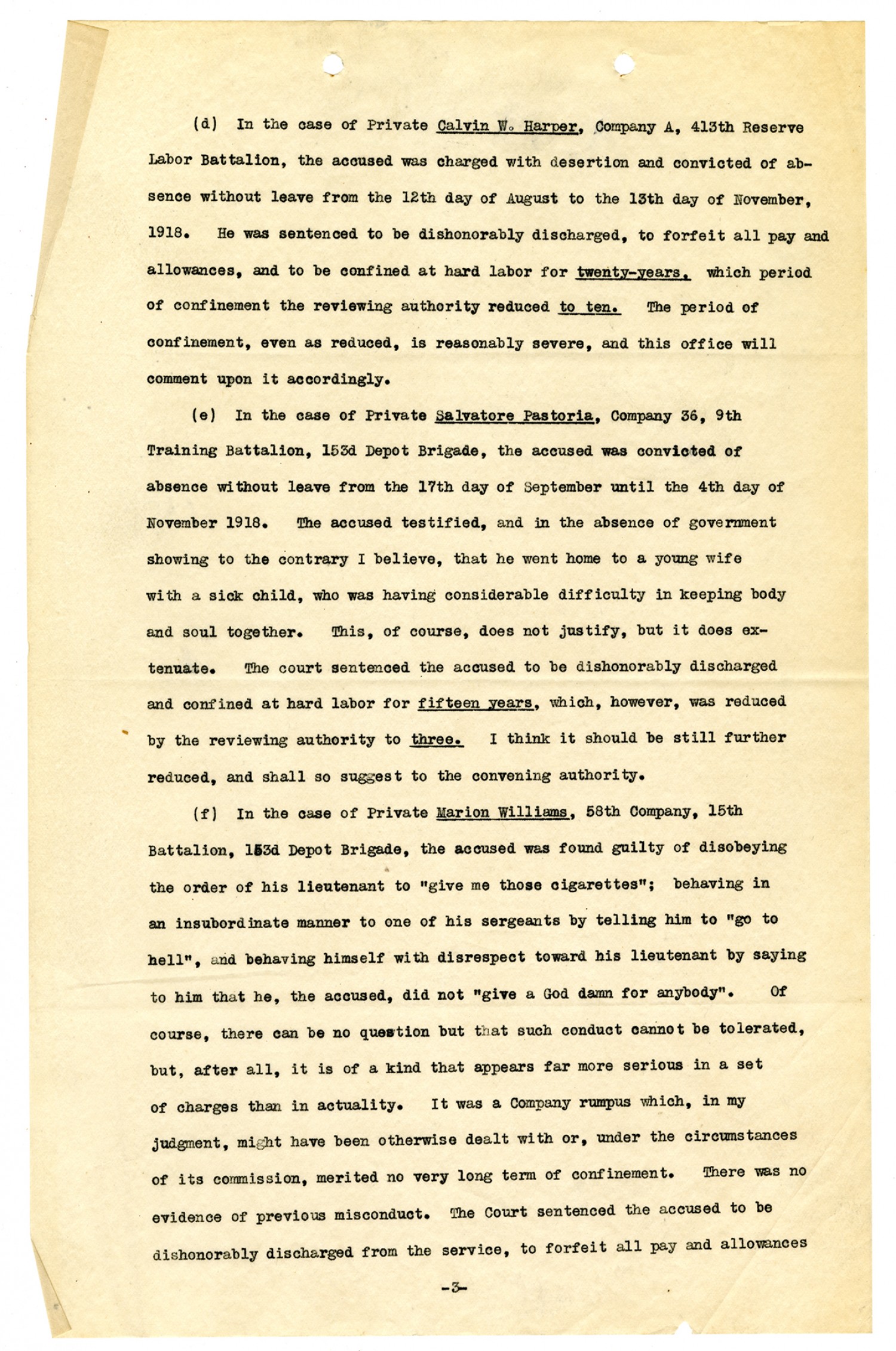
[page 3] (d) In the case of Private Calvin W. Harper, Company A, 413th Reserve Labor Battalion, the accused was charged with desertion and convicted of absence without leave from the 12th day of August to the 13th day of November, 1918. He was sentenced to be dishonorably discharged, to forfeit all pay and allowances, and to be confined at hard labor for twenty-years, which period of confinement the reviewing authorized reduced to ten. The period of confinement, even as reduced, is reasonably severe, and this office will comment upon it accordingly. (e) In the case of Private Salvatore Pastoria, Company 36, 9th Training Battalion, 153d Depot Brigade, the accused was convicted of absence without leave from the 17th day of September until the 4th day of November 1918. The accused testified, and in the absence of government showing to the contrary I believe, that he went home to a young wife with a sick child, who was having considerable difficulty in keeping body and soul together. This, of course, does not justify, but it does extenuate. The court sentenced the accused to be dishonorably discharged and confined at hard labor for fifteen years, which, however, was reduced by the reviewing authority to three. I think it should be still further reduced, and shall so suggest to the convening authority. (f) In the case of Private Marion Williams, 58th Company, 15th Battalion, 153d Depot Brigade, the accused was found guilty of disobeying the order of his lieutenant to
Transcript
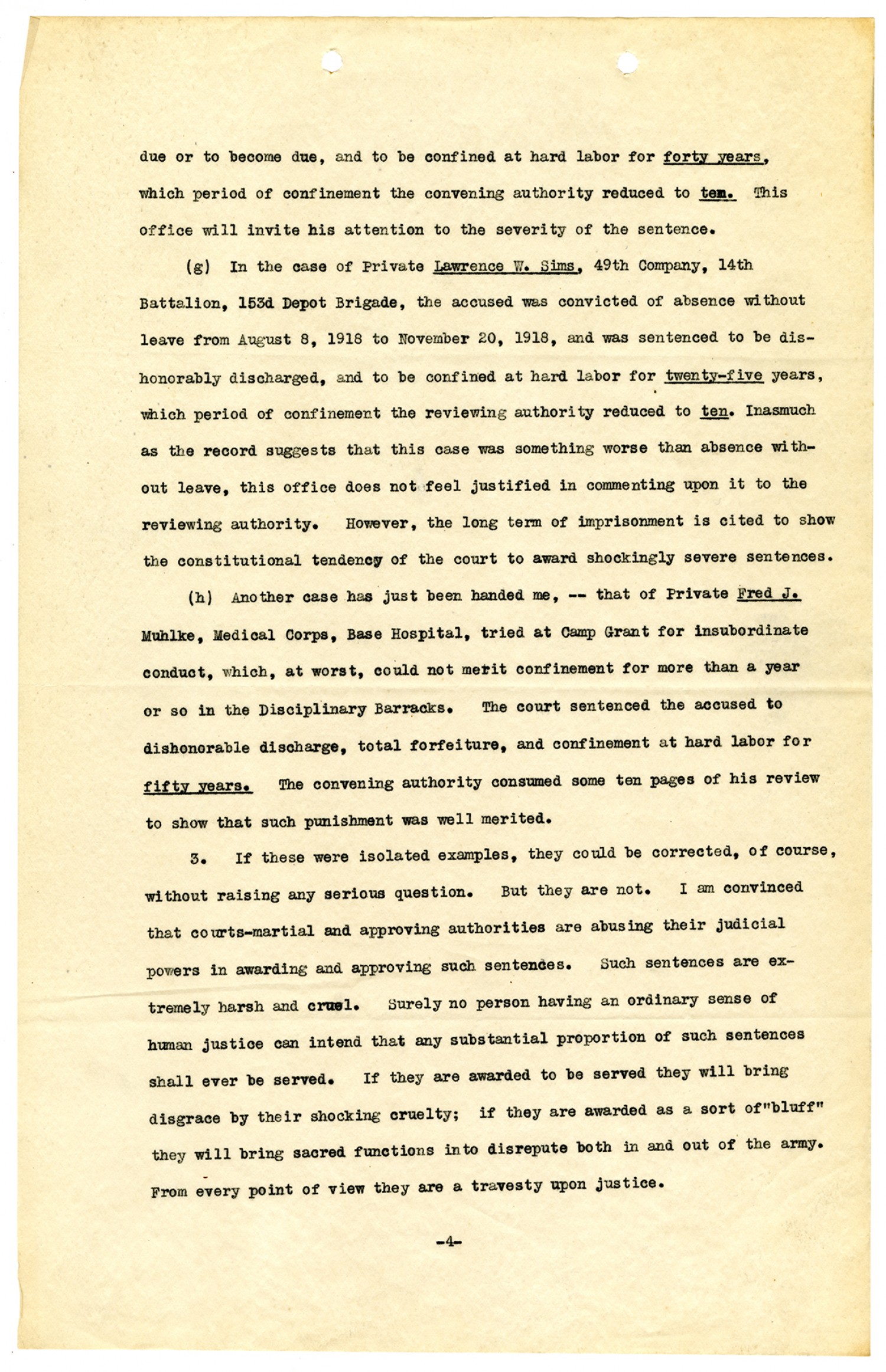
[page 4] due or to become due, and to be confined at hard labor for forty years, which period of confinement the convening authority reduced to ten. This office will invite his attention to the severity of the sentence. (g) In the case of Private Lawrence W. Sims, 49th Company, 14th Battalion, 153d Depot Brigade, the accused was convicted of absence without leave from August 8, 1918 to November 20, 1918, and was sentenced to be dishonorably discharged, and to be confined at hard labor for twenty-five years, which period of confinement the reviewing authority reduced to ten. Inasmuch as the record suggests that this case was something worse than absence without leave, this office does not feel justified in commenting upon it to the reviewing authority. However, the long term of imprisonment is cited to show the constitutional tendency of the court to award shockingly severe sentences. (h) Another case has just been handed me, -- that of Private Fred J. Muhlke, Medical Corps, Base Hospital, tried at Camp Grant for insubordinate conduct, which, at worst, could not merit confinement for more than a year or so in the Disciplinary Barracks. The court sentenced the accused to dishonorable discharge, total forfeiture, and confinement at hard labor for fifty years. The convening authority consumed some ten pages of his review to show that such punishment was well merited. 3. If these were isolated examples, they could be corrected, of course, without raising any serious question. But they are not. I am convinced that courts-martial and approving authorities are abusing their judicial powers in awarding and approving such sentences. Such sentences are extremely harsh and cruel. Surely no person having an ordinary sense of human justice can intend that any substantial proportion of such sentences shall ever be served. If they are awarded to be served they will bring disgrace by their shocking cruelty; if they are awarded as a sort of
Transcript
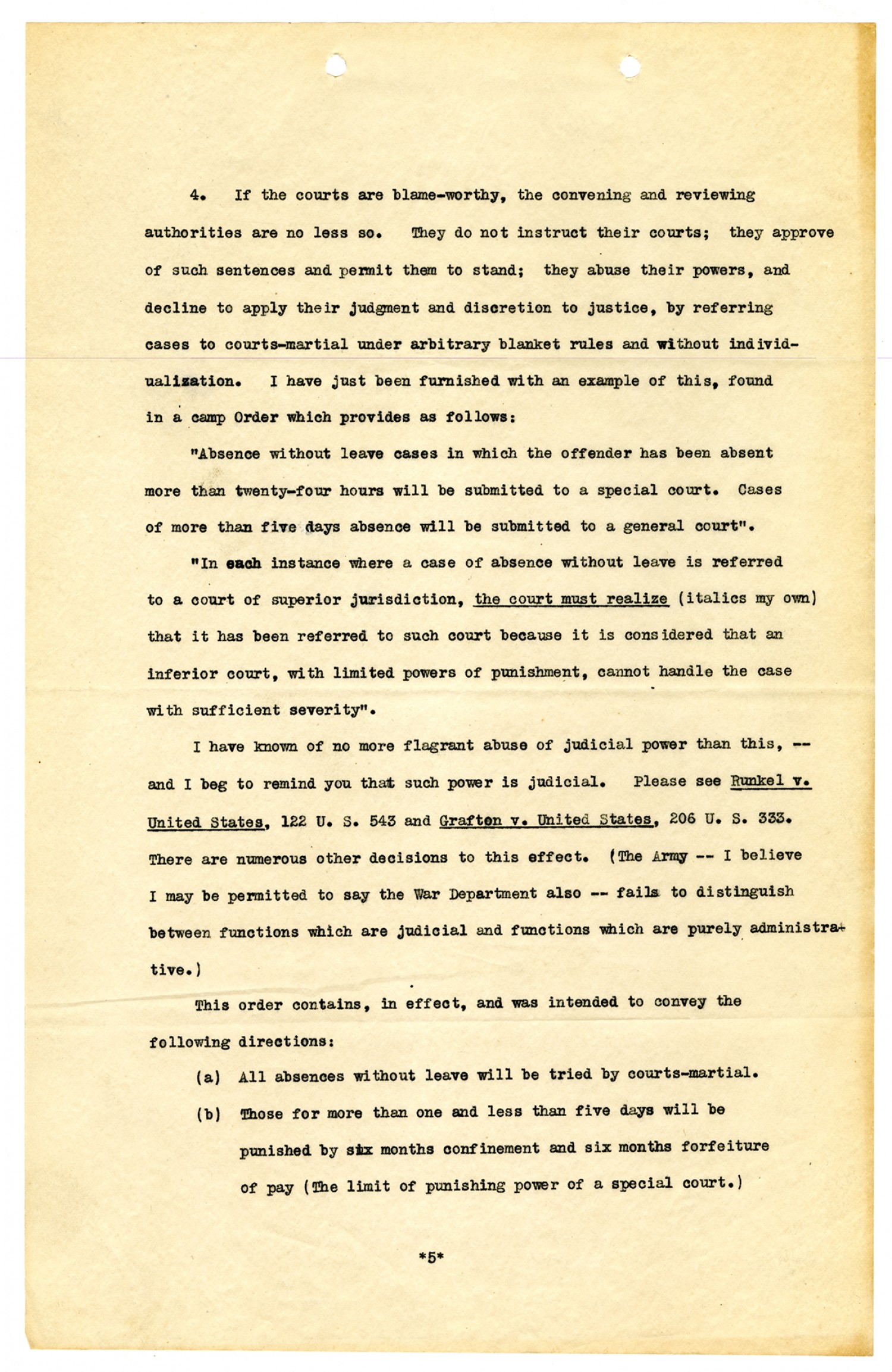
[page 5] 4. If the courts are blame-worthy, the convening and reviewing authorities are no less so. They do not instruct their courts; they approve of such sentences and permit them to stand; they abuse their powers, and decline to apply their judgment and discretion to justice, by referring cases to courts-martial under arbitrary blanket rules and without individualization. I have just been furnished with an example of this, found in a camp Order which provides as follows:
Transcript
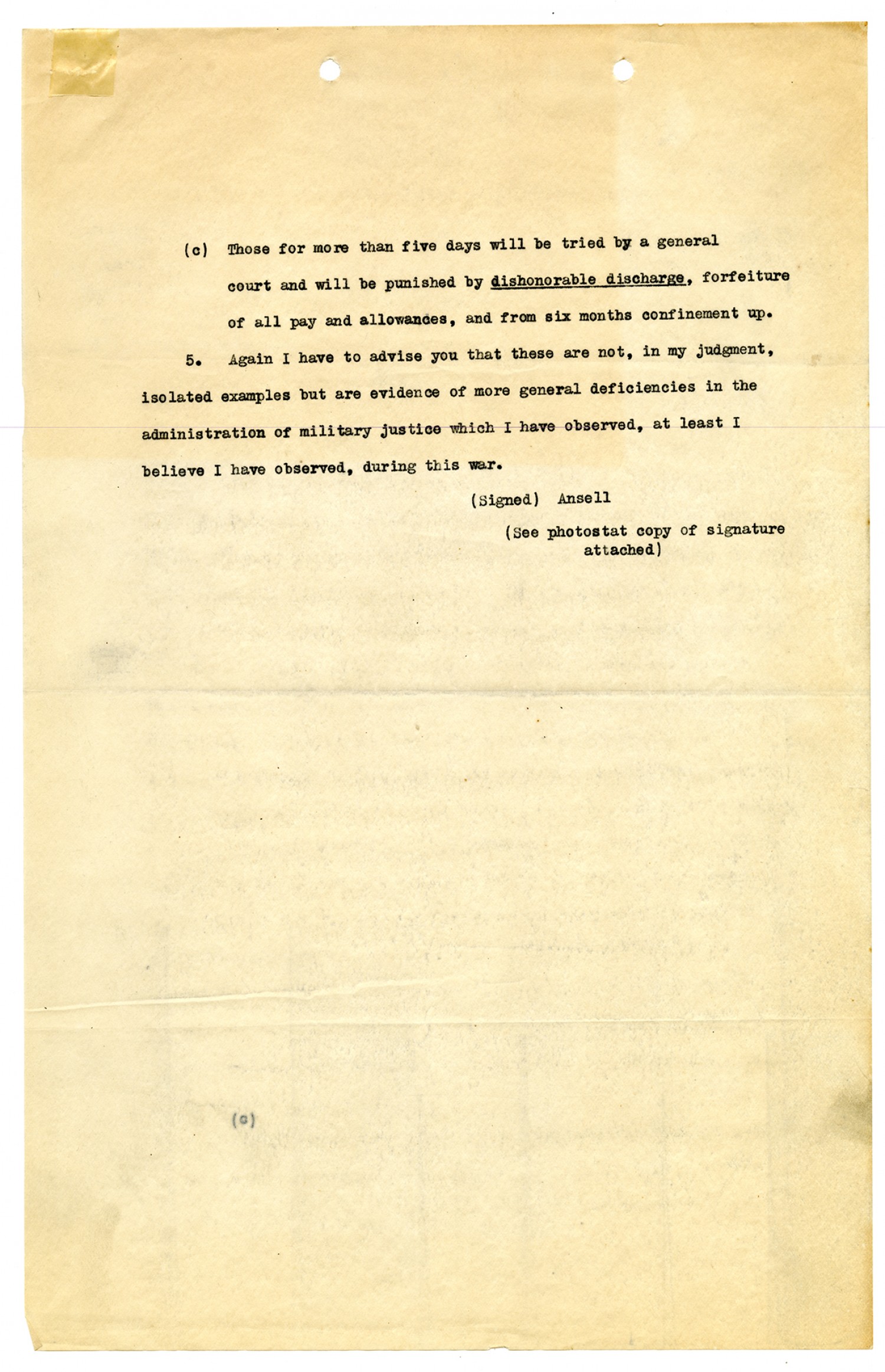
(c) Those for more than five days will be tried by a general court and will be punished by dishonorable discharge, forfeiture of all pay and allowances, and from six months confinement up. 5. Again I have to advise you that these are not, in my judgment, isolated examples but are evidence of more general deficiencies in the administration of military justice which I have observed, at least I believe I have observed, during this war. (Signed) Ansell ( See photostat copy of signature attached) (c)
Details
| Title | Memorandum for Secretary of War from Samuel Tilden Ansell - January 11, 1918 |
| Creator | Ansell, Samuel Tilden |
| Source | Ansell, Samuel Tilden. Memorandum for Secretary of War. 11 January 1918. Crowder, Enoch H. (1859-1932), Papers, 1884-1942. C1046. The State Historical Society of Missouri, Columbia, MO. |
| Description | In this memorandum to the Secretary of War, Newton D. Baker, General Samuel Ansell discussed his review of several general court-martial cases from Camp Dix. Ansell believed the cases administered to strict of a punishment on soldiers as a result of the failure of the court-martial. This document is part of a collection compiled by Enoch Herbert Crowder, the Edinburg, Grundy County, Missouri native who served as Judge Advocate General. Crowder devised the Selective Service Act in 1917 which drafted America's forces during World War I. |
| Subject LCSH | Crowder, E. H. (Enoch Herbert), 1859-1932; Camp Dix (N.J.); Court martial trials; Baker, Newton, 1871-1937; Ansell, Samuel Tilden, 1875-1954 |
| Subject Local | WWI; World War I |
| Site Accession Number | C1046 |
| Contributing Institution | The State Historical Society of Missouri |
| Copy Request | Transmission or reproduction of items on these pages beyond that allowed by fair use requires the written permission of the State Historical Society of Missouri: 1020 Lowry Street, Columbia, Missouri, 65201-7298. (573) 882-7083. |
| Rights | The text and images contained in this collection are intended for research and educational use only. Duplication of any of these images for commercial use without express written consent is expressly prohibited. |
| Date Original | January 11, 1918 |
| Language | English |