

Memorandum for General Crowder - November 11, 1918
Transcript
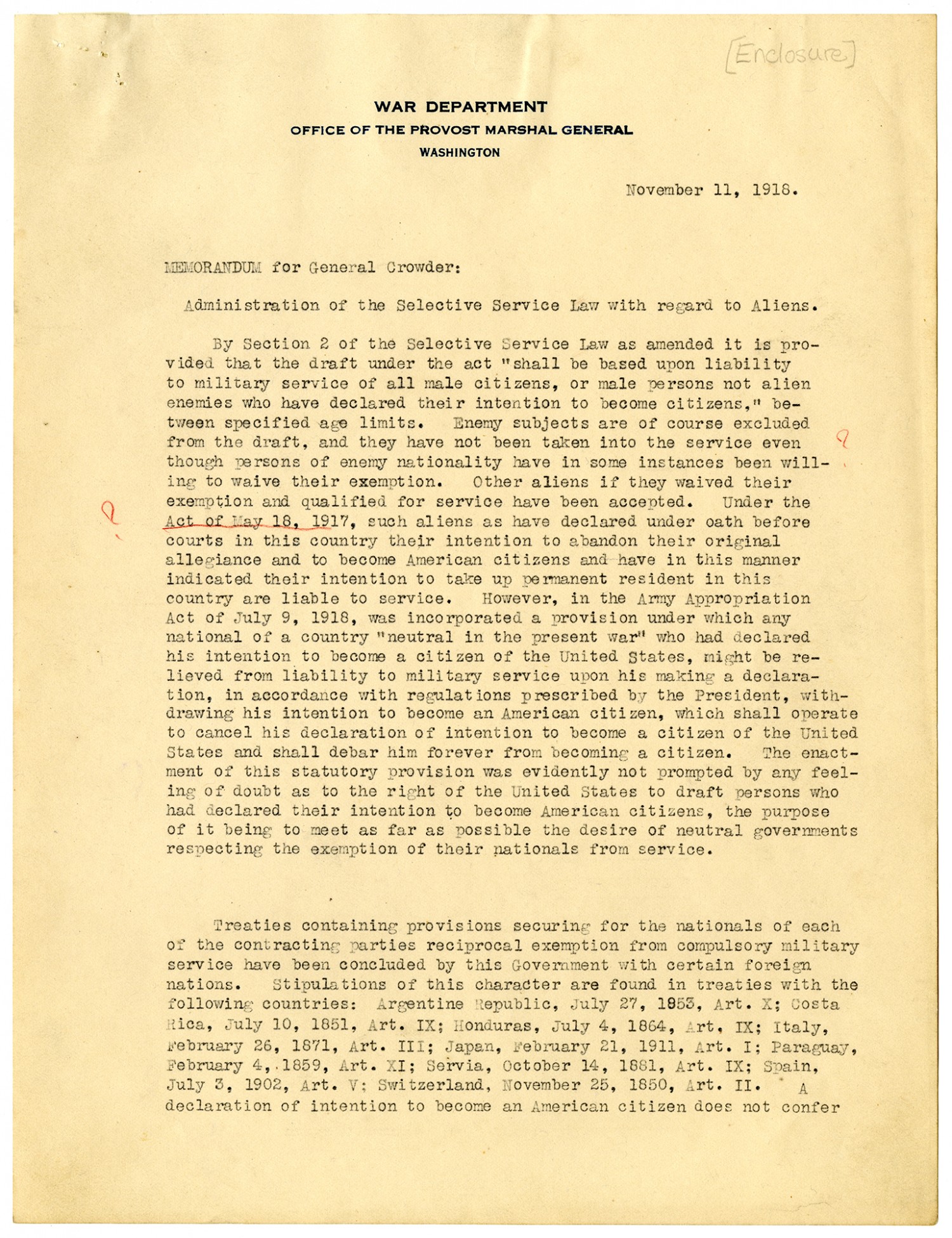
November 11, 1918. Memorandum for General Crowder: Administration of the Selective Service Law with regard to Aliens. By Section 2 of the Selective Service Law as amended it is provided that the draft under the act
Transcript
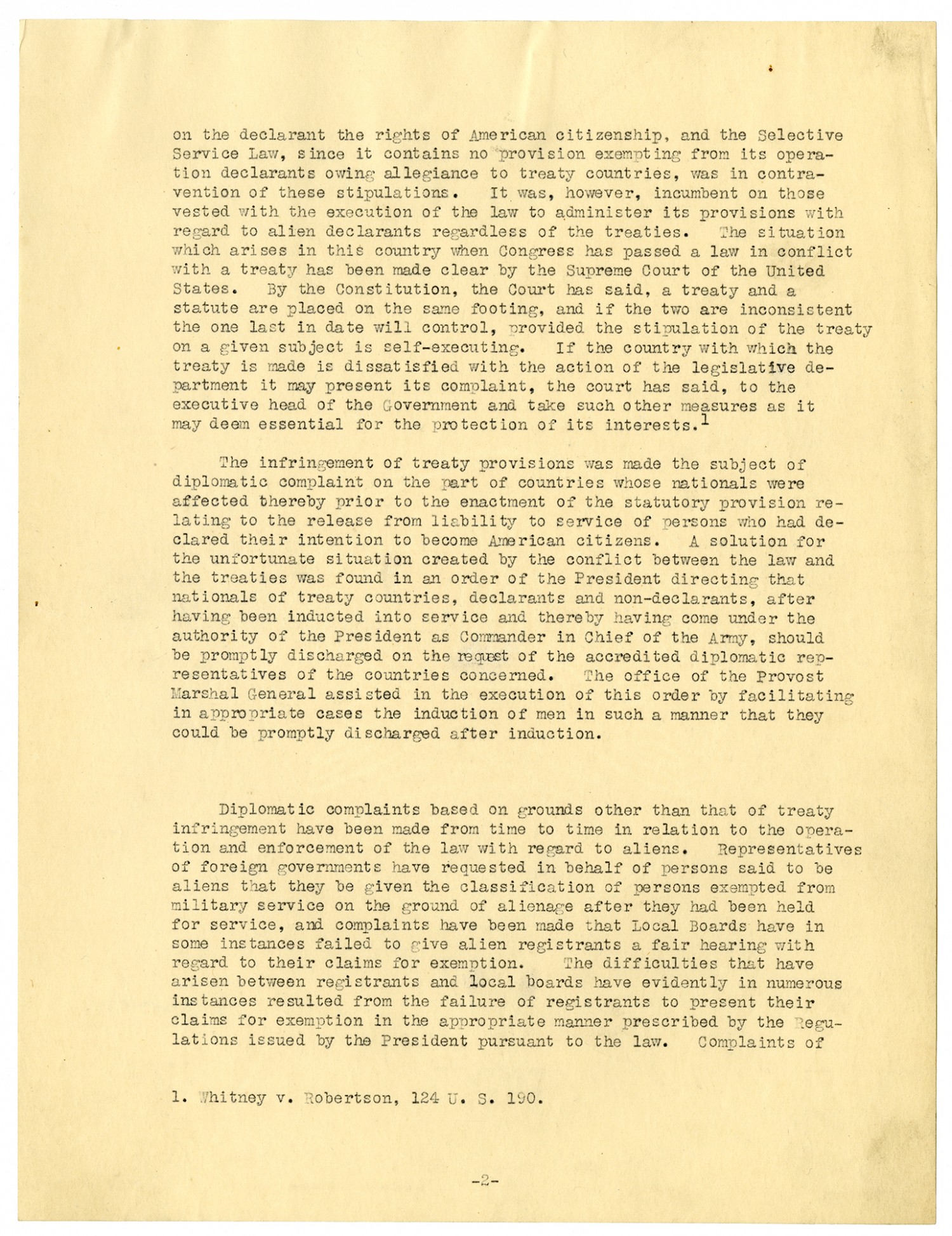
[page 2] on the declarant the rights of American citizenship, and the Selective Service Law, since it contains no provision exempting from its operation declarants owing allegiance to treaty countries, was in contravention of these stipulations. It was, however, incumbent on those vested with the execution of the law to administer its provisions with regard to alien declarants regardless of the treaties. The situation which arises in this country when Congress has passed a law in conflict with a treaty has been made clear by the Supreme Court of the United States. By the Constitution, the Court has said, a treaty and a statute are placed on the same footing, and if the two are inconsistent the one last in date will control, provided the stipulation of the treaty on a given subject is self-executing. If the country with which the treaty is made is dissatisfied with the action of the legislative department it may present its complaint, the court has said, to the executive head of the Government and take such other measures as it may deem essential for the protection of its interests. The infringement of treaty provisions was made the subject of diplomatic complaint on the part of countries whose nationals were affected thereby prior to the enactment of the statutory provision relating to the release fro liability to service of persons who had declared their intention to become American citizens. A solution for the unfortunate situation created by the conflict between the law and the treaties was found in an order of the President directing that nationals of treaty countries, declarants and non-declarants, after having been inducted into service and thereby having come under the authority of the President as Commander in Chief of the Army, should be promptly discharged on the request of the accredited diplomatic representatives of the countries concerned. The office of the Provost Marshal General assisted in the execution of this order by facilitating in appropriate cases the induction of men in such a manner that they could be promptly discharged after induction. Diplomatic complaints based on grounds other than that of treaty infringement have been made from time to time in relation to the operation and enforcement of the law with regard to aliens. Representatives of foreign governments have requested in behalf of persons said to be aliens that they be given the classification of persons exempted from military service on the ground of alienage after they had been held for service, and complaints have been made that Local Boards have in some instances failed to give alien registrants a fair hearing with regard to their claims for exemption. The difficulties that have arisen between registrants and local boards have evidently in numerous instances resulted from the failure of registrants to present their claims for exemption in the appropriate manner prescribed by the Regulations issued by the President pursuant to the law. Complaints of 1. Whitney v. Robertson, 124 U.S. 190.
Transcript
[page 3] foreign diplomatic representatives have apparently been due in some measure to the fact that representatives have not fully understood, or have not been willing to accept the construction of the Selective Service Law as to the rights and obligations of alien registrants in accordance with which the law has been administered. That construction briefly indicated is as follows: Nationals of foreign governments who have not declared their intention to become American citizens are entitled to exemption, but the burden is placed on every registrant to establish such exemption by the presentations of evidence to the local boards, which under the law are vested with power to hear and determine all questions of exemption subject to review by the district boards whose decisions are final except when modified or reversed by the President. If the registrant fails to claim exemption in the manner prescribed by the regulations either because he neglects to furnish any of such information as is required by the boards to determine the question of liability or non-liability to service or furnishes inadequate information which does not substantiate his claim to the satisfaction of the board, the board is justified in holding him for military service as any other registrants who fails to establish a claim for exemption or for deferred classification is held. Although a clear procedure under which aliens could claim exemption was prescribed by the law and the regulations, the President with a view to a satisfactory and friendly disposition of complaints made through diplomatic channels against the action of local boards in connection with the classification of aliens further directed the discharge of non-declarants of non-treaty countries in cases in which it might appear to the Secretary of State proper to accede to diplomatic requests for such discharges and in cases in which in the opinion of the War Department there might be a question as to whether a fair hearing had been accorded registrants by local boards. The office of the Provost Marshal General concerned itself with the disposition of such cases by assisting in investigations of facts with regard thereto through the local boards and by facilitating the induction of registrants so that they might after coming under the authority of the President be discharged with the least possible expense and inconvenience to the registrants and to the government. There appears to be practically no divergence between the views which have been asserted by administrative authorities of the Government in explaining the law and the regulations to foreign diplomatic representatives and the views of the courts with regard to the interpretation of the law as shown by decisions that have been rendered from time to time in cases in which applications have been made by writs of certiorari or writs of habeas corpus for release of registrants from military service. The courts have repeatedly declared that the filing of claims of exemption by non-declarant aliens including nationals of treaty countries is a condition precedent to exemption on the ground of alienage; that
Transcript
[page 4] when an alien does not make such claim in the prescribed manner he is not entitled to exemption from military service; that aliens are not excused from service automatically, so to speak, by the mere fact that they are aliens, and that the only method of excusing or exempting registrants, aliens and citizens, is through the action of the local and district boards with which all questions respecting liability and non-liability to service are primarily lodged. 1 If the registrant who claims exemption as an alien is given a full and fair hearing by the local and district boards their decisions with regard to such claim are final. The decisions of the boards are final however, only where the boards have proceeded in due form, and the registrant is given a fair opportunity to be heard and to present his evidence, and if an opportunity to be heard is denied, or if the proceedings of the boards are without or in excess of their jurisdiction or so manifestly unfair as to prevent fair investigation, or if there has been a manifest abuse of the discretion with which they are vested, the aggrieved person has a right to go into the courts for the protection of his rights, and if restrained of his liberty he may sue out a writ of habeas corpus and obtain his release.2 While the courts have held that Congress has the power to make the decisions of district boards with regard to claims for exemption final, save only as the President may see fit to modify or reverse them, and that the courts may disturb such decisions only when it appears that a registrant has not been offered a full and fair hearing, cases in which aliens have made application for release from military service are of such a nature that it appears difficult to deduce from them any comprehensive and definite rules as to the extent to which the courts will examine into the proceedings of boards with a view to determining whether a full and fair hearing has been granted a registrant and whether boards have acted according to law or have abused discretion vested in them. Touching this point the court in United States ex rel. Pascher v. Kinkead, et al., 248 Fed. Rep. 141, said in referring to the general rule announced by the courts (p.144):
Transcript
In isolated cases the courts have, apparently after examination of proceedings of local boards, released registrants who sued out writs of habeas corpus.1 It is natural that among the large number of aliens who registered some should find difficulty in fully understanding the requirements made of them in the matter of making their claims for exemption. Such registrants have been assisted by the Legal Advisory Boards, composed of lawyers with associate members of lawyers and laymen which were organized throughout the country for the purpose of advising registrants of the true meaning and intent of the Selective Service Law and of the regulations, and of assisting registrants to make full and truthful answers to the questions propounded to them.
Details
| Title | Memorandum for General Crowder - November 11, 1918 |
| Creator | Unknown |
| Source | Unknown. Memorandum for General Crowder. 11 November 1918. Crowder, Enoch H. (1859-1932), Papers, 1884-1942. C1046. The State Historical Society of Missouri, Columbia, MO. |
| Description | Memorandum for General Crowder addressing the Selective Service Law in regard to aliens. The memorandum discussed the different acts and amendments which allowed people of different countries to join the military. This document is part of a collection compiled by Enoch Herbert Crowder, the Edinburg, Grundy County, Missouri native who served as Judge Advocate General devising the Selective Service Act in 1917 which drafted America's forces during World War I. |
| Subject LCSH | Crowder, E. H. (Enoch Herbert), 1859-1932; Draft; Draft--Law and legislation; Aliens--Government policy--United States; Wilson, Woodrow, 1856-1924 |
| Subject Local | WWI; World War I; Selective Service Act of 1917; Selective Draft Act; World War, 1914-1918--Aliens |
| Site Accession Number | C1046 |
| Contributing Institution | The State Historical Society of Missouri |
| Copy Request | Transmission or reproduction of items on these pages beyond that allowed by fair use requires the written permission of the State Historical Society of Missouri: 1020 Lowry Street, Columbia, Missouri, 65201-7298. (573) 882-7083. |
| Rights | The text and images contained in this collection are intended for research and educational use only. Duplication of any of these images for commercial use without express written consent is expressly prohibited. |
| Date Original | November 11, 1918 |
| Language | English |