


Memorandum for General Crowder - January 2, 1918
Transcript
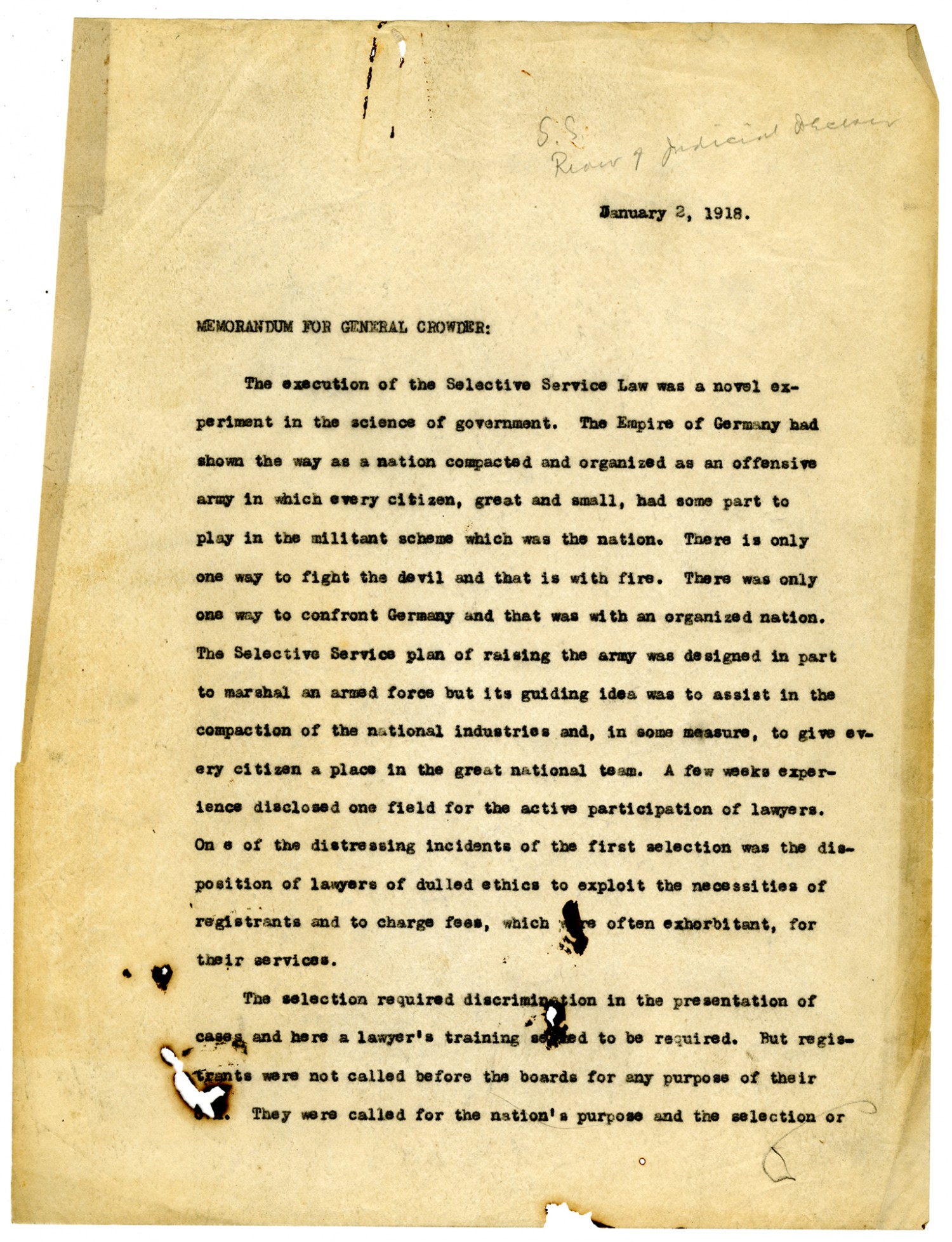
January 2, 1918. Memorandum for General Crowder: The execution of the Selective Service Law was a novel experiment in the sciences of government. The Empire of Germany had shown the way as a nation compacted and organized as an offensive army in which every citizen, great and small, had some part to play in the militant scheme which was the nation. There is only one way to fight the devil and that is with fire. There was only one way to confront Germany and that was with an organized nation. The Selective Service plan of raising the army was designed in part to marshal an armed force but its guiding idea was to assist in the compaction of the national industries and, in some measure, to give every citizen a place in the great national team. A few weeks experience disclosed one field for the active participation of lawyers. One of the distressing incidents of the first selection was the disposition of lawyers of dulled ethics to exploit the necessities of registrants and to charge fees, which were often exorbitant, for their services. The selection required discrimination in the presentation of cases and here a lawyer
Transcript
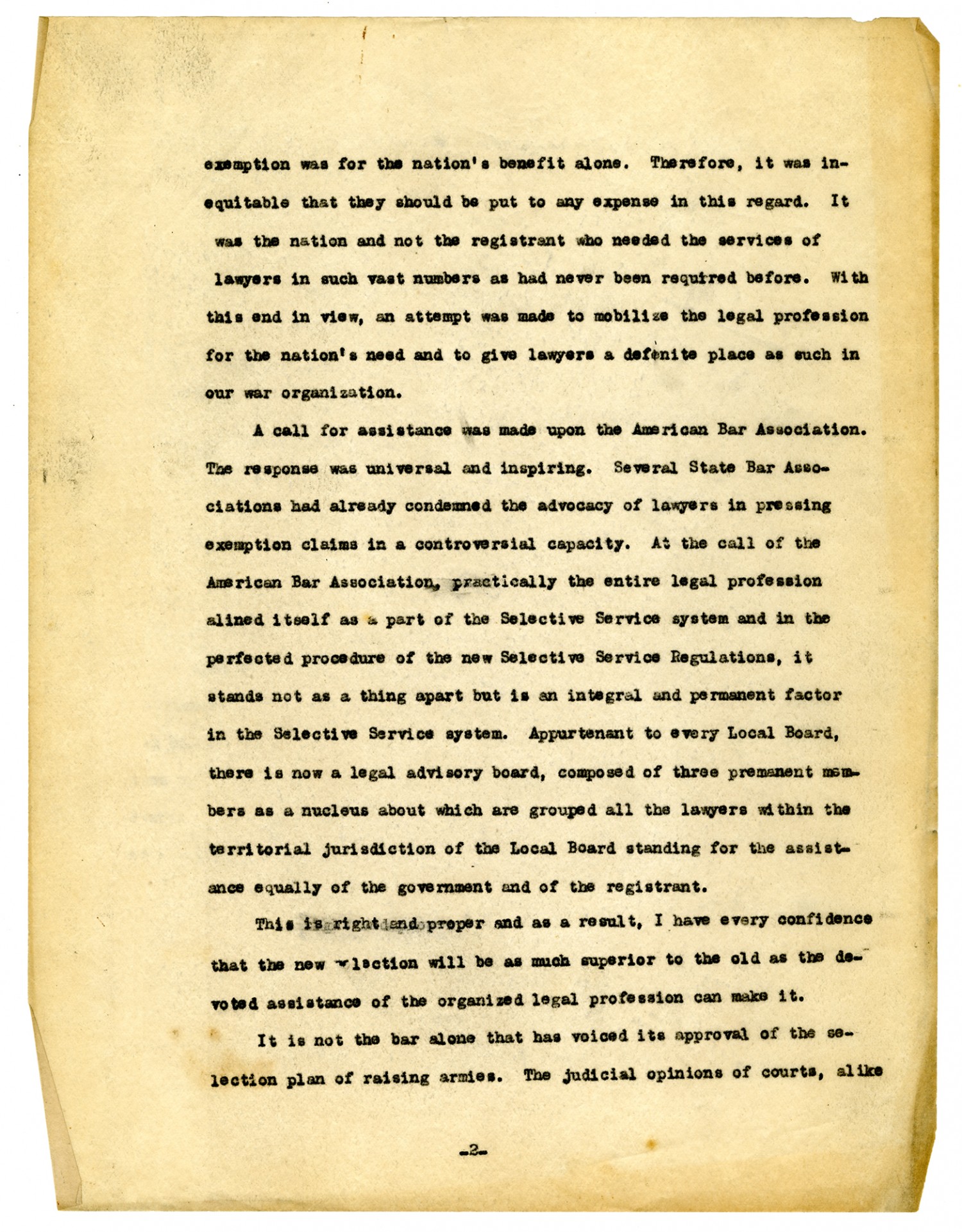
exemption was for the nation
Transcript
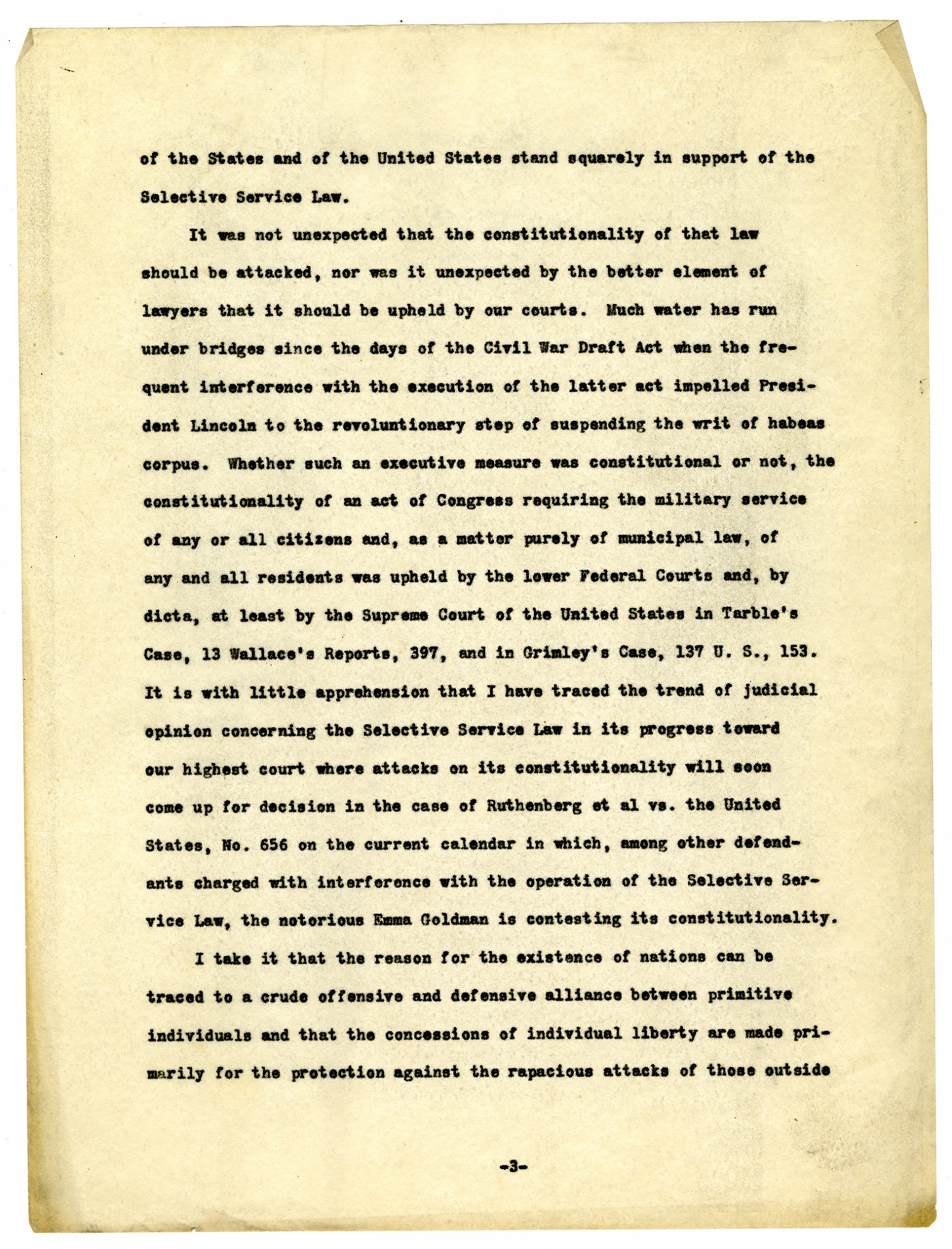
of the States and of the United States stand squarely in support of the Selective Service Law. It was not unexpected that the constitutionality of that law should be attacked, nor was it unexpected by the better element of lawyers that it should be upheld by our courts. Much water has run under bridges since the days of the Civil war Draft Act when the frequent interference with the execution of the latter act impelled President Lincoln to the revolutionary step of suspending the writ of habeas corpus. Whether such an executive measure was constitutional or not, the constitutionality of an act of Congress requiring the military service of any or all citizens and, as a matter purely of municipal law, of any and all residents was upheld by the lower Federal Courts and, by dicta, at least by the Supreme Court of the United States in Tarble
Transcript
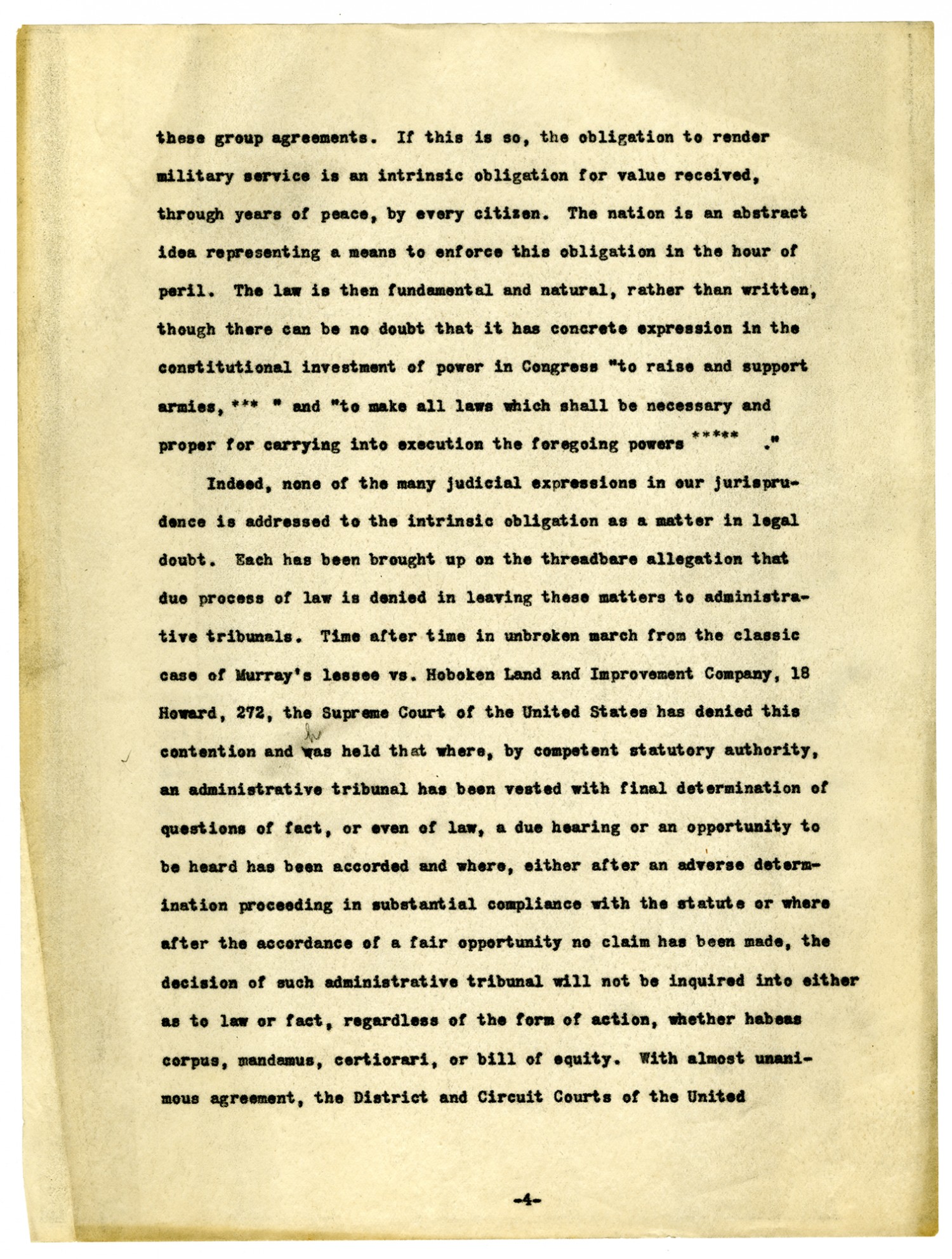
these groups agreements. If this is so, the obligation to render military service is an intrinsic obligation for value received, through years of peace, by every citizen. The nation is an abstract idea representing a means to enforce this obligation in the hour of peril. The law is then fundamental and natural, rather than written, though there can be no doubt that it has concrete expression in the constitutional investment of power in Congress
Transcript
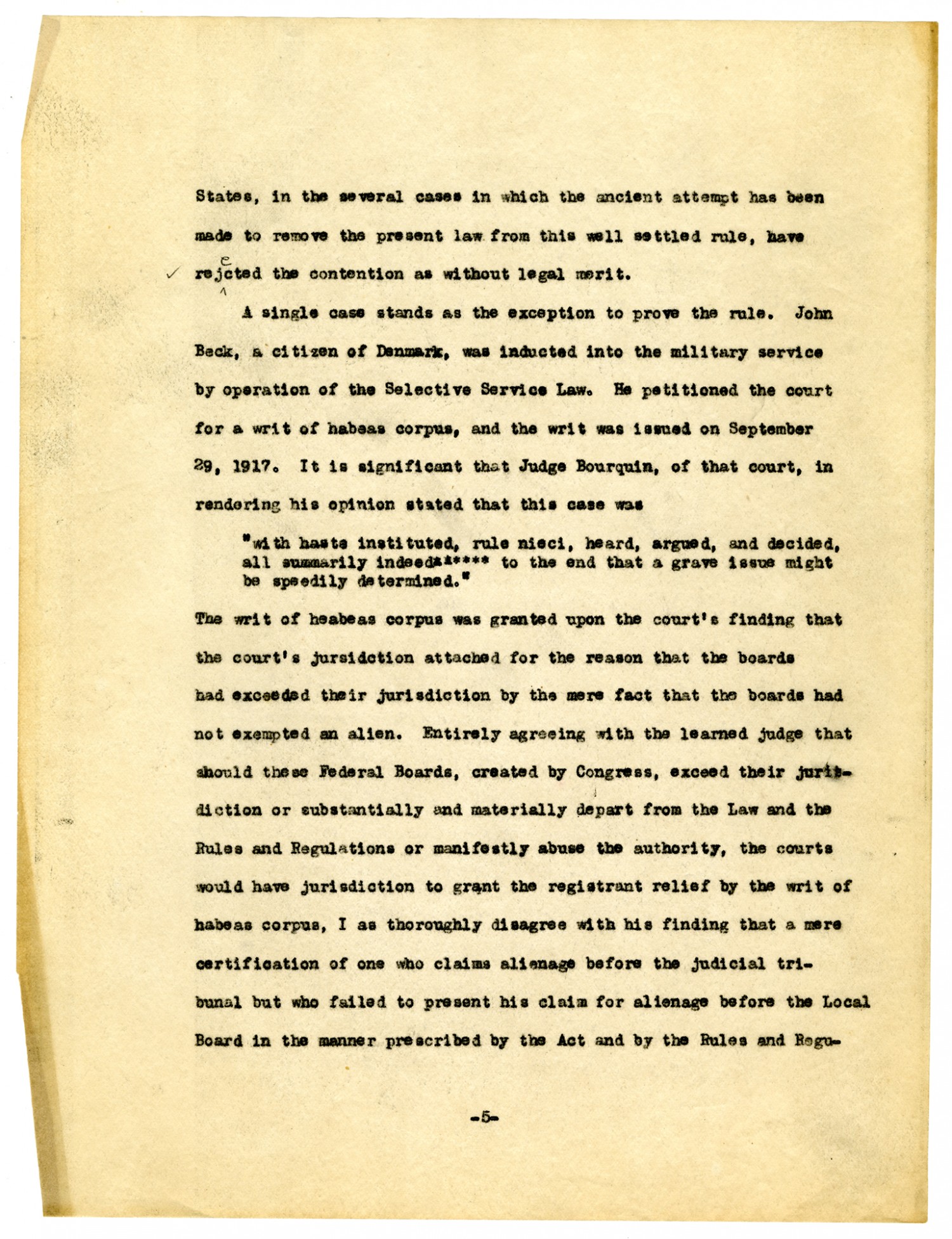
States, in the several cases in which the ancient attempt has been made to remove the present law from this well settled rule, have rejected the contention as without legal merit. A single case stands as the exception to prove the rule. John Beck, a citizen of Denmark, was inducted into the military service by operation of the Selective Service Law. He petitioned the court for a writ of habeas corpus, and the writ was issued on September 29, 1917. It is significant that Judge Bourquin, of that court, in rendering his opinion stated that this case was
Transcript
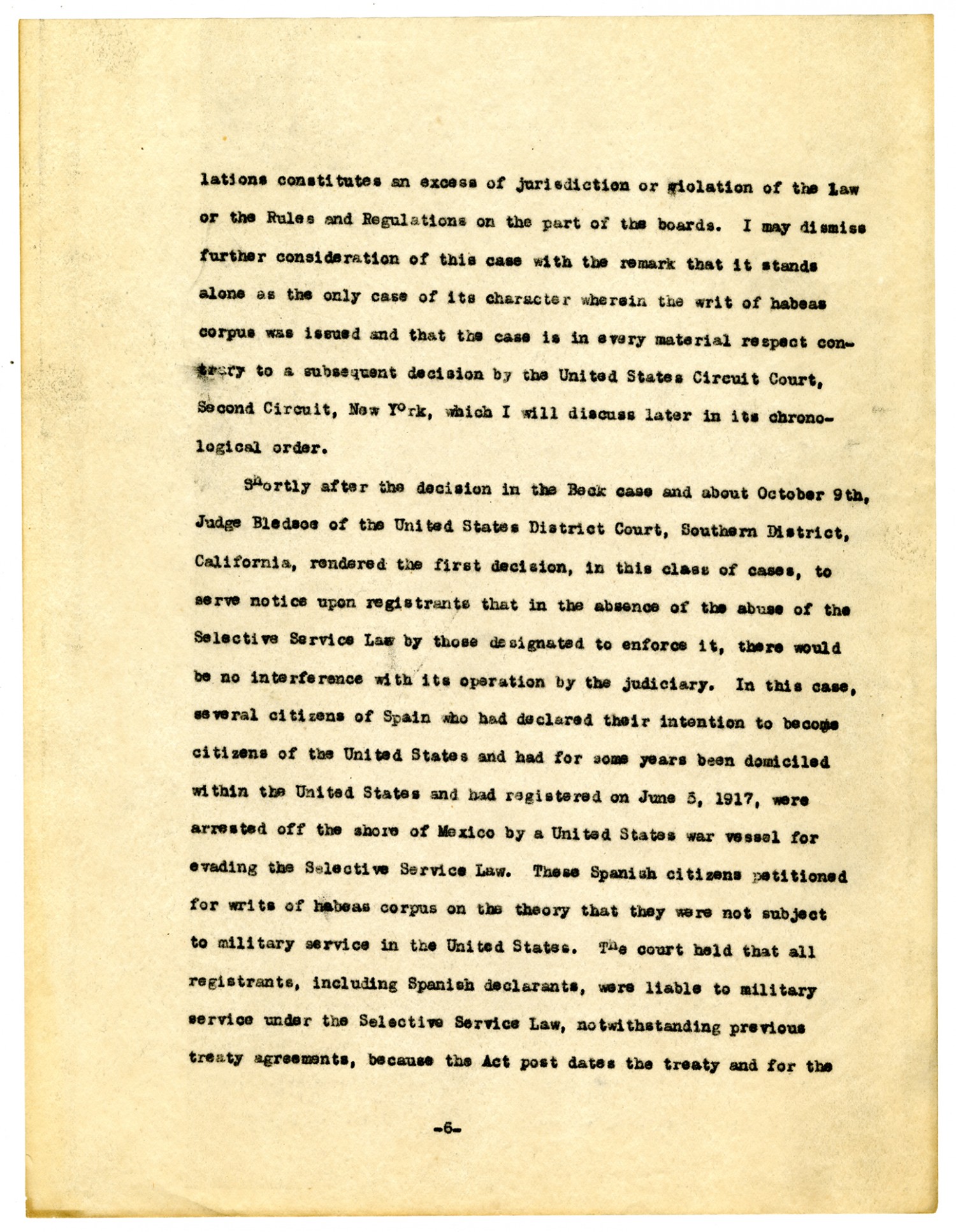
lations constitutes an excess of jurisdiction or violation of the law or the Rules and Regulations on the part of the boards. I may dismiss further consideration of this case with the remark that it stands alone as the only case of its character wherein the writ of habeas corpus was issued and that the case is in every material respect contrary to subsequent decision by the Untied States Circuit Court, Second Circuit, New York, which I will discuss later in its chronological order. Shortly after the decision in the Beck case and about October 9th, Judge Bledace of the United States District Court, Southern District, California, rendered the first decision, in this class of cases, to serve notice upon registrants that in the absence of the abuse of the Selective Service Law by those designated to enforce it, there would be no interference with its operation by the judiciary. In this case, several citizens of Spain who had declared their intention to become citizens of the United States and had for some years been domiciled within the United States and had registered on June 5, 1917, were arrested off the shore of Mexico by a United States war vessel for evading the Selective Service Law. These Spanish citizens petitioned for writs of habeas corpus on the theory that they were not subject to military service in the United States. The court held that all registrants, including Spanish declarants, were liable to military service under the Selective Service Law, notwithstanding previous treaty agreements, because the Act post dates the treaty and for the [page 6]
Transcript
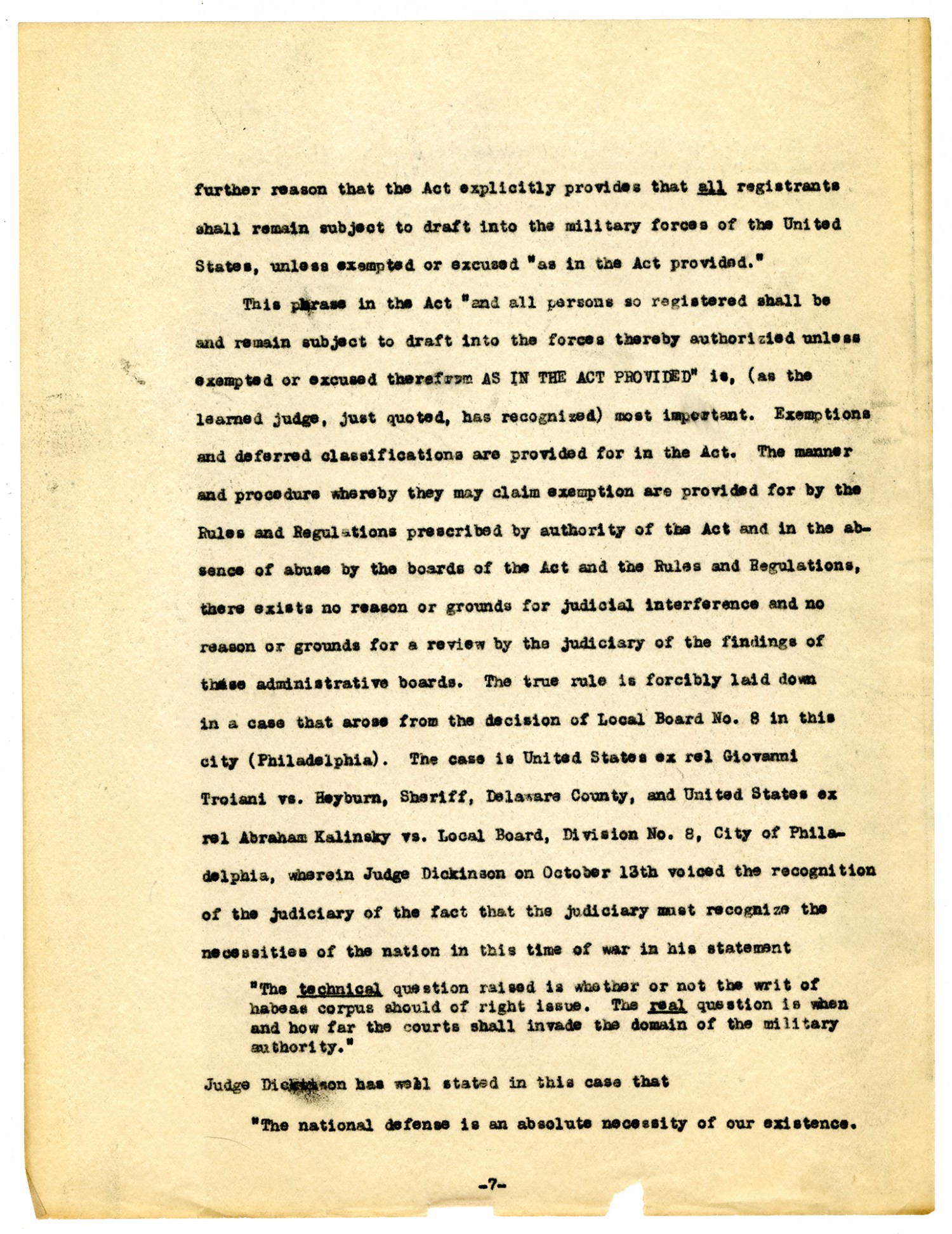
further reason that the Act explicitly provides that all registrants shall remain subject to draft into the military forces of the United States, unless exempted or excused
Transcript
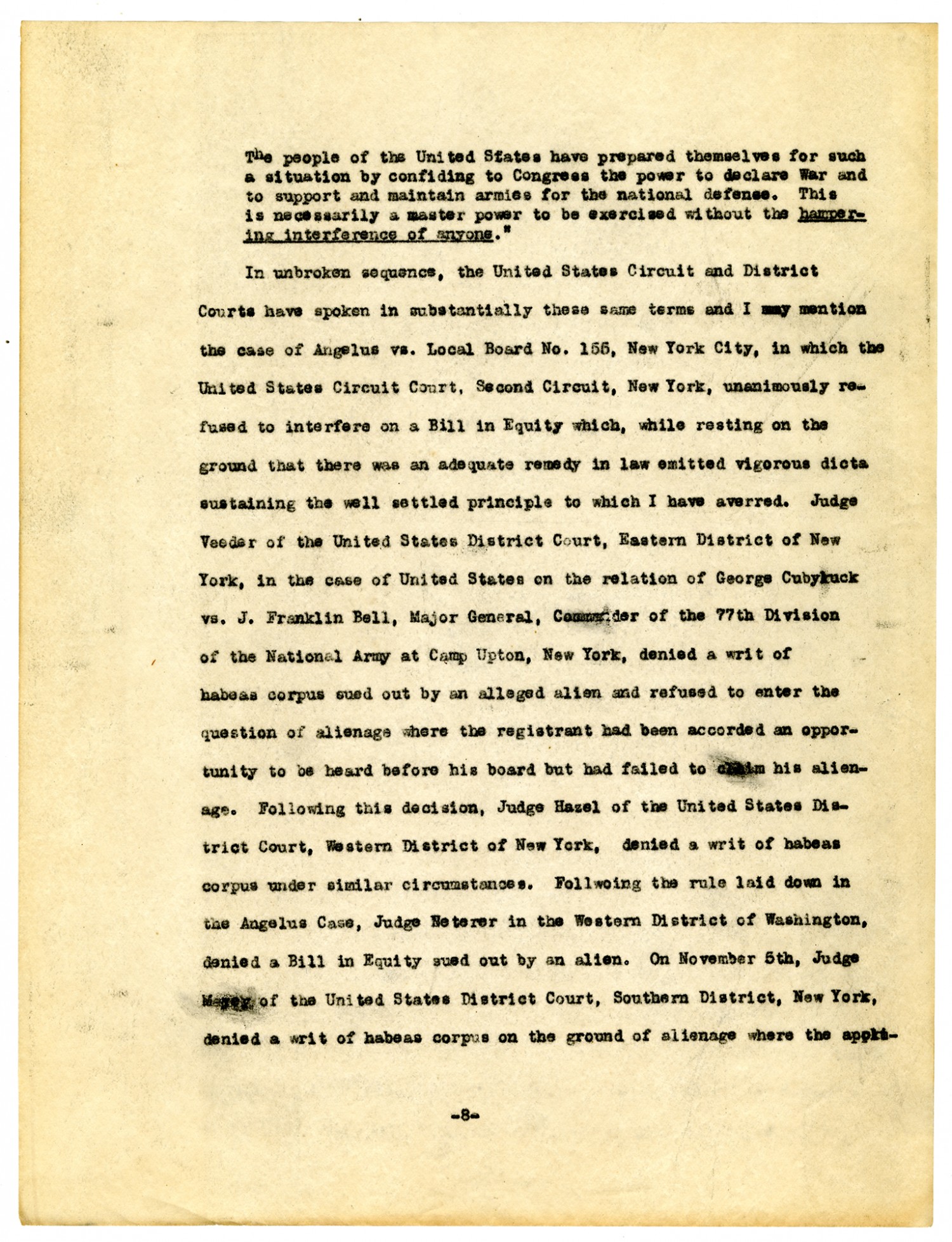
The people of the United States have prepared themselves for such a situation by confiding to Congress the power to declare War and to support and maintain armies for the national defense. This is necessarily a master power to be exercised without the hampering interference of anyone.
Transcript
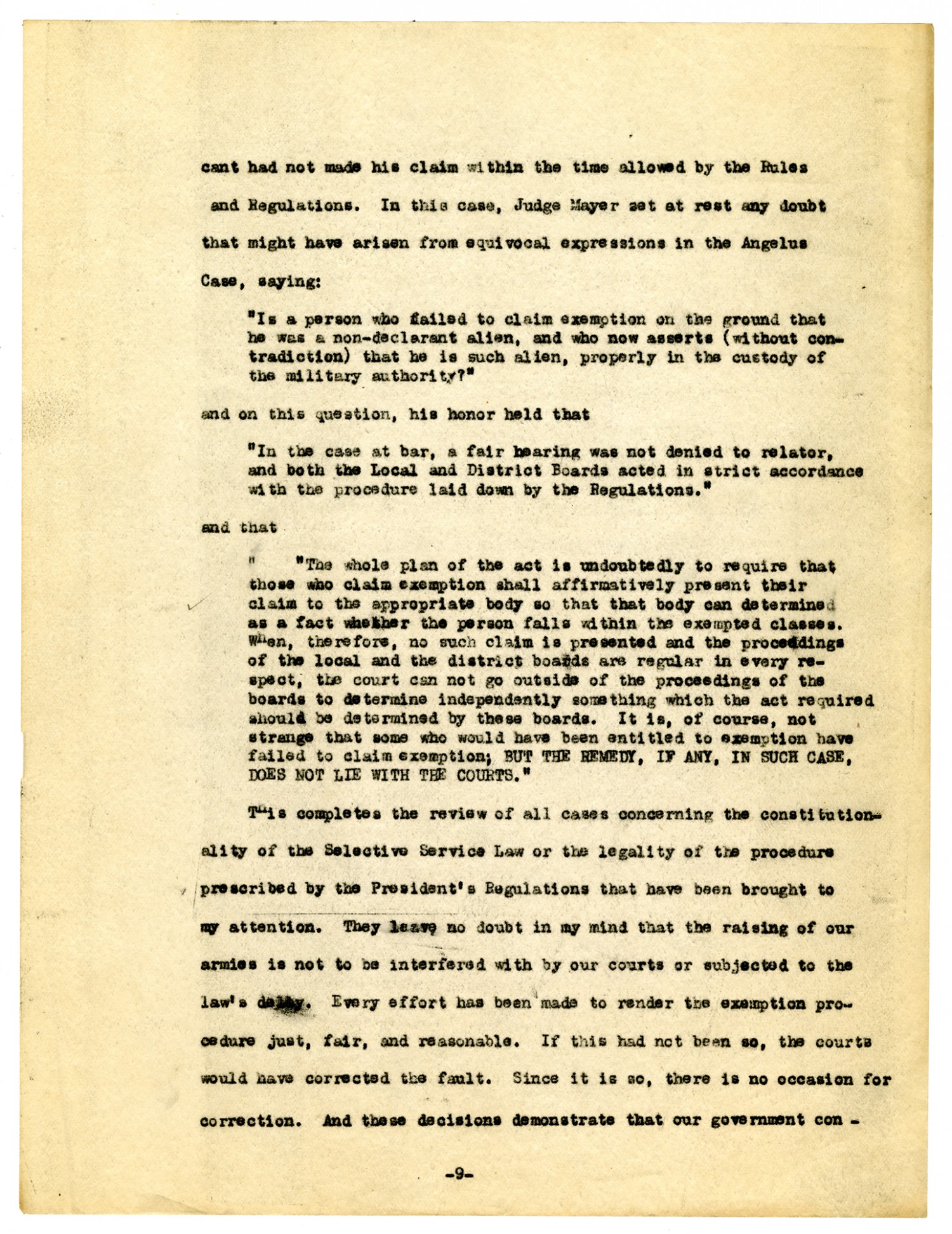
cant had not made his claim within the time allowed by the Rules and Regulations. In this case, Judge Mayer set at rest any doubt that might have arisen from equivocal expressions in the Angelus Case, saying:
Transcript
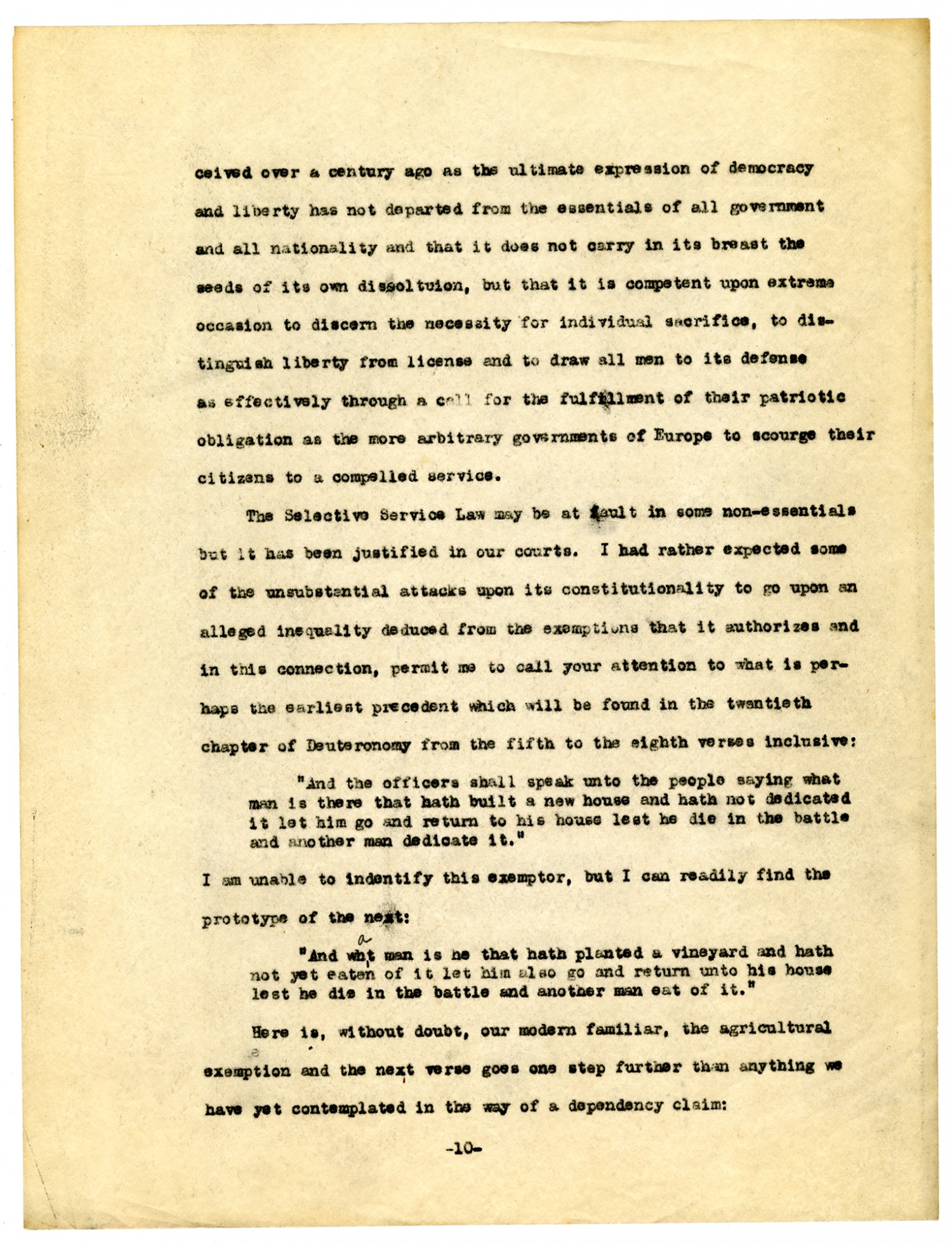
ceived over a century ago as the ultimate expression of democracy and liberty has not departed from the essentials of all government and all nationality and that it does not carry in its breast the seeds of its own dissoltuion, but that it is competent upon extreme occasion to discern the necessity for individual sacrifice, to distinguish liberty from license and to draw all men to its defense as effectively through a call for the fulfillment of their patriotic obligation as the more arbitrary governments of Europe to scourge their citizens to a compelled service. The Selective Service Law may be at fault in some non-essentials but it has been justified in our courts. I had rather expected some of the unsubstantial attacks upon its constitutionality to go upon an alleged inequality deduced from the exemptions that it authorized and in this connection, permit me to call your attention to what is perhaps the earliest precedent which will be found in the twentieth chapter of Deuteronomy from the fifth to the eighth verses inclusive:
Transcript
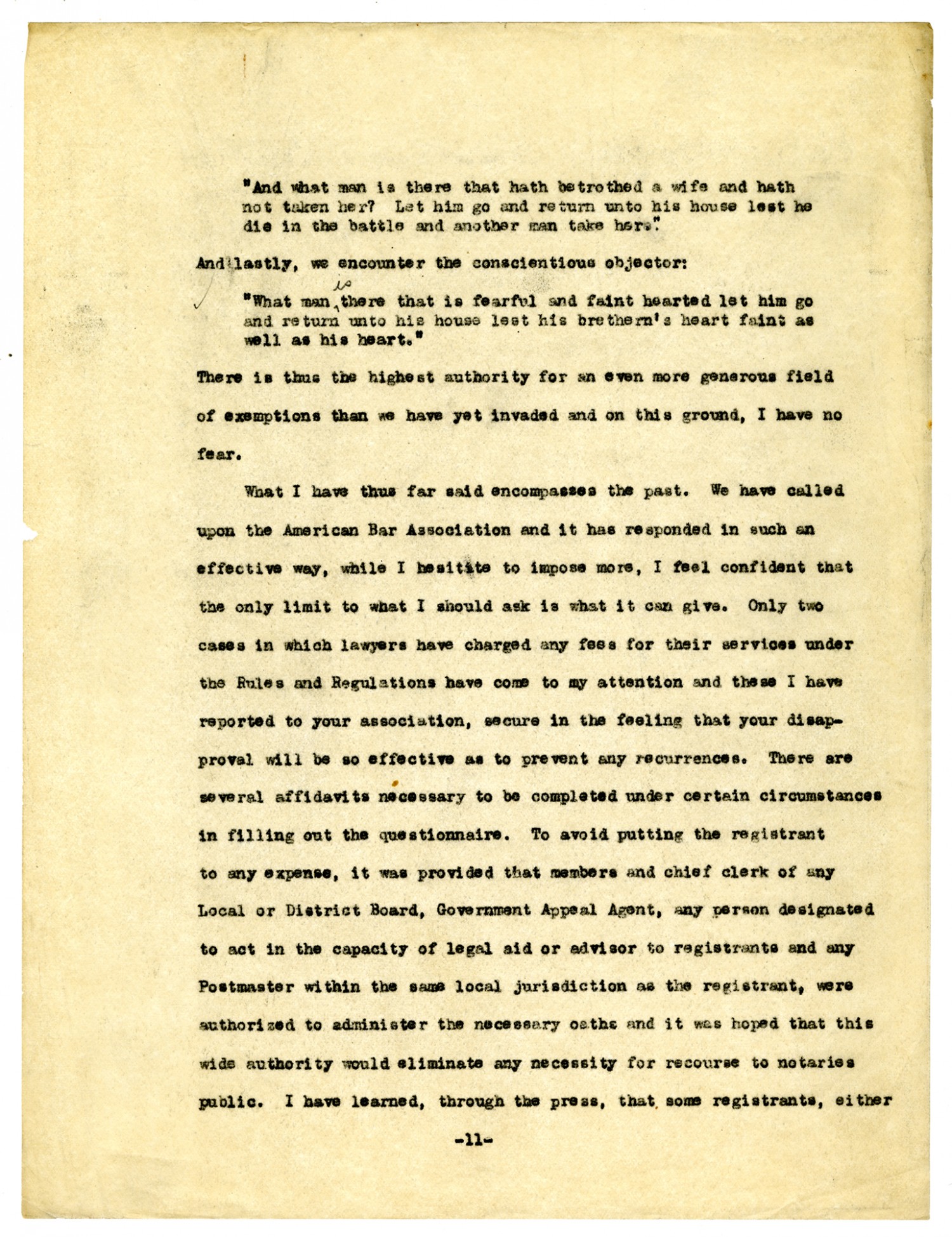
And what man is there that hath betrothed a wife and hath not taken her? Let him go and return unto his house lest he die in the battle and another man take her.
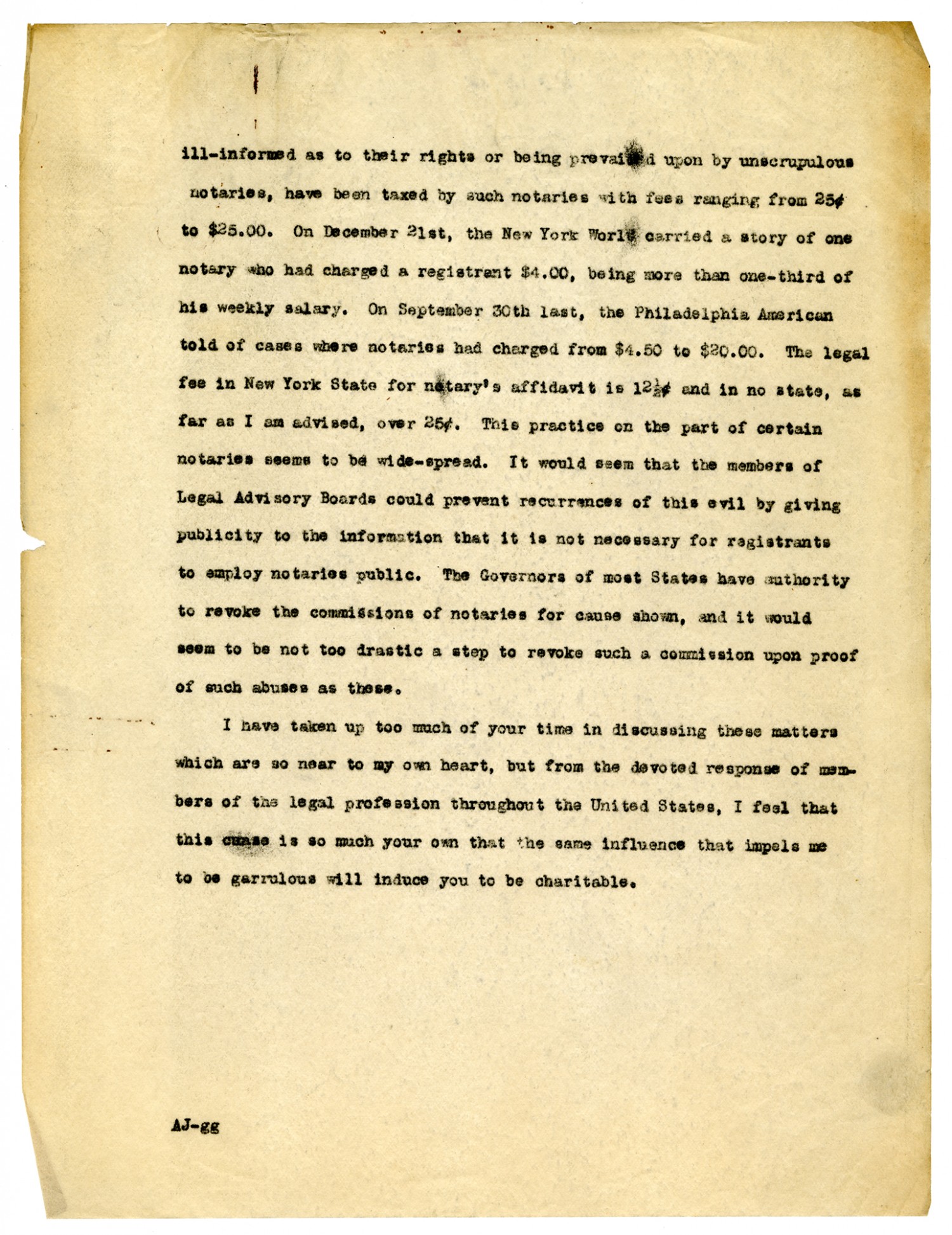
Transcript
ill-informed as to their rights or being prevailed upon by unscrupulous notaries, have been taxed by such notaries with fees ranging from 25 cents to $25.00. On December 21st, the New York World carried a story of one notary who had charged a registrant $4.00, being more than one-third of his weekly salary. On September 30th last, the Philadelphia American told of cases where notaries had charged from $4.50 to $20.00. The legal fee in New York State for notary
Details
| Title | Memorandum for General Crowder - January 2, 1918 |
| Creator | Unknown |
| Source | Unknown. Memorandum for General Crowder. 02 January 1918. Crowder, Enoch H. (1859-1932), Papers, 1884-1942. C1046. The State Historical Society of Missouri, Columbia, MO. |
| Description | Memorandum for General Enoch H. Crowder concerning the constitutionality of the Selective Service Act. This document is part of a collection compiled by Enoch Herbert Crowder, the Edinburg, Grundy County, Missouri native who served as Judge Advocate General. Crowder devised the Selective Service Act in 1917 which drafted America's forces during World War I. |
| Subject LCSH | Crowder, E. H. (Enoch Herbert), 1859-1932; Draft--Law and legislation |
| Subject Local | WWI; World War I; Selective Service Act of 1917; Selective Draft Act |
| Site Accession Number | C1046 |
| Contributing Institution | The State Historical Society of Missouri |
| Copy Request | Transmission or reproduction of items on these pages beyond that allowed by fair use requires the written permission of the State Historical Society of Missouri: 1020 Lowry Street, Columbia, Missouri, 65201-7298. (573) 882-7083. |
| Rights | The text and images contained in this collection are intended for research and educational use only. Duplication of any of these images for commercial use without express written consent is expressly prohibited. |
| Date Original | January 2, 1918 |
| Language | English |