Memorandum for General Crowder from Captain C. A. Hope - July 23, 1918
Transcript
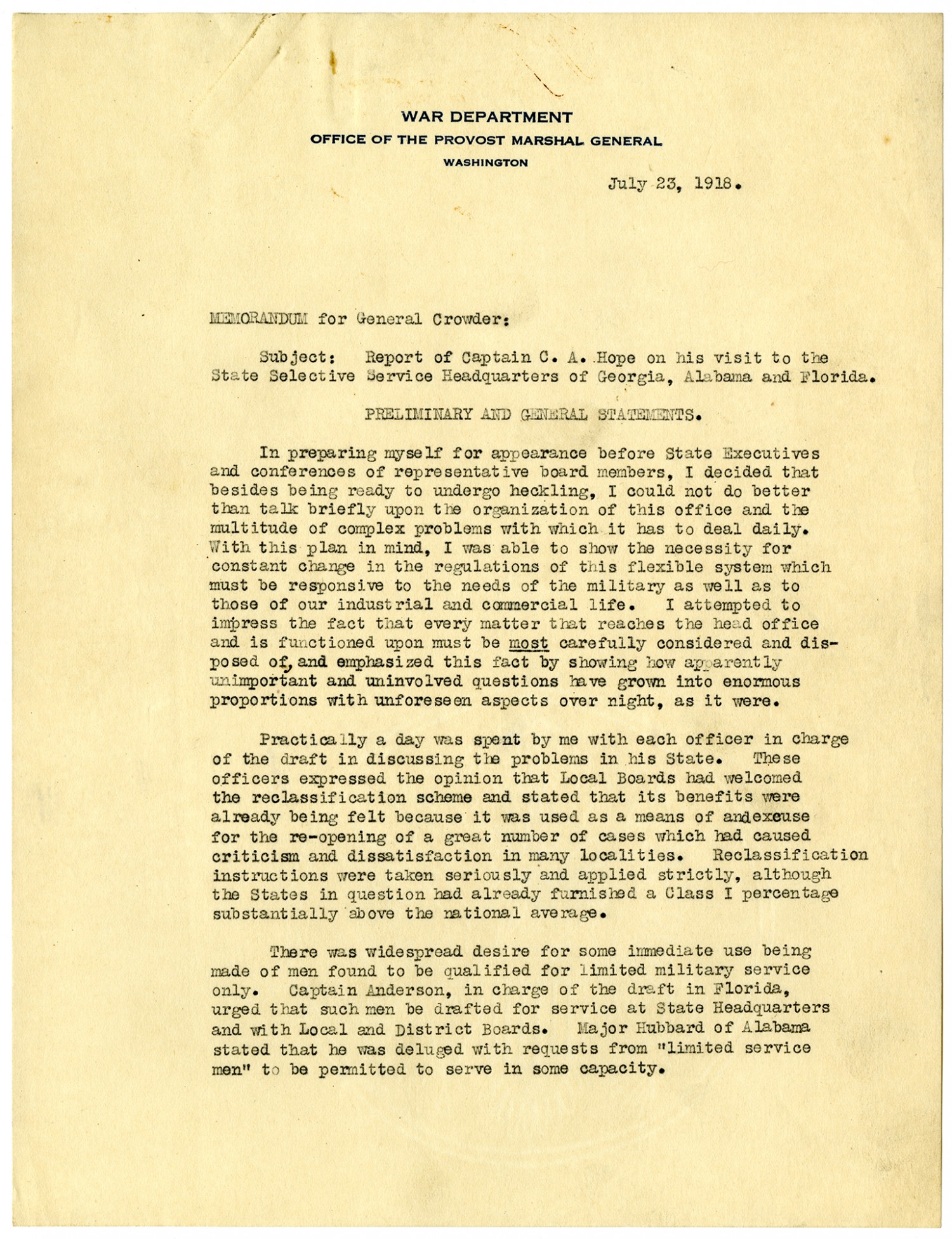
July 23, 1918. Memorandum for General Crowder: Subject: Report of Captain C.A. Hope on his visit to the State Selective Service Headquarters of Georgia, Alabama and Florida. Preliminary and General Statements. In preparing myself for appearance before State Executives and conferences of representative board members, I decided that besides being ready to undergo heckling, I could not do better than talk briefly upon the organization of this office and the multitude of complex problems with which it has to deal daily. With this plan in mind, I was able to show the necessity for constant change in the regulations of this flexible system which must be responsive to the needs of the military as well as to those of our industrial and commercial life. I attempted to impress the fact that every matter that reaches the head office and is functioned upon must be most carefully considered and disposed of, and emphasized this fact by showing how apparently unimportant and uninvolved questions have grown into enormous proportions with unforeseen aspects over night, as it were. Practically a day was spent by me with each officer in charge of the draft in discussing the problems in his State. These officers expressed the opinion that Local Boards had welcomed the reclassification scheme and stated that its benefits were already being felt because it was used as a means of and excuse for the re-opening of a great number of cases which had caused criticism and dissatisfaction in many localities. Reclassification instructions were taken seriously and applied strictly, although the States in question had already furnished a Class I percentage substantially above the national average. There was widespread desire for some immediate use being made of men found to be qualified for limited military service only. Captain Anderson, in charge of the draft in Florida, urged that such men be drafted for service at State Headquarters and with Local and District Boards. Major Hubbard of Alabama stated that he was deluged with requests from
Transcript
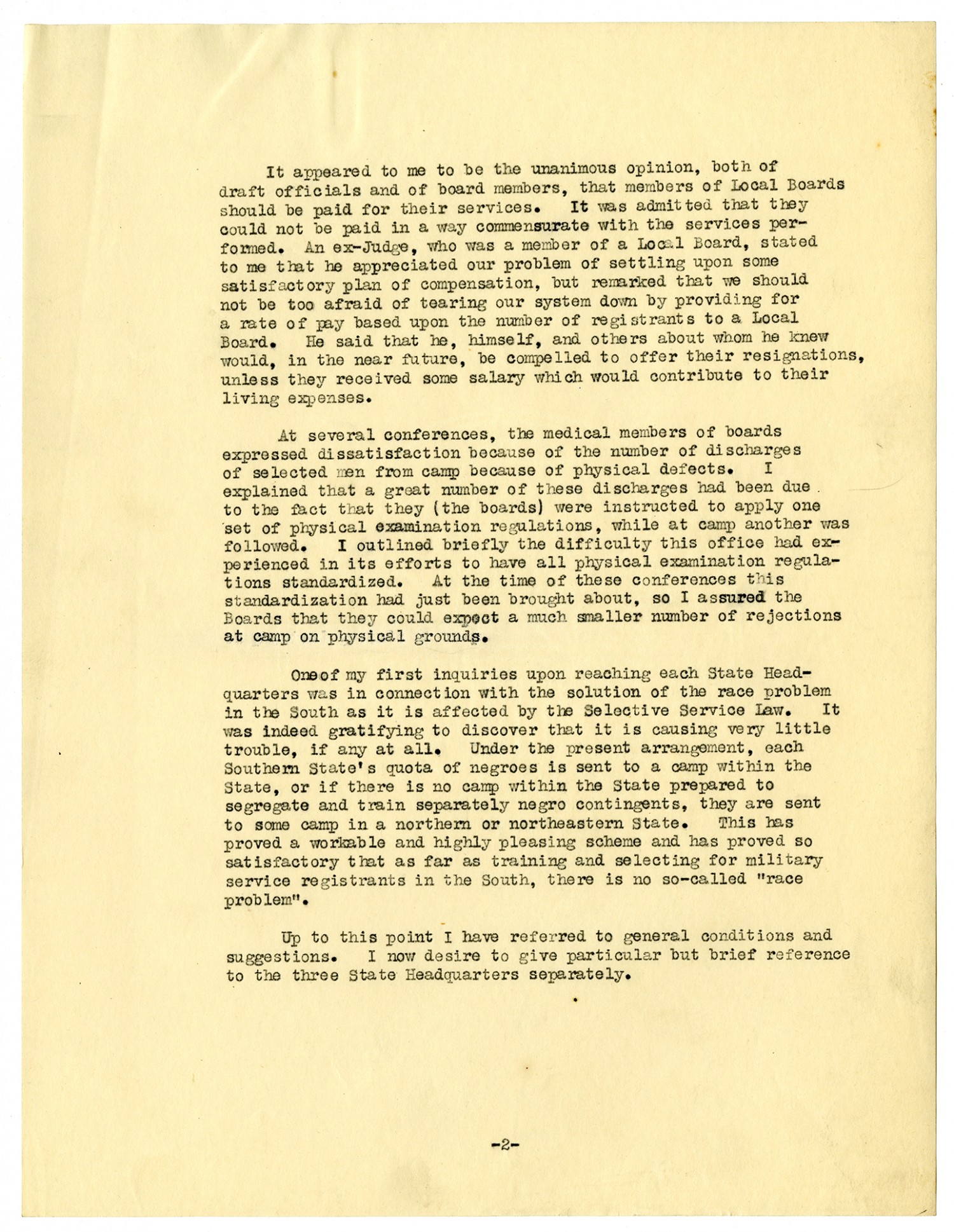
[page 2] It appeared to me to be the unanimous opinion, both of draft officials and of board members, that members of Local Boards should be paid for their services. It was admitted that they could not be paid in a way commensurate with the services performed. An ex-Judge, who was a member of a Local Board, stated to me that he appreciated our problem of settling upon some satisfactory plan of compensation, but remarked that we should not be too afraid of tearing our system down by providing for a rate of pay based upon the number of registrants to a Local Board. He said that he, himself, and others about whom he knew would, in the near future, be compelled to offer their resignations, unless they received some salary which would contribute to their living expenses. At several conferences, the medical members of boards expressed dissatisfaction because of the number of discharges of selected men from camp because of physical defects. I explained that a great number of these discharges had been due to the fact that they (the boards) were instructed to apply one set of physical examination regulations, while at camp another was followed, I outlined briefly the difficulty this office had experienced in its efforts to have all physical examination regulations standardized. At the tie of these conferences this standardization had just been brought about, so I assured the Boards that they could expect a much smaller number of rejections at camp on physical grounds. One of my first inquiries upon reaching each State Headquarters was in connection with the solution of the race problem in the South as it is affected by the Selective Service Law. It was indeed gratifying to discover that it is causing very little trouble, if any at all. Under the present arrangement, each Southern State
Transcript
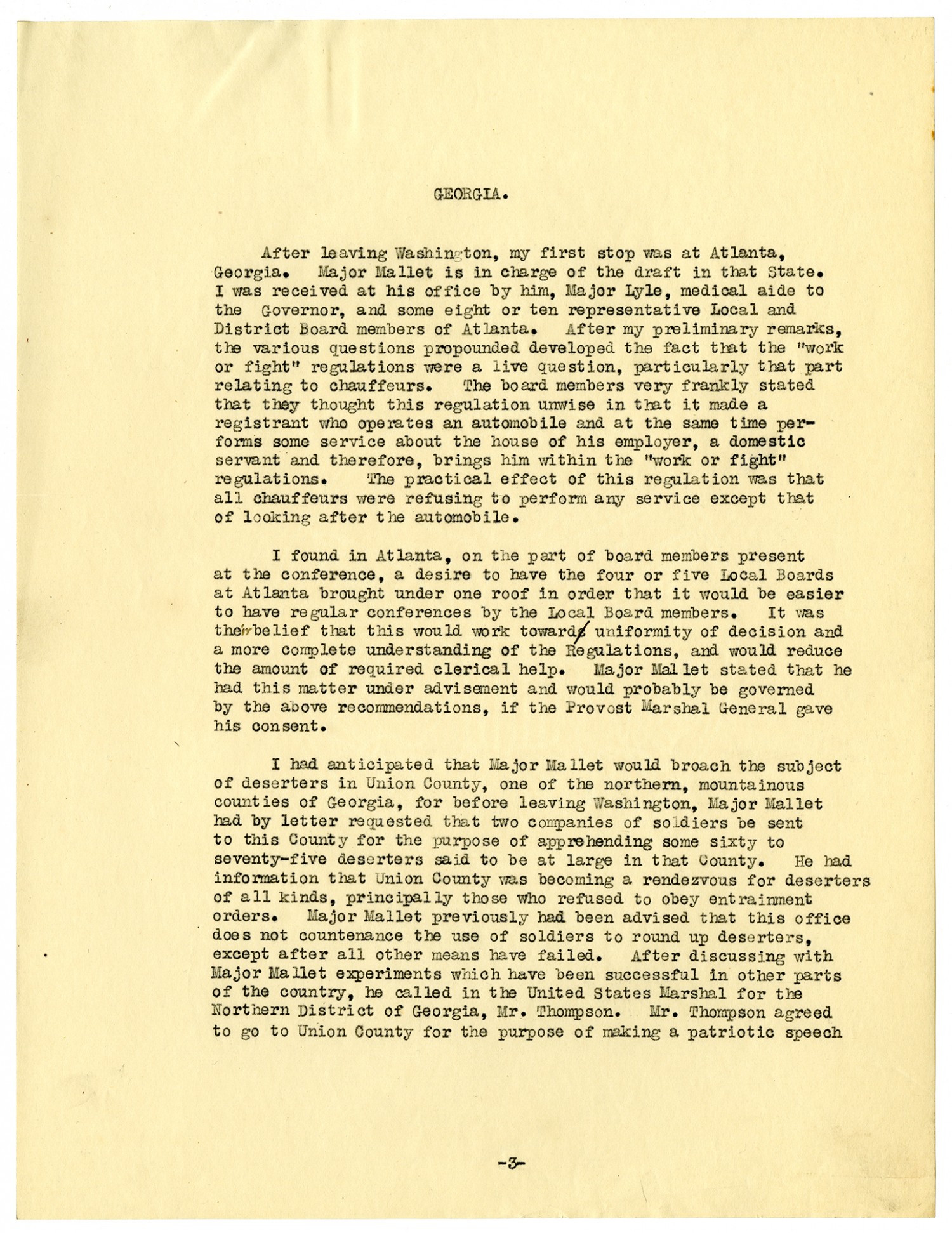
[page 3] Georgia. After leaving Washington, my first stop was at Atlanta, Georgia. Major Mallet is in charge of the draft in that State. I was received at his office by him, Major Lyle, medical aide to the Governor, and some eight or ten representative Local and District Board members of Atlanta. After my preliminary remarks, the various questions propounded developed the fat that the
Transcript
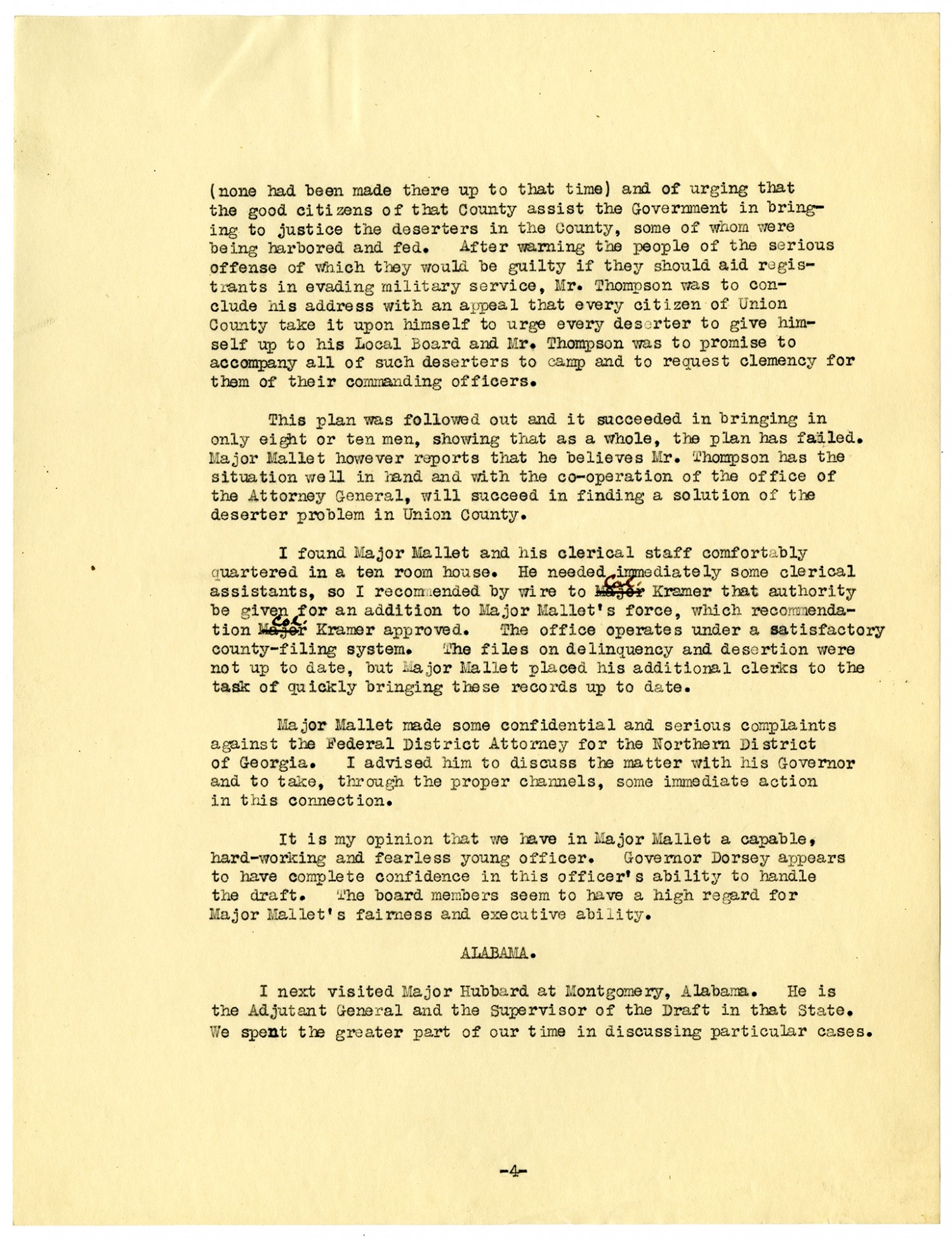
[page 4] (none had been made there up to that time) and of urging that the good citizens of that County assist the Government in bringing to justice the deserters in the County, some of whom were being harbored and fed. After warning the people of the serious offense of which they would be guilty if they should aid registrants in evading military service, Mr. Thompson was to conclude his address with an appeal that every citizen of Union County take it upon himself to urge every deserter to give himself up to his Local Board and Mr. Thompson was to promise to accompany all of such deserters to camp and to request clemency for them of their commanding officers. This plan was followed out and it succeeded in bringing in only eight or ten men, showing that as a whole, the plan has failed. Major Mallet however reports that he believes Mr. Thompson has the situation well in hand and with the co-operation of the office of the Attorney General, will succeed in finding a solution of the deserter problem in Union County. I found Major Mallet and his clerical staff comfortably quartered in a ten room house. He needed immediately some clerical assistants, so I recommended by wire to Col. Kramer that authority be given for an addition to Major Mallet
Transcript
[page 5] Major Hubbard expressed a dissatisfaction with that part of our system which makes sheriffs ex officio members of Local Boards. While I do not wish to be unfair, still I must say that I believe the average sheriff in Alabama is not the type of man who should be a Local Board member. His actions are apt to be influenced by political considerations and as a rule, his training and education do not fit him for the administration of the complicated Selective Service Law. Under the present Regulation, Local Board members are not permitted to participate in rewards for the apprehension and delivery of deserters. The practical result of this is that sheriffs, who are at the same time Local board members, neglect their duty with respect to the running down of deserters. Major Hubbard and his corps of clerks occupy several spacious rooms in the State Capitol. He has a filing system similar to the one used in Georgia and I was glad to find that his records of deserters and delinquents were in a splendid condition. In fact, a report which he will prepare, by the use of the records last mentioned, and submit to me very soon will, I think, be of material benefit to the officer in charge of this subject here. Since Major Hubbard has been in charge of the draft in Alabama he has paid several visits to the office of the Provost Marshal General. From these visits and from being with him at his own headquarters, I have formed the impression that he is a very efficient, active, sympathetic and yet firm executive. He uses his own methods and discretion freely yet carefully. Florida. Captain Edward Anderson is in charge of the draft in Florida. He has problems which are peculiar to his own State. He experiences great difficulty in obtaining proper and quick responses from his Local Boards. He explains this in many ways and gives as one of the most outstanding reasons for delay, ignorance and failure on the part of Local Board members to appreciate the responsibilities which their office places upon them. He is threatening to prosecute several board members for non-performance of duty and has removed one or two for this very offense. I was impressed with the magnificent distances which separate Captain Anderson from some of his boards. One board, reached by rail and water, is seven hundred miles from Tallahassee. Another board in South Florida sits at a place several miles from a railroad.
Transcript
[page 6] and has no telegraphic or telephonic connection with the outside world and receives mail by a Star Route. It takes Captain Anderson at least two days to reach this board by mail. By telegraph and messenger it takes three or four days, forcing the adoption of the mail as the quickest means of intercourse. Captain Anderson was having trouble with his disbursing accounts. I promised him that I would take this matter up with our Finance Section with the view of having the matter settled as soon as possible. Captain Anderson made complaints against the lack of cooperation on the part of the United States District Attorney in his vicinity. I gave him the advice that I gave Major Mallet on the similar situation in Georgia. The Draft Headquarters in Florida are situated in one large room in the Post Office building. This lack of adequate office space greatly handicaps captain Anderson. Major Price advises me, however, that arrangements have been made for the leasing of a building for Captain Anderson which will place him in comfortable and adequate offices. Because of the congested state of affairs at Captain Anderson
Transcript
[page 7] Marshal General, through members of his Staff, is given an opportunity to arouse a higher sense of responsibility on the part of State agencies and to impress the fact that, in a large measure, the conspicuous success of the administration of the Selective Service Law is due to the untiring and constant labors of Board members and State Selective Service Executives. C.A. Hope Captain, National Army, Chief, Administrative Division. CAH-afs
Details
| Title | Memorandum for General Crowder from Captain C. A. Hope - July 23, 1918 |
| Creator | Hope, C.A. |
| Source | Hope, C.A. Memorandum for General Crowder. 23 July 1918. Crowder, Enoch H. (1859-1932), Papers, 1884-1942. C1046. The State Historical Society of Missouri, Columbia, MO. |
| Description | Memorandum from Captain C. A. Hope to General Enoch H. Crowder addressing his visits to the State Selective Service Headquarters in Georgia, Alabama, and Florida. Hope reported to Crowder the problems he saw of officers operating these headquarters. This document is part of a collection compiled by Enoch Herbert Crowder, the Edinburg, Grundy County, Missouri native who served as Judge Advocate General. Crowder devised the Selective Service Act in 1917 which drafted America's forces during World War I. |
| Subject LCSH | Crowder, E. H. (Enoch Herbert), 1859-1932; United States. Selective Service System; World War, 1914-1918--African Americans; Deserters, Military |
| Subject Local | WWI; World War I; Selective Service Act of 1917; Selective Draft Act |
| Site Accession Number | C1046 |
| Contributing Institution | The State Historical Society of Missouri |
| Copy Request | Transmission or reproduction of items on these pages beyond that allowed by fair use requires the written permission of the State Historical Society of Missouri: 1020 Lowry Street, Columbia, Missouri, 65201-7298. (573) 882-7083. |
| Rights | The text and images contained in this collection are intended for research and educational use only. Duplication of any of these images for commercial use without express written consent is expressly prohibited. |
| Date Original | July 23, 1918 |
| Language | English |