
Letter to Senator George E. Chamberlain from Newton D. Baker - January 19, 1918
Transcript
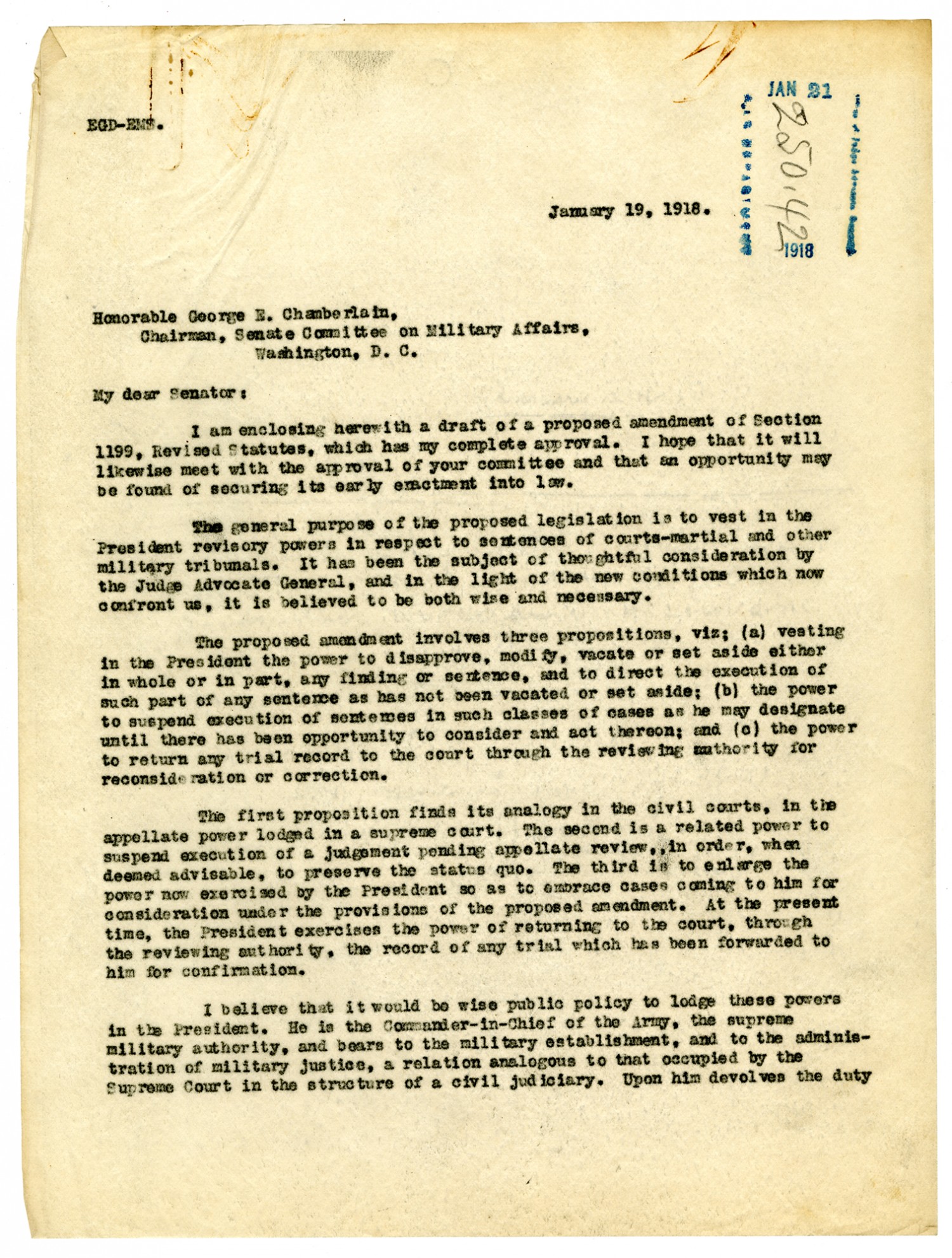
EGD-EMS January 19, 1918 Honorable George E. Chamberlain, Chairman, Senate Committee on Military Affairs, Washington, D.C. My dear Senator: I am enclosing herewith a draft of a proposed amendment of Section 1199, Revised Statutes, which has my complete approval. I hope that it will likewise meet with the approval of your committee and that an opportunity may be found of securing its early enactment into law. The general purpose of the proposed legislation is to vest in the President revisory powers in respect to sentences of courts-martial and other military tribunals. It has been the subject of thoughtful consideration by the Judge Advocate General, and in the light of the new conditions which now confront us, it is believed to be both wise and necessary. The proposed amendment involves three propositions, viz; (a) vesting in the President the power to disapprove, modify, vacate or set aside either in whole or in part, any finding or sentence, and to direct the execution of such part of any sentence as has not been vacated or set aside; (b) the power to suspend execution of sentences in such classes of cases as he may designate until there has been opportunity to consider and act thereon; and (c) the power to return any trial record to the court through the reviewing authority for reconsideration or correction. The first proposition finds its analogy in the civil courts, in the appellate power lodged in a supreme court. The second is a related power to suspend execution of a judgment pending appellate review, in order, when deemed advisable, to preserve the status quo. The third is to enlarge the power now exercised by the President so as to embrace cases coming to him for consideration under the provisions of the proposed amendment. At the present time, the President exercises the power of returning to the court, through the reviewing authority, the record of any trial which has been forwarded to him for confirmation. I believe that it would be wise public policy to lodge these powers in the President. He is the Commander-in Chief- of the Army, the supreme military authority, and bears to the military establishment, and to the administration of military justice, a relation analogous to that occupied by the Supreme Court in the structure of civil judiciary. Upon him devolves the duty
Transcript
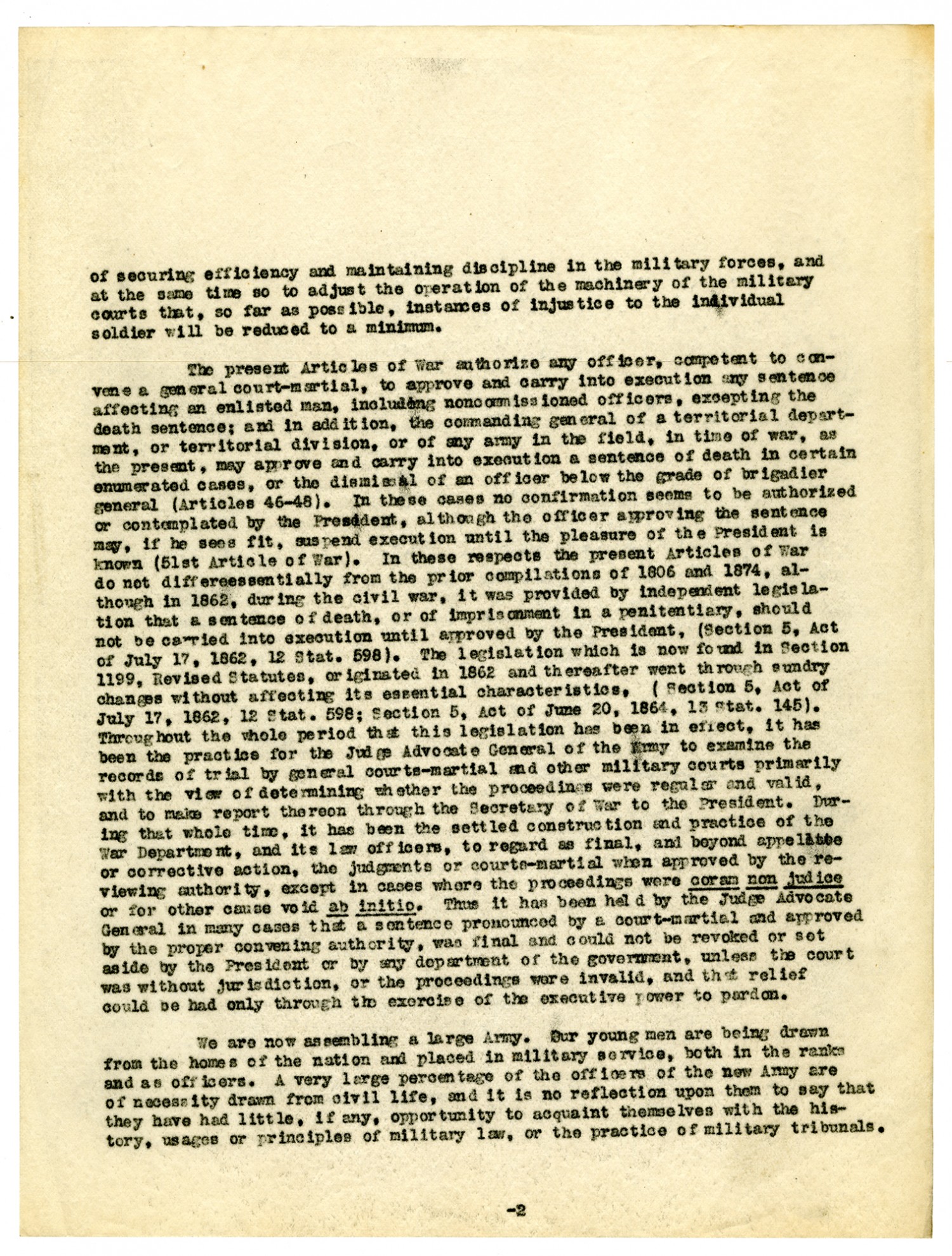
[page 2] of securing efficiency and maintaining discipline in the military forces, and at the same time so to adjust the operation of the machinery of the military courts that, so far as possible, instances of injustice to the individual soldier will be reduced to a minimum. The present Articles of War authorize any officer, competent to convene a general court-martial, to approve and carry into execution any sentence affecting an enlisted man, including noncommissioned officers, excepting the death sentence; and in addition, the commanding general of a territorial department, or territorial division, or of any army in the field, in time of war, as the present, may approve and carry into execution a sentence of death in certain enumerated cases, or the dismissal of an officer below the grade of brigadier general (Articles 46-48). In these cases no confirmation seems to be authorized or contemplated by the President, although the officer approving the sentence may, if he sees fit, suspend execution until the pleasure of the President is known (51st) Article of War). In these respects the present Articles of War do not differeessentially from the prior compilations of 1806 and 1874, although in 1862, during the civil war, it was provided by independent legislation that a sentence of death, or of imprisonment in a penitentiary, should not be carried into execution until approved by the President, (Section 5, Act of July 17, 1862, 12 Stat. 598). The legislation which is now found in Section 1199, Revised Statutes, originated in 1862 and thereafter went through sundry changes without affecting its essential characteristics, (Section 5, Act of July 17, 1862, 12 Stat. 598; Section 5, Act of June 20, 1864, 13 Stat. 145). Throughout the whole period that this legislation has been in effect, it has been the practice for the Judge Advocate General of the Army to examine the records of trial by general courts-martial and other military courts primarily with the view of determining whether the proceedings were regular and valid, and to make report thereon through the Secretary of War to the President. During that whole time, it has been the settled construction and practice of the War Department, and its law officers, to regard as final, and beyond appelatte or corrective action, the judgments or courts-martial when approved by the reviewing authority, except in cases where the proceedings were coram non judice or for other cause void ab initio. Thus it has been held by the Judge Advocate General in many cases that a sentence pronounced by a court-martial and approved by the proper convening authority, was final and could not be revoked or set aside by the President or by any department of the government, unless the court was without jurisdiction, or the proceedings were invalid, and that relief could be had only through the exercise of the executive power to pardon. We are now assembling a large Army. Our young men are being drawn fro the homes of the nation and placed in military service, both in the ranks and as officers. A very large percentage of the officers of the new Army are of necessity drawn from civil life, and it is no reflection upon them to say that they have had little, if any, opportunity to acquaint themselves with the history, usages or principles of military law, or the practice of military tribunals.
Transcript
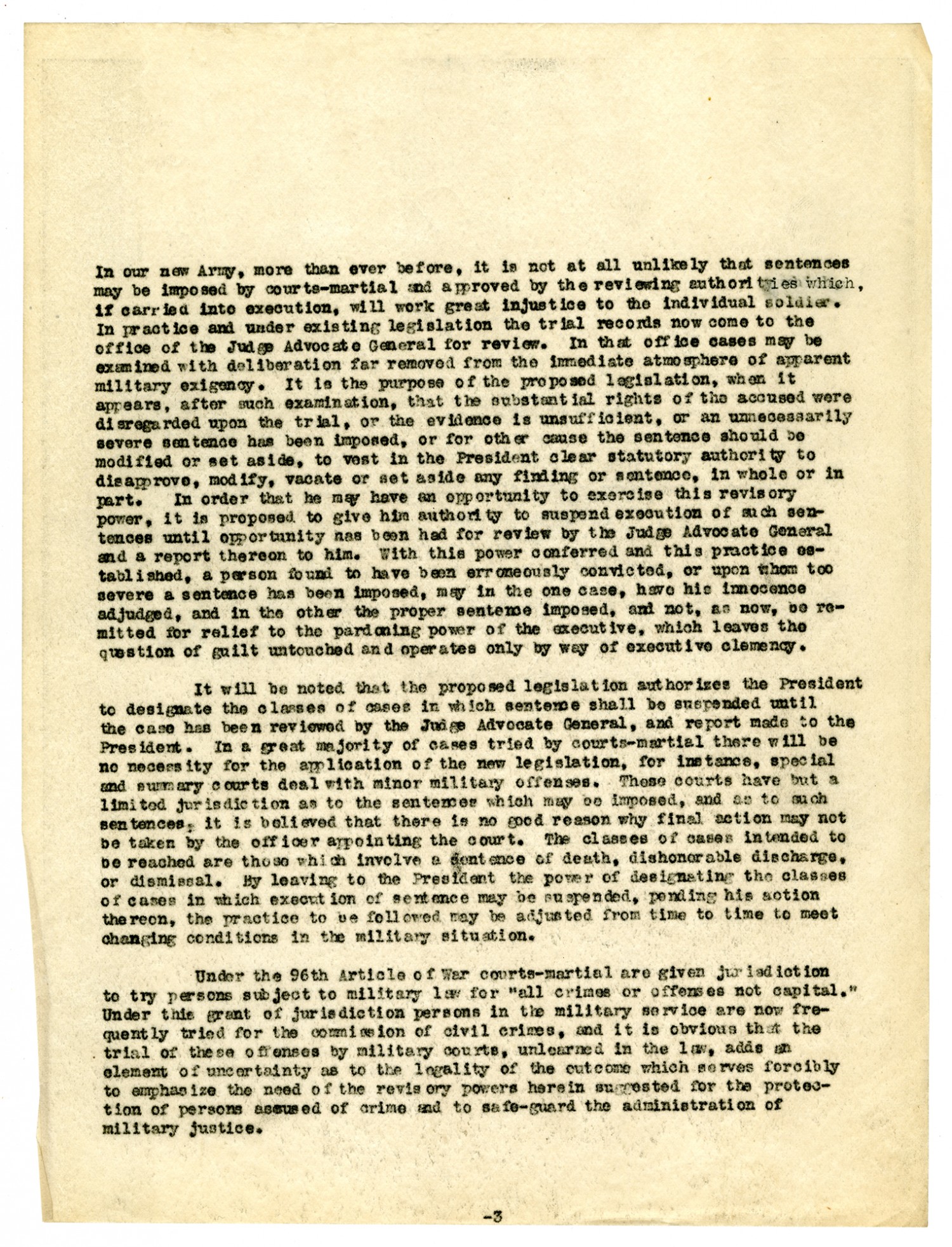
[page 3] In our new Army, more than ever before, it is not at all unlikely that sentences may be imposed by courts-martial and approved by the reviewing authorities which, if carried into execution, will work great injustice to the individual soldier. In practice and under existing legislation the trial records now come to the office of the Judge Advocate General for review. In that office cases may be examined with deliberation far removed from the immediate atmosphere of apparent military exigency. It is the purpose of the proposed legislation, when it appears, after such examination, that the substantial rights of the accused were disregarded upon the trail, or the evidence is unsufficient, or an unnecessarily severe sentence has been imposed, or for other cause the sentence should be modified or set aside, to vest in the President clear statutory authority to disapprove, modify, vacate or set aside any finding or sentence, in whole or in part. In order that he may have an opportunity to exercise this revisory power, it is proposed to give him authority to suspend execution of such sentences until opportunity has been had for review by the Judge Advocate General and a report thereon to him. With this power conferred and this practice established, a person found to have been erroneously convicted, or upon whom too severe a sentence has been imposed, may in the one case, have his innocence adjudged, and in the other the proper sentence imposed, and not, as now, be remitted for relief to the pardoning power of the executive, which leave the question of guilt untouched and operates only by way of executive clemency. It will be noted that the proposed legislation authorizes the President to designate the classes of cases in which sentence shall be suspended until the case has been reviewed by the Judge Advocate General, and report made to the President. In a great majority of cases tried by courts-martial there will be no necessity for the application of the new legislation, for instance, special and summary courts deal with minor military offenses. These courts have but a limited jurisdiction as to the sentences which may be imposed, and as to such sentences, it is believed that there is no good reason why final action may not be taken by the officer appointing the court. The classes of cases intended to be reached are those which involve a sentence of death, dishonorable discharge, or dismissal. By leaving to the President the power of designating the classes of cases in which execution of sentence may be suspended, pending his action thereon, the practice to be followed may be adjusted from time to time to meet changing condition in the military situation. Under the 96th Article of War courts-martial are given jurisdiction to try persons subject to military law for
Transcript
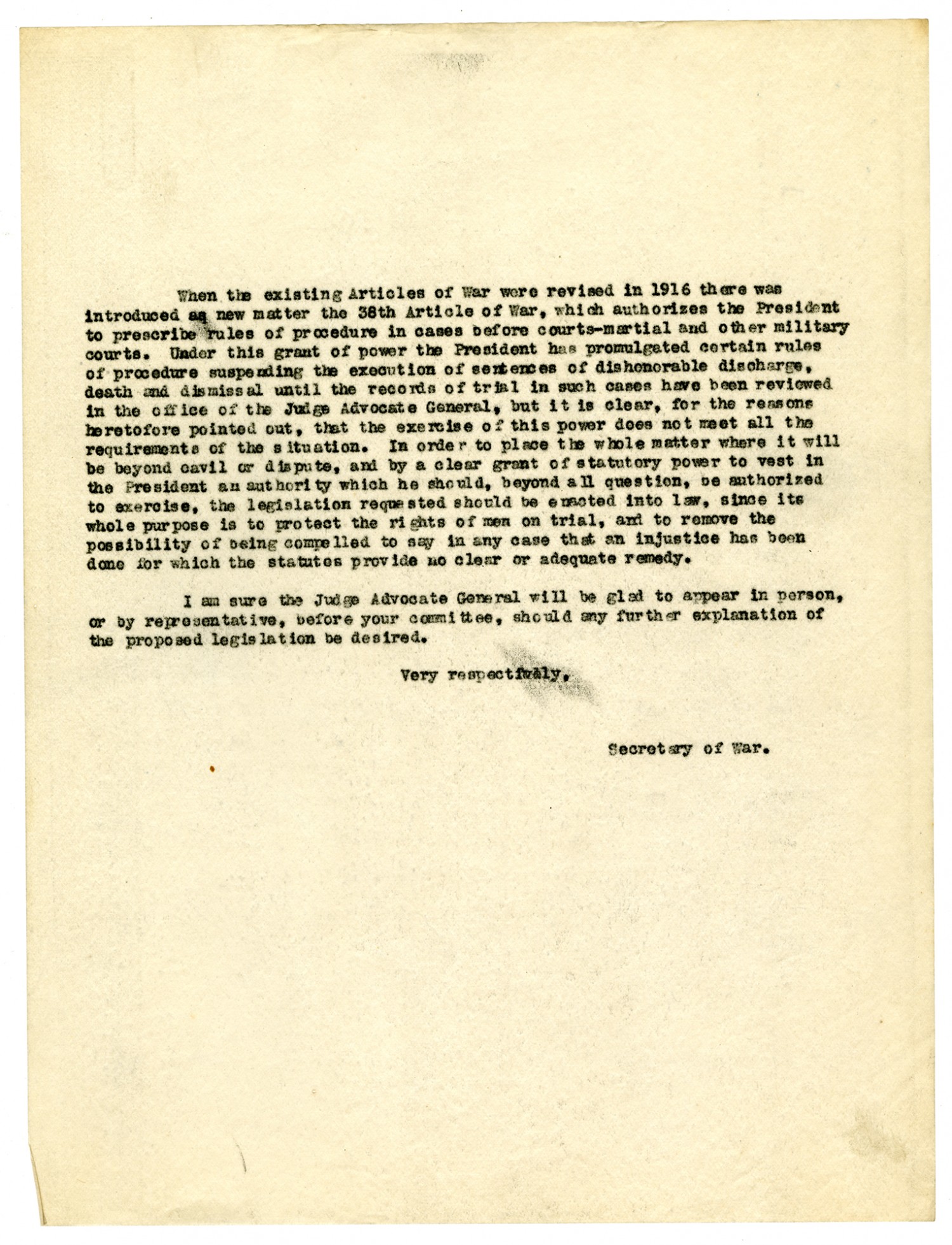
When the existing Articles of War were revised in 1916 there was introduced as new matter the 38th Article of War, which authorizes the President to prescribe rules of procedure in cases before courts-martial and other military courts. Under this grant of power the President has promulgated certain rules of procedure suspending the execution of sentences of dishonorable discharge, death and dismissal until the records of trail in such cases have been reviewed in the office of the Judge Advocate General, but it is clear, for the reasons heretofore pointed out, that the exercise of this power does not meet all the requirements of the situation. In order to place the whole matter where it will be beyond cavil or dispute, and by a clear grant of statutory power to best in the President an authority which he should, beyond all question, be authorized to exercise, the legislation requested should be enacted into law, since its whole purpose is to protect the rights of men on trail, and to remove the possibility of being compelled to say in any case that an injustice has been done for which the statutes provide no clear or adequate remedy. I am sure the Judge Advocate General will be glad to appear in person, or by representative, before your committee, should any further explanation of the proposed legislation be desired. Very respectfully, Secretary of War.
Details
| Title | Letter to Senator George E. Chamberlain from Newton D. Baker - January 19, 1918 |
| Creator | Baker, Newton D. |
| Source | Baker, Newton D. Letter to Senator George E. Chamberlain from Newton D. Baker. 19 January 1918. Crowder, Enoch H. (1859-1932), Papers, 1884-1942. C1046. The State Historical Society of Missouri, Columbia, MO. |
| Description | Letter from the Secretary of War, Newton D. Baker, to Senator George E. Chamberlain, who was a member of the Senate Committee on Military Affairs. In the letter Newton stated that his draft of a proposed amendment of Section 1199, Revised Statutes was enclosed. The amendment concerned sentences of courts-martial and the power of the President to revise them. He continues to explain his revisions and the reasons behind them. This document is part of a collection compiled by Enoch Herbert Crowder, the Edinburg, Grundy County, Missouri native who served as Judge Advocate General. Crowder devised the Selective Service Act in 1917 which drafted America's forces during World War I. |
| Subject LCSH | Crowder, E. H. (Enoch Herbert), 1859-1932; Chamberlain, George E. (George Earle), 1854-1928; Baker, Newton, 1871-1937 |
| Subject Local | WWI; World War I |
| Site Accession Number | C1046 |
| Contributing Institution | The State Historical Society of Missouri |
| Copy Request | Transmission or reproduction of items on these pages beyond that allowed by fair use requires the written permission of the State Historical Society of Missouri: 1020 Lowry Street, Columbia, Missouri, 65201-7298. (573) 882-7083. |
| Rights | The text and images contained in this collection are intended for research and educational use only. Duplication of any of these images for commercial use without express written consent is expressly prohibited. |
| Date Original | January 19, 1918 |
| Language | English |