
Letter to Enoch Crowder - January 6, 1918
Transcript
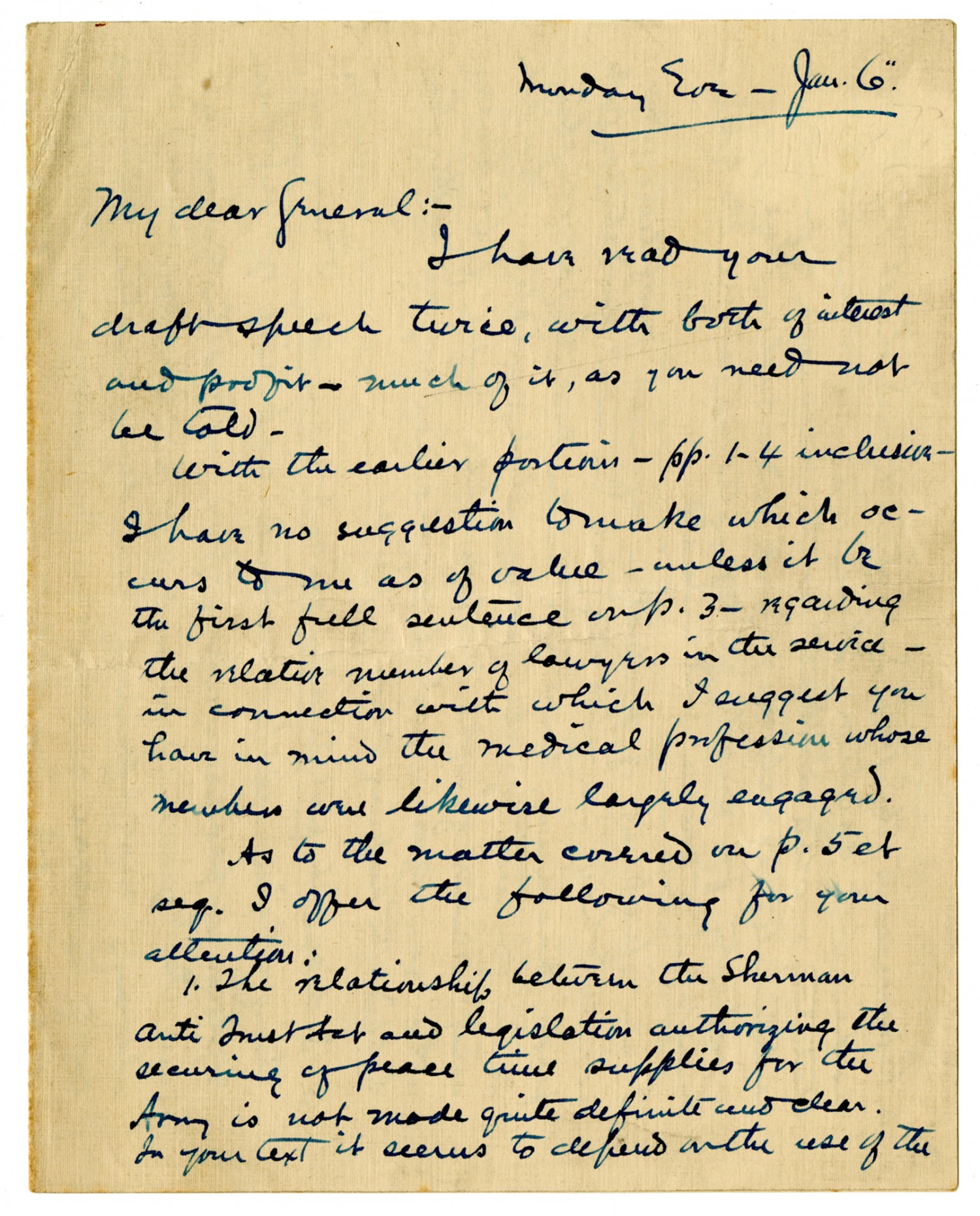
Monday [m.s. illegible: 1 wd] [January] 6 My dear General:- I have read your draft speech twice, with both of interest and [m.s. illegible: 1 wd] - much of it, as you need not be told. With the earlier portion -pp. 1-4 inclusive- I have no suggestion to make which occurs to me as of value- unless it be the first full sentence on p. 3-regarding the relative number of lawyers in the service-in connection with which I suggest you have in mind the medical profession whose members were likewise largely engaged. As to the matter covered on p. 5 et seg. I offer the following for your attention: 1. The relationship between the Sherman Anti Trust Act and legislation authorizing the securing of peace time supplies for the Army is not made quite definite and clear. In your text it seems to defend [m.s. illegible: 1 wd] use of the
Transcript
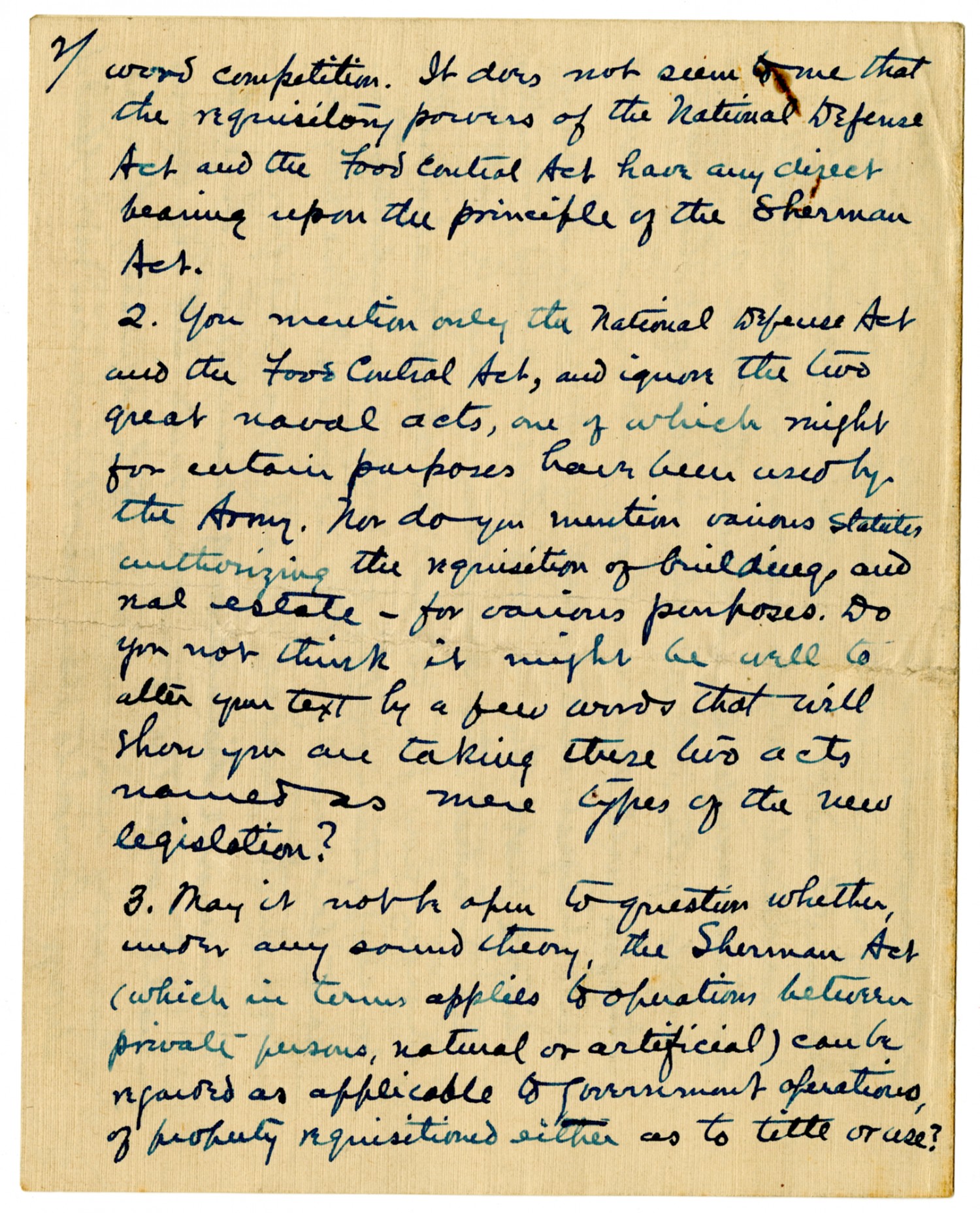
[page 2] word competition. It does not seem to me that the requisitory powers of the National Defense Act and the Food Central Act have any direct bearing upon the principle of the Sherman Act. 2. You mention only the National Defense Act and the Food Central Act, and ignore the two great naval acts, one of which might for certain purposes have been used by the Army. Nor do you mention various statutes authorizing the requisition of building and real estate - for various purposes. Do you not think it might be well to alter your text by a few words that will show your are taking these two acts named as mere types of the new legislation? 3. May is [m.s. illegible 1 wd] open to question whether, under any sound theory, the Sherman Act (which in terms applies to operation between private persons, natural or artificial) can be regarded as applicable to government operations, of property requisitioned either as to title or use?
Transcript
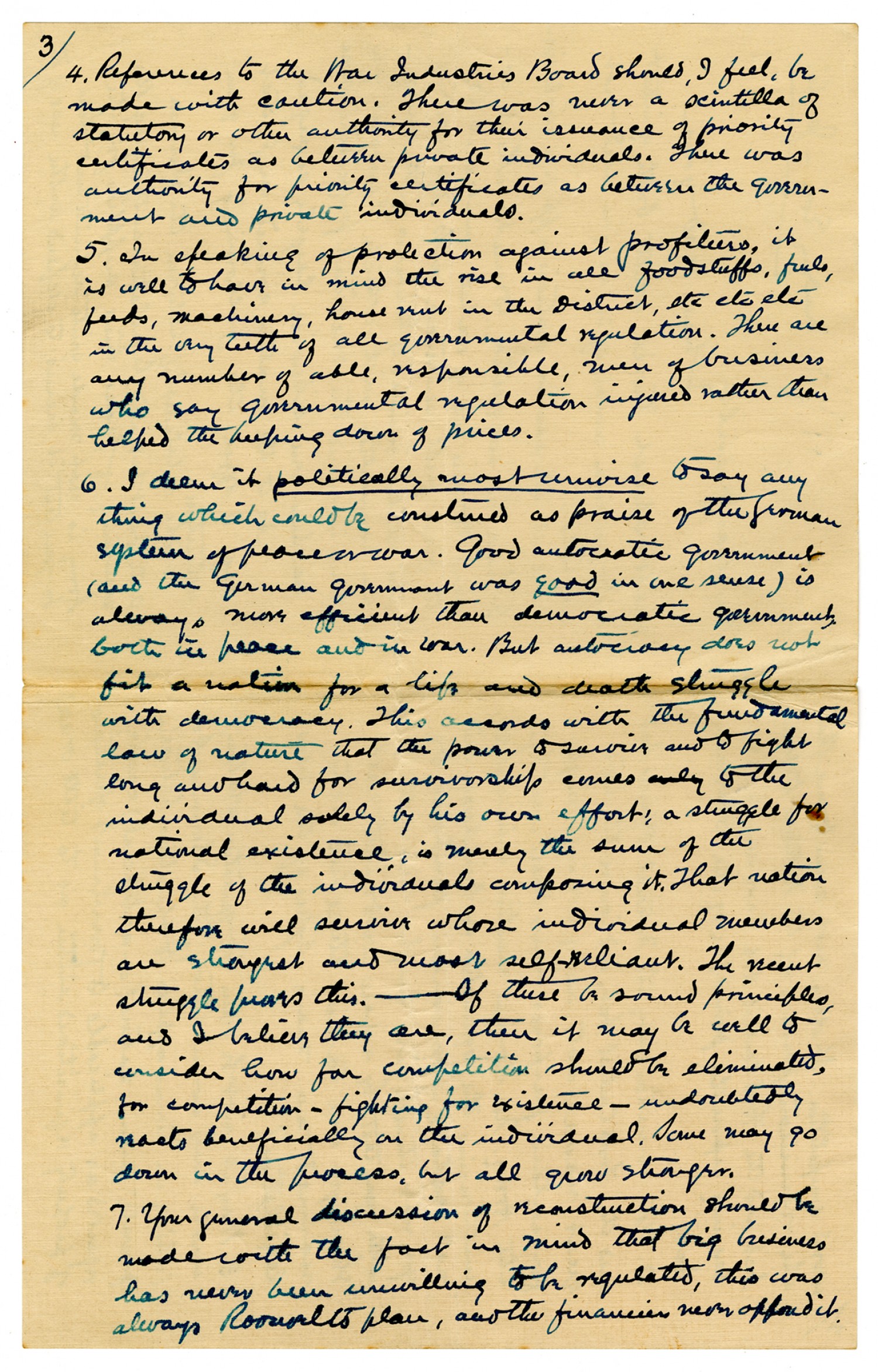
[page 3] 4. References to the War Industries Board should, I feel, be made with caution. There was never a scintilla of statutory or other authority for their issuance of priority certificates as between private individuals. There was authority for priority certificates as between the government and private individuals. 5. In speaking of protection against profiteers, it is well to have in mind the rise in all foodstuffs, fuels, feeds, machinery, house rule in the District, etc etc etc in the [m.s illegible 2 wds] of all governmental regulation. There are any number of able, responsible, men of business who say governmental regulation injured rather than helped the keeping down of prices. 6. I deem it politically most unwise to say any thing which could be construed as praise of the German system of peace or war. Good autocratic government (and the German government was good in one sense) is always more efficient than democratic government both in peace and in war. But autocracy does not fit a notion for a life and death struggle with democracy. This accords with the fundamental law of nature that the power to survive and to fight long and hard for survivorship comes to the individual solely by his own effort; a struggle for national existence is merely the sum of the struggle of the individuals comparing it. That nation therefore will survive whose individual members are strongest and most self-reliant. The recent struggle [m.s. illegible 1 wd] this. -Of these sound principles, and I believe they are, then it may be well to consider how fare competition should be eliminated, for competition- fighting of existence- undoubtedly rests beneficially on the individual. Some may go down in the process, but all grow stronger. 7. Your general discussion of reconstruction should be made with the fact in mind that big business has never been unwilling to be regulated, this was always Roosevelts plan, another financiers never afford it.
Details
| Title | Letter to Enoch Crowder - January 6, 1918 |
| Creator | Unknown |
| Source | Unknown. Letter to Enoch Crowder. 6 January 1918. Crowder, Enoch H. (1859-1932), Papers, 1884-1942. C1046. The State Historical Society of Missouri, Columbia, MO. |
| Description | In this letter to General Enoch H. Crowder an unknown author gave provided edits for a speech that Crowder wrote. This document is part of a collection compiled by Enoch Herbert Crowder, the Edinburg, Grundy County, Missouri native who served as Judge Advocate General. Crowder devised the Selective Service Act in 1917 which drafted America's forces during World War I. |
| Subject LCSH | Crowder, E. H. (Enoch Herbert), 1859-1932 |
| Subject Local | WWI; World War I |
| Site Accession Number | C1046 |
| Contributing Institution | The State Historical Society of Missouri |
| Copy Request | Transmission or reproduction of items on these pages beyond that allowed by fair use requires the written permission of the State Historical Society of Missouri: 1020 Lowry Street, Columbia, Missouri, 65201-7298. (573) 882-7083. |
| Rights | The text and images contained in this collection are intended for research and educational use only. Duplication of any of these images for commercial use without express written consent is expressly prohibited. |
| Date Original | January 6, 1918 |
| Language | English |