
Letter to Benedict Crowell from E.M. Weaver and Charles Day - April 22, 1918
Transcript
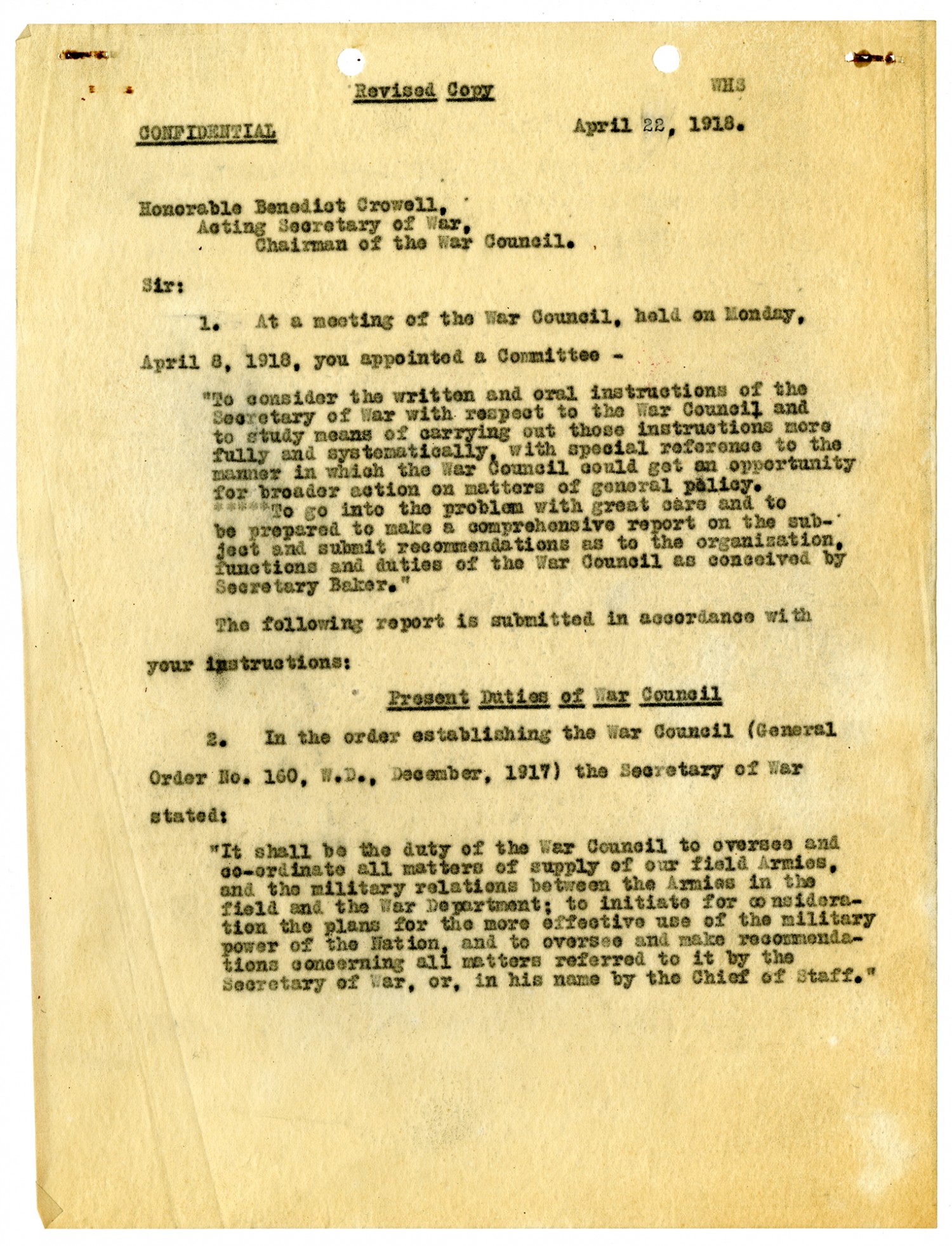
Revised Copy WHS Confidential April 22, 1918. Honorable Benedict Crowell, Acting Secretary of War, Chairman of the War Council. Sir: 1. At a meeting of the War Council, held on Monday, April 8, 1918, you appointed a Committee-
Transcript
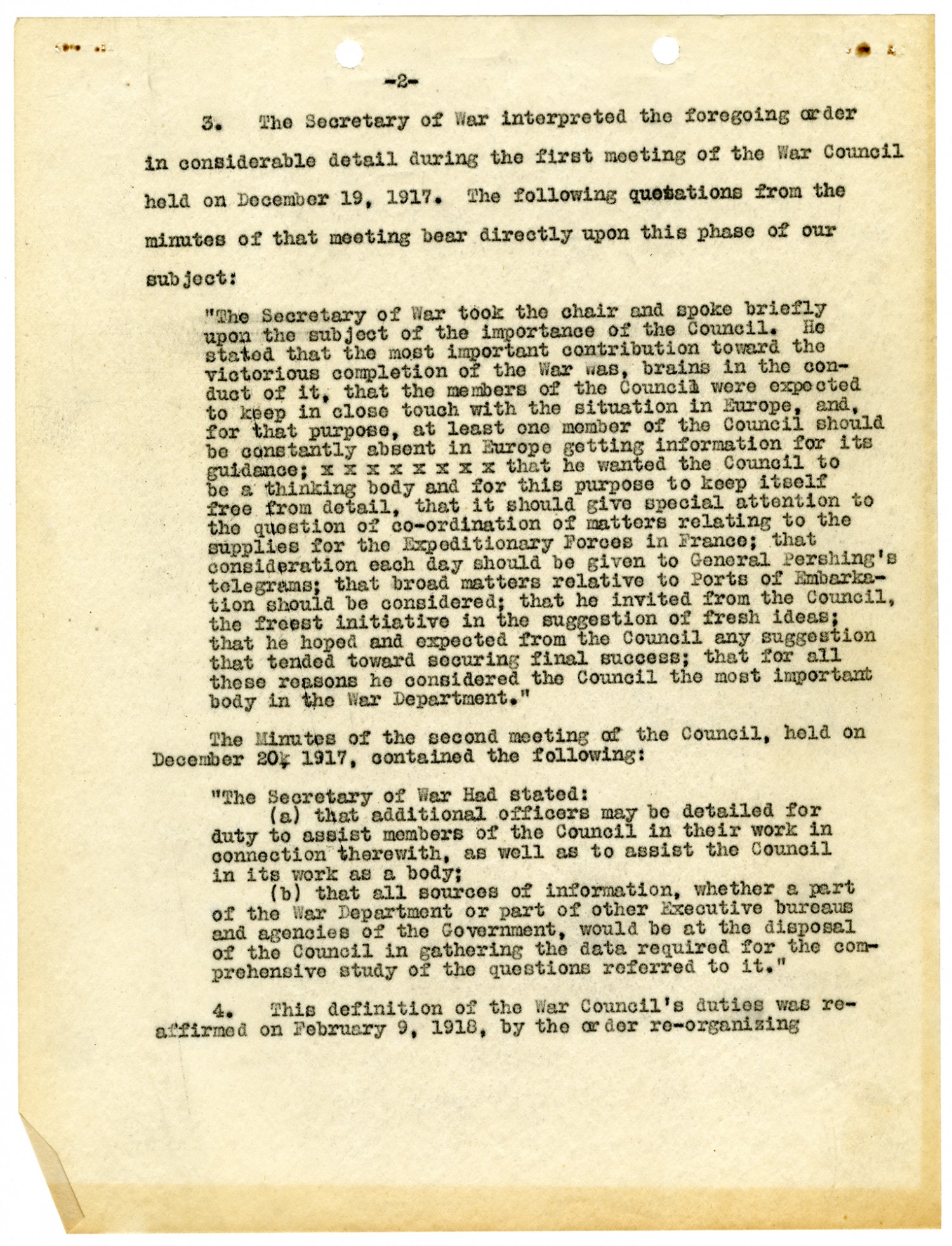
[page 2] 3. The Secretary of War interpreted the foregoing order in considerable detail during the first meeting of the War Council held on December 19, 1917. The following questions from the minutes of that meeting bear directly upon this phase of our subject:
Transcript
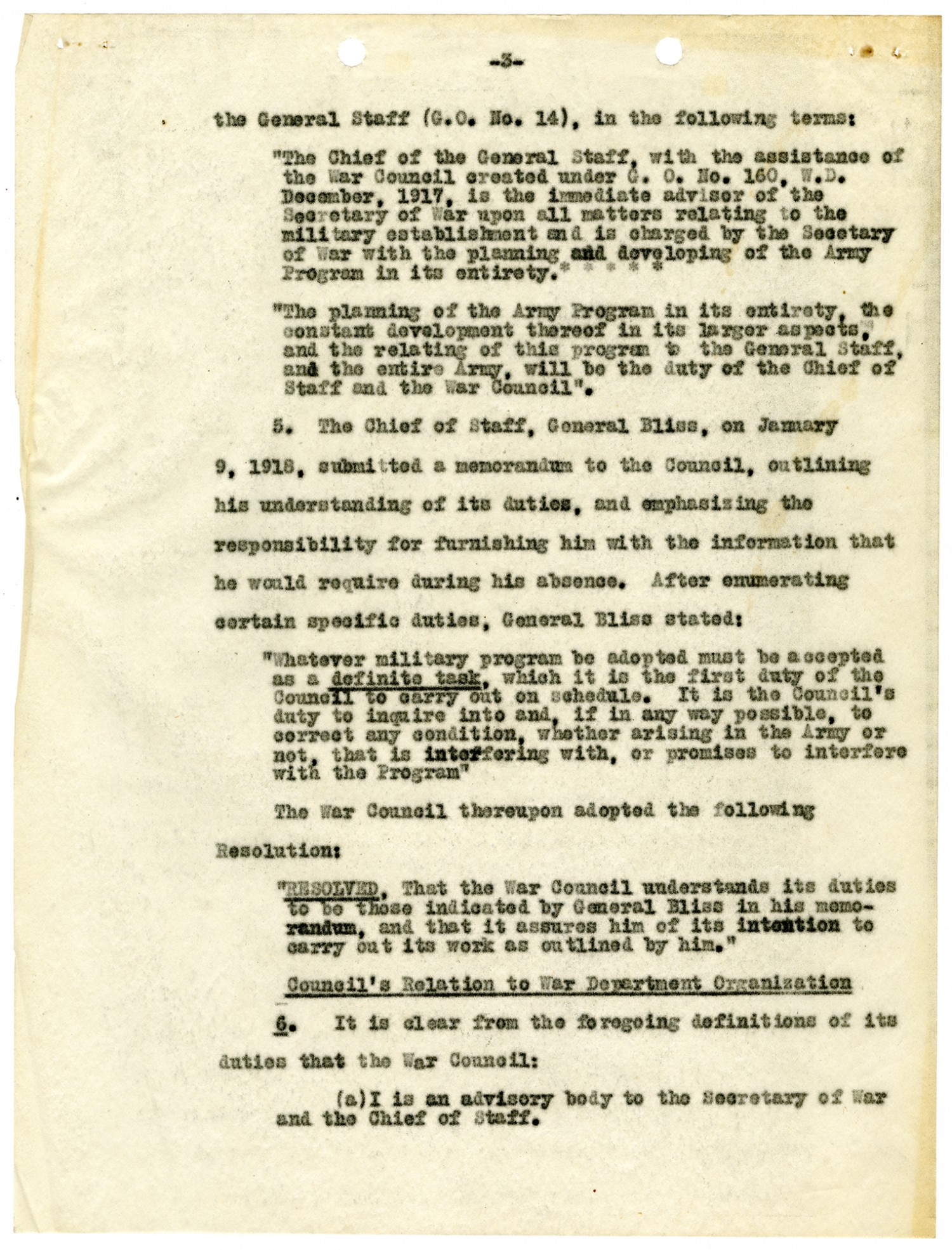
[page 3] the General Staff (G.O. No.14), in the following terms:
Transcript
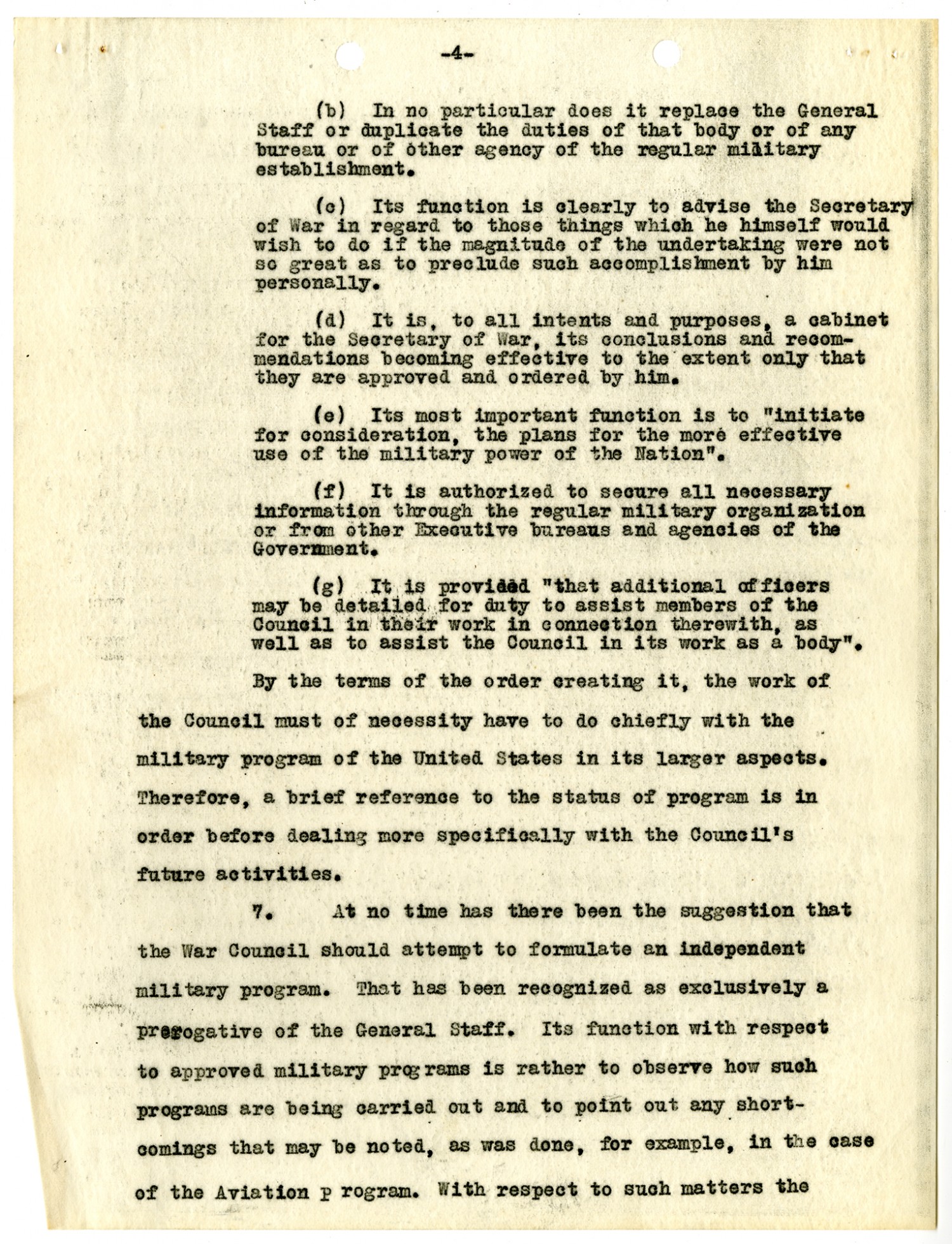
[page 4] (b) In no particular does it replace the General Staff or duplicate the duties of that body or of any bureau or of other agency of the regular military establishment. (c) Its function is clearly to advise the Secretary of War in regard to those things which he himself would wish to do if the magnitude of the undertaking were not so great as to preclude such accomplishment by him personally. (d) It is, to all intents and purposes, a cabinet for the Secretary of War, its conclusions and recommendations becoming effective to the extent only that they are approved and ordered by him. (e) Its most important function is to
Transcript
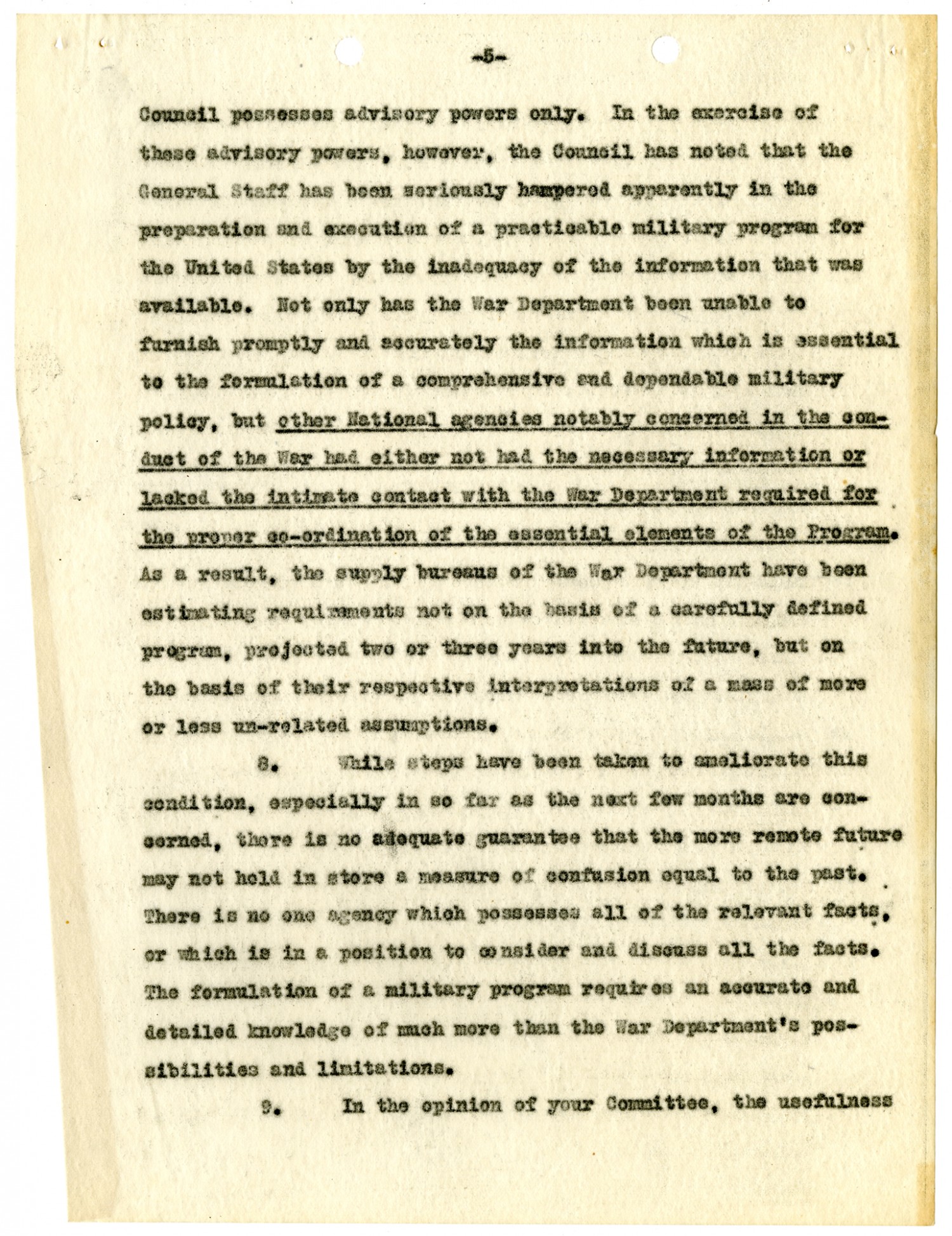
[page 5] Council possesses advisory powers only. IN the exercise of these advisory powers, however, the Council has noted that the General Staff has been seriously hampered apparently in the preparation and execution of a practicable military program for the United States by the inadequacy of the information that was available. Not only has the War Department been unable to furnish promptly and accurately the information which is essential to the formulation of a comprehensive and dependable military policy, but other National agencies notably concerned in the conduct of the War had either not had the necessary information or lacked the intimate contact with the War Department required for the proper co-ordination of the essential elements of the Program. As a result, the supply bureaus of the War Department have been estimating requirements not on the basis of a carefully defined program, projected two or three years into the future, but on the basis of their respective interpretations of a mass of more or less un-related assumptions. 8. While steps have been taken to ameliorate this condition, especially in so far as the next few months are concerned, there is no adequate guarantee that the more remote future may not hold in store a measure of confusion equal to the past. There is no one agency which possesses all of the relevant facts, or which is in a position to consider and discuss all the facts. The formulation of a military program requires an accurate and detailed knowledge of much more than the War Department
Transcript
[page 6] of the War Council lies in this field. The Secretary of War must have at his disposal the means to encourage the fullest co-operation among all the War activities of the Nation. The General Staff initiates military requirements, and the Chief of Staff directly controls the procurement and other agencies of the War Department concerned with the execution of the military program. No existing agency of the War Department, however, maintains a sufficiently intimate contact with the many activities and agencies outside the War Department that are vitally involved with the Department
Transcript
[page 7] relative to the War Council Chief Functions of the War Council 10. In the light of the conditions touched upon in the foregoing paragraphs, it is believed by the Committee that the first and foremost function of the War Council should be to act as a connecting advisory agency between the War Department and the Navy Department, the War Industries Board, the hipping Board, the Emergency Fleet Corporation, the Shipping Control Committee, and the War Trade Board, in the larger questions. It is recognized that the War Department is now in touch with these agencies, through liaison officers or by prescribed methods for the interchange of information; but such measures are upon a plane far below that to which reference is now made. Officially, the War Department is but on a parity with at least three of the other great Government departments which have come into existence since we entered the War. Nevertheless, it is believed that if there is a common understanding of the vital Army needs but few questions involving the War Department will require reference to the President. Only in the foregoing manner can it survey the whole field of procurement and deliveries both with respect to programs in the course of execution and with respect to the future needs of the forces abroad. 11. It is only necessary to cite by way of illustration the independent performances of the War Department, the Shipping Board, and the Emergency Fleet Corporation. But for the chance acquisition of the Dutch shipping, our promised military
Transcript
effort for the balance of the year (an effort far below what was considered last fall to be a reasonable minimum expectation) would now be foredoomed to failure. Even now, the fulfillment of this program hinges upon no less a performance than the building of an amount of ocean- going tonnage exceeding by more than two-fold the total cargo tonnage in Army service but a few weeks ago. 12. But what of the future? Have any steps been taken to guarantee the movement of the personnel and material that may have to be sent to France in 1919? Only to the extent that the investigation requested by the Council is now in progress. 13. These great questions cannot be left to liaison officers; to inter-department conferences; to the discretion of individuals. They require the collective consideration of the heads of the Government Departments involved, under the guidance of the Department most vitally concerned. That the War Department, in so far as its needs are concerned, should assume this role-- must assume it, in fact -- if its effort is to be more tan mediocre, has been too well demonstrated to require further discussion. Means and methods are, alone, the important question at issue. Your Committee believes that the nucleus for this purpose is to be found in the War Council. It believes, further, that it is only in the atmosphere of the War Department, and through intimate contact of the men who are dealing first-hand with the vast undertakings involved, meeting on the common ground of full enlightenment concerning the military situation, that sound judgments can be reached and accepted as a basis for immediate action
Transcript
[page 9] or references to the President. 14. Your Committee believes that it is not necessary that the War Department should be accredited with a status above that of any other Department in such matters. The potential position of the War Department is so commanding in the present emergency hat its rightful place will be conceded freely just as soon as its own knowledge, breadth of vision, capacity of its leaders, and the procedure which it adopts, justify such acknowledgement. 15. It is recommended, therefore: (a) that the Council provide its Recorder or one of its members appointed for the purpose with a Staff suitable to institute and make the necessary investigations and studies: (b) that the Secretary of War appoint to full membership, the Chairman of the Shipping Control Committee, and representatives named by the Chairmen of the War Industries board and the Shipping Board. These members should be taken into the fullest confidence of the War Council and the closest working relationship established. (c) that the Council arrange to have brought together for its consideration, possibly by the Statistical Division of the General Staff, all the master information and statistics from every source concerned which must of necessity be the basis for its deliberation. Your Committee is firmly of the opinion that if the men referred to in the second preceding paragraph are appointed members of the War Council they will gain, as in no other way, an appreciation of the part which existing ships, new ships, and raw materials should play in this War; the extent to which decisions and actions in regard to them are but a part of a joint military objective. They will then realize that a failure to achieve this ultimate objective will but spell
Transcript
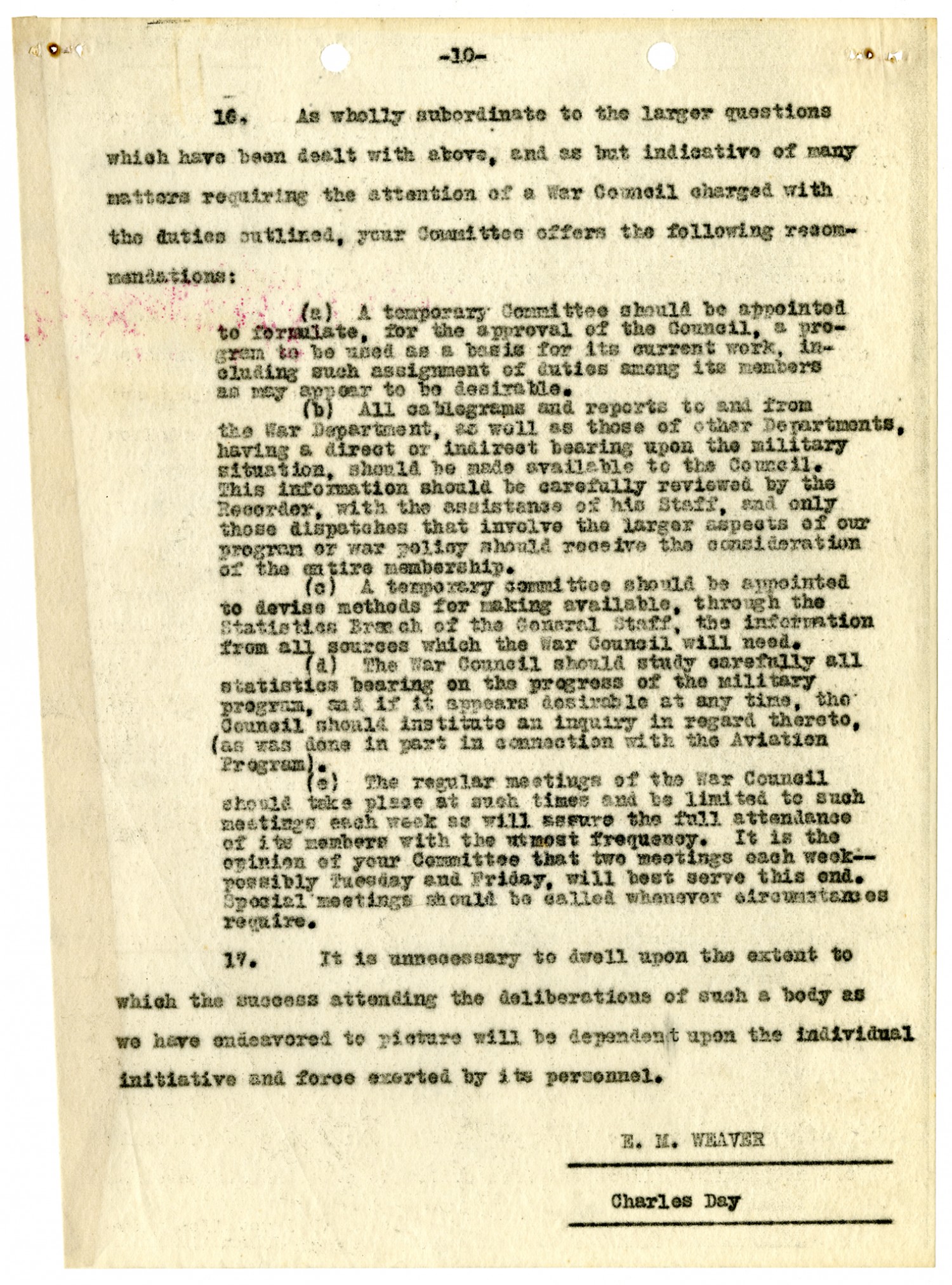
[page 10] 16. As wholly subordinate to the larger questions which have been dealt with above, and as but indicative of many matters requiring the attention of a War Council charged with the duties outlined, your Committee offers the following recommendations: (a) A temporary Committee should be appointed to formulate, for the approval of the Council, a program to be used as a basis for its current work, including such assignment of duties among its members as may appear to be desirable. (b) All cablegrams and reports to and from the War Department, as well as those of other Departments, having a direct of indirect bearing upon the military situation, should be made available to the Council. This information should be carefully reviewed by the Recorder, with the assistance of his Staff, and only those dispatches that involve the larger aspects of our program or war policy should receive the consideration of the entire membership. (c) A temporary committee should be appointed to devise methods for making available, through the Statistics Branch of the General Staff, the information from all sources which the War Council will need. (d) The War Council should study carefully all statistics bearing on the progress of the military program, and if it appears desirable at any time, the Council should institute an inquiry in regard thereto, (as was done in part in connection with the Aviation Program). (e) The regular meetings of the War Council should take place at such times and be limited to such meetings each week as will assure the full attendance of its members with the utmost frequency. It is the opinion of your Committee that two meetings each week--possibly Tuesday and Friday, will best serve this end. Special meetings should be called whenever circumstances require. 17. It is unnecessary to dwell upon the extent to which the success attending the deliberations of such a body as we have endeavored to picture will be dependent upon the individual initiative and force exerted by its personnel. E. M. Weaver Charles Day
Details
| Title | Letter to Benedict Crowell from E.M. Weaver and Charles Day - April 22, 1918 |
| Creator | Weaver, E.M.; Day, Charles |
| Source | Weaver, E.M., Charles Day. Letter to Benedict Crowell. 22 April 1918. Crowder, Enoch H. (1859-1932), Papers, 1884-1942. C1046. The State Historical Society of Missouri, Columbia, MO. |
| Description | In this letter, E.M. Weaver and Charles Day wrote Benedict Crowell, acting secretary of War, and listed the duties of the War Council. The letter also explained how the War Council would accompany the Secretary of War as an advisory board. This document is part of a collection compiled by Enoch Herbert Crowder, the Edinburg, Grundy County, Missouri native who served as Judge Advocate General. Crowder devised the Selective Service Act in 1917 which drafted America's forces during World War I. |
| Subject LCSH | Crowder, E. H. (Enoch Herbert), 1859-1932; United States. War Department; World War, 1914-1918--Political aspects--United States |
| Subject Local | WWI; World War I; War Council |
| Site Accession Number | C1046 |
| Contributing Institution | The State Historical Society of Missouri |
| Copy Request | Transmission or reproduction of items on these pages beyond that allowed by fair use requires the written permission of the State Historical Society of Missouri: 1020 Lowry Street, Columbia, Missouri, 65201-7298. (573) 882-7083. |
| Rights | The text and images contained in this collection are intended for research and educational use only. Duplication of any of these images for commercial use without express written consent is expressly prohibited. |
| Date Original | April 22, 1918 |
| Language | English |